For journalists · investigative · fact-check · newsroom counsel · freelance
Your source backpedaled. Your proof didn't.
In short: ProofSnap is a Chrome/Edge browser extension that captures social media posts, stealth-edited articles, press releases, paywalled content, and source materials as ZIPs built for FRE 902(13)/(14) self-authentication with ISO/IEC 27037-aligned chain of custody. Each ZIP carries a SHA-256 manifest, RSA-4096 signature, Bitcoin OpenTimestamps anchor, and (optionally) an eIDAS qualified timestamp under EU Regulation 910/2014. Used by investigative reporters, fact-checkers, newsroom counsel, and freelance journalists across US, EU, and UK publications. Complementary to Wayback Machine / archive.ph (public citation) and SecureDrop (source protection). Company Plan $18.99/seat/month (min 2 seats). SnapPack $4.99 for freelance. 7-day free trial.
Radim Motycka, founder and lead engineer of ProofSnap · · Verify any package yourself in the Trust Verifier
A browser extension for the newsroom and the freelance byline. Preserve what was actually said, before the stealth edit, before the deletion, before the walk-back. No public record by design: nothing is submitted to a public archive, so your investigation stays your investigation.
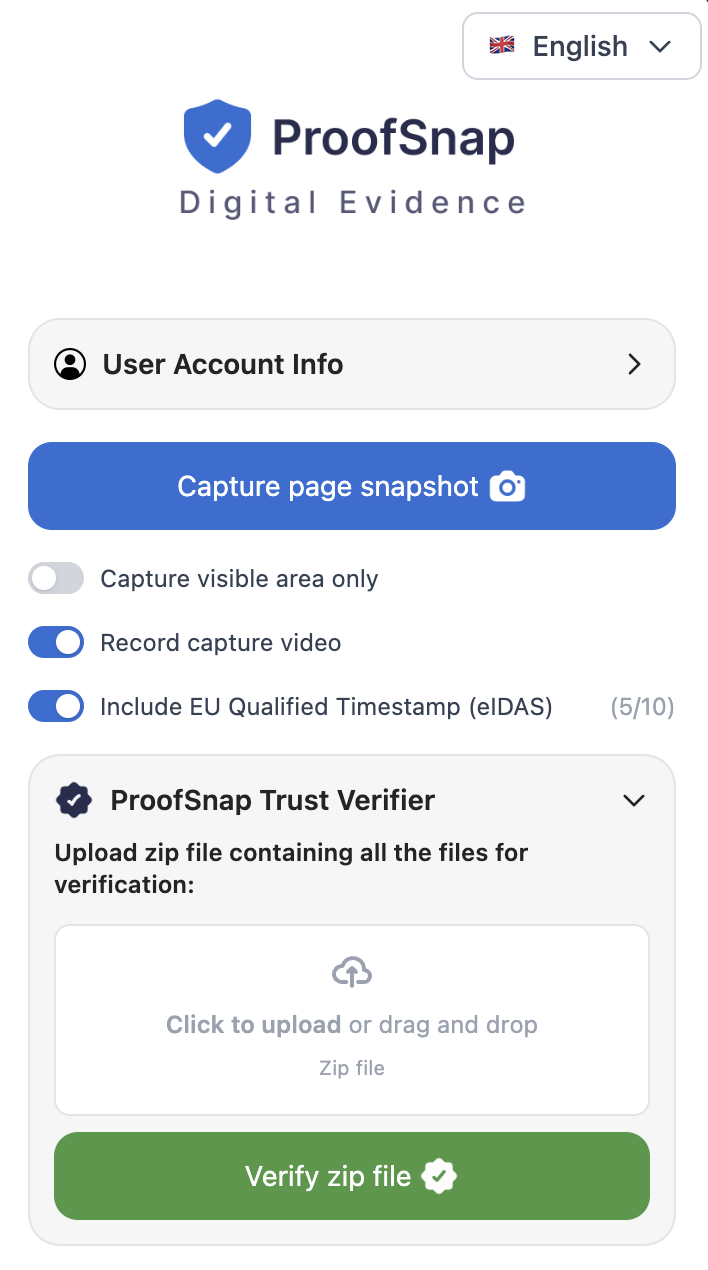
For your newsroom
- ✓Reporters, fact-checkers, editors, and newsroom counsel capture in the field
- ✓Pre-publication legal review with tamper-evident ZIPs
- ✓Newsroom Company Plan $18.99/seat/month, min 2 seats
For your freelance byline
- ✓SnapPack $4.99 one-time, 10 forensic captures for a single story
- ✓Citation-grade ZIP you can hand to any editor or publication counsel
- ✓Same forensic structure as newsroom-captured evidence
Or we do it for you
You send a link or the files. We send back the sealed package.
For public pages when you are on deadline, away from your machine, or when the desk wants the preservation done by someone outside the newsroom. You send a public URL or the files you already hold, we run the same forensic pipeline and return a signed, timestamped ZIP within 24 hours. One honest caveat: what you send us passes through our systems, so keep anything that could identify a source in the extension, where you send us nothing at all.
A chat export is the file the app gives you when you tap Export chat. We render it as a line numbered transcript, hash every file and timestamp the result, so the other side cannot argue the messages were edited.
Several URLs in one matter: Evidence Pack, up to 5 URLs for $149. A video with its comments and channel context: YouTube evidence service, from $44.99. Full comparison and FAQ.
Delivered within 24 hours (YouTube captures within 2 days). Same forensic engine as the extension, run by us. eIDAS qualified timestamps issued by Disig a.s., a qualified trust service provider on the EU Trusted List under Regulation (EU) No 910/2014.
Not sure which one fits? Tell us the situation and we will scope it →
What ProofSnap is, and what it is not
ProofSnap is a digital evidence preservation tool. It captures the cryptographic foundation that supports FRE 901/902 authentication, ISO/IEC 27037 chain of custody, and libel-defense documentation. It is NOT a source-protection tool, NOT a public archive, and NOT legal advice. For source-protection workflows use SecureDrop (deployed at major newsrooms worldwide), GlobaLeaks, or your publication's secure tip line, ProofSnap captures public-facing or session-accessible content, not confidential source communications. For reader-citable public archive links, use Wayback Machine or archive.ph alongside ProofSnap. Capture only content you are lawfully entitled to access (your paywall subscription, your authenticated session, public web). Consult publication counsel for jurisdiction-specific defamation, shield-law, and copyright questions.
What unauthenticated captures cost a journalist
Four ways missing proof ends careers and stories.
For journalists, the byline is the deliverable and the publication's legal exposure is the second-order cost. When you can't prove what was said, the story dies twice: once in the editing room, once in court.
Defamation / libel lawsuit lost
Federal filings under the "Assault, Libel, & Slander" nature-of-suit category rose from 650 in 2023 to 848 in 2025, per the Administrative Office of the U.S. Courts. The era of high-stakes media-defamation cases is firmly here: Dominion v. Fox News (settled April 2023 for $787.5 M), Sandmann v. CNN / Washington Post / NBC (CNN settled Jan 2020, Washington Post July 2020, NBC 2021, all terms undisclosed). Defending requires proving what was actually published, when, and that you didn't fabricate.
Moroccanoil v. Marc Anthony (C.D. Cal. 2014) shows the evidentiary failure mode: Facebook screenshots ruled inadmissible because there was no way to verify they were an exact representation of the live content. Two layers of risk: (a) the source content might have been a deepfake or altered before you captured it; (b) opposing counsel can argue your screenshot was altered after.
ProofSnap effect: SHA-256 manifest + RSA-4096 signature + Bitcoin OpenTimestamps anchor + Provenance Certificate close both layers. Post-capture edits break the hash; capture-origin is deterministic and verifiable by any forensic expert offline.
Stealth-edit memory-holed
You quote a press release / article / official statement. Days later, the source page is quietly modified, headline rewritten, quote attribution changed, key fact deleted, with no correction notice. The new live version contradicts your reporting. Without a contemporaneous capture, you cannot prove the original wording existed.
ProofSnap effect: ZIP captured at moment of reading is the contemporaneous record. Any third-party reviewer (counsel, ombudsman, fact-checking partner) verifies the original text offline with python3 + openssl + ots.
Source walks back the claim
A public figure tweets, then deletes. A spokesperson speaks on the record, then claims it was off the record. A company posts a statement, then "clarifies" it 48 hours later. Without a forensic capture at the original moment, the journalist's account becomes "their word against the now-corrected record."
ProofSnap effect: 41-second capture at moment of observation. Bitcoin OpenTimestamps anchors the hash to the public blockchain, "when" becomes a cryptographic fact, not a credibility contest.
Investigation exposed to subject
Submitting investigation URLs to Wayback Machine / archive.ph creates a public record of every page you preserve. AI research tools (ChatGPT, Perplexity, Claude.ai) log queries with account or device fingerprints. If subject (politician, corporate target, hostile state actor) gets access, they learn what you're investigating and can pre-empt the story.
ProofSnap effect: no public record by design. Nothing is submitted to a public archive, and the optional OpenTimestamps anchor carries only a 32-byte SHA-256 hash, reveals nothing about content. Submit to public archives only at publication time.
ROI math · typical journalism context
Defamation defense (legal fees alone)
$25K to $250K+
ProofSnap = 0.01-0.1 %
Freelance investigation budget
$2K to $15K
SnapPack $4.99 = 0.03-0.25 %
Newsroom investigative unit / year
$200K to $2M+
Company Plan = <0.1 % overhead
Company Plan $18.99/seat/month · SnapPack $4.99 one-time · pays for itself if it prevents one libel-defense hour, one published correction, or one missed deadline from a re-captured source.
The ZIP your newsroom produces
Forensic evidence package of 11 to 15 files.
Designed for clean publication-counsel handoff and citation-grade preservation: FRE 902(13)/(14) self-authenticating with an ISO/IEC 27037-aligned chain of custody. Hash + signature + blockchain anchor + qualified timestamp, verifiable independently at opentimestamps.org.
screenshot.jpeg Visual capture of the pagecapture_video.webm Screen recording of capturepage.html Full HTML contentdomtextcontent.txt Extracted DOM textmetadata.json Timestamp, URL, browser, TLSevidence.pdf Compiled evidence reportprovenance_certificate.pdf Content credentials / capture integritymanifest.json File listing + SHA-256 hashesmanifest.sig RSA-4096 digital signaturemanifest.json.ots OpenTimestamps Bitcoin anchorpublickey.pem Public key (verify signature)forensic_log.json ISO/IEC 27037 capture logchain_of_custody.json Device + NTP verificationmanifest.json.tsr eIDAS qualified RFC 3161 timestamp
The forensic log (forensic_log.json) and chain of custody (chain_of_custody.json) align with the ISO/IEC 27037:2012 process model for identification, collection, acquisition, and preservation of digital evidence. Verifies offline by publication counsel's expert with only python3 + openssl + ots, no ProofSnap service or account required on the recipient side, no internet for the integrity check.
What journalists capture
From a deleted tweet to a stealth-edited press release.
Anything you intend to quote, rely on, or cite in your reporting, preserved at the moment of reading, before the publisher or source quietly revises it.
Stealth article edits
Quietly rewritten headlines, ledes, quote attributions, key facts, photo captions, the change without a correction notice that contradicts your reporting.
Deleted social media posts
X (Twitter), Instagram, TikTok, Threads, Mastodon, Bluesky, Facebook, LinkedIn, tweets and posts that disappear within hours of going viral or after legal advice.
Press releases & corporate statements
PR Newswire, Business Wire, corporate IR pages, government regulator statements, preserved before the “quiet update” without a public revision log.
Public figure statements
Politicians, executives, public officials, influencers, on-the-record statements before they're walked back or recharacterized in a follow-up clarification.
Pre-publication source materials
Every page you intend to quote, link, or rely on, preserved as forensic ZIPs your newsroom counsel reviews before the piece runs, kept on file for years.
Fact-check evidence
Claims, counter-claims, source documents, expert-quoted research, captured at the moment you check them so the fact-check can be re-verified later.
Paywalled / login-only content
Subscription news (NYT, WSJ, FT, Bloomberg), gated press distributions, paywalled academic journals, login-only corporate databases, from your lawful subscription.
Press conferences (video)
Live-streamed statements, press conferences, recorded testimony, government broadcasts, captured with video recording inside the forensic ZIP.
Public records & court filings
PACER, state court dockets, regulator publications, sanctions lists, beneficial-ownership registers, preserved at the URL and exact moment of access.
Government / regulator pages
Agency websites that get quietly updated when policy changes, regulatory guidance that disappears after political shifts, foreign government statements pre-translation.
Corporate filings before amendment
SEC EDGAR, FCA, BaFin, AFM, ASIC filings, the original 10-K / 8-K / S-1 wording before subsequent amendments restate the disclosure.
Cross-border content
Foreign government statements, non-English regulatory pages, cross-jurisdictional content for international reporting, eIDAS qualified timestamps for EU court weight.
2026 reality · AI-generated content & deepfakes
Wayback Machine can't tell you the source video is a deepfake. ProofSnap can.
Public archives preserve that something was online. They don't preserve whether it was real. As AI-generated images, voice clones, and synthetic video flood newsfeeds in 2026, journalists need an integrity layer that survives a defamation court's increasingly-standard deepfake challenge.
The 2026 problem
- •Politician videos, AI-cloned voice + lip-sync deepfakes posted then deleted before fact-check
- •Executive statements, synthetic press-conference clips disseminated on social media as “leaked footage”
- •Image-based reporting, AI-generated photographs presented as authentic field documentation
- •Court evidence, opposing counsel claims your captured screenshot itself is AI-generated; you need cryptographic proof of capture-origin
ProofSnap's Provenance Certificate
Every ProofSnap ZIP includes a provenance_certificate.pdf with 6 integrity checks: SHA-256 hash integrity, RSA-4096 signature validity, OpenTimestamps Bitcoin-anchor verification, ISO/IEC 27037 forensic-log consistency, capture-environment fingerprint, NTP time verification, C2PA content credentials flag, and capture-pipeline determinism proof.
Outcome: any reviewer (newsroom counsel, opposing counsel, fact-check partner, regulator) verifies offline that the captured content was acquired through ProofSnap's deterministic pipeline and has not been tampered with, independent of ProofSnap's continued existence.
Why the regulatory clock matters
EU AI Act Article 50 places transparency duties on the providers and deployers of AI systems, not on newsrooms preserving what those systems produced, and it carries an express carve-out for editorial content published to inform the public under human editorial control. The duty a reporter meets is evidentiary, not regulatory: when a synthetic clip is later disputed, the question is what was on the page and when. Proposed US FRE 707 (machine-generated AI evidence rule, released by the Advisory Committee on Evidence Rules for public comment August 2025; comment period closed February 16, 2026) would tighten admissibility standards for AI-generated digital evidence in federal court. Journalists' reporting on AI-flagged content, or reporting using evidence that could be challenged as AI-generated, needs the cryptographic-integrity layer Wayback Machine and archive.ph cannot provide.
Key case law for quick reference
The cases publication counsel will cite from your captures.
Cautionary precedent for journalism
Moroccanoil, Inc. v. Marc Anthony Cosmetics, Inc., 57 F. Supp. 3d 1203 (C.D. Cal. 2014)
What happened. In a trademark-infringement and unfair-competition case under the Lanham Act over the word “Moroccanoil,” the defendant offered Facebook screenshots as evidence of how customers used the term. The court sustained the objection to the Facebook screenshots, finding the offering party had not shown they were what it claimed: nothing in the record established that the printouts fairly represented what was on the live page.
Why it matters to journalists. The same evidentiary gap applies any time a journalist's reporting relies on social media or web content. If a libel plaintiff (or any opposing party in a journalism-related lawsuit) shows that the screenshots in your possession can't be authenticated as exact representations of the live content at the time of capture, your evidence is excluded, and the story's defensibility collapses with it.
Broader trend. Courts increasingly require more rigorous documentation than raw screenshots: native file formats, cryptographic hashes, qualified timestamps, and chain-of-custody records to establish that digital evidence is genuine. Rossbach v. Montefiore (2d Cir. 2023) reinforced the trend by sanctioning fabricated iMessage screenshots based on metadata inconsistencies.
How ProofSnap closes the attack. Each capture is sealed at the moment of acquisition with a SHA-256 manifest, RSA-4096 signature, Bitcoin OpenTimestamps anchor, and (Enterprise) eIDAS qualified timestamp. The Moroccanoil-style "can't verify exact representation" attack has no remaining surface, the file is either deterministically intact or visibly broken, verifiable by any forensic expert offline.
Five supporting cases & one foundational journalism precedent
- Lorraine v. Markel Am. Ins. Co., 241 F.R.D. 534 (D. Md. 2007), Judge Grimm's foundational ESI framework (Rules 401, 901 and 902, 801-807, 1001-1008, 403). Captures support the Rule 901 identification prong; remaining prongs are publication counsel's legal work.
- Griffin v. State, 419 Md. 343 (2011), social-media printouts alone don't authenticate authorship. ProofSnap captures the full profile + surrounding posts, strengthening Rule 901(b)(4) circumstantial authorship inference.
- Commonwealth v. Mangel, 181 A.3d 1154 (Pa. Super. 2018), extends Griffin's authorship concern; HTTP/TLS metadata rebuts spoofing defense.
- United States v. Vayner, 769 F.3d 125 (2d Cir. 2014), VKontakte authentication reversed for insufficient ownership evidence.
- Rossbach v. Montefiore Med. Ctr., 81 F.4th 124 (2d Cir. 2023), case-terminating sanctions for fabricated iMessage screenshots. Reinforces 2026 trend of forensic-grade authentication expectations.
- Branzburg v. Hayes, 408 U.S. 665 (1972): the Court declined to read a First Amendment privilege against grand jury testimony into the Constitution. The qualified privilege applied by lower courts rests on Justice Powell's concurrence and on state shield statutes, and it runs to source identity, not to the public content a reporter preserved. ProofSnap captures of publicly accessible content do not implicate the privilege, the captured content was public; the privilege protects source identity, not the public-facing content itself.
Chain of custody · international standards
ISO/IEC 27037 + eIDAS for cross-border reporting.
When a story crosses jurisdictions, foreign government statements, EU regulatory disclosures, international corporate filings, your evidence has to survive the recipient's forensic standards, not just your home court.
ISO/IEC 27037:2012
International standard for identification, collection, acquisition, and preservation of potential digital evidence. The UNODC identifies ISO/IEC 27037 as a fundamental reference for digital investigations globally. ProofSnap's forensic_log.json documents the four-stage process; chain_of_custody.json records the chronology of movement and handling.
eIDAS qualified timestamps
EU Regulation 910/2014 Article 41 gives a qualified timestamp a presumption of the accuracy of the date and time it indicates and of the integrity of the data those are bound to. Paragraph 1 separately bars a court from denying an electronic time stamp legal effect and admissibility as evidence solely because it is in electronic form, or because it is not a qualified time stamp. Relevant for EU defamation actions and for content-removal disputes under the Digital Services Act, and cross-border source material.
Company Plan includes 5 eIDAS qualified timestamps / user / month. Enterprise tier ($28.99/month) includes 10 eIDAS qualified timestamps / month, recommended for EU-based publications and US/UK newsrooms with regular cross-border reporting.
Already using Wayback Machine, archive.ph, Hunchly, Page Vault, or Pagefreezer?
How ProofSnap fits journalism workflows.
Journalism evidence preservation is a workflow, not a single tool. The dominant tools solve different parts of the problem, public citation vs investigative logging vs court-ready proof vs compliance archive. ProofSnap is the cryptographic-integrity layer that complements the rest. Public information, last reviewed May 2026, verify current details on each vendor's site.
| Feature | ProofSnap | Wayback Machine | archive.ph | Hunchly | Page Vault |
|---|---|---|---|---|---|
| Pricing | $18.99/seat/mo; $4.99 SnapPack | Free (Internet Archive) | Free | $129.99/yr solo; $349.99/yr 3-user | From $195/mo |
| Reader-citable URL | No (ZIP-based) | ✓ Public link | ✓ Public link | No (local archive) | PDF/print |
| SHA-256 + RSA-4096 + Bitcoin OTS | ✓ All three, every capture | No | No | SHA-256 only | SHA-256 only |
| eIDAS qualified timestamp | ✓ Enterprise tier | No | No | No | No |
| Content removable on owner request | Never (no public copy exists) | Yes (robots.txt, DMCA) | Subject to disputes | Local archive (no) | No |
| Behind-paywall capture (your subscription) | ✓ From your session | No (public only) | No (public only) | ✓ | ✓ |
| OPSEC (no public record of capture) | ✓ No public submission | Public submission visible | Public submission visible | ✓ No public submission | Vendor-hosted |
| ISO/IEC 27037 chain of custody | ✓ Aligned | No | No | Partial | Partial |
| Best for | Forensic case file + libel defense | Reader-citable footnote | Broader public snapshots | Investigative phase log | Legal-services workflows |
vs. Wayback Machine / archive.ph
Use both. Wayback / archive.ph for the reader-citable public link in your article. ProofSnap for the forensic ZIP your publication retains for libel defense and re-verification. Wayback content can be removed on owner request; ProofSnap ZIPs cannot.
vs. Hunchly
Investigative reporters at Bellingcat-style outfits often run Hunchly for the continuous investigation log + ProofSnap for the specific exhibits going into the published piece and case file. Different workflow phases.
vs. Pagefreezer / Page Vault
Pagefreezer is compliance-archiving for regulated industries (financial services, healthcare) and overkill / overpriced for journalism. Page Vault is designed for legal-services firms and useful for newsroom counsel pre-publication review. ProofSnap adds Bitcoin OpenTimestamps + eIDAS + OPSEC with no public submission.
vs. SecureDrop
Different category. SecureDrop is a source-protection tool for whistleblower communications. ProofSnap preserves public-facing or session-accessible content. They complement each other: SecureDrop for the tip, ProofSnap for the public evidence the tip points to.
vs. perma.cc
Perma.cc is a permanent web archive operated by Harvard Law Library, popular with legal academics. Good for permanent citation; lacks cryptographic integrity proofs. Use perma.cc for the citation link + ProofSnap for the forensic record.
vs. Bellingcat OSINT Toolkit
Bellingcat's Online Investigations Toolkit (bellingcat.com) is a comprehensive discovery toolkit, geolocation, social media digging, money tracking. Use it to find the content; use ProofSnap to seal it as court-ready evidence.
Comparison based on each vendor's publicly available marketing materials and user reviews on G2 / Capterra / SoftwareWorld / journalism toolkit reviews as of May 2026. Hunchly was acquired by Maltego Technologies in May 2025. Verify current pricing and feature parity directly with each vendor.
Newsroom & freelance pricing
Start free. Pay for the matter.
7-day free trial on all plans. Billing starts at day 8 unless you cancel, credit card required to start, charged only after the trial period if you don't cancel. Newsroom overhead, not per-capture billing. SnapPack for freelance/one-off stories.
Company Plan
Minimum 2 seats · annual $190/seat (save 17%).
✓ 7-day free trial · cancel by day 7 at zero cost
- Unlimited captures per seat
- Newsroom dashboard + shared audit log
- 5 eIDAS qualified timestamps per user/month (Art. 41 EU presumption)
- ZIPs built for FRE 902(13)/(14) self-authentication
- Bitcoin OpenTimestamps anchoring on every capture
- ISO/IEC 27037 chain-of-custody documentation
- Email support · response within 1 business day
Solo / freelance journalist
Enterprise single-seat · annual $280/yr (save 20%).
✓ 7-day free trial · cancel by day 7 at zero cost
- Unlimited captures
- 10 eIDAS qualified timestamps / month (EU court-ready)
- Bitcoin OpenTimestamps + RSA-4096
- Email support · response within 1 business day
Or one-off · SnapPack $4.99 for 10 captures (no subscription) at getproofsnap.com, ideal for a single freelance story.
See full pricing table for Essential ($8.99/mo) and Professional ($16.99/mo) mid-tiers.
Journalist FAQ
• Wayback Machine (Internet Archive, free public archive, reader-citable URL, content removable on owner request via robots.txt/DMCA, no cryptographic integrity)
• archive.ph / archive.today / archive.is (free, more aggressive snapshot scope, takedown disputes, no crypto integrity)
• perma.cc (Harvard Law Library, permanent citation link, popular with academics + legal briefs, free for affiliated institutions, no cryptographic forensic proofs)
• Memento Time Travel (meta-aggregator searching Wayback + archive.today + others)
• Visualping / Stillio (change-monitoring + scheduled archiving, paid)
• Hunchly (Maltego-owned investigative-phase continuous browsing log, $129.99/yr)
• Page Vault (legal-services court-ready capture, from $195/mo)
• ProofSnap (Chrome/Edge extension at $18.99/seat/month, adds SHA-256 + RSA-4096 + Bitcoin OpenTimestamps + Enterprise eIDAS qualified timestamps + Provenance Certificate with 8 deepfake-detection integrity checks, plus $4.99 client-side SnapPack, no public submission, which is OPSEC-safe)
Recommended workflow for journalists in 2026: Wayback Machine / archive.ph for the reader-citable footnote in your article, Hunchly for investigation-phase continuous logging during long projects, ProofSnap for the forensic ZIP that survives libel litigation and AI-generated-content challenges. ProofSnap is the cryptographic-integrity + deepfake-defense layer the public archives cannot provide.
Standard journalist workflow:
(1) Open the post URL (X/Twitter, Instagram, TikTok, Facebook, Threads, Mastodon, Bluesky, LinkedIn, YouTube) in Chrome/Edge with your authenticated session (if it's a private/follower-only post, you must have lawful access);
(2) Click ProofSnap to capture, produces a 41-second forensic ZIP with screenshot, page HTML, DOM text, browser metadata, TLS handshake, SHA-256 manifest, RSA-4096 signature, Bitcoin OpenTimestamps anchor, ISO/IEC 27037-aligned chain of custody, and Provenance Certificate (6 integrity checks to defeat deepfake challenges);
(3) Submit the same URL to Wayback Machine (web.archive.org) and archive.ph for the reader-citable public-archive URL, link this in your article;
(4) Store the ProofSnap ZIP in your newsroom DMS or freelance case folder, produce to publication counsel if challenged in a libel/defamation matter.
Important: if the platform has already deleted the post and you have only existing screenshots (your own, or supplied by a tipster), you can still wrap them in ProofSnap's File Certification feature, this establishes "no modification since certification" but does not retroactively prove the screenshot was authentic at capture. Best practice: capture before deletion, every time you intend to quote or rely on a post.
Three properties make evidence citation-grade:
(1) Reader-verifiable, the citation link points to a public archive (Wayback, archive.ph) the reader can open and verify;
(2) Tamper-evident, a cryptographic hash + signature + timestamp prove the captured artifact hasn't been altered since the moment of capture (Wayback alone does NOT provide this; ProofSnap does via SHA-256 + RSA-4096 + Bitcoin OpenTimestamps);
(3) Deepfake-resistant, a Provenance Certificate documents the capture pipeline so opposing counsel cannot credibly argue your screenshot was itself AI-generated (ProofSnap's 6 integrity checks).
Why it matters in 2026: federal filings under the "Assault, Libel, & Slander" nature-of-suit category rose from 650 in 2023 to 848 in 2025, per the Administrative Office of the U.S. Courts (Dominion v. Fox $787.5M settlement, Sandmann series). The defamation defense increasingly turns on proving what was actually published, when, and that you didn't fabricate. Citation-grade evidence is the standard newsroom counsel now requires for high-risk reporting, investigative, political, public-figure, corporate-misconduct stories.
forensic_log.json aligned with the ISO/IEC 27037 process model documenting identification, collection, acquisition, and preservation steps; (2) a chain_of_custody.json recording device identifiers, NTP-verified time, and capture environment; (3) a SHA-256 manifest of all files with bit-for-bit verifiability; (4) an append-only OpenTimestamps anchor on the Bitcoin blockchain; (5) on Enterprise tier, an eIDAS qualified RFC 3161 timestamp. A forensic expert (often called by publication counsel in a libel defense) can reproduce the verification offline with python3 + openssl + ots, without depending on ProofSnap or its servers. The UNODC identifies ISO/IEC 27037 as a fundamental reference for digital investigations globally.
Next story is one click away
Install the Chrome extension. Capture your next source tonight.
7-day free trial, cancel by day 7 at zero cost. The moment a source posts, an article gets quoted, or a press release goes out, you have a forensic ZIP ready for publication counsel in under a minute.
Cancel by day 7 at zero cost · download sample ZIP first · support@getproofsnap.com
Legal disclaimer: This page provides general information for journalists and is not legal advice. ProofSnap is not a law firm and does not represent clients or publications. Capture only content you are lawfully entitled to access (your subscription, your authenticated session, public web). Comply with platform terms of service, copyright law, and your publication's editorial policy on third-party content redistribution. Consult publication counsel for jurisdiction-specific defamation, libel, shield-law, source-protection, and pre-publication review questions.
Related ProofSnap guides
- Evidence for Lawyers, publication counsel sister LP
- Evidence for Investigators, OSINT & DFIR sister LP
- AI Image Detection, C2PA, SynthID, EXIF for newsroom verification
- Hunchly vs ProofSnap, investigative-phase comparison
- Pagefreezer vs ProofSnap
- Compare all web evidence tools and prices, Hunchly, Pagefreezer, Page Vault, FAW, Truescreen, SaveTheProof
- Social Media Evidence Hub
- eIDAS Qualified Timestamps, EU court weight
- Free OSINT tools (hash, EXIF, OpenTimestamps)
Standards & journalism resources