E-Shop Changed the Product Description During Your Claim? How to Win the Dispute with Digital Evidence
Online retailers modify product listings to deny warranty claims and chargebacks. Here's how to protect yourself with forensic evidence packages and blockchain timestamps.
ProofSnap Editorial Team
Consumer rights experts specializing in digital evidence and e-commerce dispute resolution
Quick Answer: How do I win a chargeback for item not as described?
To win an "item not as described" chargeback: (1) Use reason code Visa 13.3 or Mastercard 4853, (2) Submit timestamped evidence of the original product listing, (3) Show a before/after comparison proving the description changed, (4) File within 120 days of the transaction. Consumers with forensic evidence packages win chargebacks at 2-3x the rate of those with only screenshots.
Key Takeaways
- ✓ 337 million chargebacks projected globally in 2026 (Mastercard/Ethoca data)
- ✓ Chargeback reason codes: Visa 13.3, Mastercard 4853, Amex C31, Discover RM
- ✓ Filing deadline: 120 days from transaction date (varies by card network)
- ✓ Win rate with evidence: 70%+ vs 20-30% without proper documentation
- ✓ Regular screenshots fail because EXIF dates can be modified and images can be edited
- ✓ Compelling evidence requires: SHA-256 hash, blockchain timestamp, TLS certificate verification
- ✓ EU Consumer Rights Directive: 2-year guarantee, seller must prove defect wasn't present
- ✓ Cross-border purchases (Temu, AliExpress, Shein): Chargeback is your only realistic remedy
I. The $1,200 "Waterproof" Phone That Wasn't
Sarah, a professional photographer from Austin, Texas, bought a flagship smartphone in October 2025. The product page prominently displayed: "IP68 water resistant—safe for underwater photography up to 6 meters." She specifically chose this model for an upcoming underwater photo shoot in the Caribbean.
Three weeks later, during a beach photoshoot, she submerged the phone in just 2 meters of seawater for 30 seconds. The screen flickered and went black. Water damage. Phone dead.
When Sarah filed a warranty claim, the retailer denied it. Their response: "Our product listing clearly states the device is splash-resistant only. Submersion voids the warranty."
Sarah checked the product page. The description now read: "IP68 splash resistant—not designed for underwater use." The "underwater photography" language had vanished. Without any evidence of the original listing, she had no case.
The Disappearing Description Problem
Online retailers can modify product listings at any time. Unlike physical store receipts that document what you bought, e-commerce purchases often link to dynamic pages that can change after your transaction. Your order confirmation shows the price—but rarely the full technical specifications that influenced your decision.
This isn't a hypothetical scenario. It's happening to millions of consumers every year, and the scale of the problem is staggering.
See exactly what a court receives
Download a real evidence package — the same ZIP that gets submitted as proof. Or send any URL to support@getproofsnap.com and we'll capture it for you free.
Download Sample PackageII. Real Lawsuits: When Companies Got Caught
While individual consumers often lose these battles, class action lawsuits have exposed systematic deception by major brands. These cases reveal a pattern: companies advertise features to sell products, then hide behind warranty exclusions when those features fail.
Sony Xperia Waterproof Settlement
A class action lawsuit alleged that Sony sold mobile devices "deceptively advertised as waterproof." Sony's marketing showed phones being used underwater, in pools, and in rainstorms. But when devices failed from water exposure, warranty claims were denied.
Sony Settlement Terms:
- Warranty extension for affected device owners
- 50% MSRP compensation for customers whose water-damage warranty claims were denied
- Mandatory changes to labeling, packaging, and advertising
- Sony agreed to modify use of terms "waterproof," "water resistance," and similar claims
Apple iPhone Water Resistance Lawsuits
Multiple lawsuits have targeted Apple's water resistance claims. In November 2020, the Italian Antitrust Authority (AGCM) fined Apple €10 million ($12 million) for misleading consumers by advertising water resistance while refusing warranty coverage for liquid damage.
"This means that consumers who stand at the edge of a pool or ocean and whose devices are splashed or temporarily immersed, will be denied coverage, because the water contained chlorine or salt."
The Canadian lawsuit (Case No. 500-06-001106-208, Superior Court of Québec) alleged that Apple "failed to clarify that water resistance claims were true only during specific and controlled laboratory tests with static and pure water, and not in normal use."
What is "Bait and Switch"?
Bait and switch is a deceptive marketing practice where a seller advertises a product with certain features to attract customers, then reveals limitations or substitutes a different product after the sale. In the digital age, this often involves modifying online product descriptions after purchase.
III. How Many Chargebacks Happen Each Year? The 337 Million Problem
Answer: In 2026, there will be approximately 337 million chargebacks globally, up from 238 million in 2023 (Mastercard/Ethoca data). E-commerce chargeback rates increased 222% between Q1 2023 and Q1 2024. The average dispute costs $190 to process.
The scale of e-commerce disputes is massive—and growing exponentially. According to industry data, this problem affects both consumers and honest merchants.
The "Item Not as Described" Battle
"Item not as described" is one of the most common—and most contested—dispute categories. The outcome often comes down to one question: What did the listing actually say at the time of purchase?
Without evidence, consumers face an uphill battle. Merchants can point to current listings (which may have been modified), and platforms like PayPal and eBay have no way to verify what the original description contained.
Evidence Dramatically Changes Win Rates:
- Average merchant win rate without proper evidence: 20-30%
- Win rate with comprehensive documentation: 70%+
- Mastercard reports higher success when merchants include delivery confirmation, policy screenshots, and communication logs
The same principle applies in reverse: consumers who can prove what was promised have dramatically higher success rates in disputes.
Chargeback Reason Codes: Know Your Weapon
When filing a chargeback, you must select a reason code. Using the wrong code—or failing to provide matching evidence—results in automatic rejection. Here are the codes most relevant to product description disputes:
| Network | Code | Description | Evidence Required |
|---|---|---|---|
| Visa | 13.3 | Not as Described or Defective | Original listing + current listing comparison |
| Mastercard | 4853 | Goods/Services Not as Described | Documentation of original description |
| Amex | C31 | Goods/Services Not as Described | Proof of original product claims |
| Discover | RM | Cardholder Disputes Quality of Goods/Services | Original advertisement documentation |
A forensic capture provides exactly what these codes require: timestamped proof of the original description. When your bank sees a blockchain-verified document matching the reason code requirements, your case moves from "he said, she said" to "documented fact."
Dark Patterns: Fake Scarcity and Dynamic Pricing
Modern e-commerce uses psychological manipulation tactics that ProofSnap can expose:
- Fake scarcity: "Only 2 left in stock!" when they have thousands. Capture the page, then capture it again tomorrow—if the count resets, you have evidence of deceptive practices.
- Dynamic pricing: Prices change based on your browsing history, location, or device. Capture before and after to document discriminatory pricing.
- Disappearing discounts: "50% off—ends in 2 hours!" that magically reappears every day. A series of timestamped captures proves the pattern.
- Bait pricing: Advertised price differs from checkout price. Capture both pages to document the switch.
In the EU, these practices violate the Unfair Commercial Practices Directive. In the US, they may violate FTC regulations. Your forensic captures become the evidence that transforms a personal grievance into a reportable violation.
IV. Why the Wayback Machine Isn't Enough
Answer: The Wayback Machine is not reliable legal evidence. In Weinhoffer v. Davie Shoring (2022), the U.S. Fifth Circuit ruled it "falls short of being a source whose accuracy cannot reasonably be questioned." Courts often require expert testimony from Internet Archive employees to authenticate Wayback Machine evidence—impractical for consumer disputes.
Many people assume they can rely on the Internet Archive's Wayback Machine to prove what a website said in the past. While it's a valuable resource, courts have repeatedly found it insufficient for legal evidence.
"A private internet archive falls short of being a source whose accuracy cannot reasonably be questioned."
The Wayback Machine's Legal Limitations
- Not automatic judicial notice: Courts don't automatically accept Wayback Machine screenshots as reliable evidence
- Requires expert testimony: In Gasperini, the government had to present testimony from an Internet Archive employee to authenticate records
- Incomplete coverage: The Wayback Machine doesn't capture every page, every day. Your specific product page on your purchase date may not exist
- No guarantee of accuracy: Pages can be excluded by robots.txt, JavaScript-rendered content may not be captured, and timing gaps exist
What is Evidence Authentication?
Authentication is the legal process of proving that evidence is what it claims to be. For digital evidence, this typically requires demonstrating: (1) the evidence hasn't been altered, (2) it came from the claimed source, and (3) it existed at the claimed time. Screenshots alone lack these verifiable properties.
Even when Wayback Machine evidence has been accepted (as in some Australian trademark cases), it required testimony from Internet Archive employees—something impractical for individual consumer disputes.
V. What Are Your Legal Rights in E-Commerce Disputes?
Answer: In the EU, you have a 2-year minimum guarantee and the right to repair, replace, or refund if goods don't match the description. The burden of proof is on the seller for defects appearing within 1-2 years. In the US, implied warranty laws and FTC Act Section 5 prohibit deceptive practices. For cross-border purchases (Temu, AliExpress, Shein), chargebacks are your only realistic remedy.
Consumer protection laws strongly favor buyers when products don't match their descriptions. The challenge isn't the law—it's proving what was promised.
EU Consumer Rights Directive
The EU provides robust consumer protections that apply to all online purchases from EU-based sellers:
Key EU Consumer Protections:
- 2-year minimum guarantee from delivery date for all goods
- If goods are faulty or not as advertised, the seller must repair, replace, or provide full/partial refund
- Reversed burden of proof: For defects appearing within 1 year (2 years in some countries), the seller must prove the defect wasn't present at delivery
- 14-day cooling off period for online purchases with right to withdraw without explanation
The 2024 updates strengthened these protections further. The "right to repair" directive (adopted May 30, 2024) extends the seller's liability period by 12 months after any repair.
US FTC and State Consumer Protection
In the United States, consumer protections come from both federal and state law:
- Implied warranty of merchantability: Products must perform as commonly expected
- Implied warranty of fitness: Products must do what the seller said they would do
- FTC Act Section 5: Prohibits "unfair or deceptive acts or practices"
- State consumer protection statutes: Many states allow treble damages (3x) for willful violations
You can report unfair business practices to your state's attorney general or the FTC at ReportFraud.ftc.gov. Small claims courts can handle disputes up to $25,000 in some states.
What is "Burden of Proof"?
Burden of proof determines which party must prove their claims in a dispute. In consumer cases, EU law shifts the burden to the seller for defects appearing within 1-2 years. However, for "not as described" claims, consumers typically must prove what was originally described—making documentation essential.
Cross-Border Purchases: Temu, AliExpress, and Shein
When you buy from Chinese marketplaces (Temu, AliExpress, Shein, Wish), your legal options change dramatically. EU and US consumer protection laws have limited reach—good luck serving a lawsuit to a Shenzhen warehouse.
Your only realistic remedy is a chargeback through your bank or credit card company. And here's the critical insight: your bank doesn't care about Chinese contract law. They care about evidence.
Why Evidence Matters More for Cross-Border Disputes:
- You cannot sue a foreign seller in small claims court
- Platform dispute resolution (AliExpress, Temu) often favors sellers
- Your bank's chargeback process is your strongest tool
- Banks require documentation—a forensic capture with timestamp is compelling evidence
- Visa and Mastercard's "Compelling Evidence 3.0" rules accept timestamped documentation
For cross-border purchases, capturing the product page isn't optional—it's your primary insurance policy.
ADR: The Faster Alternative to Courts
Before hiring a lawyer, consider Alternative Dispute Resolution (ADR)—a free or low-cost way to resolve e-commerce disputes without going to court. In the EU, every member state has designated ADR bodies specifically for consumer complaints.
EU ADR Bodies by Country:
- EU-wide: ODR Platform (Online Dispute Resolution) for cross-border disputes — Note: ODR Platform discontinued July 2025; being replaced by new digital tool
- Czech Republic: ČOI (Czech Trade Inspection Authority)
- Germany: Universalschlichtungsstelle, Verbraucherschlichtungsstelle
- France: Médiateur de la consommation
- UK: Retail Ombudsman, The Furniture Ombudsman
- US: BBB (Better Business Bureau), state consumer protection offices
Why ADR Bodies Love Forensic Evidence
ADR mediators typically spend weeks gathering evidence, requesting documents from both parties, and trying to establish what actually happened. A ProofSnap evidence package with blockchain timestamp changes their workflow completely:
- No need to request website archives from the seller (who may refuse)
- No reliance on unreliable Wayback Machine snapshots
- Timestamp proves the capture predates the dispute
- SHA-256 hash proves the evidence wasn't modified
One ADR specialist called forensic evidence packages "the holy grail" because they collapse months of fact-finding into a single verified document. Your case jumps to the front of the queue.
What is ADR (Alternative Dispute Resolution)?
ADR is a collective term for methods of resolving disputes outside of court litigation. For consumer complaints, ADR typically means mediation or arbitration through designated bodies. In the EU, ADR is mandated for consumer disputes under Directive 2013/11/EU, and many ADR bodies are free for consumers while binding on businesses.
VI. How Do You Create Court-Admissible Digital Evidence?
The key to winning e-commerce disputes is capturing evidence before you need it. Here's what makes digital evidence legally defensible.
What Your Evidence Package Needs
| Element | Regular Screenshot | Forensic Package |
|---|---|---|
| Timestamp | No: EXIF date can be modified | Yes: Blockchain timestamp (immutable) |
| Integrity proof | No: File can be edited | Yes: SHA-256 cryptographic hash |
| Source verification | No: Could be from any source | Yes: URL, TLS certificate, server metadata |
| Full page content | No: Only visible portion | Yes: Complete HTML + extracted text |
| Anti-manipulation | No: Inspect Element vulnerable | Yes: HTML hash validates visual content |
| Legal admissibility | No: Easily challenged | Yes: eIDAS 2 compliant |
The Screenshot is a Lie. The Metadata is the Truth.
In 2026, AI can generate or modify any image in seconds. A screenshot (pixels) proves nothing—it's just a picture that could have been created by anyone with basic tools.
What cannot be faked is the TLS certificate digital signature from the server. When ProofSnap captures a page, it records the cryptographic handshake with the server—proof that you connected to the real amazon.com or temu.com at that exact moment.
This is the moment the e-shop's legal team backs down: they can claim "the screenshot was manipulated," but they cannot claim their own server's TLS certificate was forged. The math doesn't lie.
How Blockchain Timestamps Work
A blockchain timestamp creates an immutable record that specific data existed at a specific time. Here's the process:
- A SHA-256 hash is calculated from the captured content (screenshot, HTML, metadata)
- This hash is embedded in a Bitcoin blockchain transaction via OpenTimestamps
- The transaction is confirmed by thousands of independent nodes worldwide
- Anyone can verify the timestamp independently—no central authority needed
- The hash cannot be backdated because Bitcoin's blockchain is cryptographically secured
Evidence Flow: From Browser to Bank Decision
Browser Capture
Product page with all specifications
ProofSnap Processing
SHA-256 hash + TLS certificate + metadata
Bitcoin Blockchain
Immutable timestamp via OpenTimestamps
Evidence Package
PDF + .ots file + manifest.json
Bank Approves Chargeback
Compelling evidence = 70%+ win rate
5 sec
Capture time
~2 hrs
Blockchain confirmation
70%+
Win rate with evidence
# Verify a ProofSnap evidence package
$ ots verify manifest.json.ots
Assuming target filename is 'manifest.json'
Success! Bitcoin block 927182 attests existence as of 2025-10-15
Under eIDAS 2 (EU Regulation 2024/1183), qualified electronic ledgers have "legal effect equivalent to certified documents" regarding data integrity and timestamp accuracy. This makes blockchain-timestamped evidence legally defensible across all EU member states.
VII. What Should You Capture Before Every Online Purchase?
Protect yourself from e-commerce disputes by following this checklist for every significant online purchase:
Before and During Purchase:
- • Capture the product page with a forensic tool before checkout
- • Scroll through all specifications—capture the full page, not just visible area
- • Capture any promotional materials or claims that influenced your decision
- • Save confirmation emails and order receipts immediately
- • Capture Terms & Conditions—e-shops change these too, not just product descriptions
Mobile App Purchases (Amazon, Allegro, Temu apps):
Forensic capture tools work in web browsers, not inside mobile apps. For important purchases:
- • Buy through the website instead of the app when possible
- • Open the product page in a browser and capture it before purchasing in the app
- • Screenshot app screens as backup—better than nothing, but not forensically defensible
If a Problem Occurs:
- 1. Capture the current product page immediately—document any changes
- 2. Gather your evidence package: original capture, order confirmation, correspondence
- 3. Contact the seller in writing—capture all communications
- 4. File a dispute with your payment provider (PayPal, credit card) within their time limits
- 5. Report to consumer protection agencies: FTC, state AG, or EU Consumer Centre
The First Email That Makes E-Shops Back Down
Consumer protection specialists report that most disputes are won or lost in the first communication. Include this sentence in your initial complaint email:
This single sentence signals that you're not bluffing, you know the process, and escalation will be painful for them. Many retailers "find a solution" immediately rather than face a documented chargeback that affects their merchant account standing.
How to Present Evidence to Your Bank (Evidence Cover Letter)
Banks reject chargebacks not because consumers are wrong, but because they submit 50 disorganized files. Structure your submission like this:
- Cover letter (1 page): State the dispute, amount, date, and reason code. One paragraph summary.
- Evidence PDF from ProofSnap: Timestamped capture of original product page with SHA-256 hash.
- Current page capture: Screenshot or capture showing the changed description.
- Order confirmation: Proof of purchase with date and amount.
- Communication log: Your complaint to the seller and their response (if any).
Pro tip: In your cover letter, write: "Evidence integrity verified via SHA-256 hash and Bitcoin blockchain timestamp (see attached .ots file for independent verification)." This technical note stops automatic rejections and flags your case for manual review.
High-Value Purchases (Over $500):
- • Capture multiple pages: Product listing, specifications, warranty terms, return policy
- • Use credit card over debit: Better dispute protection under US federal law
- • Check Wayback Machine for historical snapshots (as supplementary evidence)
- • Keep evidence organized with dates and descriptions
The New Reality of E-Commerce
The shift to digital commerce has created an evidence gap that disadvantages consumers. Unlike physical receipts that document what you purchased, online listings are ephemeral—they can change the moment after you click "Buy."
But the same technology that creates this problem also provides the solution. Blockchain timestamps, cryptographic hashes, and forensic capture tools give consumers the ability to create evidence that's more reliable than traditional paper documentation.
"The question isn't whether you can prove what you bought—it's whether you documented it before you needed to."
In an era of AI-generated content, deepfakes, and easily-modified digital records, proactive evidence capture isn't paranoia—it's prudent consumer behavior. The few seconds it takes to capture a product page could save you hundreds or thousands of dollars in disputed claims.
How to Win a Chargeback: Step-by-Step Guide
Follow this proven process to maximize your chances of a successful chargeback:
| Step | Action | Why It Matters |
|---|---|---|
| 1 | Attach evidence.pdf from your ProofSnap capture to the chargeback request | Bank sees a certified document with metadata, not just an image file that could be fabricated |
| 2 | Include technical note: "Integrity verified via SHA-256 hash and Bitcoin blockchain timestamp" | Prevents automatic rejection; signals your evidence meets forensic standards |
| 3 | Show before/after comparison: Original capture vs. current product page | Visual proof of the description change—undeniable evidence of deception |
| 4 | Select correct reason code: Visa 13.3, Mastercard 4853, Amex C31 | Matching evidence to reason code dramatically increases approval rate |
| 5 | Meet the deadline: File within 60-120 days of purchase (varies by card network) | Late filings are automatically rejected regardless of evidence quality |
Success metric: Consumers with properly documented forensic evidence packages win chargebacks at 2-3x the rate of those with only screenshots. The combination of blockchain timestamp + SHA-256 hash + server metadata creates what banks call "compelling evidence" under Visa and Mastercard dispute rules.
What Your Evidence Package Looks Like
Banks and ADR bodies take your case seriously when they see a professional forensic document—not a casual screenshot. Here's an actual evidence.pdf generated by ProofSnap:
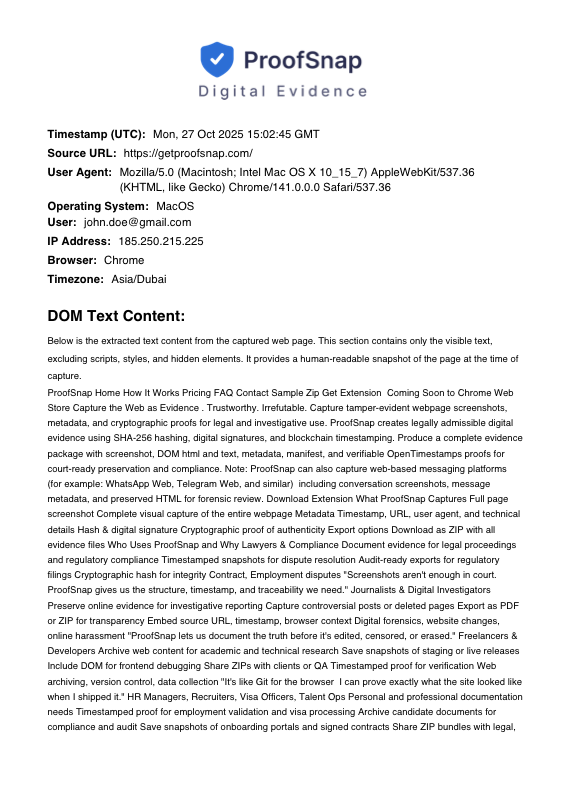
Click to view full sample evidence report
Contains: SHA-256 hash, blockchain timestamp, TLS certificate, URL, capture date
The Real Cost of Skipping Evidence Capture
The 5 seconds you spend capturing evidence saves 5 months of frustration—and often hundreds of dollars.
The Cost of Evidence: DIY vs Professional
A forensic capture tool pays for itself with a single successful dispute. The traditional "notarized screenshot" approach costs more per page than most products cost to buy.
Protect Your Next Purchase
ProofSnap captures product pages with SHA-256 hash, blockchain timestamp, and full metadata—creating court-admissible evidence in one click.
7-day free trial. Captures are instant—no waiting for notary appointments.
Try ProofSnap – 7 Days FreeSources and References
- EU Consumer Guarantees – Your Europe
- Sony Xperia Waterproof Class Action Settlement – Top Class Actions
- Apple Fined €10 Million in Italy – Euronews (November 2020)
- Zouzout v. Apple Canada Class Action – Top Class Actions Canada
- Chargeback Statistics 2026 – Chargebacks911 (Mastercard/Ethoca data)
- Q4 2025 Digital Trust Index – Sift (222% chargeback increase)
- Weinhoffer v. Davie Shoring, Inc. – Fifth Circuit (Wayback Machine ruling)
- Using Wayback Machine in Court – Norton Rose Fulbright
- Returns, Refunds, and Resolutions – FTC Consumer Advice
- eIDAS 2 Regulation (EU 2024/1183) – EUR-Lex
- EU Right to Repair Directive – Council of the EU (May 2024)
- ADR Directive 2013/11/EU – EUR-Lex
- Visa Reason Code 13.3 – Chargeflow
- Mastercard Reason Code 4853 – Chargebacks911