For DFIR · litigation · journalism · claims · AI compliance
AI image detection that runs in your browser.
Reads C2PA · Google SynthID · EXIF · Court-admissible ZIP
Your client just sent a screenshot. The SIU desk got a suspicious claim photo. The newsroom has 12 minutes before deadline. ProofSnap captures the page as a forensic ZIP and reads C2PA Content Credentials, SynthID Detector pointers, and EXIF software signatures from every image — three deterministic local layers, no image upload. From $4.99 SnapPack to $28.99/month Enterprise. 7-day trial.
What is AI image detection, and how does ProofSnap do it?
AI image detection is the process of determining whether a digital image was generated or substantially modified by a generative AI model (such as DALL-E, Midjourney, Stable Diffusion, Adobe Firefly, or Google Imagen). Detection methods fall into two families: cryptographic provenance reading — checking for signed manifests, watermarks, and metadata that the generating tool itself attached to the image — and machine-learning classification — running the image through a neural network trained to spot AI artifacts.
ProofSnap takes the first approach. It is a Chrome and Edge browser extension that, when you capture any web page, runs three deterministic detection layers locally inside the browser tab against every image on the page:
- C2PA Content Credentials — cryptographically signed manifest read from the image binary (production signers: Adobe Firefly, OpenAI DALL-E 3 / ChatGPT Image / Sora 2, Google Imagen / Veo / Lyria / Nano Banana). The parser also reads the IPTC DigitalSourceType field, which Midjourney uses to mark AI output during its C2PA pilot phase.
- Google SynthID watermark pointer — recorded when the C2PA generator field matches a Google model; the reviewer manually verifies at synthid.google.com.
- EXIF / XMP software signatures —
Software/xmp:CreatorToolpatterns from Stable Diffusion, Flux, Midjourney, Firefly, ChatGPT Image, and others.
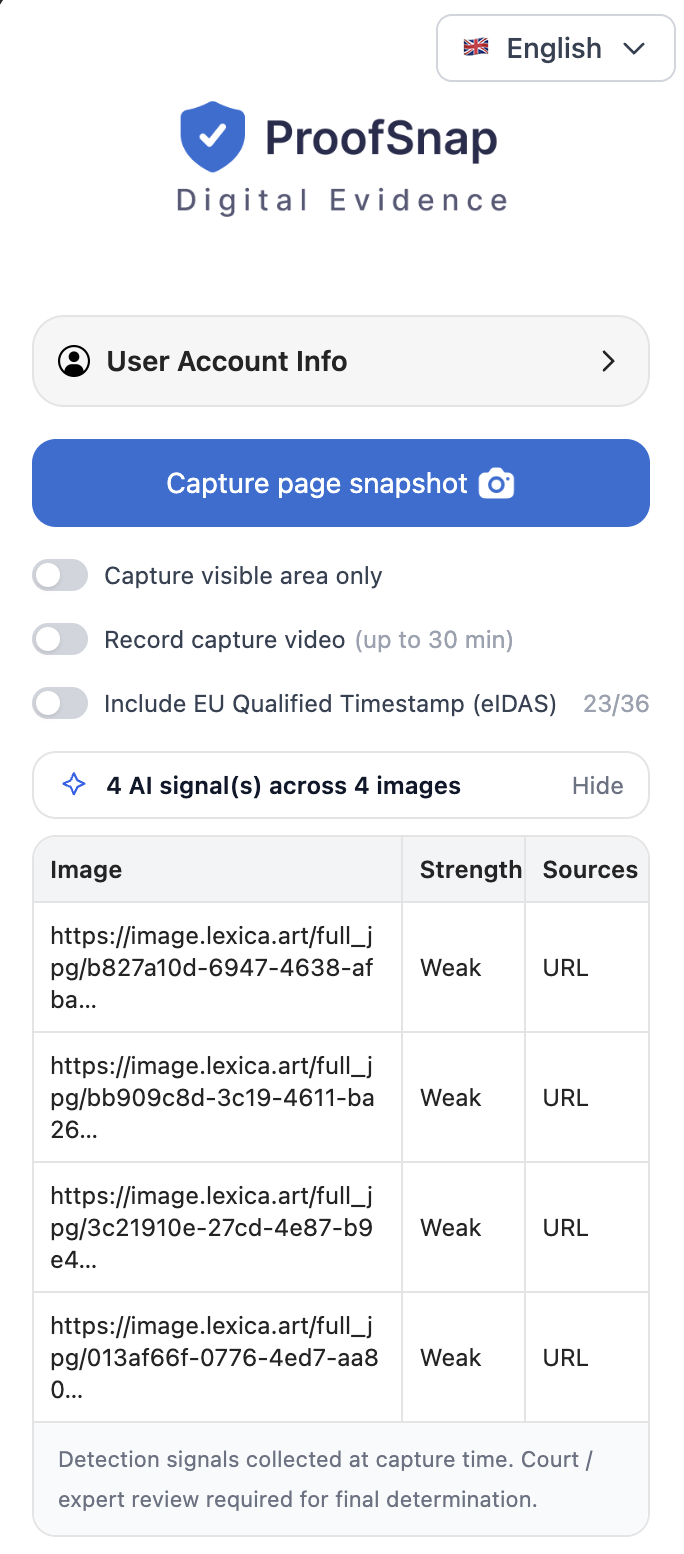
A fourth weaker layer matches the page URL against known AI gallery domains. All four layers parse in your browser only — no image binary, thumbnail, or hash is sent to ProofSnap servers, Hive, Sightengine, Copyleaks, or any other third party. The detection results travel into the forensic ZIP (metadata.json + evidence.pdf) alongside the SHA-256 hash, RSA-4096 signature, Bitcoin OpenTimestamps anchor, and optional eIDAS qualified timestamp.
What ProofSnap is — and what it is not
ProofSnap is a forensic recorder of AI-generation signals — not an AI image classifier. It does not return a probabilistic 'AI-generated' verdict, it does not replace expert review, and it does not guarantee that any given image is or is not synthetic. The evidence ZIP records what provenance metadata was present at the moment of capture (or its deterministic absence), under chain of custody. Final determination remains a question for the court, the qualified expert, the SIU adjuster, or the editorial reviewer.
Why this matters in 2026
Why AI image detection matters — four 2026 forces.
EU AI Act Article 50 — 2 Aug 2026
Generative AI providers must mark outputs in machine-readable form; deployers must disclose deepfakes. Penalty under Article 99(4)(g) reaches the higher of EUR 15 million or 3% of global annual turnover. Code of Practice final version expected June 2026.
Insurance fraud — Verisk March 2026
98% of insurers say AI editing tools fuel digital fraud. 76% see manipulated media getting more sophisticated. Only 32% feel confident detecting deepfakes. 36% of consumers (55% of Gen Z) would consider altering a claim image.
FRE 707 + Rule 901 deepfake amendments
Proposed Federal Rule of Evidence 707 would apply Daubert-level scrutiny to AI-generated evidence. It is not in force, and the Advisory Committee has not recommended action on it. Rule 901 deepfake amendments are progressing on a separate track.
SynthID Detector portal — I/O 19 May 2026
Google opened the SynthID Detector portal to journalists, researchers, and media professionals at I/O 2026 — scans images, audio, video, and text for SynthID watermark across Imagen, Veo, Lyria, Gemini, plus OpenAI / Kakao / ElevenLabs adopters. 10 billion+ pieces watermarked.
How AI image detection works in ProofSnap
Three local layers. No image upload to any third party.
Every AI-generation signal is parsed inside the user's browser. The C2PA WASM parser, the EXIF reader, and the URL matcher all run on the captured image binary locally. No image leaves the browser — no Hive, no Sightengine, no Copyleaks third-party processor.
Layer 1
C2PA Content Credentials
Cryptographically signed provenance read from the image binary. The parser extracts claim_generator, digitalSourceType IPTC code (load-bearing AI flag = trainedAlgorithmicMedia), actions array, signer organization, and signature validity. Production signers: Adobe Firefly, OpenAI (DALL-E 3 / ChatGPT Image / Sora 2), Google (Imagen / Veo / Lyria / Nano Banana). Midjourney is in C2PA pilot and marks AI output via IPTC DigitalSourceType, which the parser also reads. BBC / AP / Reuters / AFP / NYT publish signed wire content.
Library: c2pa v0.30.17 WASM (~2 MB lazy-loaded). Local parser, zero API calls.
Layer 2
SynthID Detector pointer
When a Layer-1 C2PA generator field matches a Google model (Imagen, Veo, Lyria, Nano Banana, Gemini), the evidence package records a pointer to synthid.google.com so a court reviewer, journalist, or SIU adjuster can manually upload for independent watermark verification. Strip-resistant — survives re-upload and compression. OpenAI / Kakao / ElevenLabs are adopting partners.
Privacy: URL recorded only. No automatic upload by ProofSnap — reviewer performs it themselves.
Layer 3
EXIF / XMP signatures
Software identifier strings written into image EXIF / IPTC / XMP metadata by the generating tool — the load-bearing fallback for open-source generators that don't embed C2PA. Whitelist match patterns include Software: Midjourney, xmp:CreatorTool: Adobe Firefly, Software: Stable Diffusion WebUI, Software: Flux.1, Software: ChatGPT Image.
Caveat: EXIF easily stripped on social-media re-upload. Negative result itself recorded.
Plus a weaker Layer 4 — URL host match against known AI-gallery domains (Midjourney, Civitai, Ideogram, Playground, Leonardo, Krea, Flux1, NightCafe, OpenArt, Lexica). Useful as corroborating signal when Layers 1–3 strip, not proof on its own.
The evidence package
11–15 forensic files per capture — with AI signals embedded.
Essential 11 / Professional 12 / Enterprise / Company 15. AI Detection results live in metadata.json (top-level ai_content_analysis key) and a dedicated section of evidence.pdf.
screenshot.jpeg Visual capturepage.html Full HTML contentdomtextcontent.txt Extracted DOM textmetadata.json Timestamp, URL, browser, TLS, ai_content_analysisevidence.pdf Report with AI Content Detection sectionmanifest.json File listing + SHA-256 hashesmanifest.sig RSA-4096 digital signaturemanifest.json.ots OpenTimestamps Bitcoin anchorpublickey.pem Public key for offline verificationforensic_log.json ISO/IEC 27037 capture logchain_of_custody.json Device + NTP verificationcapture_video.webm Pro+ — capture screen recordingprovenance_certificate.pdf Enterprise — content credentialsmanifest.json.tsr Enterprise — eIDAS qualified timestampmanifest.json.tsr.crt Enterprise — TSA certificate chainPer-image rows in evidence.pdf carry image URL, scroll-section position, SHA-256, C2PA generator field, EXIF software match, and SynthID portal pointer when applicable. Negative result (no signal fired) is itself recorded. Offline verifiable with python3 + openssl + ots.
Use cases
Four workflows that need provenance, not just pixels.
Litigation · defamation · deepfake
Deepfake civil-litigation evidence
When a deepfake appears in a defamation, IP, NCII, or family-law matter, ProofSnap captures the page with C2PA, EXIF, and SynthID signals embedded into the FRE 902(13)/(14)-ready ZIP. Rule 901 deepfake amendments (Spring 2026) and proposed FRE 707 (earliest December 2027) are the upcoming frame; the ZIP gives the proponent the evidentiary foundation today.
Insurance · SIU · claims investigation
AI-fueled claims fraud investigation
SIU adjuster receives a suspicious claim photo URL. ProofSnap captures the source page; the evidence ZIP records whether C2PA shows Firefly / DALL-E / Imagen provenance, whether EXIF software signature shows Stable Diffusion, and whether the URL host is a known AI gallery. Verisk 2026 data (98% / 76% / 32% / 36% / 55% Gen Z) makes AI claim fraud a top-tier carrier priority.
News · journalism · fact-checking
Newsroom verification & sourcing
BBC, AP, Reuters, AFP, and NYT reject unsigned wire imagery for major news events. ProofSnap captures the source post (Twitter, Telegram, Facebook, news site) and reads the C2PA manifest of the image — the editor instantly sees whether it was signed by a known generator. SynthID pointer for Google content lets the desk verify the watermark before publication.
DFIR · compliance · EU AI Act
DFIR & AI Act compliance audit trails
DFIR teams handling incident response, OSINT, or internal investigations need browser-native capture with ISO/IEC 27037 chain of custody and (optionally) eIDAS qualified timestamps. For EU AI Act Article 50 compliance officers, ProofSnap is the reader side of Article 50 — the audit-evidence ZIP proves an internal AI content audit was performed, with chain of custody from the moment of capture.
ProofSnap vs Hive, Sightengine, Copyleaks AI image detectors
Two different jobs. Forensic recorder ≠ ML classifier.
ML detectors return a probability score from a deep-learning classifier. ProofSnap reports deterministic signals attached to the image by the originating tool. The two approaches answer different questions — and for DFIR, GDPR, and litigation workflows, the no-image-upload design matters.
| Approach | ProofSnap | Hive / Sightengine / Copyleaks (ML) |
|---|---|---|
| Image upload to third-party | No — all parsing local in browser | Yes — binary sent to vendor API |
| GDPR / DSA / DFIR clean | Yes — no processor agreement needed | Depends on vendor jurisdiction |
| Per-image cost | $0 ongoing (deterministic) | $0.001–$0.010 (annual contracts above 100/day for Hive) |
| Strip-resistant for Google content | Yes — SynthID pointer recorded | Varies by vendor |
| Output format | Raw signals + signer org + IPTC code | Probability score 0–1 + top-model guess |
| Court interpretation needed | Yes — we report signals, court interprets | Yes — FRE 707 / Daubert scrutiny applies |
| Stripped-metadata content coverage | Negative result recorded — expert next | Visual ML model attempts classification |
| Independent verification | Offline — python3 + openssl + ots client | Vendor portal account / API key required |
When ML still helps
For stripped-metadata, non-Google content (e.g. a Stable Diffusion image re-uploaded to a forum after the EXIF was removed), an ML classifier remains the next-best signal. ProofSnap's deterministic layers will record the negative result; an expert with Hive Moderation (94% benchmark) or Copyleaks (99.2% true-positive / 99.3% true-negative) can be retained downstream. An optional opt-in ML layer is on the ProofSnap product roadmap.
Where ProofSnap sits in the forensic-capture landscape
- ProofSnap — Chrome / Edge extension, captures in the authenticated browser session (logged-in social, SaaS dashboards, behind-login), AI detection runs in the tab, ISO/IEC 27037 chain of custody, OpenTimestamps free, eIDAS optional. From $4.99 SnapPack / $18.99 Company / $28.99 Enterprise.
- TrueScreen (Italy) — certified acquisition across mobile, web, forensic browser, extension; qualified timestamp + SHA-256 + GPS + separate ML deepfake detector. Business plan EUR 60 / month (3 users).
- Page Vault, Hanzo, X1 Social Discovery — enterprise e-discovery platforms with deep review / production workflows. Thousands per seat per year; fit for corporate investigation teams handling 100,000+ items per matter.
- Hive Moderation, Sightengine, Copyleaks — ML classifier APIs (probability score, image binary uploaded). Complementary to ProofSnap for stripped-metadata content, not substitutive.
When ProofSnap fits best: the moment a live web page, social-media post, or behind-login dashboard needs to be preserved with AI-generation provenance recorded, by a paralegal / journalist / SIU adjuster / compliance officer / DFIR analyst working from a Chromium-based browser, on a per-seat or one-off-capture budget rather than enterprise licensing.
Pricing
AI Content Detection on every tier.
No upsell, no add-on. The three deterministic layers run on Essential, Professional, Enterprise, and Company Plan alike — including the 7-day trial.
One-off · no subscription
SnapPack
$4.99
one-time · 10 captures
- ✓10 forensic captures
- ✓AI Content Detection included
- ✓Bitcoin OpenTimestamps anchor
- ✓Credit card at purchase, no recurring charge
Need EU court-grade timestamps?
Upgrade to eIDAS SnapPack 10 — $49.99. Qualified RFC 3161 timestamp on every capture, statutory weight in 27 EU member states.
Firm / team / SIU squad
Company Plan
$18.99/seat/mo
min 2 seats · 7-day trial
- ✓Team capture & shared evidence access
- ✓5 eIDAS qualified timestamps / user / month
- ✓Bitcoin OpenTimestamps unlimited
- ✓AI Content Detection included
- ✓Cancel any time during the trial at zero cost
Solo / 10 eIDAS qualified timestamps / month
Enterprise
$28.99/mo
single seat · 7-day trial
- ✓10 eIDAS qualified timestamps / month
- ✓15-file forensic package on every capture
- ✓Capture video recording included
- ✓AI Content Detection included
- ✓Cancel any time during the trial at zero cost
Credit card required for the 7-day trial · cancel any time during the trial at zero cost · no refunds on completed subscription periods · support@getproofsnap.com
AI image detection — frequently asked questions
1. Check for C2PA Content Credentials — a cryptographic manifest the generating tool embeds into the image. Production signers in 2026: Adobe Firefly, OpenAI DALL-E 3 / ChatGPT Image / Sora 2, and Google Imagen / Veo / Lyria / Nano Banana. Midjourney is in C2PA pilot phase and currently marks AI output via the IPTC DigitalSourceType field rather than a full C2PA manifest.
2. Check for a Google SynthID watermark via the SynthID Detector portal — strip-resistant, survives re-upload and screenshot.
3. Inspect EXIF / XMP metadata for software signatures like
Software: Midjourney or xmp:CreatorTool: Adobe Firefly.
4. For stripped-metadata content, an ML classifier such as Hive Moderation (~94%) or Copyleaks (~99%) returns a probability score.
Best practice combines multiple methods. ProofSnap automates methods 1–3 inside the browser when you capture a web page, with no image upload to any third-party.
For provenance-based detection (reading C2PA Content Credentials, Google SynthID hints, and EXIF software signatures) the free options are:
• Content Credentials Verifier — official Content Authenticity Initiative web tool, single image
• C2PA Viewer — community tool for manifest inspection
• ProofSnap — Chrome / Edge browser extension; records detection results into a court-admissible forensic ZIP and runs the detection on every image on a captured web page in one pass without uploading any image
For ML-classifier-based detection (probability scores), free tier options include Hive Moderation's web demo (~94%), AI Or Not, and DeepAI.
The most reliable workflow combines provenance reading with an ML classifier for stripped-metadata content.
Cryptographic provenance readers (C2PA, SynthID, EXIF) are deterministic. If the originating tool signed the image and the signature has not been stripped, the detection is binary and reliable. Coverage is broad among major-model AI output (Adobe Firefly, OpenAI, Google) and expanding fast under EU AI Act Article 50 pressure (effective 2 August 2026), but does not yet reach open-source generators such as Stable Diffusion and Flux that do not embed cryptographic provenance.
ML classifiers in 2026 independent benchmarks: Hive Moderation 94%, Copyleaks 99.2% true-positive / 99.3% true-negative, Sightengine ~91%. They work well on known generators but struggle on newer models such as Google Nano Banana and Flux.
No detector is 100%. Stripped-metadata, open-source-model content that has not been re-uploaded to a SynthID-watermarking provider remains the gap. ProofSnap reports the negative result honestly when no signal fires, rather than guessing.
• Adobe Firefly (founding C2PA member, signed since launch)
• OpenAI — every DALL-E 3 image, ChatGPT image generation, and Sora 2 video signed with a Content Credentials manifest plus a SynthID-style watermark
• Google — Imagen 4, Veo 3, Lyria 2, Nano Banana use SynthID and C2PA together
• Newsrooms — BBC, AP, Reuters, AFP, NYT publish signed wire content
Midjourney is in C2PA pilot phase as of 2026 and currently marks AI-generated output via the IPTC DigitalSourceType field (not a full C2PA manifest). ProofSnap reads the DigitalSourceType field as part of Layer 1.
Not signed: Stable Diffusion, Flux, and most open-source forks. Those are caught by Layer 2 (EXIF) and Layer 3 (URL context) instead.
The SynthID Detector portal launched at Google I/O 2026 (May 19, 2026) as an upload-only verification tool at
synthid.google.com — journalists, media professionals, and researchers are joining the public waitlist; rollout is extending to Google Search and Chrome (desktop and mobile) in the weeks after I/O.
Strip-resistant: SynthID survives re-upload, screenshot, and compression, unlike C2PA and EXIF. When ProofSnap reads a C2PA generator field matching a Google model, the evidence package includes a textual pointer to the SynthID Detector portal so the court reviewer or investigator can manually upload the image for independent verification — ProofSnap does not auto-upload anything to Google.
This is a deliberate design choice for GDPR / DSA / DFIR-clean workflows: image binaries never leave the user's machine, no third-party processor agreement is required, and there is no cloud round-trip latency. An optional ML detector layer (Hive Moderation) is on the future roadmap but will be opt-in with explicit consent, never default.
Penalty tier under Article 99(4)(g): the higher of EUR 15 million or 3% of global annual turnover. The Code of Practice second draft was published March 2026; the final version is expected June 2026.
ProofSnap fit: reader side — when an EU compliance officer needs to evidence that an internal AI content audit was actually performed (capture a generator output, document the disclosure, archive the snapshot), the forensic ZIP records which C2PA / SynthID / EXIF signals were present at capture time, with chain of custody and (Enterprise) eIDAS qualified timestamp.
The AI Content Detection section reports raw signals (C2PA generator field, EXIF software string, SynthID portal pointer, URL context match) — not a probabilistic 'AI-generated' verdict.
Proposed Federal Rule of Evidence 707, which is not in force and on which the Advisory Committee has not recommended action, would apply Daubert-level scrutiny to AI-generated evidence acknowledged as such by the proponent (validation, error rates, peer review where feasible).
Rule 901 amendments targeting AI-altered media and deepfake authentication challenges are progressing on a separate track. ProofSnap supports authentication of the capture and reports raw provenance signals; final determination of whether a given image is AI-generated remains a question for the expert witness, the court, or the investigator.
ProofSnap reports deterministic signals (C2PA cryptographic signature, EXIF metadata, SynthID pointer, URL context) recorded locally, without any image upload. The two approaches answer different questions:
• ML asks: 'does this image look AI-generated to the model?'
• ProofSnap asks: 'what provenance signals were attached to this image at capture time, and what is the chain of custody?'
For DFIR, GDPR-sensitive, and litigation workflows the no-upload design matters. For stripped-metadata content (Stable Diffusion image re-uploaded with EXIF cleared), an ML detector remains the next-best signal — expert opt-in. A native ProofSnap ML integration is on the future roadmap as opt-in.
For strip-resistant detection of Google-model content, the SynthID Detector portal is the appropriate next step (Imagen / Veo / Lyria SynthID watermarks survive re-upload and compression). For non-Google stripped content, expert ML analysis or forensic image examination by a qualified expert remains the standard.
ProofSnap captures the verifiable starting state; downstream expert review fills the strip-resistant gap.
AI Content Detection requires the c2pa WASM library (~2 MB) which lazy-loads on first capture; CSP
wasm-unsafe-eval is declared in the extension manifest per Chrome Web Store policy.
Behind-login captures use the authenticated browser session — no scraping, no credential storage, no headless rendering on a third-party server.
Core forensic files:
screenshot.jpeg, page.html, domtextcontent.txt, evidence.pdf, metadata.json, forensic_log.json, chain_of_custody.json, manifest.json, manifest.sig, manifest.json.ots, publickey.pem.
Professional adds
capture_video.webm (screen recording of the capture). Enterprise and Company Plan add provenance_certificate.pdf, manifest.json.tsr (eIDAS qualified RFC 3161 timestamp), and the TSA certificate chain.
The AI Content Detection results live as a top-level
ai_content_analysis section in metadata.json and as a dedicated 'AI Content Detection Signals' section in evidence.pdf, with per-image SHA-256, signals[], and SynthID pointer when applicable.
The ZIP is offline-verifiable with
python3, openssl, and the ots client — or via the Trust Verifier page.
7-day trial — credit card required, autorenews at the end of the trial. Cancel any time during the trial at zero cost.
Subscription tiers:
• Essential — entry-level, AI Content Detection included
• Professional — via Company Plan, $18.99/seat/month, minimum 2 seats
• Enterprise — $28.99/month solo, 10 eIDAS qualified timestamps / month
EU court-grade upgrade: eIDAS SnapPack 10 — $49.99 one-time, 10 forensic captures with eIDAS qualified RFC 3161 timestamp on every capture (statutory weight in 27 EU member states), no recurring charge.
AI Content Detection is included on every tier including the trial and both SnapPack variants — no upsell, no add-on.
First capture in 41 seconds
Install the Chrome extension. Capture the next AI image with provenance.
7-day trial — cancel any time during the trial at zero cost. The moment you need to evidence an AI-generation signal — in a litigation matter, a claims investigation, a newsroom workflow, or an EU AI Act audit — the ZIP is ready before opposing counsel finishes their email.
Cancel any time during the trial at zero cost · download sample ZIP first · support@getproofsnap.com
Disclaimer: This page provides general technical and product information about ProofSnap's AI Content Detection feature. It is not legal advice and is not professional forensic guidance. ProofSnap is not a law firm, a forensic-examination provider, or an AI-classifier service. Admissibility under FRE 901/902/707, Rule 901 deepfake amendments, EU AI Act Article 50, eIDAS, or any other applicable framework is decided by the court or competent authority on a case-by-case basis. C2PA and SynthID specifications and AI-tool support change frequently — the references above reflect publicly available information as of May 2026; verify current state before relying on any specific signal in production workflows.
Related ProofSnap pages
- AI Claim Photo Detection for SIU — insurance vertical
- EU AI Act Article 50 Compliance — 2 Aug 2026 deadline audit trail
- Evidence Software for Lawyers — FRE 902 self-authenticating ZIPs
- Evidence for Investigators
- Evidence for Journalists
- eIDAS Qualified Timestamps — EU court weight
- Brand Protection — counterfeit listing evidence
- DMCA & Copyright Evidence
- Trust Verifier — offline ZIP verification