Faculty Tenure & Title IX Evidence
The Evidence Your Employment Lawyer Will Ask For First.
Capture your tenure dossier, annual reviews, chair emails, and Title IX records before IT revokes access. Blockchain-timestamped, FRE 901-admissible, ready to hand to your attorney.
- 41 seconds per capture — Interfolio, Workday, Canvas, university email
- 13-file forensic package — SHA-256 hash, blockchain timestamp, chain of custody
- Accepted by AAUP grievance committees, OCR, EEOC, federal courts
Also available for Microsoft Edge
SnapPack: $4.99 one-time · 7-day free trial, cancel anytime · Cancel anytime
Admissible under FRE 901 (US) · OCR Title IX complaint evidence · AAUP Regulation 10 grievance documentation · EEOC Title VII charge
Before anything else: get a free consult with an employment lawyer.
A tenure denial or Title IX matter is a legal situation, not a document problem. Evidence preservation matters, but the first decision — what to say, what to sign, which deadlines apply to your specific facts — belongs to a lawyer. Most higher-ed employment attorneys offer free initial consultations and many work on contingency for strong cases.
NELA — Find an Employment Lawyer →
National Employment Lawyers Association directory. Filter by state and specialty (higher-ed, Title IX).
AAUP Legal Program →
AAUP provides referrals and, in some cases, legal support for faculty members facing academic freedom and tenure issues.
While you wait for the consult, preserve your evidence.
Your consult may be in 3–10 days. IT can revoke your Interfolio, Workday, Canvas, and email access in 24–72 hours. ProofSnap is what lawyers recommend faculty use in that gap — forensic-grade, authenticated captures that hold up under FRE 901 and are exactly the format attorneys and OCR investigators want to receive.
“The most important thing a faculty member can do in the immediate aftermath of a tenure denial is to preserve every document in their file — annual reviews, correspondence with the chair, external letters, and the denial letter itself — before institutional access is revoked.”
Paraphrased from published guidance on responding to tenure denials. See the Inside Higher Ed: 12 Steps for Responding to a Tenure Denial and the AAUP Recommended Institutional Regulations.
Important: if you are the respondent in an active Title IX investigation
If a Title IX complaint has been filed against you, talk to your lawyer before you capture anything from university systems. Evidence preservation is lawful, but bulk extraction during an active investigation can be recharacterized by institutional counsel as interference, tampering, or retaliation against the complainant. The analysis depends on your facts, your institution’s policies, and any preservation order in place.
What to do: retain counsel first, follow their scope instructions, and use ProofSnap only on the specific records they authorize. This page is built for faculty who are filing a complaint or appealing a denial — if your situation is the mirror image, your lawyer’s guidance supersedes everything on this page.
Key terms every faculty member should know before appealing a tenure denial
Plain-English definitions of the legal and procedural concepts that decide tenure denial and Title IX retaliation cases in the United States.
- Tenure denial
- A formal decision by a university not to grant a tenure-track faculty member permanent tenured status. Nationwide denial rates are typically estimated at 5–15%, though they vary widely (Harvard recently reported 17–29%; some CSU campuses report under 1%). A tenure denial usually leads to a terminal year of employment and, absent a successful appeal or legal claim, ends the faculty member’s position at that institution.
- AAUP Regulation 10
- Shorthand for the grievance-procedure section of the AAUP Recommended Institutional Regulations on Academic Freedom and Tenure. Most US institutions that have adopted AAUP standards include a Regulation 10 analog in their faculty handbook, giving faculty a fixed window (commonly 30 to 60 days, up to 90 at some institutions) to file an internal grievance after a tenure denial or other adverse decision.
- McDonnell Douglas burden-shifting
- The framework courts use under Title VII to evaluate discrimination claims (including tenure denial discrimination) when there is no direct evidence of bias. The plaintiff must first show a prima facie case (protected class, qualified for tenure, adverse action, inference of discrimination). The burden then shifts to the institution to articulate a legitimate, non-discriminatory reason. Finally, the burden returns to the plaintiff to show the stated reason is pretext — that discrimination was the real motive. Contemporaneous evidence of qualifications and comparator decisions is central to every step.
- Title IX retaliation
- A prohibited adverse action taken against a faculty member because they engaged in protected activity under Title IX — such as filing a complaint of sex discrimination, supporting a complainant, or participating in a Title IX investigation. Title IX retaliation claims apply to faculty employment at federally funded institutions and can be filed with the Department of Education Office for Civil Rights (OCR) within 180 days of the adverse action.
- Temporal proximity
- How closely in time an adverse action (tenure denial, non-renewal, committee removal) follows protected activity (filing a Title IX complaint, supporting a complainant). Courts treat short temporal proximity as circumstantial evidence of retaliatory causation. A tenure denial issued weeks or months after a Title IX filing raises the inference; a denial years later usually does not. Date-stamped records of both the protected activity and the adverse action are the strongest way to establish this element.
- Exhaustion of internal remedies
- A judicial doctrine holding that faculty must first use the grievance procedures provided by their faculty handbook or collective bargaining agreement before filing suit in federal court. Courts have dismissed tenure discrimination cases where faculty skipped the internal grievance process. This is why the 30–60 day internal deadline is often the most important early deadline — missing it can forfeit federal claims that would otherwise have a 180/300 day window.
- Faculty handbook as enforceable contract
- Under the law of many US states, faculty handbooks and institutional regulations function as binding contractual terms between the university and the faculty member. This means an institution that departs from its own stated tenure standards or grievance procedures may be liable for breach of contract — not just discrimination. Capturing the version of the handbook in effect at hire and at review is critical because institutions can (and do) quietly revise these documents.
- FRE 901 authentication
- Federal Rule of Evidence 901(b)(9) allows authentication of electronic evidence by describing the process that produced it and showing that the process produces an accurate result. Blockchain timestamps, SHA-256 hashes, and documented chain of custody meet this standard — which is why forensic capture tools are preferred over bare screenshots, which can be (and have been) rejected as fabricated (see Rossbach v. Montefiore Medical Center, 2d Cir. No. 21-2084 (Aug. 28, 2023), aff’g sanctions for fabricated screenshots, S.D.N.Y. No. 19-cv-05758 (Aug. 5, 2021)).
3 steps. 41 seconds. Grievance-ready evidence.
ProofSnap captures forensic faculty evidence that AAUP grievance committees, OCR investigators, and Title VII courts accept.
Install ProofSnap
Add the Chrome extension. Start your free 7-day trial.
Capture Before IT Revokes Access
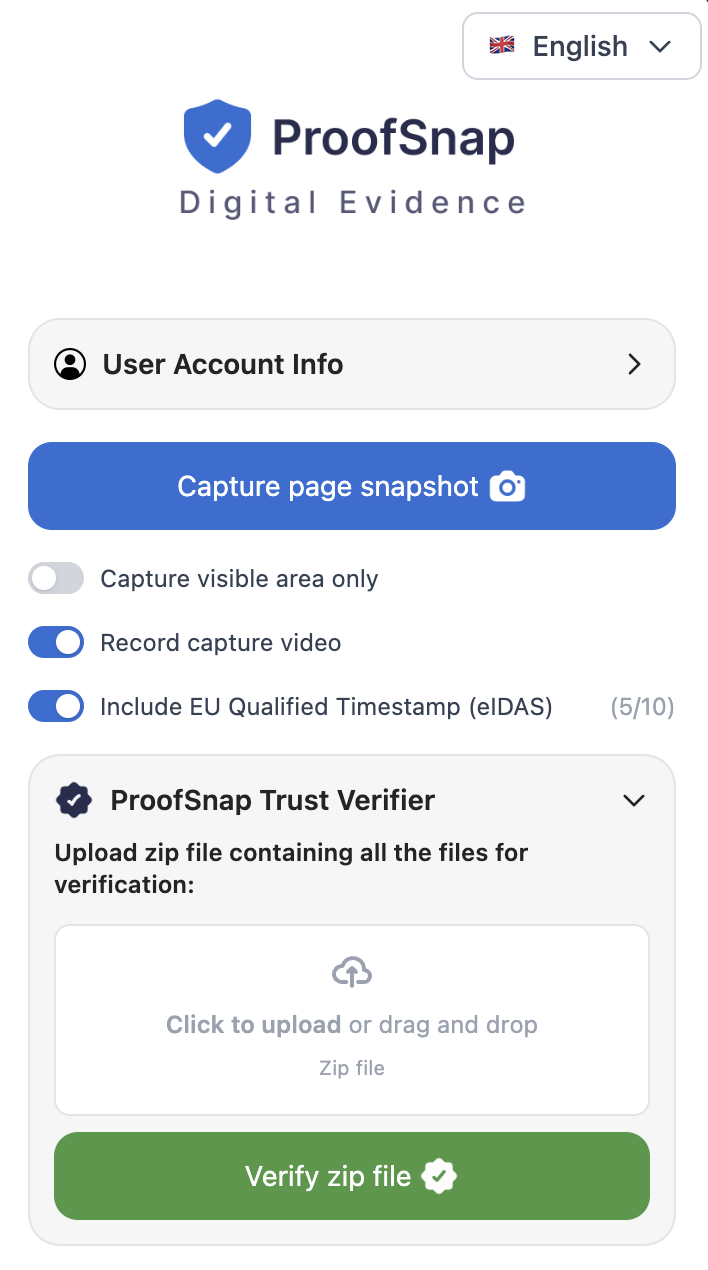
Open Interfolio, Workday, Canvas, your faculty portal, or university email. Click ProofSnap. It captures everything — screenshot, HTML, metadata, cookies, TLS — in 41 seconds.
File Your Grievance or Charge
Download your 13-file evidence ZIP. Submit to your institutional grievance committee, the Department of Education OCR, the EEOC, or your employment lawyer.
Denied tenure? 6 patterns faculty discrimination lawyers see every year.
These are the recurring fact patterns in faculty Title VII, Title IX retaliation, and AAUP grievance cases — and the specific evidence you need to preserve to prove each one.
Denial Letter, No Written Reasons
A one-paragraph denial letter from the provost. No written reasons, no reference to the department vote, no explanation of how external reviews were weighed. The institutional record exists in Interfolio and committee minutes you never see.
Evidence needed: denial letter, your dossier, external reviewer letters, annual reviews
Interfolio and Workday Locked
Within 72 hours of the denial, IT deactivates your faculty account. Interfolio dossier, Workday HR records, Canvas course evaluations, and institutional email — all gone. The university now controls every piece of evidence.
Evidence needed: capture Interfolio, Workday, Canvas BEFORE IT revokes access
Positive Annual Reviews Rewritten
Your third-year review said "on track for tenure." Your 5th-year review praised your research trajectory. Now the denial letter says you "failed to meet expectations all along." The positive reviews are gone from Interfolio. Your chair "doesn’t recall" endorsing you.
Evidence needed: timestamped capture of all annual and pre-tenure reviews in Interfolio/Workday
Chair and Dean Emails Disappear
Your department chair’s email about "fit" concerns. The dean’s remark questioning whether a mother of young children can keep up with research. The committee message suggesting you need to "be more collegial." All on institutional email servers you no longer access.
Evidence needed: chair, dean, provost, and committee email threads — captured before account deactivation
Title IX Office "Lost" Your Complaint
You filed a Title IX complaint about harassment by a senior colleague. The Title IX Coordinator said they’d investigate. Months later, you’re denied tenure for "collegiality" concerns. The Title IX office now has no record of your intake. It’s your word against theirs.
Evidence needed: Title IX complaint, intake confirmation, coordinator responses, outcome letter
Retaliation Disguised as "Collegiality"
You filed a Title IX complaint. Or supported a student’s complaint. Or raised concerns about a chair’s conduct. At your tenure review, suddenly "collegiality" becomes the decisive factor — and it was never mentioned in any prior annual review.
Evidence needed: your Title IX filing, timing of denial, prior annual reviews showing collegiality was never raised
Tenure denial lawsuits: real cases, real outcomes, real evidence.
Real cases. Real outcomes. Contemporaneous evidence made the difference.
Jew v. University of Iowa — Dr. Jean Jew, a tenured associate professor in the College of Medicine, prevailed on Title VII sex discrimination and hostile work environment claims arising from a pattern of sexist rumors and retaliation by colleagues. The University ultimately paid roughly $1.08 million in back pay, damages, and attorneys’ fees and expenses. Documented memoranda and witness statements were central to the ruling.
Source: 749 F. Supp. 946 (S.D. Iowa 1990); settlement reported publicly in Newsweek and the Journal of Gender, Race & Justice.
Brown v. Trustees of Boston University — Julia Prewitt Brown, an assistant professor of English denied tenure, won a $200,000 jury verdict on a breach-of-contract claim under the anti-discrimination clause of BU’s collective bargaining agreement with its faculty. The First Circuit opinion at 891 F.2d 337 addressed the right to a jury trial on the contract claim. Her parallel Title VII and Massachusetts Chapter 151B claims were heard by the bench in the same proceeding.
Source: 891 F.2d 337 (1st Cir. 1989)
Tuchman-type dismissals — Faculty Title VII tenure discrimination claims routinely fail when plaintiffs cannot produce contemporaneous records of department deliberations, external reviews, or comparator decisions. Courts defer heavily to institutional peer review unless the plaintiff presents independently documented evidence of bias or procedural irregularity.
Source: Pattern recognized in Title VII tenure jurisprudence.
Rossbach v. Montefiore Medical Center — The district court detected fabricated text-message screenshots: emoji depictions from iOS 13 or later appeared in images that plaintiff claimed came from an iPhone 5 limited to iOS 10. Judge Denise Cote dismissed the action with prejudice as a sanction for fabrication, and the Second Circuit affirmed the case termination in 2023. Courts now scrutinize screenshot authenticity. ProofSnap addresses this with blockchain-timestamped, hash-verified captures.
Source: S.D.N.Y. No. 19-cv-05758 (Aug. 5, 2021); 2d Cir. No. 21-2084 (Aug. 28, 2023).
Will a screenshot of my tenure dossier hold up in court? FRE 901 authentication explained.
When you file a Title VII or Title IX claim, your university responds with Interfolio exports, HR server logs, timestamped committee minutes, and institutional counsel. You send screenshots that anyone could have faked in Photoshop. Courts reject unverified screenshots (Rossbach v. Montefiore).
Your Screenshot
- No timestamp proof — when was it taken?
- Easily edited in 30 seconds (Photoshop, Inspect Element)
- No metadata, no URL verification
- No chain of custody
- Just 1 image file
- Challenged by university’s general counsel (Rossbach precedent)
ProofSnap Evidence Package
- Blockchain timestamp — immutable proof of when
- SHA-256 hash — any tampering detected instantly
- Full metadata: URL, IP, headers, TLS certificate, cookies
- Forensic log + chain of custody documentation
- 13 files: screenshot, HTML, DOM, PDF, metadata, video
- Admissible under FRE 901(b)(9), accepted by OCR, EEOC, and federal courts
Legal basis: FRE 901(b)(9) (authentication of electronic evidence) · Title VII damage caps: $50K–$300K depending on institution size · Title IX retaliation claims not subject to Title VII caps · AAUP Regulation 10 grievance procedures
Denied tenure? Tenure denial evidence checklist for the first 72 hours.
Step 0 — Do this first, before anything on the checklist below:
Email an employment lawyer for a free consult (NELA directory or AAUP referral). State the facts, the denial date, and any Title IX complaint. Ask what you can and cannot do with university systems before your consult. A 5-minute email now prevents expensive mistakes later.
If you still have access to Interfolio, Workday, Canvas, and university email, every minute matters. Once IT deactivates your account (typically within 24 to 72 hours of denial), this evidence is gone. If you’ve already been locked out, capture what’s still accessible from personal email, your own device, and public records. If a Title IX complaint is pending against you, wait for your lawyer’s guidance before using this checklist.
Your emergency capture checklist:
Why this matters even if you already have screenshots: Your university’s general counsel will challenge every screenshot as fabricated. In Rossbach v. Montefiore, a court detected fake screenshots by analyzing emoji versions. With ProofSnap, each capture has a SHA-256 hash, digital signature, and blockchain timestamp that independently proves when and what you captured. That’s the difference between an institutional grievance committee dismissing your appeal and a successful Title VII or Title IX claim.
Do the math:
Total: $4.99 to protect a career-defining claim. Or use the free 7-day trial that covers your entire dossier.
Install takes 30 seconds. First capture in under 2 minutes.
Already locked out? You can still capture from personal inbox (forwarded emails), public comparator records (department pages, Google Scholar profiles of recently tenured colleagues), the public faculty handbook, and any separation agreement before signing.
How to appeal a tenure denial: the 4 parallel tracks (grievance, Title IX, EEOC, AAUP)
Faculty facing a tenure denial or Title IX retaliation have four parallel filing paths with different deadlines and remedies. You do not have to choose one — and missing the internal grievance deadline can forfeit your federal claims under the exhaustion of remedies doctrine.
Institutional faculty grievance (AAUP Regulation 10 analog)
- 1. Open your faculty handbook — before the university revises it. Find the grievance procedure and the filing window (commonly 30, 60, or 90 days from the denial letter).
- 2. File a written grievance with the faculty grievance committee or provost’s office within that window. Attach your ProofSnap evidence ZIP.
- 3. The grievance committee reviews the record, typically holds a hearing, and recommends a remedy to the president. Under AAUP Reg 10, you are entitled to a hearing before a faculty committee and access to the evidence against you.
- 4. If the grievance fails, you still have Title IX, Title VII, and state law claims — provided you did not waive them.
Title IX complaint — Department of Education Office for Civil Rights
- 1. File a Title IX complaint with OCR within 180 days of the discriminatory act (sex discrimination, sexual harassment, pregnancy discrimination, or Title IX retaliation).
- 2. OCR investigates the institution’s Title IX compliance and can require systemic remedies. Faculty are protected under Title IX’s employment provisions at federally funded institutions.
- 3. Title IX retaliation claims are not subject to Title VII’s damage caps and often carry stronger remedies, including reinstatement and back pay.
- 4. File internally with your Title IX Coordinator as well — this creates a contemporaneous institutional record.
Title VII, ADA, ADEA charge with the EEOC
- 1. File a charge with the EEOC within 180 days (300 days if your state has a Fair Employment Practices Agency). Filing is free and online.
- 2. The EEOC investigates and attempts mediation. Attach your ProofSnap evidence package.
- 3. After the right-to-sue letter, you have 90 days to file a federal lawsuit.
- 4. Tenure discrimination cases are evaluated under the McDonnell Douglas burden-shifting framework: prima facie case, legitimate non-discriminatory reason, pretext.
AAUP Committee A on Academic Freedom and Tenure
- 1. If your institution violated AAUP’s 1940 Statement of Principles on Academic Freedom and Tenure, or failed to provide procedural due process under Regulation 10, you can request AAUP review.
- 2. AAUP investigation can result in institutional censure — a significant reputational consequence that some institutions settle to avoid.
- 3. Contact AAUP’s Department of Academic Freedom, Tenure, and Governance with your documented case.
All of these paths require documented evidence. ProofSnap creates the forensic package that AAUP grievance committees, OCR investigators, EEOC, and federal judges accept. For finding a lawyer, see the Step 1 section above.
Start NowThe Terminal Year Trap: Don’t Sign Away Your Rights Without Evidence
After a tenure denial, many institutions offer a terminal-year contract or a separation package in exchange for a release of all claims. Before you sign, understand what you’re giving up — and what evidence you need to negotiate a better outcome.
What they want you to sign:
- General release of all claims (Title VII, Title IX, ADEA, state law, grievance)
- Non-disparagement clause (you can’t speak publicly about your denial)
- Confidentiality (you can’t share the settlement terms)
- Waiver of internal grievance and AAUP Committee A review
Your legal protections:
- 21 days to consider (ADEA, age 40+, individual release) or 45 days (group release)
- 7 days to revoke after signing (ADEA age 40+)
- Cannot waive future claims or your right to file an EEOC/OCR charge
- Documented bias = leverage for reinstatement, back pay, or a materially better offer
Capture the separation agreement with ProofSnap before you sign. This creates a blockchain-timestamped record of exactly what terms were offered, when, and by whom. Consult a lawyer who understands higher-ed employment before releasing any claims — a release signed under pressure may be unenforceable but is very expensive to contest.
Evidence disappears. Deadlines don’t wait.
- Interfolio, Workday, Canvas, faculty email — revoked within 24 to 72 hours of denial
- Internal grievance: ~90 days. OCR Title IX: 180 days. EEOC: 180/300 days. Non-negotiable.
Start capturing evidence now
One-time $4.99 covers most tenure denial cases. 7-day free trial included with all plans.
$4.99
SnapPack — 10 Forensic Captures
One-time purchase. All features. Credits never expire.
10 captures is enough for most cases:
Or start the 7-day free trial first — cancel anytime
Need more than 10 captures? See monthly plans →
Essential
100 captures/month
13-file package, Provenance Certificate. No blockchain timestamp.
Professional
200 captures/month
Everything in Essential + Blockchain (OpenTimestamps).
Enterprise
Unlimited captures
Everything in Professional + eIDAS qualified timestamp, priority support.
Annual plans save 20%. See full pricing →
Not sure yet? Download a sample evidence package
Tenure denial appeal & Title IX retaliation FAQ (2026): everything US faculty need to know
Faculty rights and higher-education resources
Internal grievance, OCR Title IX, EEOC Title VII, and AAUP review all work — but they require documented evidence.
AAUP Academic Freedom Program
American Association of University Professors — Committee A on Academic Freedom and Tenure, investigation and censure process.
OCR — Title IX Complaint
Department of Education Office for Civil Rights. File Title IX sex discrimination and retaliation complaints within 180 days.
EEOC
Equal Employment Opportunity Commission. File Title VII, ADA, ADEA charges. Free, no lawyer needed.
NELA — Find an Employment Lawyer
National Employment Lawyers Association. Largest directory of plaintiff-side employment attorneys.
AAUP Regulation 10
Recommended Institutional Regulations on Academic Freedom and Tenure — faculty grievance procedures.
AAUP 1940 Statement
Foundational statement of principles on academic freedom and tenure adopted by most US institutions.