Laid off or fired? Save the record before you lose access.
Laid off? Locked out? Save your evidence before it disappears.
As of 2026, ProofSnap is a Chrome and Edge extension that saves work emails, Slack and Teams messages, performance reviews and HR records as sealed evidence for an EEOC charge, a WARN Act claim or a US employment lawyer: a SHA-256 hash and a digital signature on every capture, and a Bitcoin timestamp on every plan except Essential.
Radim Motycka, founder and lead engineer of ProofSnap ·
Your employer runs the email server, the Slack workspace and the HR system. On the day you are let go, your access usually goes with your badge. A sealed copy you make while you still have access is a record your employer does not control.
For Chrome and Microsoft Edge · trial requires a card · or $4.99 one-time for 10 captures
About to be let go, or just let go? Do these three things today.
- 1. Save your record.Reviews, HR emails, your contract and your pay, while you still have access.
- 2. Do not sign the severance agreement yet.If you are 40 or older and it waives age claims, federal law gives you at least 21 days to consider it.
- 3. Talk to an employment lawyer.An EEOC charge usually has to be filed within 180 or 300 days, so the clock is already running.
How it works, in three steps
No technical knowledge needed. If you can open it in Chrome, you can save it as evidence.
1. Install
Add ProofSnap to Chrome or Edge on a computer you control.
2. Capture before the lockout
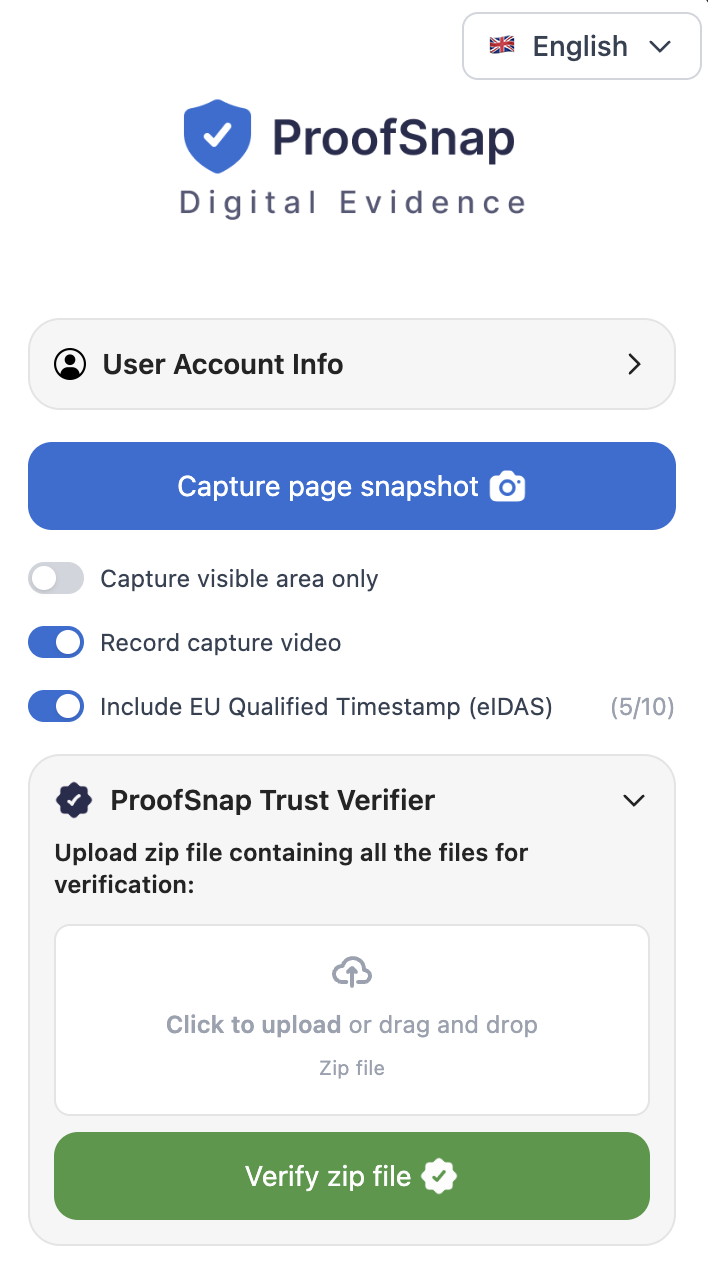
Open your work email, Slack, Teams or HR portal and click ProofSnap. The capture is sealed with a SHA-256 hash and a digital signature, and on every plan except Essential it gets a Bitcoin timestamp.
3. Hand it to your lawyer
Download the evidence package and take it to your employment lawyer, the EEOC or your state agency.
How the evidence disappears after a layoff
These things happen, and they happen fast.
-
Fired by email, locked out the same morning
A message from “leadership” arrives before work. By the time you read it, your laptop, VPN, Slack and badge may already be switched off.
Save the termination email and the reason given.
-
Performance reviews changed or gone
Your last reviews said you exceeded expectations. Now HR says your performance was below standard, and the old reviews are no longer where you could see them.
Capture every review while you can still open it.
-
Messages deleted from the workspace
Your manager’s comments in Slack, the HR conversation that gave the real reason: retention settings your employer controls can delete them automatically.
Save the messages that matter, with the thread around them.
-
Retaliation disguised as reorganization
You complained about discrimination. A few weeks later your role is “eliminated” in a reorganization, and you are the only one let go.
Save your complaint, your earlier reviews and the timing.
-
HR “lost” your complaint
You reported a problem and HR said they would look into it. After you are let go, HR says there is no record of it.
Save the complaint and every reply, or proof that none came.
-
Your job advertised again
Your position was “eliminated,” and then the same role appears on the careers page. A posting like that can be evidence that the stated reason was not the real one.
Capture the posting with its date and URL.
Can screenshots be used as evidence? Why a screenshot is not enough
You send a screenshot. Your employer’s lawyer says you edited it. In Rossbach v. Montefiore Med. Ctr., the Second Circuit affirmed dismissal after the district court found a text-message image had been fabricated.
Your screenshot
- No verifiable timestamp
- Easy to edit after the fact
- No URL or page record
- No chain of custody
ProofSnap evidence package
- SHA-256 hash and RSA-4096 signature: any later change is detectable
- Bitcoin timestamp on every plan except Essential
- The page URL, its HTML and the HTTP response headers
- A chain of custody log for the capture
- 11 to 15 files: screenshot, HTML, PDF report, metadata, logs and video when you record
- Provenance Certificate recording six checks of the capture conditions
Save these 10 things before your access ends
You don’t need all of them, but each one you save strengthens the record.
Your work record
- Every performance review in Workday, BambooHR or your HR portal
- Your offer letter or employment contract
- HR emails, and any complaint you made with the replies
- Slack or Teams messages with your manager
- Pay stubs, PTO balance and equity vesting
The layoff itself
- The termination notice and the reason given
- The severance agreement, before you sign
- A WARN notice, if you got one
- The team page or org chart, before and after
- The job posting, if your role is advertised again
Also save the employee handbook, and keep your own dated notes of conversations about your job, with the names of anyone who was there.
Already locked out?
You can still capture a lot from your own computer:
- the termination email in your personal inbox
- LinkedIn messages with your manager or colleagues
- the company careers page, if your role is advertised again
- public reviews by former colleagues describing the layoff
- the severance agreement, as soon as it arrives
$4.99 is 10 captures. Capture credits never expire.
Deadlines and the laws behind them
1. The EEOC charge: 180 or 300 days
For discrimination or retaliation under federal law, the EEOC says: “In general, you need to file a charge within 180 calendar days from the day the discrimination took place. The 180 calendar day filing deadline is extended to 300 calendar days if a state or local agency enforces a law that prohibits employment discrimination on the same basis.” Once the EEOC closes your charge and issues a Notice of Right to Sue, the clock is short: “Once you receive a Notice of Right to Sue, you must file your lawsuit within 90 days.” Sources: EEOC time limits, filing a lawsuit.
2. The WARN notice: 60 days
Under 29 U.S.C. § 2102, an employer with 100 or more full-time employees “shall not order a plant closing or mass layoff until the end of a 60-day period after the employer serves written notice of such an order.” A mass layoff means at least 50 employees at one site losing their jobs within 30 days, if they are at least 33 percent of the workforce there, or at least 500 employees regardless of percentage. Without the notice, the employer owes back pay and benefits for each day of the violation, up to 60 days. Several states have their own WARN laws. See the Department of Labor WARN guide.
3. The severance agreement: 21 or 45 days, then 7 to revoke
If you are 40 or older and the agreement waives age discrimination claims, the waiver counts as knowing and voluntary under 29 U.S.C. § 626(f) only if you get at least 21 days to consider it, or 45 days when it is offered to a group in a layoff, and at least 7 days to revoke it after signing. Save the agreement as offered, with the date you received it.
Before you sign the severance agreement
A severance package is usually offered in exchange for a release of your claims. A typical agreement includes a general release of claims, a non-disparagement clause, a confidentiality clause and sometimes language describing your departure as voluntary, which can matter for unemployment benefits.
Capture the agreement with ProofSnap before you sign. You then have a dated record of exactly what was offered, and the evidence you saved before the layoff is what gives your lawyer leverage to negotiate.
From $4.99, no subscription needed
Subscriptions include a 7-day trial; a card is required to start.
Laid off today? Start here
$4.99
one-time SnapPack: 10 captures, including the Bitcoin timestamp
No subscription. Capture credits never expire.
Start saving evidenceEssential, $8.99 per month
100 captures per month, the evidence package, video recording and the Provenance Certificate.
Professional, $16.99 per month
200 captures per month, plus the Bitcoin timestamp on every capture.
Enterprise, $28.99 per month
Unlimited captures and 10 eIDAS qualified timestamps per month.
Wrongful termination evidence: your questions
Employment rights resources
Each of these works best when you bring documented evidence.
EEOC
Equal Employment Opportunity Commission. File discrimination and retaliation charges. Free, no lawyer needed.
NELA: find an employment lawyer
National Employment Lawyers Association. A directory of plaintiff-side employment lawyers.
DOL: the WARN Act
The Department of Labor guide to WARN notices for plant closings and mass layoffs.
State labor agencies
Directory of state labor agencies. Many states have stronger protections than federal law.
Unemployment insurance
The Department of Labor guide to unemployment benefits. File soon after you lose your job.
EEOC filing guide
Step-by-step guide to filing an EEOC charge of discrimination online.
Expert guides on wrongful termination evidence
Wrongful Termination Checklist
FindLaw: what to document and preserve
Gathering Documentation for a Wrongful Termination Case
Nolo: gathering documentation
How to Gather Evidence for a Wrongful Termination Claim
Super Lawyers: gathering evidence
EEOC Enforcement Guidance on Retaliation
EEOC: official guidance on retaliation
Gathering Evidence When Locked Out of Work Email
Harris & Kaufman: when your employer revokes access
EEOC Time Limits for Filing a Charge
EEOC: the 180-day and 300-day deadlines
Related evidence guides for specific employment situations
Faculty facing a tenure denial or Title IX retaliation? See our dedicated tenure denial evidence guide.
In Australia? The deadline for an unfair dismissal application to the Fair Work Commission is far shorter. See unfair dismissal evidence in Australia.