Bali Airbnb & Villa Rental Rules for Foreigners 2026: How to Avoid Deportation, Fines & Demolition
Foreigners can legally rent out a villa on Airbnb in Bali in 2026, but only through a PT PMA company holding an NIB and a TDUP tourism license. Indonesia’s Ministry of Tourism began delisting 1,600 unlicensed accommodation businesses from Airbnb, Booking.com, Agoda, and Expedia on August 1, 2026. Nominee structures remain void under Indonesian law.
This guide covers what the delisting actually means, what a PT PMA costs in 2026, which licenses you need, what foreign villa owners pay in tax, and what happens to operators who stayed unlicensed: fines, deportation and, at Bingin Beach, demolition.
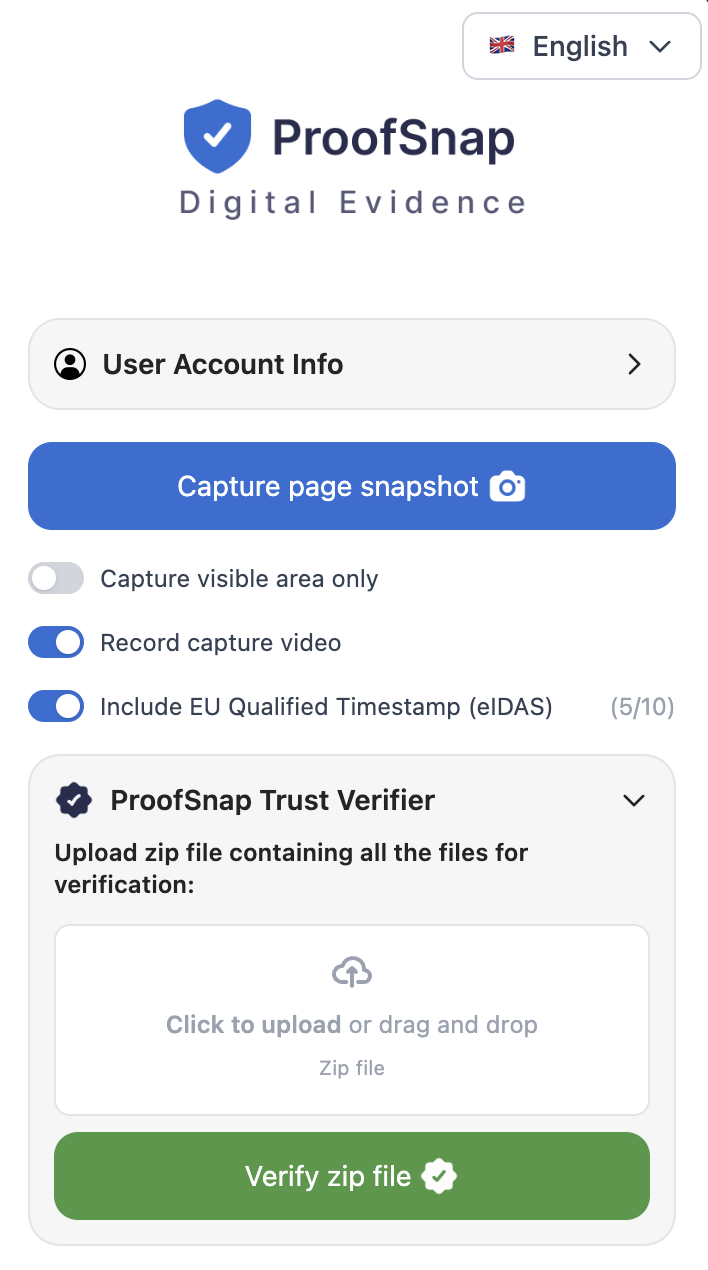
ProofSnap opens as a side panel next to the page you are looking at, so you never leave the Airbnb thread, the OSS dashboard or the Bapenda receipt you are capturing. There is one button that matters, Capture page snapshot, and the toggles under it decide what goes into the package:
- Evidence language: the PDF is generated in the language your court or platform reads, independent of the interface language.
- Capture visible area only: off by default, so you get the full scrolled page rather than one screen.
- Record capture video: a screen recording of the capture itself, useful when a guest disputes what the page showed.
- EU Qualified Timestamp (eIDAS): adds an RFC 3161 qualified timestamp from Disig a.s., a Qualified Trust Service Provider on the EU Trusted List, on top of the Bitcoin anchor.
The Trust Verifier at the bottom re-checks any package, including one somebody else sends you, and the File Certifier seals files you already have, such as a photo album export or a bank statement PDF. Every capture produces an evidence package of 11 to 15 files, depending on plan.
Pay per use
$4.99
SnapPack, one time. No subscription and no credit card, which is the difference from the trial. Enough captures to document a delisting notice, an OSS dashboard, a Bapenda receipt and a guest thread in one go.
Get a SnapPack for $4.99Ongoing
$8.99/month
For hosts capturing every month: guest threads, monthly PBJT receipts, OSS status and regulation pages. Starts with a 7-day free trial, which does require a credit card.
Start the 7-day free trialThe SnapPack is a one-time purchase with no card required. The 7-day free trial requires a credit card and can be cancelled anytime. Either way, ProofSnap is a deductible business expense for your PT PMA.
Bali attracted 6.3 million foreign visitors in 2024 and set another record in 2025 (2.64 million in the first five months alone, up 9% year-on-year). The island had an estimated ~38,000 active Airbnb listings and ~84,000 total vacation rentals across all platforms in 2025, at an average annual revenue of ~USD 20,000 per listing (Airbtics and Hospitable, 2025). The Indonesian government estimates that 60 to 80 percent of villa accommodation operates without proper licenses, and it is closing that gap fast.
The paradox: Bali’s short-term rental (STR) market is booming, but most operators are running illegally, and oversupply is already hurting margins. Booking values fell ~21.6% year-on-year in 2025 while supply grew ~18%, and average discounting jumped from ~15% in 2024 to ~19% in 2025 (Villa-Finder, 2025). The licensing crackdown that began removing unlicensed listings on August 1, 2026 is now forcing that cleanup. For compliant hosts, this means less competition and stronger pricing power. For unlicensed operators, it means deportation, fines, and delisting. Sources: Airbtics, Hospitable, Jakarta Globe, Villa-Finder.
QUICK FACTS Bali Villa Rental Regulations at a Glance (2026)
- Is Airbnb legal in Bali?
- Yes, with NIB + TDUP
- Can foreigners operate short-term rentals?
- Only via PT PMA
- OTA delisting started
- August 1, 2026
- PT PMA paid-up capital
- IDR 2.5B (~USD 157K)
- PT PMA investment value
- > IDR 10B per KBLI
- PT PMA setup cost
- USD 3,000-7,000
- Hotel tax (PBJT)
- 10% of gross rental
- Corporate tax (PT PMA)
- 22% on profits
- VAT on accommodation
- Generally exempt
- Fine (unlicensed operation)
- Up to IDR 50M (~USD 3,150)
- Deportation risk
- Yes + 1-6 year ban
- Property demolition risk
- Yes (zoning violations)
- Nominee structure
- Illegal, void by courts
- Guest immigration reporting
- Mandatory (APOA)
- APOA non-compliance penalty
- 3 months / IDR 25M
- Tourist levy
- IDR 150K per visitor
- Avg. annual revenue/listing
- ~USD 20,000
Data current as of . Sources: Ministry of Tourism, BKPM, OSS, Airbtics, PHRI Bali. Regulations change frequently, so verify with a local legal advisor.
6 Steps to Legal Villa Rental in Bali as a Foreigner
Full compliance timeline: 3-6 months. Scroll down for details on each step, or jump to the compliance checklist.
Four situations where screenshots fail and timestamped captures win
Guest writes “sorry about the table” in Airbnb messaging, then deletes it and files a counter-complaint. Without a timestamped capture of that conversation, the admission never existed. Claim denied.
Bapenda updates PBJT tax rules on its website without archiving the old version. You filed correctly under the old rules, but now you can’t prove what the rules said when you complied. A timestamped capture of the regulation page proves it.
Airbnb removes your listing, claiming you lack a license. You have one, but can you prove you had it on the date of delisting? A timestamped capture of your OSS registration page proves compliance at that point in time.
Your Indonesian nominee claims the property is theirs. Courts won’t enforce your side agreement, but timestamped captures of online communications, payment records, and management dashboards can support fraud claims in criminal proceedings.
All of these involve web pages that can change or disappear at any time: Airbnb conversations, government portals, tax dashboards, platform listings. Evidence documentation costs ~USD 10/month. One lost dispute can cost thousands. More on evidence documentation ↓
On this page
I. The Licensing Deadline and the August 2026 Delisting
Quick answer: The March 31, 2026 licensing deadline has passed. Only properties with status “Terdaftar dan Berizin” (Registered and Licensed) stay on OTA platforms, and on August 1, 2026 the Ministry of Tourism began removing roughly 1,600 identified unlicensed accommodation businesses from Airbnb, Booking.com, Agoda, and Expedia. Operators who complete licensing after a delisting can be reinstated.
The delisting is the end point of a two-year regulatory sequence, not a sudden decision. Here is how it unfolded:
- August 6, 2025: Ministry of Tourism Circular Letter No. 4 of 2025, calling on all accommodation operators to complete OSS licensing
- October 29, 2025: Coordination meeting with OTA representatives (Airbnb, Booking.com, Agoda, Expedia) on licensing verification
- December 8, 2025: Official government letter asking the platforms to direct merchants to register through OSS
- UU 18/2025: Third Amendment to Indonesia’s Tourism Law, introducing ecosystem-based tourism development and a mandated national tourism data system
- PP 28/2025: Risk-based licensing regulation working alongside UU 18/2025
- March 31, 2026: the original licensing deadline for OTA-listed accommodation, followed by a final grace period running into mid-2026
- June 2, 2026: the Ministry of Tourism sent the delisting lists to the platforms, asking them to warn affected hosts one month in advance
- August 1, 2026: delisting begins for the accommodation businesses still unlicensed at that date
“Jumlah dari semua proses yang kita telah lakukan dengan pengisian form, kami telah mendata sekitar 1.600 pelaku usaha yang tidak berizin, yang dipasarkan ke OTA.”
Tourism Minister Widiyanti Putri Wardhana, quoted by the Indonesian state news agency ANTARA on May 27, 2026. In English: across every registration form processed, the Ministry had recorded about 1,600 unlicensed businesses whose accommodation was marketed through OTAs. Those are the listings that started disappearing on August 1, 2026.
This is not just Bali. Enforcement has been active across Yogyakarta, West Nusa Tenggara, West Java, and Jakarta since March 2025. Bali is the highest-profile target, but the regulatory framework is national.
Is Airbnb banned in Bali? No. Despite Bali Governor Wayan Koster’s December 2025 announcement seeking to halt Airbnb operations, the central government’s Ministry of Tourism explicitly overruled the ban. Tourism Minister Widiyanti Wardhana confirmed that platforms remain “strategic partners.” The focus is on licensing enforcement, not platform bans.
II. PT PMA: The Only Legal Path for Foreign Villa Owners
Foreigners cannot directly own land in Indonesia (Agrarian Law, UUPA No. 5 of 1960) and cannot hold a Pondok Wisata homestay license personally (Permenpar 18/2016 Article 15(3)). The only legal vehicle is a PT PMA (Perseroan Terbatas Penanaman Modal Asing), a foreign-owned Indonesian limited liability company.
PT PMA Requirements (2026)
| Minimum paid-up capital | IDR 2.5 billion (~USD 157,500) |
| Minimum investment value (per KBLI, per location) | More than IDR 10 billion |
| Setup cost (registration, notary, legal) | USD 3,000-7,000 |
| Timeline (company formation) | 2-4 weeks |
| Full compliance (all permits) | 3-6 months |
| KBLI code | 55193 (Villa) or 55203 (new) |
| Property title type | HGB (Hak Guna Bangunan) |
| Corporate income tax | 22% on profits |
| Governing regulation | BKPM Regulation 5/2025 |
BKPM Regulation 5/2025, in force since October 2025, cut the minimum paid-up capital from IDR 10 billion to IDR 2.5 billion per company. It did not cut the investment requirement. As the law firm A&O Shearman summarizes the rule, “PMA companies must invest more than IDR10bn per five-digit KBLI per project location, excluding land and buildings,” and Article 27 requires the paid-up capital to stay in the company bank account for at least 12 months from placement, “except for asset purchases, building construction and company operations.” Sources: A&O Shearman, DDA Real Estate, RUMAVI.
Critical KBLI code warning: Do NOT use KBLI 68111 (property operation): it cannot be used by a PT PMA to justify short-term housing rentals. The correct codes are 55193 (Villa) under the current classification or 55203 (Villa Activity) under the new KBLI 2025/2026 introduced via Peraturan BPS No. 7 of 2025. Companies had roughly six months to migrate, and that window closed during 2026.
ALTERNATIVE Don’t Want to Set Up a PT PMA? Use a Licensed Management Company
Many foreign villa owners avoid the PT PMA route entirely by hiring an Indonesian-owned villa management company that operates under its own TDUP and NIB. The management company lists and operates the villa under its license, handles tax filings, APOA guest reporting, and platform management. You remain the property owner (via leasehold or Hak Pakai) and receive rental income minus management fees (typically 15-30% of gross revenue).
- No IDR 2.5B capital requirement
- No PT PMA setup cost or ongoing corporate tax filings
- Management company handles all licensing, taxes, and guest reporting
- Operational within weeks, not months
- You depend on the management company’s compliance
- Less control over pricing, guests, and operations
- Management fees eat into margins (15-30%)
- If the company loses its license, your listing goes down too
Due diligence checklist: Before signing, verify the management company’s NIB and TDUP on the OSS portal, check its tax registration with Bapenda, ask for references from other foreign owners, and get the contract reviewed by an Indonesian lawyer. This is the most common legal path for foreigners who own 1-3 villas and do not want the overhead of a PT PMA.
III. The Nominee Trap: Why It Will Cost You Everything
The single biggest risk for foreign villa owners in Bali is not the government: it is their own nominee.
Nominee arrangements (where a foreigner uses an Indonesian citizen’s name to hold property or business licenses) are explicitly illegal under Indonesian law. The Constitutional Court has ruled them void. Under Article 26(2) of the Agrarian Law, any indirect transfer of Hak Milik (freehold title) to a foreigner is null and void, and the land reverts to the state.
Real Case: Susi Johnston, Canggu, and What a Nominee Deal Really Costs
Susi Johnston, a US national, held a multimillion-dollar villa near Canggu through a nominee arrangement. Her Indonesian nominee signed over the assets he held, Johnston’s villa among them, to loan sharks to settle personal debts. The new “legal” owners took Johnston to court to evict her, and won.
She refused to leave. In the months and years that followed, men raided the villa, stole furniture, planted drugs in the house and threatened her with guns and machetes while she locked herself in the study. After her husband’s death she discovered that not one of her signed agreements had any legal standing under Indonesian law: the notary and lawyers who told her the nominee deal was binding were wrong.
How it ended: Johnston kept the villa, without paying a ransom, and the estranged nominee and the man who hired the gangsters both stood criminal trial. That is the best-case outcome of a nominee deal, and it took years of litigation and violence to reach. Johnston has since said she knows of roughly 100 comparable cases in which expatriates in Bali lost their property.
Sources: The CEO Magazine, Domain, Good Morning Bali.
Johnston’s case is not an isolated one. Research from the Indonesian Nominee Crisis Working Group (K3NI) estimated in 2025 that approximately 10,500 land plots worth USD 10.4 billion, 7,500 villas and 3,000 foreign property investments are illegal because they rest on nominee structures. Source: BaliVillaRealty.
What can happen:
- The Indonesian nominee can legally claim full ownership and walk away, and courts will not enforce the side agreement because it is based on an illegal arrangement
- The Indonesian Supreme Court has ruled that nominee transactions are “a form of legal smuggling” and void from the start
- Criminal prosecution for both parties (fraud, immigration violations, tax evasion)
- Business license revocation, asset confiscation, imprisonment, deportation, blacklisting
- DJP (tax directorate) is increasing audits of nominee-held assets in 2025-2026
If you are transitioning out of a nominee arrangement: Capture all communications with your nominee (WhatsApp Web conversations, email threads, bank transfer confirmations, property management dashboards) with timestamped evidence before informing the nominee of your plans. Once a nominee dispute begins, messages disappear and stories change. Timestamped web captures are the only evidence that cannot be retroactively denied.
Legal alternatives:
- PT PMA + HGB: Foreign company holds building rights. The legally correct structure for commercial villa rental.
- Hak Pakai (Right to Use): Available to foreigners for personal residential use, up to 80 years in total (PP No. 18/2021). Cannot be used for commercial rental.
- Hak Sewa (Leasehold): Long-term lease (typically 25-30 years with options to extend). Lower capital requirement but less control.
IV. What Licenses Do You Need to Rent a Villa in Bali?
At a minimum you need an NIB (business ID), a TDUP (tourism license), a PBG (building permit), an SLF (safety certificate) and an NPWPD (local tax registration). Indonesia uses a risk-based licensing system through the OSS (Online Single Submission) platform. Tourism accommodation is classified as medium-risk, meaning an NIB alone is not sufficient.
Required Documents for Legal STR Operation
Source: LegalIndonesia, Zenith Hospitality.
Pondok Wisata (homestay license): This license is available to Indonesian citizens only (Permenpar 18/2016). If you are a foreigner in a leasehold situation, the Indonesian landlord must hold the Pondok Wisata license. For foreign-owned villas, you need a PT PMA plus a villa license (KBLI 55193 or 55203). Source: BaliVillaRealty.
V. Can Foreigners Own Property in Bali? HGB vs Hak Pakai vs Leasehold
| Title Type | Duration | Who Can Hold | Commercial Rental |
|---|---|---|---|
| HGB (via PT PMA) | 30 years, renewable to 80 | Indonesian companies (incl. PT PMA) | Yes |
| Hak Pakai | 30 years, renewable to 80 | Foreigners with KITAS/KITAP | No (personal use only) |
| Hak Sewa (Leasehold) | Negotiated (typically 25-30 years) | Anyone (contractual) | Depends on contract |
| Hak Milik (freehold) | Perpetual | Indonesian citizens only | Yes (but NOT for foreigners) |
Key takeaway: If you want to commercially rent a villa in Bali as a foreigner, you need HGB through a PT PMA. Hak Pakai is for your personal residence only. Leasehold may work but limits your control and exit options. For a comparison with other markets, see our guides on Dubai STR rules, France (Loi Le Meur), and Spain.
VI. What Taxes Do Foreign Villa Owners Pay in Bali?
| Tax | Rate | Collected By | Notes |
|---|---|---|---|
| Hotel Tax (PBJT) | 10% | Local Bapenda | Self-reported. Airbnb does NOT collect this. |
| Corporate Income Tax | 22% | National DJP | On PT PMA profits. A 0.5% final tax option is available to small businesses with revenue below IDR 4.8 billion. |
| Land Lease Withholding | 10% | Tenant withholds | PPh Final Article 4(2) on gross lease value. |
| VAT (PPN) | Exempt | N/A | Standard villa STRs are generally exempt from national VAT. Confirmed by Airbnb’s own 2025 Indonesia Tax Guide. |
| Bali Tourist Levy | IDR 150K/visitor | Paid by tourist | Since February 2024. Via the Love Bali portal. |
Critical fact: Airbnb does NOT collect or remit hotel tax (PBJT) in Indonesia. You must register with your local Bapenda, report revenue monthly, and pay independently. Spot-checks in May 2025 found villa owners who had never obtained tax IDs. Tax evasion penalties: 100-400% of unpaid tax plus up to 6 years imprisonment for intentional evasion. Source: BaliVisa.co.
VII. Do I Need to Register Foreign Guests with Immigration?
Yes. All accommodation providers must report foreign guests at check-in and check-out via the APOA system. Failing to supply that guest data carries up to 3 months detention or a fine up to IDR 25 million. Under the Immigration Law as amended by Law No. 63 of 2024, Articles 72(1) and 72(2), the obligation applies to hotels, villas, homestays, and guesthouses without exception. The Directorate General of Immigration states the penalty as a maximum of three months detention or a fine of up to IDR 25 million.
- Report at both check-in AND check-out
- Upload a photo of the guest’s passport main page
- System generates a “Foreign Guest Reporting Receipt” as proof
- Applies to ALL accommodation types: hotels, villas, homestays, guesthouses
Two different penalties, often confused:
- Article 72, failing to supply guest data on request: up to 3 months detention or a fine up to IDR 25 million (~USD 1,575)
- Articles 78 and 123, overstaying or using false information to obtain a visa or stay permit: up to 5 years imprisonment and fines up to IDR 500 million (~USD 31,500)
- Deportation and blacklisting for foreign operators, on top of either
The IDR 500 million figure circulates widely as “the APOA penalty”. It is not. It belongs to the immigration offences in Articles 78 and 123, which is what catches the foreign owner personally, not the reporting duty in Article 72.
As of March 2025, only 78,077 foreign guests were registered in APOA across all of Indonesia, a figure far below actual tourist arrivals and a sign of widespread non-compliance. During Operation Wira Waspada (May 14 to 16, 2025), officers apprehended 170 foreign nationals across 28 locations. Source: The Bali Sun.
VIII. Penalties: Fines, Deportation, Demolition
| Violation | Penalty | Legal Basis |
|---|---|---|
| Operating without a license | Up to IDR 50M (~USD 3,150) + closure | PP 5/2021 |
| Foreign business on tourist visa | Deportation + 1-6 year ban | Immigration Law 6/2011 |
| APOA guest data not supplied | 3 months / IDR 25M | Immigration Law Art. 72 |
| Overstay or false visa information | 5 years / IDR 500M | Immigration Law Art. 78, 123 |
| Building in protected zone | Demolition | Spatial Planning Regulation |
| Nominee structure | Contract void + asset seizure | UUPA Art. 26(2), Investment Law |
| Tax evasion (intentional) | 100-400% penalty + 6 years | KUP (General Tax Provisions) |
| Visa overstay (>60 days) | IDR 1M/day + deportation | Immigration Law |
IX. Recent Enforcement: The Crackdown Is Real
Bingin Beach Demolition (July 21, 2025)
The most dramatic enforcement action in Bali’s history: 48 illegal structures demolished along the Bingin Beach cliffs, including villas, restaurants, homestays, and tourist facilities. More than 500 government officials, police officers, and civil service personnel were deployed. Governor Wayan Koster personally oversaw the operation.
All structures were built on state-owned coastal land classified as protected green zones, violating Perda Tata Ruang Provinsi Bali 2023. Many had been operating for decades. On July 22, 2025, the community filed a lawsuit at Pengadilan Tata Usaha Negara Denpasar. The site then lay in rubble for close to a year: in May 2026 the Badung Regency government published a staged redevelopment plan starting with new beach access, a wider cliffside staircase and public toilets. Sources: ABC News, Bukit Vista, Suasa Real Estate.
Ongoing Enforcement: Named Cases
Felix Demin (Russian): 20 Villa Blocks Sealed in Ubud
On June 23, 2025, Satpol PP sealed 20 blocks of the Green Flow Villa complex on Jalan Raya Sayan, Ubud, owned by Russian citizen Felix Demin (34) through PT Bali Investments. Three violations: buildings on LP2B protected agricultural land, a breach of the 25-meter setback from Pura Masceti Sayan, and construction without permits. Despite warnings since 2024, Demin continued building. He now faces criminal investigation by Bali Police’s Criminal Investigation Division.
Source: Detik Bali, Kilas Bali.
Canggu Villas Sealed for River Encroachment (October 2025)
On October 28, 2025, Satpol PP Badung sealed Villa Trinity, Villa Mango, and two other accommodations in Padang Linjong, Canggu, after BPN measurements confirmed they encroached up to 2.5 hectares into river buffer zones. Officers arrived with marker stakes and cordon tape and marked the violation points inside the villa grounds. All the properties were ordered to demolish the structures themselves.
Source: Detik Bali, Warta Bali.
Specific Deportation Cases (2025)
Indonesia’s Directorate General of Immigration recorded 2,669 deportations nationwide between January and July 2025, according to the state news agency ANTARA on August 21, 2025, with overstaying, working on a tourist visa and misusing an investor visa among the stated reasons. Specific Bali cases involving villa and STR operations:
- Indian national: detained for renting Bali villas to foreigners through social media without proper licensing
- Swiss couple: arrived on an investor KITAS and were found providing unauthorized educational services in a villa, in breach of their KITAS terms
- Ukrainian citizen in Ubud: apprehended while instructing employees in a store without work authorization
- Canggu raid: 15 locations searched (beauty salons, tattoo studios, car rentals), 10 foreigners detained, 6 found guilty of visa offenses
Badung Bapenda Tax Crackdown (May 2025)
Ni Putu Sukarini, Head of the Revenue Division for Badung Regency, deployed 31 field officers in 8 groups to identify unregistered villas. Spot-checks in North Kuta, Mengwi, and South Kuta found villa owners who had never obtained a tax ID (NPWPD). Badung had 4,218 registered villas as of May 2025, but officials estimated the real number of actively rented villas at 4 to 5 times higher (Bali Discovery, 2025). Sukarini stated: “There is no reason not to register. Even though a business is not licensed, if the business meets the elements of the subject and object of tax, we can still collect taxes.” Bapenda is now using data from online booking platforms to identify unregistered operators.
Source: Bali Discovery.
When Bapenda cross-references platform data with tax records, can you prove you paid? If your PBJT payment was made through an online portal, a timestamped capture of the confirmation page is proof that survives even if the portal resets or your login history expires. One capture per tax payment: that is all it takes.
Additional sources: The Bali Sun, Asia Lifestyle Magazine.
The Hotel Industry Is Pushing for More
PHRI Bali (Indonesian Hotel and Restaurant Association) is the strongest voice demanding crackdowns:
- PHRI counted 378 registered accommodation units in 2025 against an estimated 16,000+ units marketed online (Jakarta Globe, 2025)
- Hotel occupancy fell ~8% in 2025 on unfair competition from unlicensed villas (PHRI Bali, 2025)
- BVRMA, the Bali Villa Rental and Management Association, reported occupancy for licensed villas below 30% in 2025
- Unlicensed villas charged as little as IDR 5 million a night in 2025 against IDR 8 to 9 million at compliant properties, because they avoid licensing costs and taxes
X. Market Data: Revenue, Occupancy, and Best Areas
Bali STR Market Overview, 2025 to 2026 (Airbtics, Hospitable and AirDNA)
Sources: Airbtics, Hospitable, AirDNA.
What Are the Best Areas for Villa Rental in Bali?
| Area | Market | Enforcement Risk | Notes |
|---|---|---|---|
| Seminyak | Premium, established | HIGH | Active inspections, highest villa density |
| Canggu | Digital nomad hub, fast-growing | HIGH | Primary crackdown target, zoning issues |
| Ubud | Cultural tourism, wellness | MEDIUM-HIGH | Rice terrace zoning restrictions |
| Uluwatu | Surf, luxury | MEDIUM-HIGH | Clifftop zoning enforcement (post-Bingin) |
| Sanur | Family-oriented, quieter | MEDIUM | More established, fewer zoning issues |
| Nusa Dua | Resort area, luxury | LOW | Designated tourism zone, easier compliance |
Oversupply warning: Supply grew ~18% year-on-year while booking values fell ~21.6%. Average discounting increased from ~15% (2024) to ~19% (2025). The delisting that started on August 1, 2026 is now removing unlicensed supply, which benefits the operators who did license.
XI. How Do You Sell a Bali Villa as a Foreigner?
You sell the PT PMA company that owns the villa, not the property directly. The most common method is a share transfer (USD 3,000-5,000 in legal fees, 4-8 weeks). Capital gains tax is a flat 2.5% on the gross transfer value. Every investor needs an exit plan: selling a foreign-owned villa in Bali is more complex than it is in Western markets because you are transferring (or dissolving) the PT PMA that holds the HGB title.
Three Exit Options
The buyer acquires 100% of shares in your PT PMA, which already holds the HGB title, NIB, TDUP, and all permits. Fastest route, no title transfer needed. Cost: USD 3,000-5,000 in legal fees. Timeline: 4-8 weeks. The buyer inherits all assets, contracts, and liabilities of the company.
The buyer has their own PT PMA and you transfer the HGB title via a notarial deed at the local BPN (Land Office). Slower and more expensive (BPHTB transfer tax of 5% applies). Timeline: 2-4 months. Required when the buyer wants a clean company without inheriting liabilities.
If you operate on a leasehold (Hak Sewa), you can assign the remaining lease term to the buyer, provided the lease agreement permits assignment. No PT PMA transfer needed, but the buyer still needs their own licensing structure.
Capital gains: Indonesia imposes a flat 2.5% tax on gross property transfer value (PPh Final Article 4(2)) when selling property or shares in a property-holding company. This is lower than capital gains rates in most Western countries, making Bali exits relatively tax-efficient. Consult a local tax advisor for your specific structure.
XII. Can I Use a Digital Nomad Visa to Run an Airbnb in Bali?
No. The Remote Worker Visa (E33G) only permits work for foreign employers. You need a KITAS sponsored by your PT PMA to legally operate a villa rental. Bali has adopted a “zero-tolerance approach” to visa abuse, and Indonesian immigration deported 2,669 foreigners nationwide in the first seven months of 2025 alone (ANTARA, August 21, 2025). You cannot operate a villa rental business on:
- Tourist visa / Visa on Arrival: No business activity of any kind
- Social-cultural visa (B211): No commercial activity
- Remote Worker Visa (E33G): valid only for work performed for employers abroad, so you cannot earn from Indonesian sources
- Pre-investment visa: Being actively targeted for abuse
You need: A KITAS (Temporary Stay Permit) sponsored by your PT PMA. This gives you the legal authority to manage your villa rental business. Cost: USD 1,500-3,000/year. Deportations for running a business on the wrong visa are routine, not theoretical.
XIII. Complete Compliance Checklist with Costs
Full Compliance Cost Breakdown (First Year)
The IDR 2.5 billion (~USD 157,500) minimum paid-up capital is deposited into the PT PMA’s bank account and can be used for business operations (property acquisition, renovations, etc.). It is not a “fee” that disappears.
Real-World Timeline: How Long It Actually Takes
Based on reported timelines from foreign villa owners who went through the process in late 2025:
Common surprise: The building inspection (PBG/SLF) is where most owners get stuck. If your villa was built without commercial permits or needs safety upgrades (fire extinguishers, emergency exits, pool fencing), add 4-8 weeks. Budget an extra USD 2,000-5,000 for renovation requirements discovered during inspection.
Pro tip: Budget ~USD 10/month for evidence documentation, or start with a one-time $4.99 SnapPack if you only need to document the current round of licensing. Tools like ProofSnap create blockchain-timestamped captures of Airbnb conversations, OSS dashboards, tax receipts and regulation pages: tamper-proof records of web pages that can disappear at any time. A rounding error on your compliance budget, but it can save you thousands when a guest deletes a damage admission or a regulation page gets overwritten.
XIV. Evidence Documentation: Why It Matters More in Bali
In most STR markets, documentation is a nice-to-have. In Bali, it is the difference between winning and losing, because the evidence you need lives on web pages that can disappear at any time. Guest messages get deleted. Indonesian government websites get overwritten without archives. Tax payment portals keep no history. Airbnb changes its policies and the old version is gone. And you cannot rely on the Wayback Machine: Indonesia blocked archive.org in May 2025 and only lifted the block after content was removed. When a dispute arrives weeks later, the web page that would have proved your case no longer exists.
Why a Screenshot Is Not Evidence (full guide)
Courts have repeatedly ruled that screenshots without metadata and chain of custody are inadmissible. Three landmark cases:
- Moroccanoil v. Marc Anthony Cosmetics: Facebook screenshots rejected because “there was no way to prove that the screenshots were an exact copy of what existed on the live site”
- United States v. Vayner: a social media page printout was rejected on appeal: “the mere fact that a page existed on the Internet does not permit a reasonable conclusion that this page was created by the defendant”
- Edwards v. Junior State of America Foundation: court ruled screenshots “could not show that the messages were authentic.” The court stated: “Only native files can ensure authenticity.”
What courts DO accept: digital evidence with verifiable metadata, cryptographic signatures proving integrity, and documented chain of custody. This is exactly what ProofSnap generates: a complete evidence package with SHA-256 hash, RSA-4096 digital signature, full page HTML, metadata, and a Bitcoin blockchain timestamp proving when the capture was made. Source: Pagefreezer.
Real Case: Guest Accused Host of Using AI to Fake a $16,000 Damage Claim
What happened: An Airbnb Superhost in Manhattan submitted $16,000 (£12,000) in damage claims in 2025 against a long-term guest: cracked coffee table, stained mattress, broken TVs, damaged appliances. Airbnb initially sided with the host and demanded £5,314 from the guest.
What went wrong: The guest noticed that two photos of the same coffee table showed similar but not identical cracks, inconsistencies she argued were evidence of AI manipulation. She contacted The Guardian. Five days later, Airbnb reversed the decision entirely, refunded the guest £4,269, removed the host’s negative review, and issued a public apology.
The lesson: The host may have been telling the truth, but had no way to prove the photos were authentic. No metadata, no timestamps, no chain of custody. A ProofSnap capture of the damage would have included a SHA-256 hash of the exact image, a digital signature, and a blockchain timestamp: cryptographic proof that the photo was not altered after capture. Unprovable authenticity cost this host $16,000 and their Superhost status.
Source: Meyka, PetaPixel, Fox Business.
The AirCover Reality in Indonesia
Airbnb’s AirCover for Hosts provides up to USD 3 million in damage protection, in theory. In practice, claims in Bali face unique challenges:
- 14-day filing deadline: you must submit evidence before the next guest checks in or within 14 days of check-out, whichever comes first
- Guests delete messages: a guest admits damage in Airbnb chat, then deletes the message and files a counter-complaint. Without a captured copy, the admission never existed
- Burden of proof is on you: you must prove damage was not pre-existing. Airbnb defaults to denying claims without strong evidence
- Replacement costs are local: Airbnb may reimburse at Indonesian market rates, not import costs for Western furniture
- No coverage for unlicensed properties: if Airbnb discovers you operate without proper NIB/TDUP, AirCover claims may be denied entirely
- New chargeback liability (September 2025): under Airbnb’s updated payment terms, guests can file a chargeback months after a completed stay. Airbnb withdraws the disputed amount from your future payouts immediately. You need evidence from months ago; see our chargeback evidence guide
The fix: Capture Airbnb conversations immediately when a guest mentions damage, before messages can be deleted or edited. Capture your Airbnb listing page showing your license number. Capture platform policy pages so you know what terms applied on the date of the dispute. These are all web pages, and a browser-based evidence tool captures them in one click with tamper-proof timestamps.
Real Case: Airbnb Message Thread Disappeared During Guest Stay
What happened: An Airbnb host accepted a 9-day booking. During the stay, the guest’s toddler damaged property (cracked glass tabletop, yanked-out ceiling fan switch requiring rewiring, missing items, bathroom damage from hair dye). The guest initially reported the damage and paid USD 50 for the tabletop. But then the host discovered their entire Airbnb message thread had vanished while the guest was still in the property. The inbox showed nothing. The conversation link returned “PAGE NOT FOUND.”
Outcome: Without the message thread, the host could not file a proper damage claim, could not leave a review, and had no evidence of the guest’s initial damage admission. Airbnb cited an unspecified “issue” with the account and refused to explain. The host lost the remaining damages and all recourse.
How timestamped captures would have helped: If the host had captured the Airbnb conversation (including the guest’s damage admission) the moment it happened, the message thread’s disappearance would have been irrelevant. The blockchain-timestamped capture proves what the conversation said before it vanished.
Source: Airbnb Hosts Forum.
What to Capture (and When)
Every item below is a web page you open in your browser, and each takes one click to capture with full metadata and a blockchain timestamp.
- Airbnb guest messages: especially damage admissions, complaints, special requests (guests can delete messages)
- Guest reviews with false claims (before platform moderation changes them)
- APOA guest registration receipt after submitting
- Bapenda PBJT tax payment confirmation page
- OSS dashboard showing that your NIB and TDUP are active
- Your Airbnb listing page showing your license number
- Bapenda/government regulation pages (sites get overwritten without archives)
- Platform policy pages (AirCover terms on specific dates)
- KBLI code updates, tax rate changes on OSS
- Full Airbnb conversation thread (capture it before the guest deletes it)
- Management company dashboards and communications
- Competitor unlicensed listings (if reporting to authorities)
- Nominee communications via email/messaging platforms
What about physical villa condition photos? ProofSnap captures web pages. For before/after villa photos, the workflow is: take photos with your phone, upload them to a shared album (Google Photos, Google Drive), then open that album in Chrome and capture it with ProofSnap. This timestamps the entire photo album page with blockchain proof. It is an extra step compared to capturing a web page directly, but it gives those photos the same tamper-proof timestamp that makes web captures legally defensible.
A Screenshot Is Not Evidence. ProofSnap Is.
Courts reject screenshots without metadata (Moroccanoil, Vayner, Edwards). Airbnb rejects damage claims when guests accuse photos of being AI-altered ($16K case). A screenshot in your folder proves nothing. ProofSnap produces a forensic evidence package (SHA-256 hash, RSA-4096 digital signature, full page HTML, complete metadata, chain of custody, and a Bitcoin blockchain timestamp) that proves what existed, when, and that it was not altered.
Every ProofSnap capture produces an evidence package of 11 to 15 files, depending on plan: a SHA-256 hash of every artifact, an RSA-4096 signed manifest, the full page HTML, an OpenTimestamps anchor in the Bitcoin blockchain, an optional eIDAS qualified timestamp issued by Disig a.s., a Qualified Trust Service Provider on the EU Trusted List, and an ISO/IEC 27037 style chain of custody. One click. Any web page. Airbnb conversations, OSS dashboards, Bapenda tax receipts, regulation pages, competitor listings. Download a sample evidence package to see exactly what courts and platforms receive, or jump back to the panel and the pricing at the top of this guide.
The SnapPack is a one-time purchase with no card required. The 7-day free trial requires a credit card and can be cancelled anytime. Either way, ProofSnap is a deductible business expense for your PT PMA.
XV. Bali vs Other STR Markets: Comparison
| Rule | Bali | Dubai | France | Spain |
|---|---|---|---|---|
| License required? | Yes (NIB + TDUP) | Yes (DET permit) | Yes (registration) | Yes (NRU) |
| Foreigners can operate? | Only via PT PMA | Yes (directly) | Yes (directly) | Yes (directly) |
| Max fine | IDR 50M + deportation | AED 100K (~$27K) | €100K | €600K |
| Deportation risk? | Yes | No | No | No |
| Demolition risk? | Yes | No | No | No |
| Tax on rental | ~30-40% effective | ~19% | ~30% | ~24% |
| Night cap? | No | No | 90 days | Varies by region |
Key insight: Bali is the only major STR market where foreign operators face deportation and property demolition as enforcement tools. The fines themselves are relatively low (IDR 50M, about USD 3,150), but the personal consequences are far more severe than in any European or Middle Eastern market.
XVI. Bali Airbnb Rules 2026: Frequently Asked Questions
The thirteen questions below are the ones foreign villa owners in Bali ask most often, each answered in a single self-contained paragraph.
Jump to a question
Can foreigners legally rent out a villa on Airbnb in Bali?
Yes, but only through a PT PMA (a foreign-owned Indonesian company) holding a valid NIB (Business Identification Number) and a TDUP tourism license registered through the OSS system. Foreigners cannot hold a Pondok Wisata homestay license personally. Operating on a tourist visa or through a nominee structure is illegal and can lead to deportation, fines up to IDR 50 million and property seizure.
What happened to the March 31, 2026 Bali Airbnb licensing deadline?
It passed, and enforcement followed. The Ministry of Tourism set March 31, 2026 as the date by which OTA-listed accommodation had to show status “Terdaftar dan Berizin” (Registered and Licensed), then allowed a final grace period into mid-2026. From August 1, 2026 the Ministry began removing roughly 1,600 identified unlicensed accommodation businesses from Airbnb, Booking.com, Agoda, and Expedia. Operators that obtain a license afterwards can be reinstated.
My Bali villa listing was delisted. Can I get it back?
Yes. The Ministry of Tourism has stated that delisted accommodation businesses may be reinstated on the platforms once they complete licensing. In practice that means registering the operating entity in OSS, obtaining an NIB under KBLI 55193 or 55203, securing the TDUP tourism license, and having the platform re-verify the listing against the Ministry register.
What are the penalties for operating an unlicensed villa in Bali?
Administrative fines up to IDR 50 million (about USD 3,150), deportation with a 1- to 6-year re-entry blacklist for foreigners, demolition of buildings that violate zoning (48 structures were demolished at Bingin Beach in July 2025), business license revocation, and tax penalties of 100 to 400 percent of unpaid tax. Intentional tax evasion carries up to 6 years imprisonment.
What is a PT PMA and why do I need one for a Bali villa rental?
A PT PMA (Perseroan Terbatas Penanaman Modal Asing) is a foreign-owned Indonesian limited liability company, and it is the only legal vehicle for a foreigner to operate a short-term rental business in Bali. Under BKPM Regulation 5/2025 the minimum paid-up capital is IDR 2.5 billion (about USD 157,500), while the declared investment value must still exceed IDR 10 billion per five-digit KBLI per project location, excluding land and buildings. Setup costs run USD 3,000 to 7,000.
Is using a nominee structure legal in Bali?
No. Nominee arrangements are explicitly illegal under Indonesian law and the Constitutional Court has ruled them void. Under Article 26(2) of the Agrarian Law (UUPA No. 5 of 1960) any indirect transfer of Hak Milik freehold title to a foreigner is null and void and the land reverts to the state. The Indonesian nominee can legally claim full ownership, and penalties include license revocation, asset confiscation, imprisonment, deportation and blacklisting.
What taxes do foreign villa owners pay in Bali?
Hotel tax (PBJT) of 10 percent of gross rental income, self-reported to the local Bapenda. Corporate income tax of 22 percent on PT PMA profits. Land lease withholding tax of 10 percent of gross lease value. VAT is generally exempt for standard villa accommodation. Airbnb does not collect or remit the Indonesian hotel tax, so operators must register and pay it independently. The effective burden reaches 30 to 40 percent of gross rental income.
Do I need to register foreign guests with immigration in Bali?
Yes. Under Article 72 of the Immigration Law as amended by Law No. 63 of 2024, the owner or manager of any accommodation must supply data on foreign guests to immigration officials, and the Directorate General of Immigration requires this through the APOA system (Aplikasi Pengawasan Orang Asing) at check-in and at check-out, including a photo of the guest passport page. Failing to supply that data carries up to 3 months detention or a fine up to IDR 25 million. Separately, Articles 78 and 123 punish overstaying and false information for visas or stay permits with up to 5 years imprisonment and fines up to IDR 500 million, plus deportation and blacklisting.
What happened at Bingin Beach in July 2025?
On July 21, 2025 the Bali provincial government demolished 48 illegal structures along the Bingin Beach cliffs, including villas, restaurants, and tourist facilities, with more than 500 officials, police and civil service units deployed. All of them stood on state-owned coastal land classified as protected green zone, in breach of the 2023 Bali spatial planning regulation. Governor Wayan Koster oversaw the operation personally.
What KBLI code do I need for a villa rental in Bali?
Villa accommodation uses KBLI 55193 (Villa) under the outgoing classification, or 55203 (Villa Activity) under KBLI 2025/2026 introduced by Peraturan BPS No. 7 of 2025. Do not use KBLI 68111 (property operation): a PT PMA cannot rely on it to justify short-term housing rental. Companies had roughly six months to migrate, and that window closed during 2026.
How much does it cost to set up a legal villa rental business in Bali as a foreigner?
Budget USD 3,000 to 7,000 for PT PMA formation, USD 1,500 to 3,000 a year for a KITAS stay permit, USD 1,000 to 3,000 for the TDUP and related permits, and USD 200 to 500 a month for an accountant. First-year total is roughly USD 8,000 to 15,000, on top of the IDR 2.5 billion (about USD 157,500) paid-up capital and the IDR 10 billion declared investment value.
Can I use a digital nomad visa to run an Airbnb in Bali?
No. The Remote Worker Visa (E33G) permits work for employers abroad only, and it does not allow income from Indonesian sources, which includes villa rental income. Running a villa rental on a tourist visa, a social-cultural visa or a digital nomad visa is illegal and led to deportations through 2025 and 2026. You need a KITAS sponsored by your own PT PMA.
Is Airbnb banned in Bali?
No. Bali Governor Wayan Koster announced plans to halt Airbnb operations in December 2025, but the central Ministry of Tourism overruled a ban and Tourism Minister Widiyanti Wardhana confirmed the platforms remain strategic partners. What the government enforces instead is licensing: from August 1, 2026 only properties with a verified NIB and tourism permit stay visible on the platforms.
- PT PMA
- Foreign-owned Indonesian company, the only legal vehicle for foreigners to operate villa rentals
- NIB
- Business Identification Number via OSS, the foundational license required before all others
- TDUP
- Tourism Business Registration, required for all tourism accommodation
- OSS
- Online Single Submission, the centralized licensing platform managed by BKPM
- KBLI
- Industrial classification code: villa = 55193 (or 55203 under KBLI 2025/2026)
- HGB
- Building Rights Title: 30 years, renewable to 80. The property title PT PMA companies use
- Hak Pakai
- Right to Use: personal residence only, not commercial rental
- PBJT
- Hotel tax (10% of gross rental), self-reported to Bapenda. Airbnb does NOT collect
- APOA
- Foreigner Supervision App, mandatory guest reporting at check-in and check-out
- KITAS
- Temporary Stay Permit: required for foreigners doing business, sponsored by PT PMA
- Pondok Wisata
- Homestay license (1-5 rooms), Indonesian citizens only. Foreigners cannot hold
- Nominee
- Illegal arrangement using an Indonesian’s name to hold property, void by courts
Key Takeaways
- 1. The deadline is behind you; the delisting is not. The Ministry of Tourism started removing about 1,600 unlicensed accommodation businesses from the platforms on August 1, 2026, and it says delisted operators can be reinstated once they license. Get the NIB and TDUP now.
- 2. PT PMA is the only legal path for foreigners. Nominee structures are illegal and the courts treat them as void from the start. Minimum paid-up capital is IDR 2.5 billion, and the declared investment value must still exceed IDR 10 billion per KBLI per location.
- 3. The crackdown is real. 48 buildings demolished at Bingin Beach. 40+ villas under enforcement in Canggu/Uluwatu/Ubud. Deportations are happening.
- 4. Airbnb does NOT collect your hotel tax. You must register with Bapenda and pay 10% PBJT independently. Tax evasion penalty: up to 400% + prison.
- 5. Guest immigration reporting (APOA) is mandatory. Failing to supply guest data costs up to 3 months detention or IDR 25 million under Article 72, and the separate offences in Articles 78 and 123 reach 5 years and IDR 500 million.
- 6. Licensed operators win. The crackdown is already removing unlicensed supply, which strengthens pricing power for compliant hosts.
Bottom Line
Bali’s villa rental market is past the turning point. Roughly 84,000 vacation rentals are marketed across the platforms, the government estimates 60 to 80 percent of villa accommodation has operated without proper licenses, and on August 1, 2026 it started deleting the listings it had already identified. For foreign villa owners the choice is binary: get compliant or get out.
You have two legal paths: set up a PT PMA (USD 8,000-15,000 first year + IDR 2.5B capital, 3-6 months) or hire a licensed Indonesian management company (15-30% of revenue, operational within weeks). Both are expensive. But the alternative (deportation, asset seizure, property demolition) is far more expensive.
Capture everything that can disappear. Guest messages admitting damage. Government regulation pages before they change. Tax payment confirmations. Your OSS dashboard showing active licenses. In Bali, the web page that would prove your case may not exist when you need it. One deleted message, one overwritten regulation, and you are back to zero.
Related Articles
Dubai Airbnb Rules 2026: Avoid AED 100,000 Fines
DET Holiday Home permit, Tourism Dirham, 3-hour guest check-in, damage claims.
FranceFrance Airbnb Rules for Expats & Foreigners 2026
Loi Le Meur, 90-day limit, DPE energy rating, fines up to €100,000.
ItalyItaly STR Rules for Foreign Owners 2026
CIN code mandatory, financial police raids, safety compliance.
GreeceGreece Short-Term Rental & Airbnb Regulations 2026
AMA registration, climate levy, Athens registration freeze.
SpainSpain Short-Term Rental Regulations 2026
NRU mandatory registration, HOA approval, fines up to €600,000.
ThailandIs Airbnb Legal in Thailand? 2026 Rules and Fines
Hotel Act 30-day rule, condo bans, TM30 reporting, fines from THB 20,000.
EvidenceAre Screenshots Admissible in Court?
Courts reject screenshots without metadata and chain of custody. What you need instead.