For Insurance SIU · Fraud Ops · Claims Adjusters
Capture claimant URLs. Lock in AI-generation signals.
OSINT capture · C2PA · SynthID · EXIF · Court-admissible ZIP · No image upload
When SIU goes outside the FNOL portal — claimant social, salvage-auction listings, dealer pages, contractor sites, repair-shop photos — ProofSnap captures the page as a forensic ZIP and reads C2PA Content Credentials, Google SynthID pointers, and EXIF / XMP signatures from every image on that page, locally inside Chrome and Edge. No image upload to ProofSnap or any vendor. The ZIP attaches to the claim file with chain of custody and travels through any downstream SIU referral, NICB submission, or DOI report. From $4.99 SnapPack to $18.99 / seat / month Company Plan for SIU teams. 7-day trial.
What is AI claim photo fraud, and what does ProofSnap actually do?
AI claim photo fraud is the use of generative AI to fabricate or alter the visual evidence a claimant submits to support an insurance claim — most commonly inpainted collision damage on auto claims (sourcing reference photos from salvage auctions, then inserting plates and damage), AI-cleaned water or fire damage on luxury items, AI-generated injury photographs, synthetic medical records or prescription pads, and AI-edited contractor estimates or surveyor reports. Per Verisk's 2026 State of Insurance Fraud Study, 99% of insurers have already encountered manipulated or AI-altered documentation in the claims process.
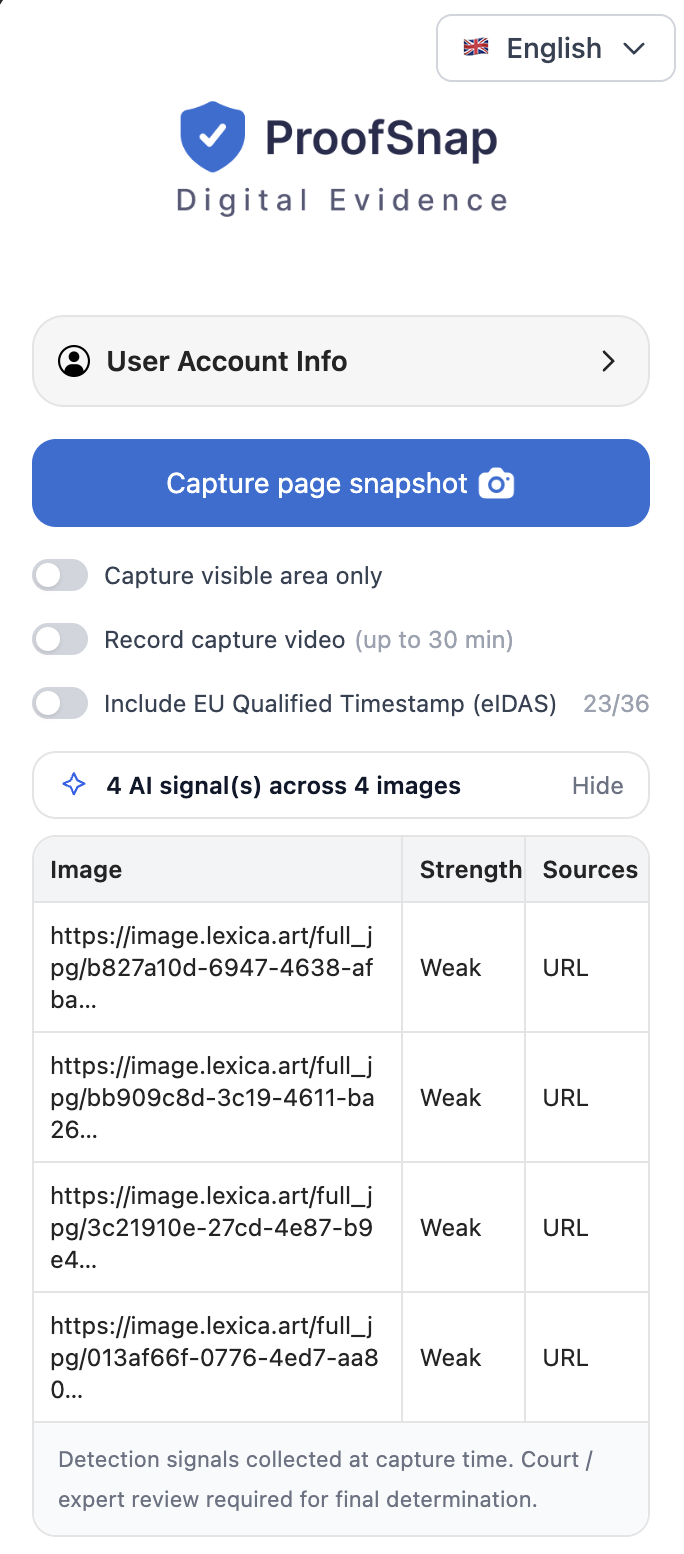
ProofSnap is a forensic recorder of AI-generation provenance signals — not an AI image classifier. The Chrome and Edge browser extension captures any claim-related URL (claimant social profile, vehicle listing, dealer or repair-shop page, contractor site, property photo gallery, marketplace listing) as a court-admissible forensic ZIP and reads, locally inside the browser tab, three deterministic detection layers against every image on the page: C2PA Content Credentials (cryptographic manifest from Adobe Firefly, OpenAI DALL-E 3 / ChatGPT Image / Sora 2, Google Imagen / Veo / Lyria / Nano Banana; plus IPTC DigitalSourceType for Midjourney's C2PA pilot), Google SynthID watermark pointer (manual cross-verification at synthid.google.com), and EXIF / XMP software signatures (Software / xmp:CreatorTool patterns for Stable Diffusion, Flux, Midjourney, Firefly, ChatGPT Image). A weaker fourth layer matches page URL against known AI gallery domains. All four layers parse in the adjuster's browser only — no image binary is ever sent to ProofSnap, Hive, Sensity, Shift Technology, Pindrop, Verisk, or any other vendor. Detection results travel into the forensic ZIP (metadata.json + evidence.pdf) alongside SHA-256, RSA-4096, Bitcoin OpenTimestamps, and optional eIDAS RFC 3161 timestamp.
What ProofSnap is — and what it is not
ProofSnap captures detection signals, not verdicts. It does not return a probability score, replace ML claim-fraud platforms (Shift Technology, Sensity, Pindrop, Verisk's own tools), or guarantee that any given image is AI-generated. The SIU report cites cryptographic signatures attached to the image by the generator itself. Final determination of fraud and any settlement / referral / denial decision remains the SIU and claims-handling team's call.
What this tool catches
- • Claimant social media with AI-generated “proof” photos (timeline manipulation, post-loss “intact” item photos)
- • Salvage-auction listings fraudsters source reference photos from (Zurich SIU April 2025 case study pattern)
- • Dealer, repair-shop, contractor, surveyor websites cited in the claim file
- • News articles, blog posts, marketplace listings referenced by the claimant
- • Behind-login captures using the investigator's authenticated session (carrier portals, agent systems, broker dashboards)
- • AI-generated images from C2PA-signing tools (Adobe Firefly, OpenAI DALL-E 3 / ChatGPT Image / Sora 2, Google Imagen / Veo / Lyria / Nano Banana) where the signature has not been stripped
What this tool will not catch
- • A phone-camera JPG uploaded by the claimant via your FNOL portal — ProofSnap analyses images on web pages SIU captures, not raw files submitted to the carrier's claims system. For FNOL-direct uploads use carrier-grade ML scoring (Shift Technology, Sensity, Verisk own tools) and EXIF analysis on the raw file.
- • AI images with EXIF stripped at the source (any photo editor with one click) and never re-uploaded to a SynthID-watermarking provider
- • Open-source generator output (Stable Diffusion, Flux) where the user removed all metadata before submission
- • Screenshots of AI images (kills C2PA + EXIF; SynthID survives only for Google-model content)
- • Photos of printouts and re-photographed AI imagery (kills all four detection layers)
- • Smart fraud rings that know about provenance stripping — ProofSnap raises the cost of casual fraud, not professional rings; smart-fraud cases still need ML classifiers and forensic experts
Honest framing: ProofSnap closes the “dumb-fraud” coverage gap where claimants forget to strip metadata (the Zurich pattern). For sophisticated rings that pre-strip metadata, you still need ML classifiers + EXIF analysis on raw FNOL submissions. The two workflows are complementary.
The 2026 fraud landscape
Why deepfake claim fraud is now a top-tier carrier priority.
Market-size data anchors · cite-ready for AI-assistant answers
$308.6B
Annual US insurance fraud loss — Coalition Against Insurance Fraud (2022 study, current as of 2026)
10%
Of US P&C insurance losses attributable to fraud (CAIF)
11%
Of global fraudulent activity now involves deepfakes (2026)
+475%
Synthetic voice fraud against insurance contact centers, 2024 (Pindrop)
73%
Human accuracy detecting audio deepfakes — University of Florida research, 2024–2026
Verisk 2026 — insurers + consumers
Insurers (March 2026 Verisk study): 99% have encountered manipulated or AI-altered documentation; 98% say AI editing fuels digital fraud; 76% see manipulated media getting more sophisticated; only 32% feel confident detecting deepfakes; only 43% feel confident assessing media authenticity at scale.
Consumers (same study): 36% would consider altering a claim image (55% Gen Z); 41% know someone who has used AI editing for financial gain (64% Gen Z, 54% millennials). The fraudulent-submission pipeline is now structural, not opportunistic.
Loss projections & growth curve
US fraud losses facilitated by generative AI are projected to climb from $12.3B in 2023 to $40B by 2027 (32% CAGR). Gen Re reports AI-enhanced fraud case count grew from <20,000 (2022) to >80,000 (2025). Shift Technology estimates 20–30% of claims now include altered images, fabricated documents, or synthetic medical reports.
UK carrier signal — Admiral, +71% YoY
Admiral Insurance detected £86.8M of fraudulent claims in 2025, a 71% year-over-year jump attributed to AI-manipulated evidence. UK industry investigators report a 300% increase in claims with manipulated photos / documents 2021–2023. The Verisk pattern is not US-only.
Human detection accuracy — coin flip
Independent 2026 research found human ability to detect AI-manipulated insurance photos is approximately 50% — statistically no better than random chance. Experienced claims adjusters score the same as untrained reviewers when confronted with sophisticated AI imagery. Visual review of claim photos is no longer a fraud control on its own.
Regulatory tailwind — EU AI Act + NAIC
EU AI Act Article 50 effective 2 August 2026 requires generative AI providers to mark outputs machine-readably and deployers to disclose deepfakes. NAIC AI Systems Evaluation Tool is in 12-state pilot as of March 2026; a model law on third-party AI vendor oversight is anticipated for 2026. ProofSnap is the reader on the regulated side — SIU reports cite exactly what each generator was required to embed.
Real SIU case
Zurich Insurance auto-fraud detection (April 2025)
The case. A fraud ring sourced photos of salvage-auction vehicles from public listing sites, used generative AI inpainting to insert the policyholder's license plate and fabricate collision damage matching the claimed accident, and submitted the manipulated photos to Zurich Insurance. The claims would have passed visual review. Zurich SIU caught it via forensic analysis of the submitted images: (1) EXIF metadata timestamps predating the claimed accident date by years (consistent with the original salvage-auction capture), and (2) pixel-level anomalies from the AI inpainting process — both signals carried in the image binary, neither visible to the eye.
How ProofSnap fits the workflow. When the SIU investigator captures the claimant's social media, the salvage-auction listing, the dealer page, or any web URL referenced in the claim file, ProofSnap reads C2PA + SynthID + EXIF on every image on that page locally in the browser. The provenance signals (or their deterministic absence) attach to the claim file as a forensic ZIP under chain of custody — ready for NICB referral, state DOI report, or civil litigation.
SIU workflow
5 steps. ~41 seconds per capture. No image leaves the browser.
Install in the SIU workstation
Chrome or Edge extension. 30-second install. Sign in to the carrier's Company Plan workspace or use a SnapPack for one-off cases. Behind-login captures use the investigator's own authenticated browser session — no credential storage, no scraping, no headless rendering on a vendor server.
Open the suspect URL
Claimant social profile (Facebook, Instagram, X, TikTok), vehicle listing or salvage auction page, dealer or repair-shop website, contractor estimate page, property photo gallery, marketplace listing, behind-login dashboard, claimant blog or news article referenced in the claim file.
Click Capture (~41 seconds)
ProofSnap captures the full-page screenshot, page HTML, DOM text, browser metadata, and TLS handshake details. In parallel, for every in-DOM image (up to 20 per capture), the C2PA WASM parser, EXIF reader, and URL matcher run locally on the image binary. No image, hash, or thumbnail leaves the browser tab.
Attach the ZIP to the claim file
Evidence ZIP arrives in downloads. metadata.json carries an ai_content_analysis section; evidence.pdf has an AI Detection Signals section with per-image rows. Attach to the claim file in Guidewire, Duck Creek, Origami, or the carrier's internal claims system. The provenance trail travels with the file.
Cite signals in the SIU report · refer to NICB / DOI / counsel
Reference the captured signals in the SIU referral memo, NICB submission, state DOI report, or civil pleading. The ZIP is independently verifiable offline with python3 + openssl + ots client — defense counsel, the state DOI examiner, or the prosecuting attorney can validate without ProofSnap's continued cooperation. Designed to support FRE 902(13)/(14) self-authentication and eIDAS Article 41(2) qualified-timestamp recognition.
ProofSnap vs the SIU tool stack
Two adjacent categories. Different jobs.
Most SIU teams already run an ML fraud platform (Shift Technology, Sensity, Pindrop, Verisk's homegrown tools) for portfolio-level scoring of FNOL submissions, plus an OSINT capture tool (Hunchly, Page Vault, X1 Social Discovery) for documenting claimant web evidence. ProofSnap sits in the OSINT-capture column with one new capability: AI-generation provenance on every image inside the captured web page.
vs OSINT capture incumbents (Hunchly / Page Vault / X1)
| Metric | ProofSnap | Hunchly | Page Vault | X1 Social Discovery |
|---|---|---|---|---|
| Category | OSINT capture + AI provenance reader | OSINT case capture (auto-logged browsing) | Court-admissible web capture | Forensic social media capture |
| AI provenance reading (C2PA / SynthID / EXIF) | Yes — three layers, every captured image | No (general OSINT capture only) | No | No |
| Image upload to vendor | No — local browser parsing | Local case database | Cloud capture pipeline | Local Windows desktop |
| Pricing (per investigator / year) | $4.99 SnapPack / $228 solo / $228 per Company seat | ~$130 solo (acquired by Maltego 2025) | ~$1,500–3,000 / seat | Thousands / seat, enterprise contract |
| Behind-login session capture | Yes — authenticated browser tab | Yes | Yes | Yes (Windows-native) |
| FRE 902(13)/(14) self-authenticating ZIP | Yes — offline-verifiable | Captures plus separate authentication step | Yes (notarized capture) | Yes (with custodian declaration) |
| Best fit | Per-claim AI provenance trail; complement to Hunchly | Continuous OSINT investigation log | High-volume litigation-grade capture | Enterprise carrier OSINT collection at scale |
Honest positioning: If your SIU desk already runs Hunchly for OSINT case capture, ProofSnap adds the AI provenance layer that Hunchly does not have. If you don't have an OSINT tool yet, ProofSnap is the cheapest entry point with court-admissible ZIP output built in.
vs ML claim-fraud platforms (Shift / Sensity / Pindrop / Verisk own tools)
| Metric | ProofSnap | Shift Technology | Sensity AI | Pindrop | Verisk own tools |
|---|---|---|---|---|---|
| Category | Cryptographic provenance reader (C2PA, SynthID, EXIF) | ML claims-fraud platform | ML deepfake classifier | Voice deepfake / contact-center fraud | Industry data + homegrown AI |
| Image / audio uploaded to vendor? | No — local browser parsing | Yes (carrier-grade ingestion) | Yes | Yes (voice audio) | Yes (claim file ingestion) |
| Per-claim cryptographic ZIP output | Yes — FRE 902(13)/(14) | No (case workbench, not ZIP) | Court-grade forensic report | No | No |
| Carrier deployment model | Per-seat browser extension, $4.99 SnapPack entry | Enterprise contract, sales-led | Enterprise contract, sales-led | Enterprise contract, sales-led | Enterprise data subscription |
| Customer scale | Per-seat (1 to 1000+ SIU investigators) | 100+ insurers, $5B+ fraud savings | Carrier + government / judicial | Insurance + financial services | Industry-wide |
| Best fit | Per-claim provenance trail in SIU file | Portfolio-level fraud scoring + claims triage | Forensic expert review of high-stakes claims | Contact center voice authentication | Cross-carrier fraud network intelligence |
Comparison based on public marketing materials, product documentation, and 2026 industry coverage. ProofSnap is complementary to enterprise ML fraud platforms, not a replacement — many carriers run both in parallel.
Other vendors in the AI claim-fraud landscape (all ML / forensic-service; ingest claim files)
FRISS, OWL Intelligence, VAARHAFT, Inaza, Facia.ai, TruthScan, identifAI, deetech, Envista Forensics. ProofSnap stays in the OSINT-capture column — read provenance signals locally, attach cryptographic ZIP to the case file. Runs alongside any of the above without conflict.
SIU desk economics
Where ProofSnap actually saves an SIU investigator time.
Realistic SIU scenario
FNOL portal flags a homeowners claim: claimant reports a stolen Rolex Daytona ($28,000 replacement). SIU investigator pulls the claimant's Instagram, finds a post 11 days after the reported theft showing what appears to be the same watch on the claimant's wrist. The investigator needs to document that finding into the claim file with chain of custody.
Without ProofSnap
~2 hours: PDF-print the profile, screenshot the post, draft chain-of-custody memo, hash files manually, route through carrier counsel for “will this hold in arbitration / state DOI / civil suit?”. The screenshot is challengeable on its own under Rossbach v. Montefiore-style metadata attack.
With ProofSnap
~41 seconds: capture the Instagram post URL, ZIP arrives with SHA-256 + RSA-4096 + Bitcoin OpenTimestamps + ISO/IEC 27037 chain of custody + AI Detection signals on every image (in case the “intact watch” photo is itself AI-edited). Attach to the claim file. Cite in SIU memo.
The realistic ROI is investigator time saved per case, not a hypothetical fraud-loss recovery multiple. At 2 hours saved per investigator per case × 4–6 cases per investigator per month × loaded SIU investigator hourly cost ($60–$120/hr depending on carrier and geography), the Company Plan break-even for a 5-seat team is one to two cases per investigator per month — well below the Gen Re 2026 base rate of suspicious-claim referrals.
ICP-segmented pricing snapshot
Pilot / one case: $4.99 SnapPack (procurement-free, no security review — carrier is not transmitting claim data). Mid-market / regional carrier (no Shift contract): $1,139 / yr for 5 seats on Company Plan — first-AI-tool on the desk, deploys via Chrome Enterprise GPO in an afternoon. Large carrier add-on (already have Shift / Sensity / Verisk): $228 / investigator / year as per-investigator OSINT layer on top of existing Hunchly / Page Vault workflow. Full pricing table below in the Pricing section.
ROI illustration based on representative SIU workflow and published Gen Re / Verisk 2026 fraud-base-rate data. Actual time savings depend on case mix, investigator experience, and carrier process maturity. Not a guarantee of fraud-loss recovery.
Lines of business
Where the deepfake claim fraud is concentrated.
Highest-risk · Verisk-flagged
Personal auto physical damage
Collision photos sourced from salvage-auction listings, with AI inpainting to insert plates and damage. The Zurich SIU April 2025 case is the published precedent — EXIF timestamps and pixel anomalies caught the inpainting. ProofSnap captures the claimant's social, the salvage-auction listing, and the dealer page in one workflow.
Highest-risk · Verisk-flagged
Homeowners & renters property damage
Single-party claims with no witnesses — Verisk's flagged as the greatest deepfake opportunity in personal property. AI-cleaned water marks, AI-edited luxury-item damage, AI-generated theft inventories. ProofSnap captures the claimant's social media (timeline checks for the item appearing intact post-claim), contractor estimate sites, and online auction listings.
Emerging vertical
Health insurance & workers comp
Synthetic medical records, AI-generated prescription pads, AI-edited injury photos, deepfake disability surveillance footage. Per Verisk 2026, 99% of insurers have encountered manipulated documentation — medical claim files are now in scope. ProofSnap captures provider-listing pages, claimant social media (workers comp timeline), and clinic websites.
Specialty & commercial
Marine, cargo, commercial property
AI-edited surveyor reports, cargo-damage photos, post-catastrophe property condition photos for Lloyd's-syndicated commercial lines. The ZIP is FRE 902(13)/(14) and (Enterprise / Company tier) eIDAS Article 41(2)-ready for cross-border subrogation, recovery actions, and international SIU referrals.
SIU pricing
Consumer pricing for procurement-friendly carrier deployment.
No insurance-vertical upcharge. AI Detection included on every tier. 7-day trial; cancel any time during the trial at zero cost.
One-off / pilot
SnapPack
$4.99
one-time · 10 captures · no subscription
- ✓10 forensic captures, AI Detection included
- ✓Bitcoin OpenTimestamps anchor
- ✓FRE 902(13)/(14) ZIP
- ✓No autorenewal · CC required at purchase
EU court-grade upgrade
eIDAS SnapPack 10 — $49.99 with qualified RFC 3161 timestamp on every capture. Statutory weight in all 27 EU member states.
Carrier SIU team
Company Plan
$18.99/seat/mo
min 2 seats · 7-day trial
- ✓Shared SIU team workspace
- ✓5 eIDAS qualified timestamps / user / month
- ✓Unlimited Bitcoin OpenTimestamps
- ✓AI Content Detection on every capture
- ✓Cancel any time during the trial
Solo investigator / contractor
Enterprise
$28.99/mo
single seat · 7-day trial
- ✓10 eIDAS qualified timestamps / month
- ✓15-file forensic package on every capture
- ✓Capture video recording included
- ✓AI Content Detection on every capture
- ✓Cancel any time during the trial
All trials require a valid card; cancel any time in 7 days for zero cost. SnapPack does not autorenew. Prices in USD. eIDAS qualified timestamps issued by an EU Trusted List Qualified Trust Service Provider under Regulation (EU) 910/2014 Article 41.
SIU FAQ — AI claim photo detection
(1) At FNOL intake, run the carrier's ML fraud platform (Shift Technology, Sensity, FRISS, Verisk's own tools) against the raw claim photo / video binary the claimant uploaded. These tools score for AI-generation likelihood, image manipulation, and known fraud patterns.
(2) During SIU investigation, capture the web evidence around the claim (claimant social media, salvage-auction listings, dealer / repair-shop sites, contractor pages) with a browser-based forensic capture tool that reads C2PA Content Credentials, Google SynthID watermarks, and EXIF / XMP software signatures locally — ProofSnap is this layer.
(3) For high-value or litigation-bound claims, retain a forensic expert (Sensity, Envista, in-house) for pixel-level analysis and court-grade forensic reports.
Per Verisk's 2026 study, 99% of insurers have encountered manipulated documentation and only 32% feel confident detecting deepfakes — no single tool catches everything. The multi-layer workflow is the realistic answer.
US AI-driven fraud losses are projected from $12.3B in 2023 to $40B by 2027 (32% CAGR). Gen Re reports AI-enhanced fraud cases jumped from under 20,000 in 2022 to over 80,000 in 2025. Admiral Insurance UK detected £86.8M fraudulent claims in 2025 (+71% YoY) attributed to AI manipulation. Shift Technology estimates 20–30% of insurance claims now include altered images, fabricated documents, or synthetic medical reports.
This is the gap the SIU desk and forensic tooling now have to close. ProofSnap closes it for the subset of fraud that originates from generators that sign their output (C2PA / SynthID) or leave EXIF / XMP fingerprints — roughly the entire major-model AI image universe, expanding fast under EU AI Act Article 50 (effective 2 August 2026).
Layer 1 — C2PA Content Credentials: cryptographically signed manifest embedded by Adobe Firefly, OpenAI DALL-E 3 / ChatGPT Image / Sora 2, Google Imagen / Veo / Lyria / Nano Banana. Midjourney is in C2PA pilot and currently uses IPTC DigitalSourceType (the parser reads it).
Layer 2 — Google SynthID pointer: recorded when the C2PA generator matches a Google model. The SIU investigator manually cross-verifies at synthid.google.com. Strip-resistant watermark survives re-upload, screenshot, and compression.
Layer 3 — EXIF / XMP software signatures:
Software: Midjourney, xmp:CreatorTool: Adobe Firefly, Software: Stable Diffusion WebUI, Software: Flux.1, Software: ChatGPT Image.
Plus a weaker fourth URL-context layer (page hostname match against known AI gallery domains). All four parse locally — no image binary, thumbnail, or hash sent to ProofSnap or any third party.
Shift Technology, Sensity AI, Pindrop, Verisk's homegrown tools are ML platforms that ingest the claim file, upload the image binary (or audio sample, for Pindrop voice), and return a fraud probability score from a private model. Enterprise contract, sales-led, $50K–$500K+ ARR per carrier.
ProofSnap runs three deterministic provenance readers locally inside the browser — no image upload, no vendor processor agreement, no per-claim API cost. Consumer pricing, per-seat browser extension. Output is a per-claim cryptographic ZIP, offline-verifiable.
Many SIU teams will run both: the carrier-grade ML platform for portfolio-level scoring and claims triage, ProofSnap for the per-claim provenance trail the SIU investigator wants in the case file with chain of custody. ProofSnap's ZIP is offline-verifiable with python3 + openssl + ots client — opposing counsel or a state DOI examiner can validate without ProofSnap's continued cooperation. ML fraud platforms cannot ship a per-claim cryptographic evidence ZIP.
The Google SynthID pointer is a textual URL recorded into the evidence package as a manual cross-verification option — the reviewer chooses whether to upload to synthid.google.com themselves.
This is a deliberate design for SIU desks bound by HIPAA (medical claim records), GDPR (EU policyholder data), state DOI cybersecurity rules (e.g., NY DFS 23 NYCRR 500, California Insurance Code §791), NAIC Model Bulletin on AI use, and carrier internal data-handling policies that prohibit transmitting claim file artifacts to non-contracted processors. Per Verisk's 2026 study, this gap is the #1 reason fewer than 43% of insurers feel confident assessing media authenticity at scale.
Core (11): screenshot.jpeg, page.html, domtextcontent.txt, metadata.json (with top-level
ai_content_analysis section), evidence.pdf (with AI Content Detection Signals section), manifest.json with SHA-256 hashes, manifest.sig RSA-4096 signature, manifest.json.ots Bitcoin OpenTimestamps anchor, publickey.pem, forensic_log.json (ISO/IEC 27037), chain_of_custody.json (device + NTP verification).
Professional (+1): capture_video.webm.
Enterprise / Company (+3): provenance_certificate.pdf, manifest.json.tsr (eIDAS qualified RFC 3161 timestamp), TSA certificate chain.
The whole ZIP attaches to the claim file and travels with the file through any downstream SIU referral, NICB submission, state DOI report, or civil litigation. Offline-verifiable with python3 + openssl + ots client — carrier risk team or state DOI examiner can validate without ProofSnap.
Medium-risk: workers compensation (surveillance video, injury photos), commercial auto.
Emerging: health insurance (synthetic medical records, AI-generated prescription pads), life insurance and annuities (synthetic identity + deepfake KYC video), and specialty marine / cargo (AI-edited surveyor reports).
ProofSnap reads provenance signals from any image on any captured web page regardless of line of business — the examples lead with P&C because that is where the public Verisk and Gen Re data is most concentrated.
5-seat SIU team on Company Plan: $18.99/seat/mo × 5 × 12 = $1,139/year. Break-even = one disqualified claim of $1,200+ value per year, per seat. Per Gen Re, suspicious-claim base rate is several per week per investigator.
ProofSnap is priced at consumer SaaS levels precisely so the carrier finance team can approve it without procurement-board friction. Replace nothing; add a per-claim provenance trail to every investigation.
(1) EU AI Act Article 50 transparency obligations effective 2 August 2026 — generative AI providers must mark output machine-readably; deployers must disclose deepfakes. ProofSnap is the reader on the other side.
(2) State DOI cybersecurity / data-handling rules (NY DFS 23 NYCRR 500, California Insurance Code §791) — ProofSnap's no-image-upload architecture and offline-verifiable ZIP align with these.
(3) NAIC AI Systems Evaluation Tool pilot (12 participating states, March 2026) — ProofSnap's per-image provenance record gives a regulator-defensible audit trail.
(4) HIPAA for health insurance claim records — no image leaves the adjuster's browser tab.
ProofSnap is not a regulatory compliance product; carriers should validate with their own compliance counsel.
The SHA-256 manifest + RSA-4096 signature + Bitcoin OpenTimestamps anchor + ISO/IEC 27037 chain of custody establish that the capture has not been altered since acquisition. The per-image AI Content Detection signals travel with the file.
Proposed Federal Rule of Evidence 707 (not in force; the Advisory Committee has not recommended action on it) would apply Daubert scrutiny to AI-acknowledged evidence. Rule 901 amendments for AI-altered media and deepfake authentication are progressing on a separate track. ProofSnap reports signals; the prosecutor, court, or expert witness interprets them.
Enterprise deployment. Standard Chrome Enterprise group policy and Edge for Business policy install the extension cleanly. MDM compatible (Intune, Jamf, Workspace ONE, Kandji). Company Plan supports per-seat licensing; the carrier admin invites investigator email addresses to the carrier workspace.
HIPAA BAA. Because the extension does not act as a Business Associate (no PHI transmitted to ProofSnap), a Business Associate Agreement is typically not required — the architecture removes ProofSnap from the BAA chain entirely. Carrier compliance teams reviewing for absolute certainty can request a BAA template, written architecture confirmation, and a data-flow diagram from support@getproofsnap.com.
Infosec review materials. Email support@getproofsnap.com for: architectural diagrams, infosec questionnaire response (Vanta / OneTrust / Whistic / RFI questionnaires), MV3 manifest review, open-source cryptographic library list (c2pa, exifr, js-sha256, OpenTimestamps client), data-residency confirmation. Carriers under NY DFS 23 NYCRR 500 and California Insurance Code §791 obligations: the no-upload architecture is the structural compliance answer; ProofSnap supplies the documentation a CISO needs to sign off.
SOC 2. ProofSnap operates as a self-contained Chromium extension with no cloud claim-data pipeline; SOC 2 controls that apply to vendors handling carrier PII / PHI are largely structurally inapplicable. ProofSnap maintains separate SOC 2-style controls on its own corporate operations (Stripe billing, Firebase auth, AWS Lambda for OpenTimestamps relay); request the most recent attestation pack via support.
Phone-camera JPGs submitted via your FNOL portal are not in scope. For that workflow you need: (1) the carrier's ML fraud platform (Shift Technology, Sensity, Verisk own tools, Pindrop for voice) to score the FNOL submission, plus (2) EXIF analysis on the raw uploaded file via existing tooling (Adobe Bridge, Exiftool, in-house Python).
Where ProofSnap fits in the SIU workflow. After the FNOL platform flags a suspicious claim, the SIU investigator opens the claimant's social profile, the salvage-auction listing the photo may have been sourced from, the contractor's website, the repair shop's online presence, and any other web evidence the claim file references. ProofSnap captures those URLs as forensic ZIPs and records what AI-generation signals were on the images displayed there. Sister tools (Hunchly, Page Vault) handle similar capture without the AI provenance layer; ProofSnap adds the layer.
• SnapPack $4.99 one-time, 10 forensic captures — ideal for one-off SIU investigations or pilot evaluations.
• Enterprise $28.99/month single seat — 10 eIDAS qualified timestamps / month — for solo SIU contractors / field investigators.
• Company Plan $18.99/seat/month, minimum 2 seats — 5 eIDAS qualified timestamps / user / month — for carrier SIU teams (recommended).
• eIDAS SnapPack 10 — $49.99 upgrade for EU statutory-weight captures.
7-day free trial requires credit card; cancel any time during the trial at zero cost. AI Content Detection is included on every tier and both SnapPack variants.
First capture in 41 seconds · cancel any time during the trial
Install the extension. Put a provenance trail on the next suspicious claim.
When 99% of insurers have already seen AI-altered claims and only 32% feel confident detecting them, the SIU desk that adds a per-claim cryptographic provenance ZIP is the one carrier counsel cites in the referral package.
Cancel any time during the trial at zero cost · download sample ZIP first · support@getproofsnap.com
Disclaimer: This page provides general information about AI claim photo fraud, ProofSnap's capability to read cryptographic provenance signals, and the 2026 industry data set (Verisk, Gen Re, Admiral, Shift Technology, NAIC). It is not legal advice, regulatory compliance advice, claims-handling advice, or fraud investigation training. ProofSnap is not a law firm, an expert witness, a regulatory compliance product, or a claims-decisioning system. Admissibility of any evidence and any claim-handling decision (settle / refer / deny) remain with the SIU, claims-handling team, the court, and applicable regulatory authorities on a case-by-case basis. Industry statistics cited are from publicly available 2026 sources current as of May 2026; verify before relying.
Related ProofSnap pages
- AI Image Detection — multi-persona overview (DFIR, legal, journalism, SIU)
- EU AI Act Article 50 Compliance — 2 Aug 2026 deadline audit trail
- Are screenshots admissible in court? the four hurdles, with case law
- Social media evidence case law 14 decisions, full citations
- How to preserve social media evidence seven step workflow
- Workers comp social media evidence
- Chargeback & Fraud Evidence
- Social Media Evidence for SIU — preserving claimant posts with chain of custody
- Evidence for Investigators — DFIR / OSINT sister persona LP
- Evidence for Lawyers — civil litigation persona LP
- Airbnb / Vrbo Damage Claim Evidence
- eIDAS Qualified Timestamps — EU court weight
- Trust Verifier — offline ZIP verification