GDPR compliance evidence for what you don’t control
By Radim Motycka, Founder and Lead Engineer, ProofSnap · Updated 15 August 2026 · Not legal advice
GDPR Compliance Evidence when your vendor changes their terms without telling you
You control your own CMS. You don’t control theirs. ProofSnap gives you the proof.
Your processor updated their privacy policy. Your SaaS vendor quietly changed their DPA. Your sub-processor added a new data transfer clause. A client’s cookie banner broke after your agency handed it over. You need proof of what their website showed before the change, but you have no access to their version history.
ProofSnap captures any website with a cryptographic timestamp, creating tamper-evident evidence of what a third party’s website showed on any date. The accountability layer for the third-party pages you cannot version.
Also available for Microsoft Edge
7-day free trial, credit card required, cancel any time. From $8.99 a month, or a one-time $4.99 SnapPack.
10 seconds per capture · Capture any website, yours or third-party · No IT department required
What is GDPR compliance evidence?
GDPR compliance evidence is dated, tamper-evident proof of what a vendor's website, privacy policy, cookie banner or DPA said on a given day. Articles 5(2) and 28 make the controller demonstrate compliance, including for processors it cannot control. ProofSnap captures any page with a SHA-256 hash and a cryptographic timestamp in about 10 seconds.
That matters because a controller stays accountable for a processor it does not host, cannot version and will not be told about when the terms change.
“The controller shall be responsible for, and be able to demonstrate compliance with, paragraph 1.”
You control your own website.
You don’t control theirs.
Your CMS has version history. Your CMP has consent logs. But when a vendor, processor or client changes their website, you have no record of what it said before.
What you already have covered
For your own website, you have tools:
- CMS version history (your privacy policy)
- CMP consent logs (your cookie banner)
- Git/deployment logs (your code changes)
What you have NO record of
For third-party websites, you have nothing:
- Processor’s privacy policy: changed without notice
- Vendor’s DPA / terms: quietly updated
- Sub-processor list: new entity added silently
- Client’s cookie banner: broke after you delivered it
ProofSnap fills the gap: evidence for what you don’t control
Capture any website
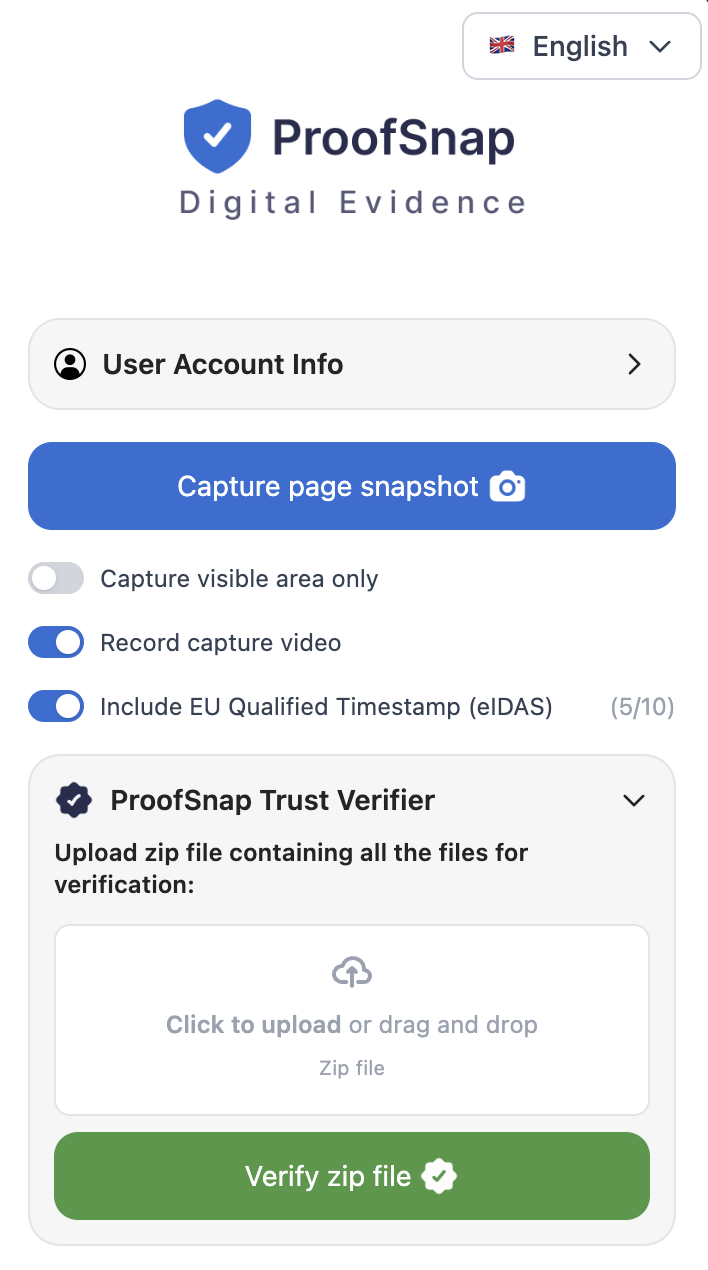
Open your processor’s privacy policy, vendor’s DPA, or client’s cookie banner. Click ProofSnap. 10 seconds: full-page screenshot, HTML source, metadata, forensic log, chain of custody, cryptographic timestamp.
Tamper-evident record
SHA-256 hash, RSA-4096 digital signature, blockchain timestamp (Professional) or eIDAS qualified timestamp with legal presumption (Enterprise). It becomes much harder for a third party to claim it never said that.
Monthly monitoring
5 captures/month covers your critical vendors. When something changes, you have proof of what it said before and when it changed. Evidence for your Art. 28 processor monitoring.
What is the fine for GDPR cookie consent violations?
CNIL alone has issued over €935M in cookie-specific fines. GDPR penalties for the most serious violations (Art. 83(5)) reach up to €20M or 4% of total worldwide annual turnover, whichever is higher. UK PECR penalties now reach £17.5M under the Data (Use and Access) Act 2025.
Google (CNIL, Sep 2025)
Gmail ads inserted between emails without consent. Cookies placed during Google account creation without valid consent of millions of French users. Split €200M Google LLC + €125M Google Ireland.
SHEIN (CNIL, Sep 2025)
10 types of advertising cookies placed before consent. “Reject All” didn’t work. 12 million French visitors/month affected.
Google (CNIL, Jan 2022)
Accept = 1 click. Refuse = multiple screens. No equal “Refuse All” button on google.fr and youtube.com.
Meta/Facebook (CNIL, Jan 2022)
Same dark pattern as Google: accept was 1 click, refuse required navigating multiple pages on facebook.com.
Microsoft/Bing (CNIL, Dec 2022)
Accepting cookies = 1 click. Refusing = 2 clicks. Dark pattern in cookie consent on Bing search engine.
Criteo (CNIL, Jun 2023)
Failed to verify that partner websites had obtained valid consent before placing Criteo tracking cookies. 370M user identifiers across the EU.
Additional cookie fines: Apple €8M (2022) · TikTok €5M (2022, no reject button) · American Express €1.5M (2025, cookies despite refusal) · Condé Nast €750K (2025) · noyb has filed more than 700 formal GDPR complaints across multiple waves against non-compliant cookie banners.
What changed in 2025-2026: what changed in 2025 and 2026
UK: £500K → £17.5M
PECR penalties jumped 35-fold
Under the Data (Use and Access) Act 2025, UK cookie consent penalties now match UK GDPR levels, up to £17.5M or 4% of global turnover. The ICO launched a cookie compliance sweep of the top 1,000 UK websites in January 2025.
EU: Digital Omnibus (proposal)
Cookie rules moving into GDPR
The EU Commission’s Digital Omnibus package (19 November 2025) proposes integrating cookie rules directly into GDPR, single-click refusal requirements and machine-readable preference signals. It moves through the EU legislative process during 2026.
Ireland: €530M TikTok
DPC doubled down in 2025
The Irish DPC fined TikTok €530M in May 2025 for transferring EEA user data to China (now under appeal; the Irish High Court stayed the decision in November 2025). CNIL’s average sanction grew sharply between 2024 and 2025. Cumulative GDPR fines reached €7.1B by January 2026 (DLA Piper GDPR Fines and Data Breach Survey).
Who needs GDPR compliance evidence?
Four roles with one common problem: proving what a third party’s website showed on a specific date. Web agencies, DPOs, privacy lawyers, and anyone filing a DPA complaint.
Web Agencies & Developers
Your client gets fined: “You built our website. You set up the cookie banner. The supervisory authority says it wasn’t compliant. This is your liability.” After handover, you lose access to their CMS. You can’t prove the banner was correctly configured when you delivered it, or that the client broke it afterwards.
With ProofSnap: capture every client website at deployment and after every cookie banner update. Timestamped proof that the consent mechanism was correctly configured when you delivered it. If the client breaks it later, that is on them, and you have the evidence.
DPOs & Compliance Officers
Your processor changed their terms: Art. 28 GDPR requires you to monitor processors. Your analytics provider quietly added a new sub-processor. Your cloud vendor updated their DPA to allow data transfers to a new jurisdiction. You received no notification, and now the supervisory authority is asking about your oversight.
With ProofSnap: monthly captures of every processor’s privacy policy, DPA, and sub-processor list. When they change something, you have timestamped proof of what it said before and when it changed. Evidence for your Art. 28 monitoring, in about 10 seconds per vendor.
Privacy Lawyers & Legal Departments
The vendor says “we never said that”: Your SaaS vendor promised GDPR-compliant data processing in their DPA. Now there’s a breach, and their current DPA has different terms. They claim the clause you relied on never existed. Without evidence, it’s your word against theirs.
With ProofSnap: forensic evidence package with chain of custody and cryptographic timestamp. Prove what their DPA stated on the date you relied on it. eIDAS qualified timestamp = legal presumption in 27 EU member states.
Filing GDPR Complaints
You found a violation: A competitor’s cookie banner has no reject button. A website processes your data without consent. You want to file a complaint with the DPA, but by the time they investigate, the website may well have changed, and the violation with it.
With ProofSnap: capture the violation with a cryptographic timestamp before they fix it. Submit the evidence package with your DPA complaint. noyb’s model: capture first, complain second. More than 700 formal complaints filed across multiple waves.
“Our analytics processor changed their sub-processor list without notification. During the DPA inquiry, we showed 6 months of ProofSnap captures proving the original list and the exact date of the change. The supervisory authority focused its investigation on the processor, not on us.”
DPO at a fintech company, illustrative scenario
“A client blamed us for their cookie banner fine. We pulled ProofSnap captures from the deployment date: the banner was correct. Then we showed captures from three months later: they had modified it themselves. ”
Web agency founder, illustrative scenario
How to prove GDPR compliance in 5 steps
Under the GDPR Art. 5(2) accountability principle, you must demonstrate compliance, not just claim it. Here’s how to build an audit-ready evidence trail.
-
1
Identify your data processors and sub-processors
List every third party processing personal data on your behalf: cloud hosts, analytics, CRM, email providers, payment processors, marketing tools. Art. 28(1) GDPR requires you to use only processors providing sufficient guarantees.
-
2
Capture each processor’s privacy policy and DPA
Use ProofSnap to create a timestamped snapshot of each processor’s privacy policy, data processing agreement, and sub-processor list. This is your baseline evidence: what they promised on the date you engaged them.
-
3
Set up monthly monitoring captures
Repeat the captures monthly. When a processor silently changes their DPA or adds a sub-processor, you’ll have timestamped proof of both the old and new versions. That is exactly what the Art. 28(2) notification duty requires.
-
4
Document your own compliance artefacts
Capture your own cookie banner, privacy policy, and consent journey at deployment and after every change. For agencies: this is your handover proof. For DPOs: this complements your CMS version history with independent, cryptographically verified evidence.
-
5
Store evidence with chain of custody
Each ProofSnap capture includes a forensic log, SHA-256 hash, RSA-4096 digital signature, blockchain timestamp, and (on Enterprise) an eIDAS qualified timestamp with legal presumption in 27 EU member states. Store the ZIP packages in a secure archive. During a DPA audit, present 12-24 months of unbroken evidence.
What is a GDPR processor monitoring checklist?
Under GDPR Article 28, data controllers must monitor processors and sub-processors. Capture these 5 pages per vendor every month, 10 seconds each, and you have 12 months of audit-ready Art. 28 compliance evidence.
Processor’s Privacy Policy
Their data handling practices, retention periods, legal basis
Vendor’s DPA / Terms
Data processing agreement, transfer clauses, SCC references
Sub-Processor List
Which entities process data on their behalf, jurisdictions
Client’s Cookie Banner
For agencies: post-handover monitoring
Competitor Violations
Non-compliant banners, dark patterns, missing policies
The legal foundation: why you must monitor
GDPR Art. 28(1)
“The controller shall use only processors providing sufficient guarantees to implement appropriate technical and organisational measures.” You must verify, not just trust.
GDPR Art. 28(2)
The processor shall not engage another processor without prior specific or general written authorisation. Sub-processor changes require your awareness.
GDPR Art. 5(2)
“The controller shall be responsible for, and be able to demonstrate compliance.” The burden of proof is on you, including for processor oversight.
Processor monitoring from $8.99 a month
5 captures per vendor per month. Full forensic evidence package. 7-day free trial.
SnapPack
no subscription
10 captures, used whenever you need them
- Full evidence package
- SHA-256 hash + digital signature
- No auto-renewal, no trial commitment
For: a one-off vendor check, no plan needed
Essential
or $80/year
100 captures/month
- Full evidence package
- SHA-256 hash + digital signature
- Enough for 20 websites a month
For: solo DPOs, freelancers, small websites
Professional
or $160/year
200 captures/month + blockchain timestamps
- Everything in Essential
- Blockchain timestamp (OpenTimestamps)
- 200 captures = 40 websites/month
For: agencies, multi-site compliance
Enterprise
or $280/year (a 20% saving)
Unlimited captures + eIDAS qualified timestamps
- Everything in Professional
- eIDAS qualified timestamp, legal presumption in 27 EU member states
- File certification, 50/month
For: DPOs, legal departments, compliance teams
Comparable archiving and CMP tooling starts far higher
Pagefreezer $500+/mo
Enterprise web archiving. Multi-year contracts. Sales process required.
MirrorWeb (custom)
Banks and government only. Pricing not published. Requires implementation.
OneTrust $10K+/year
Enterprise CMP. Consent logs only, no website captures.
ProofSnap from $8.99/mo
Self-service. 10 seconds. Full evidence package with cryptographic timestamps.
Built for the major privacy regimes
One evidence package for GDPR, UK GDPR, CCPA, PIPEDA, the Australian Privacy Act and more. Capture once, use the same package across regimes.
EU GDPR (27 member states)
€7.1B+ in cumulative fines to January 2026 (DLA Piper GDPR Fines Survey). Art. 5(2) accountability, Art. 7 consent proof, Art. 24 controller responsibility, Art. 28 processor monitoring.
Top DPAs: Irish DPC (€4B+ total, TikTok €530M May 2025, under appeal), CNIL (17,772 complaints/yr, €935M+ cookie fines), Spanish AEPD (932 fines)
UK GDPR / ICO
42,315 complaints in 2024/25. Average fine jumped from £150K to £2.8M. PECR penalties now £17.5M (35-fold increase). Data Protection Act 2018 + Data (Use and Access) Act 2025.
Notable: British Airways £20M, Marriott £18.4M, Capita £14M, Clearview AI £7.5M
USA: CCPA + 19 State Privacy Laws
20 states with active laws (CA CCPA, VA VCDPA, CO CPA, CT CTDPA, TX TDPSA). up to $7,988 per intentional violation (CA, 2025 inflation-adjusted). Texas TDPSA: up to $7,500/violation after 30-day cure. Businesses must honour Global Privacy Control signals.
Notable: Meta’s $1.4B biometric settlement with Texas (2024), Google $1.375B Texas settlement (2025), Disney $2.75M CCPA settlement (largest to date), Tractor Supply $1.35M (largest CPPA administrative fine).
Australia (OAIC)
OAIC activity is increasing under the 2024 reform package. New statutory tort for serious privacy invasions. ADM (automated decision-making) disclosure requirements from December 2026. Shift from declarative to evidentiary compliance.
Privacy Act 1988 + Privacy and Other Legislation Amendment Act 2024. Maximum penalties for serious interferences: AUD 50M, three times the benefit obtained, or 30% of adjusted turnover during the breach period, whichever is highest.
Canada (PIPEDA)
1,200+ complaints/year to the Office of the Privacy Commissioner (OPC). PIPEDA remains in force after Bill C-27 lapsed when Parliament was prorogued in January 2025. Quebec’s Law 25 imposes stricter GDPR-style obligations with penalties up to CAD 25M or 4% of turnover; Alberta and British Columbia PIPA add provincial layers.
Nordics & Netherlands
the Dutch AP: €290M Uber fine (2024), 37,839 breach notifications, one of the most active EU regulators. the Swedish supervisory authority (IMY): reprimands for pre-selected cookie categories (April 2025). Denmark Datatilsynet: cookie enforcement priority for 2026.
How does ProofSnap capture GDPR compliance evidence?
No API, no IT department, no enterprise contract. Self-service Chrome extension. 10 seconds per capture. Full forensic evidence package.
Install ProofSnap
Add the Chrome extension, then start the 7-day free trial. A credit card is required to start the trial, and you can cancel at any point during it at zero cost.
Open your compliance page
Navigate to your cookie banner, privacy policy, consent preferences, or terms of service page.
Capture the evidence
Click ProofSnap. In 10 seconds: full-page screenshot, HTML, metadata, forensic log, chain of custody, SHA-256 hash, digital signature, and cryptographic timestamp.
Present during audit
12 months of timestamped captures. Unbroken compliance archive. You can answer questions about accountability documentation with dated records.
Frequently Asked Questions
Official sources & legal framework
GDPR & Data Protection
Cookie Consent & Enforcement
Related ProofSnap landing pages
eIDAS Qualified Timestamps
EU legal presumption (Art. 41(2)) in 27 member states. Highest evidential weight for GDPR audits.
File Certification
Timestamp any file (DPA, policy, contract) with SHA-256 hash + blockchain. Complements website captures.
Recruitment Compliance (EU)
Archive job postings and recruitment pages for GDPR + anti-discrimination compliance.
Further reading from the ProofSnap blog
Start monitoring vendors in 10 seconds
GDPR Art. 28 processor monitoring + Art. 5(2) accountability evidence, without waiting for IT, sales calls, or enterprise contracts. Capture any website with a cryptographic timestamp. From $8.99 a month, or a one-time $4.99 SnapPack.
Start monitoring with a 7-day free trialFrom $8.99 a month, or a one-time $4.99 SnapPack for 10 captures. eIDAS qualified timestamps from $28.99 a month.