How to Spot a Fake LinkedIn Profile in 2026
To spot a fake LinkedIn profile in 2026, check seven signals: an AI-generated headshot, a photo a reverse image search traces to someone else, generic role descriptions, overlapping employment dates, fewer than 100 connections and no mutual contacts, no activity history, and an employer that cannot confirm the person. Gartner predicts 1 in 4 candidate profiles will be fake by 2028, so capture the profile before it changes.
Generative AI has made a convincing profile a five-minute job, and the fraud no longer stops at the profile. It continues into the video interview and onto the payroll. This guide covers the seven red flags, the checks that catch a proxy interview, and how to preserve what you saw so it still counts as evidence months later, when the profile has been quietly edited and the dispute reaches the EEOC, a UK employment tribunal or the Fair Work Commission.
Last updated:
The 7 red flags of a fake LinkedIn profile
No single red flag proves a LinkedIn profile is fake. Three or more together justify a verification step before you book the interview.
- 1 An AI-generated headshot. Look at the ears, glasses frames and hairline. Diffusion models still produce mismatched earrings, warped frames and a background that dissolves at the edges. The eyes usually sit at exactly the same height in every generated portrait.
- 2 A headshot that belongs to somebody else. Run a reverse image search. Stolen stock photos and lifted real profiles are still the cheapest way to build a fake, and they are the easiest red flag to confirm in under a minute.
- 3 Generic role descriptions with no specifics. Real engineers name the stack, the scale and the outcome. A fabricated profile describes responsibilities in the abstract, because the writer has no project to describe.
- 4 Overlapping or impossible employment dates. Two full-time senior roles running in parallel, or a career timeline that would have started at fifteen, is an artifact of generation rather than a record of work.
- 5 Fewer than 100 connections and no mutual contacts. Someone who claims eight years at two well-known employers will have colleagues in common with somebody in your network. A profile with no overlap at all is either brand new or invented.
- 6 No activity history. No posts, no comments, no endorsements, no recommendations, and an account created within the last few months. Real professional histories leave traces.
- 7 The claimed employer cannot confirm the person. The final check, and the one fraudsters cannot survive. It is also the moment the profile is most likely to be edited or deleted, which is why it should already be captured.
The scale behind the checklist: LinkedIn removed more than 83 million fake accounts in the first half of 2025, and reports that 99.7% of them were stopped proactively, before any member report (LinkedIn Community Report). The ones that survive that filter are the ones that reach your inbox.
A bad hire is expensive. A fake hire is a security incident.
The CrowdStrike 2025 Threat Hunting Report found that the DPRK-linked group FAMOUS CHOLLIMA infiltrated more than 320 companies in twelve months, a 220% year-on-year increase, using AI-written resumes and real-time deepfakes in video interviews. When you discover it, you need evidence, not screenshots that any employment lawyer will pick apart.
ProofSnap starts at $80 per year per seat. A single US wrongful termination settlement is commonly cited in the six figures. That is the whole business case.
Real cases: what happens when nobody kept the evidence
KnowBe4, July 2024: a North Korean operative on the payroll
The security-awareness firm KnowBe4 hired a “principal software engineer” who passed four video interviews, a background check and reference checks. The new hire was a North Korean threat actor using a stolen US identity and an AI-enhanced photo. Within 25 minutes of the laptop arriving, malware was loading. (KnowBe4)
Captured in advance, the profile as it appeared before the first interview stays available after it is taken down.
Vidoc Security: candidates who simply did not exist
A security startup came close to hiring backend engineers who were entirely fictional. They passed coding tests and several interview rounds, and only raised suspicion through video-call artifacts. One claimed to be Polish but could not speak Polish. (Pragmatic Engineer)
A capture preserves the full profile with its metadata, so a later edit or deletion does not erase what was claimed.
LinkedIn, first half of 2025: more than 83 million fake accounts removed
LinkedIn removed over 83 million fake accounts in six months and reports that 99.7% were stopped proactively, before any member report. Gartner predicts 1 in 4 candidate profiles will be fake by 2028. (LinkedIn Community Report)
When LinkedIn removes the account, the profile is the one piece of proof that the candidate ever existed.
Why a phone screenshot does not survive cross-examination
A screenshot has no chain of custody and no verifiable timestamp, which is why a regular screenshot fails in court and why admissibility turns on authentication rather than on the image itself. Opposing counsel will argue it was taken after the fact, cropped or fabricated. Rule 901(a) of the Federal Rules of Evidence sets the bar: “the proponent must produce evidence sufficient to support a finding that the item is what the proponent claims it is.” (Cornell Law School, FRE 901)
A ProofSnap package answers that question with a SHA-256 hash, an RSA-4096 signature over the manifest, and an OpenTimestamps anchor in the Bitcoin blockchain that no later edit can move.
Without a capture
- 1. The candidate sends a resume with fabricated experience
- 2. You hire on the strength of the LinkedIn profile
- 3. Three months in, the work does not match the claims
- 4. You terminate, and they file for wrongful termination
- 5. The profile has already been edited. It is your word against theirs.
With a capture
- 1. You capture the LinkedIn profile before the first interview
- 2. You capture the resume and the job description with a timestamp
- 3. The discrepancy surfaces, and the original profile is still on file
- 4. Termination for cause: misrepresentation of qualifications
- 5. A documented, contemporaneous reason your counsel can produce on day one.
What a ProofSnap capture looks like
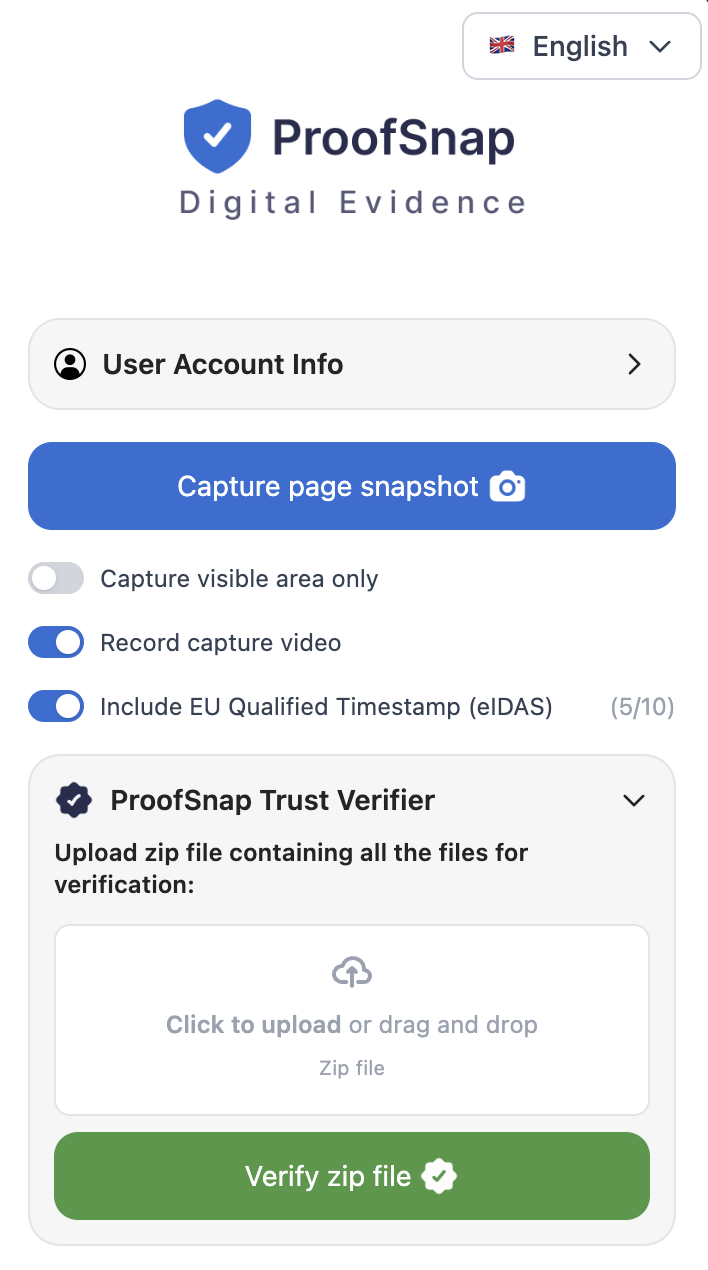
ProofSnap runs as a side panel in Chrome and Edge. You open the candidate's profile, click once, and 41 seconds later a signed evidence package lands in your downloads folder. Nothing is uploaded to us.
Every capture produces a package of 11 to 15 files, depending on your plan:
- • The full-page screenshot and the underlying HTML source
- • The extracted page text, so the claims stay searchable
- • A metadata file with the TLS certificate, DNS, WHOIS and HTTP response headers
- • A chain-of-custody document and a tamper-evident forensic log
- • A manifest signed with an RSA-4096 key, the signature and the public key
- • Verification scripts a third party can run offline, with no ProofSnap account, or through the public Trust Verifier
- • Optional: an OpenTimestamps Bitcoin anchor, an eIDAS qualified timestamp from a Qualified Trust Service Provider on the EU Trusted List, and a US Rule 902(13)/(14) certification template
Not ready for a subscription? SnapPack, $4.99
A one-time purchase of 10 captures. No subscription, no auto-renewal, no trial to remember to cancel. Enough to document a full shortlist of five candidates twice over, and the credits stay valid for 12 months.
Get SnapPack, 10 captures for $4.99The four-step protocol: two minutes per candidate
Capture all five candidates' LinkedIn profiles, 41 seconds each. The trusted timestamp fixes the profile state before the interview.
Capture evaluation notes in your ATS (Workday, Greenhouse, Lever). Proof that the decision was based on competencies, not discriminatory criteria.
Capture the final profile and resume of the selected candidate. If the LinkedIn profile changes afterwards, you still hold the original, with the job description captured alongside it.
If the employee claims wrongful termination or discrimination, the ZIP goes straight to your employment lawyer as a package that already meets FRE 901 authentication.
ATS compatibility: ProofSnap captures the screen of any web-based system, including Workday Recruiting, Greenhouse, Lever, BambooHR and SAP SuccessFactors. Direct API integration is planned for later in 2026.
Installs in 30 seconds. One click produces a capture in 41 seconds. The 7-day trial requires a payment card. SnapPack at $4.99 is a one-time purchase with no subscription and no auto-renewal.
The two pillars of digital truth
Instead of navigating dozens of local laws, ProofSnap anchors evidence in two globally recognized standards:
Pillar 1: RFC 3161
Digital Authenticity Standard
RFC 3161 is the IETF standard for trusted timestamps, used by governments, banks and courts worldwide. ProofSnap timestamps follow it, which is why the same evidence format reads the same way in New York, Sydney and London.
Pillar 2: Bitcoin Blockchain
Immutable Ledger
Evidence is anchored in the Bitcoin network through OpenTimestamps blockchain timestamping, a decentralized ledger that no single entity controls. The value in a dispute is narrow but decisive: nobody, including ProofSnap, can move the moment your capture was sealed.
Why this matters: when you hire across borders, a local screenshot travels badly. A cryptographic seal built on published standards can be verified by anyone, in any jurisdiction, without trusting the party that produced it.
What is chain of custody in hiring?
Chain of custody is an unbroken forensic record showing that digital evidence has not been altered between collection and court. In hiring, that means documenting every candidate touchpoint (the LinkedIn profile, the job offer, the portal exchange) with a SHA-256 hash and a trusted timestamp. It speaks to the authentication requirements in FRE 901 (US), the Civil Evidence Act 1995 (UK) and the Evidence Act 1995 (Australia), and it matters most in discrimination claims, wrongful termination defense and unfair dismissal proceedings.
10 takeaways for HR teams in the US, UK, Australia and New Zealand
- 1 1 in 4 candidate profiles will be fake by 2028, according to Gartner's July 2025 survey of 3,000 candidates, in which 6% admitted to interview fraud. Reference calls alone no longer close that gap.
- 2 The profile is the perishable evidence. A candidate can edit or delete it in seconds, and LinkedIn removes tens of millions of accounts a year. Capture at first contact or accept that it may be gone.
- 3 Identity fraud is now an attacker technique, not just a hiring nuisance. CrowdStrike attributes a 220% year-on-year rise to one DPRK-linked group that reached more than 320 companies in twelve months.
- 4 EEOC exposure is rising. The agency received 88,531 charges in FY2024, up 9.2%, and recovered nearly $700 million for more than 21,000 workers. A position statement is due within about 30 days of notice, so the documentation has to already exist.
- 5 Section 1981 is the uncapped US risk. Race discrimination claims under 42 U.S.C. § 1981 carry no damages cap, unlike Title VII's $300,000 ceiling, and run on a four-year statute of limitations.
- 6 In the UK the burden flips. Under Section 136 of the Equality Act 2010, once a claimant shows facts from which discrimination could be inferred, the employer has to prove the reason was something else.
- 7 Australia's bigger risk is General Protections, not unfair dismissal. No minimum employment period, no compensation cap, and a reverse onus on the employer. The Fair Work Commission received 6,209 such applications in 2024-25.
- 8 New Zealand's good faith duty is a documentation duty. The Employment Relations Act 2000 expects employers to be able to show what was promised during recruitment. Where a promise is undocumented, the dispute is usually decided against the employer.
- 9 Contemporaneous beats comprehensive. Every jurisdiction on this list rewards evidence that demonstrably existed at the time of the decision, and discounts a file assembled after the claim landed.
- 10 The economics are not close. ProofSnap costs $80 per seat per year on the Essential annual plan, or $160 on Professional. For a verifiable comparison, the EEOC alone recovered nearly $700 million for over 21,000 workers in FY2024, an average of roughly $33,000 per worker before any private litigation.
Hiring Fraud and Employment Claims: Verified 2025-2026 Figures
6%
Of 3,000 surveyed candidates admitted taking part in interview fraud, either posing as someone else or having someone pose as them
Source: Gartner candidate survey, 2025
83M+
Fake LinkedIn accounts removed in the first half of 2025, with 99.7% stopped before any member report
Source: LinkedIn Community Report
+220%
Year-on-year growth in DPRK-linked fake IT worker infiltration, reaching more than 320 companies in twelve months
88,531
Discrimination charges received by the EEOC in FY2024, up 9.2%, with nearly $700 million recovered for over 21,000 workers
Source: EEOC FY2024 reports
93,000
UK Employment Tribunal claims received in 2023/24 (34,000 single, 59,000 multiple), with single claims up 8% year-on-year
Source: MoJ Tribunal Statistics
£53,403
Average UK tribunal award for sex discrimination in 2023/24 (disability £44,483, race £29,532; medians are far lower, at £16,161, £17,218 and £10,253)
44,074
Applications lodged with Australia's Fair Work Commission in 2024-25, 24% above its five-year average; 6,209 were General Protections dismissal applications
Legal Term (USA)
FRE 901
Federal Rules of Evidence, Rule 901: the authentication requirement for digital evidence. The proponent must produce evidence sufficient to support a finding that the item is what the proponent claims it is. A hash plus a trusted timestamp is how a captured page meets that bar.
Source: Cornell Law
Legal Term (UK)
Equality Act 2010
The UK's primary anti-discrimination law. Under Section 136, the burden of proof shifts to the employer once the employee shows prima facie discrimination. The employer must then prove a non-discriminatory reason with evidence.
Source: UK Legislation
Legal Term (USA)
Section 1981
42 U.S.C. § 1981: federal law prohibiting race discrimination in contracts, including employment. No damages cap, unlike Title VII's $300,000 limit. Jury trials available, and a four-year statute of limitations. For most US employers this is the largest single exposure.
Source: Cornell Law
Legal Term (USA)
NYC Local Law 144
A New York City law requiring bias audits of automated employment decision tools (AEDT). It applies to AI screening, chatbots and resume parsers, and requires an annual audit together with a published summary. Penalties run from $500 for a first violation up to $1,500 for each subsequent one.
Source: NYC DCWP
Technical Standard
SHA-256 (FIPS 180-4)
The Secure Hash Standard specifies SHA-256, an approved algorithm for use inside FIPS-validated cryptographic modules. Note the distinction a security reviewer will make: FIPS 140-2 and its successor FIPS 140-3 validate modules, not algorithms. ProofSnap uses standard SHA-256 and RSA-4096 rather than custom cryptography.
Source: NIST FIPS 180-4
Legal Concept (USA)
At-Will Employment
Employment can be terminated by either party for any reason except an illegal one, such as discrimination or retaliation. At-will status does not prevent a lawsuit. It only means you have to be able to show the reason was legitimate.
Source: employment law doctrine, applied in 49 US states
Legal Term (USA)
Title VII (Civil Rights Act of 1964)
Federal law prohibiting employment discrimination based on race, color, religion, sex, or national origin. Damages capped at $300,000. EEOC enforces. Employer must prove legitimate non-discriminatory reason with documented evidence.
Source: Cornell Law
Security Threat
Proxy Interview Fraud
A professional stand-in takes the video interview on behalf of the actual candidate, and the person who starts on day one is not the person who was interviewed. The best-documented variant is state-sponsored: CrowdStrike's 2025 Threat Hunting Report records a 220% year-on-year rise in DPRK-linked fake IT worker infiltration, reaching more than 320 companies in twelve months.
Source: CrowdStrike
Technology
Bitcoin Blockchain Timestamp
A cryptographic hash anchored in the Bitcoin network, showing that a document existed in that exact form at a given time. No single party, including ProofSnap, can move the anchor afterwards. Courts increasingly treat it as strong authentication evidence, though weight remains a matter for the tribunal.
Source: IETF RFC 3161
When is a capture worth taking? A decision matrix
| Scenario | Use ProofSnap? | Why |
|---|---|---|
| First contact with candidate (LinkedIn InMail) | YES | Establishes chain of custody; captures original profile before modification |
| Sending job offer through portal | YES | Documents exact terms; prevents ghosting disputes |
| Rejecting a candidate | YES | Archives objective criteria for EEOC/discrimination defense |
| Video interview with remote candidate | YES | Captures identity for proxy interview fraud prevention |
| Terminating during probation for resume fraud | CRITICAL | You need the original claims captured before the employee edits the profile |
| Internal team communications | Optional | Useful for whistleblower cases, not essential for routine hiring |
The five-step hiring evidence checklist
Total time: about five minutes per candidate, spread across five points you already touch.
Should your company use blockchain evidence for hiring?
Yes, if you hire remotely, operate across jurisdictions, have faced or expect discrimination claims, or want to cut the time your lawyers spend authenticating documents in discovery.
The arithmetic: a ProofSnap seat is $80 a year on the Essential annual plan, $160 on Professional. Set that against a UK tribunal discrimination award averaging £29,532 to £53,403 in 2023/24, or against the nearly $700 million the EEOC recovered for workers in FY2024. Preventing one six-figure outcome covers a ten-person recruiting team for decades.
The key point: the side with contemporaneous documentation is the side that does not have to explain itself. A hash and a trusted timestamp shift the argument from “can we trust this file?” to the merits of the case.
The common law advantage: who has to prove the file is real
In common law jurisdictions (the United States, the United Kingdom, Canada, Australia, New Zealand and Ireland), the burden of authentication rests on the party offering the evidence. That rule is stated plainly in the US Federal Rules of Evidence:
“To satisfy the requirement of authenticating or identifying an item of evidence, the proponent must produce evidence sufficient to support a finding that the item is what the proponent claims it is.”
What that means in a hiring dispute: a screenshot puts the recruiter on the stand to explain how it was taken. A signed package with a hash and a trusted timestamp answers the question in the file itself, and it answers it the same way in a US federal court, a UK employment tribunal, a Canadian human rights commission or the Fair Work Commission. It is not a guarantee of admissibility, which always remains the judge's call, but it removes the objection that is easiest to make.
Global coverage by jurisdiction
| Region | Legal Risk Addressed | ProofSnap Value |
|---|---|---|
| USA | EEOC & Title VII Claims, Section 1981 | An objective audit trail for every hiring decision, in an FRE 901-compliant form. |
| UK / EU | GDPR & Equality Act 2010 | Local-first storage of candidate data, and a burden-of-proof defence under Section 136. |
| Canada | CHRC Compliance, Human Rights Acts | Evidence against systemic bias allegations. Provincial compliance. |
| Australia | Fair Work Act, Unfair Dismissal, Privacy Act 1988 | A trusted timestamp shows the evidence existed at the time of the decision, which is what the Fair Work Commission asks for. Data stays on your own systems. |
| New Zealand | Employment Relations Act 2000, "Good Faith" requirement, Privacy Act 2020 | “Good faith” documentation of all promises. Personal grievance defence before the Employment Relations Authority. Data stays in your jurisdiction. |
| Global | Remote identity fraud (DPRK-linked infiltration up 220% year-on-year, CrowdStrike 2025) | Verification: "Who you interviewed is who you hired." |
One tool, one process. RFC 3161 timestamps and a Bitcoin anchor are both published mechanisms, so the same package can be checked anywhere.
Screenshot vs. ATS audit trail vs. ProofSnap
| Feature | Regular Screenshot | ATS Audit Trail (Workday, Greenhouse) |
ProofSnap Evidence |
|---|---|---|---|
| Chain of custody | No | Partial (internal logs) | Yes (Blockchain + SHA-256) |
| FRE 901-compliant (US) | Questionable | Supportive (business record) | Yes (Authentication met) |
| E-discovery ready | No (requires processing) | Partial (export needed) | Yes (ZIP with metadata) |
| Survives Inspect Element | No | N/A (internal system) | Yes (HTML source captured) |
| Time-stamped | EXIF (modifiable) | Server clock (vendor-controlled) | Bitcoin blockchain (immutable) |
| TLS server certificate | No | No | Yes (source verification) |
| Captures external profiles | Yes (but no integrity proof) | No (internal data only) | Yes (with full provenance) |
| Deposition-ready | Easily challenged | Moderate (vendor testimony needed) | Cryptographically provable |
| Opposing counsel attack surface | High | Medium (admin access concerns) | Minimal |
An unbroken chain of custody, from LinkedIn to the courtroom
How ProofSnap establishes defensible evidence at every hiring stage
Sourcing
LinkedIn, CV, portfolio
Screening
Tests, AI chat, scorecards
Reference
Background check, certs
Offer
Terms, conditions
Archive
Court-ready package
Sourcing
LinkedIn profile, CV, portfolio
Screening
Tests, AI chat, scorecards
Reference
Background check, certifications
Offer
Terms, conditions, acceptance
Archive
Court-ready evidence package
Key: every step is one click. A SHA-256 hash and a trusted timestamp together produce litigation-ready evidence for EEOC proceedings in the US, employment tribunals in the UK, the Fair Work Commission in Australia and the Employment Relations Authority in New Zealand.
Why hiring disputes now turn on documentation
The reality: the UK Employment Tribunal received roughly 93,000 claims in 2023/24 (34,000 single and 59,000 multiple), with single claims up 8% year-on-year, according to Ministry of Justice tribunal statistics. In the same window the EEOC took in 88,531 charges. HR teams are not shopping for nice tools. They are shopping for documentation that holds up.
Five years ago, checking a candidate meant reading the LinkedIn profile and calling two references. That no longer separates a real career from a generated one. Generative AI produces a plausible profile, a matching resume and invented certifications in minutes, and the same tools now sit in the video call.
What a hiring dispute actually costs:
- • US wrongful termination: settlements are commonly cited in the six figures, though published ranges vary widely and no official average exists
- • EEOC charge response: legal fees, document production and management time, with a position statement due about 30 days after notice
- • UK tribunal discrimination awards, 2023/24: average £53,403 for sex discrimination, £44,483 for disability, £29,532 for race. Medians are far lower, at £16,161, £17,218 and £10,253. Awards are uncapped, and the highest single award that year was £995,128
- • UK IR35 exposure: back taxes, National Insurance contributions and penalties, assessed against the hiring organisation since the 2021 reforms
- • Australia: General Protections claims carry no compensation cap and can be brought from day one of employment
"Where the employee has established facts from which the tribunal could conclude that there has been a contravention, the burden shifts to the employer to prove that there was no contravention."
The effect of Section 136, Equality Act 2010, as applied in Efobi v Royal Mail Group Ltd [2021] UKSC 33
What changed in 2026
An HR team that cannot show contemporaneous documentation now faces three compounding problems: a reversed burden of proof it cannot discharge, discovery costs spent authenticating its own files, and settlement pressure that has nothing to do with the merits.
See exactly what a court receives
Download a real evidence package, the same ZIP that gets submitted as proof. Or send any URL to support@getproofsnap.com and we will capture it for you free of charge.
Download Sample PackageHow to establish chain of custody for every candidate touchpoint
The problem: your evidence has gaps
Consider a common sequence. You terminate an employee for falsifying their resume. Three weeks later the EEOC sends an inquiry, because the employee has filed a discrimination charge. You now need to show:
- • What the employee's LinkedIn profile showed when you hired them
- • What their resume claimed
- • What you discovered during your investigation
- • That none of this evidence was created or modified after the fact
Problem? The employee modified their LinkedIn profile after termination. Your HR system logs can be challenged as "company-controlled." It's your word against theirs.
What one click actually freezes
With one click, you "freeze" evidence at the moment of each hiring milestone:
- • Screenshot of exact profile/document state
- • HTML source code (shows the content was not altered through Inspect Element)
- • SHA-256 cryptographic hash (any change breaks the seal)
- • Bitcoin blockchain timestamp (immutable, third-party verified)
- • TLS certificate (proves source authenticity)
Benefit: the package speaks to authentication requirements in several jurisdictions at once, including FRE 901 in the US, tribunal practice in the UK and Fair Work Commission practice in Australia. Opposing counsel can still object, but the objection now costs them expert evidence rather than a rhetorical question.
EEOC compliance and the Title VII defense
The EEOC reality check
In FY2024 the EEOC received 88,531 discrimination charges, up 9.2% on the previous year, and secured nearly $700 million for more than 21,000 workers, its highest recovery in recent history (EEOC FY2024 reports). When a charge is filed, your position statement is typically due within about 30 days. Whatever documentation exists at that moment is the documentation you get to use.
What to capture at each decision point
Create contemporaneous documentation at each decision point:
- • Interview scorecards: capture immediately after the interview
- • Test results: capture the Codility or HackerRank score page with a timestamp
- • Rejection rationale: record the objective criteria at the time of the decision
- • Comparison data: capture all candidate ratings side by side
Value: when an EEOC investigator asks why you rejected a candidate, you produce timestamped evidence showing that the decision rested on objective criteria documented before the complaint.
Title VII: the burden of proof problem
Under Title VII of the Civil Rights Act of 1964, once an employee establishes a prima facie case (membership in a protected class plus an adverse action), the burden shifts to the employer to articulate a legitimate, non-discriminatory reason. Without contemporaneous documentation you are assembling that reason after the fact, and opposing counsel will spend the deposition on exactly that point.
The at-will myth, and terminating during probation for resume fraud
At-will employment is not immunity from lawsuits
At-will employment applies in 49 US states, and it is routinely read as “I can fire anyone for any reason.” It means any reason except an illegal one. Discrimination, retaliation and whistleblower retaliation all create liability regardless of at-will status.
When a terminated employee claims the “real reason” was discrimination:
- • Your stated reason: Poor performance
- • Their claim: The "poor performance" was pretextual; real reason was age/race/gender
- • What you need: contemporaneous documentation showing that the performance problem existed before the termination decision
The hard case: terminating during probation for resume fraud
You discover an employee lied on their resume during the probation period. You want to terminate. They sue claiming discrimination. The problem:
- • The employee has already modified their LinkedIn profile, so the false claim is gone
- • Their resume on file? They claim “HR must have edited it”
- • Without forensic evidence, it's your word against theirs
- • What a jury sees is a protected-class employee terminated during probation, which invites the inference the claimant wants
Solution: capture the LinkedIn profile on the hire date. When the employee edits it later, you still hold a timestamped record of what was originally claimed, which is the fact the case turns on.
Building the termination file
Build your termination file with blockchain-sealed evidence:
- • The original LinkedIn profile: capture at first contact, before it can be edited
- • Performance reviews: capture the review portal on the dates the reviews happen
- • Warnings: capture the email or Slack warning with a timestamp
- • Comparators: record how you handled similar issues with employees outside the protected class
- • The discrepancy itself: capture it the moment you find it in the resume
Value: your defense attorney has a complete, cryptographically sealed record. Discovery becomes presentation rather than excavation.
Proxy interviews and identity fraud in remote hiring
What the 220% figure actually measures
The CrowdStrike 2025 Threat Hunting Report attributes a 220% year-on-year increase to one specific actor: the DPRK-linked group FAMOUS CHOLLIMA, which reached more than 320 companies in twelve months using AI-written resumes and real-time deepfakes in video interviews. It is not a general measure of interview fraud, and that distinction matters when you take the number to your board. The ordinary version of the same problem is simpler: a professional stand-in takes the video interview, and a different person appears on day one, or nobody appears at all once the onboarding documents have been sent.
The problem is particularly acute in remote technical hiring:
- • Proxy interviews: a skilled impostor takes the technical interview and an unqualified person gets hired
- • Deepfake overlays: Real-time face-swapping during video calls
- • Identity theft: Scammers use stolen identities to pass background checks
- • Ghost employees: Hired person never appears; data/access theft risk
Building an identity record across the process
Create a forensic identity record at each stage:
- • Initial screen: capture the video thumbnail together with the profile
- • Technical test: capture the screen with the candidate's face visible
- • Final interview: capture the Zoom or Teams call metadata
- • Onboarding: compare the archived images with the person on camera
Value: if the person on day one does not match the person in the archived interview material, you have documented grounds for termination and for a fraud investigation, rather than a recollection.
Verification without biometrics
ProofSnap runs no facial recognition and builds no biometric template. It documents what was presented at each stage, so a later inconsistency becomes visible by comparison rather than by inference. That distinction is what keeps the approach usable under the GDPR, the Australian Privacy Act 1988 and the New Zealand Privacy Act 2020.
Hiring across borders is now the default
In 2026, hiring across borders is ordinary. An engineering team can interview a developer in Bangalore, a designer in Berlin and a product manager in São Paulo in the same week.
The Problem:
When hiring across borders, local screenshots are worthless. A PNG file captured in London means nothing to a court in New York. An Indian timestamp has no legal weight in Australia. You need a globally verifiable cryptographic seal.
The Solution:
ProofSnap anchors evidence in RFC 3161 timestamps, the IETF standard, and in the Bitcoin blockchain through OpenTimestamps. Both are published, independently checkable mechanisms, so a package captured in London can be verified in New York, Sydney or Singapore without anyone taking your word for it.
AI hiring tool audits: NYC Local Law 144 and the state laws behind it
NYC Local Law 144: what an AEDT obliges you to do
If you use an automated employment decision tool (AEDT) for hiring in New York City, a category that covers AI screening, chatbots, resume parsers and video interview analysis, you must:
- → Conduct an annual bias audit by an independent auditor, analyzing impact ratios by sex and by race or ethnicity
- → Publish audit summary on careers page (must be accessible)
- → Notify candidates 10 business days before AEDT use
- → Provide alternative selection process if candidate requests
Penalties: $500 for a first violation and up to $1,500 for each subsequent one. Each candidate counts as a separate violation.
AI transparency in hiring: the wider regulatory wave
NYC is just the beginning. The EU AI Act adds further obligations for AI hiring tools. Similar laws are active or pending in Illinois (the Artificial Intelligence Video Interview Act), California (the CCPA plus proposed AI hiring regulations), Colorado (an AI Act taking effect in 2026) and Maryland (facial recognition in hiring restricted). If you operate in multiple states, you need a unified documentation approach.
When your annual auditor asks "What did your AI chatbot say to this candidate?", you need more than server logs (which can be challenged as company-controlled). You need independent, blockchain-sealed records.
ProofSnap as AI "Black Box" Recorder
ProofSnap archives all interactions with your recruitment AI:
- • Exact candidate question/input
- • AI response/recommendation
- • A timestamp sealed outside your infrastructure, not read off your own servers
- • Context and session data
- • Model version identifier
Audit value: when your annual bias auditor asks what the AI said to a given candidate, you produce a forensic record rather than an export from the database you control.
UK Equality Act 2010: defending a reversed burden of proof
Section 136: how the burden actually shifts
Under Section 136 of the Equality Act 2010, if an employee shows facts from which a tribunal could conclude that discrimination occurred, the burden shifts to the employer, who then has to prove that it did not. That is close to impossible without contemporaneous documentation.
The volume and the exposure both moved in 2023/24, the most recent full year of published Ministry of Justice figures:
- • Roughly 93,000 claims received, made up of 34,000 single and 59,000 multiple claims
- • Single claims up 8% year-on-year, multiples up 7%
- • Average discrimination awards of £53,403 (sex), £44,483 (disability) and £29,532 (race), with medians of £16,161, £17,218 and £10,253
- • Discrimination awards are uncapped. The highest single award that year was £995,128
Building the tribunal file
Build your defense file with blockchain-sealed evidence:
- • The job advertisement: capture it, to show the criteria were objective
- • All candidate profiles: to show equal treatment in sourcing
- • Interview scorecards: to show a standardized evaluation
- • Rejection rationale: recorded before the rejection email goes out
Value: when a tribunal asks why you rejected a candidate, you produce evidence created at the time of the decision, not after a claim was filed.
UK Specific: IR35 & Contractor Fraud
IR35, the off-payroll working rules, is one of the biggest compliance headaches for UK hiring teams. Since the 2021 reforms the hiring organisation, not the contractor, determines employment status and bears liability for getting it wrong. HMRC can pursue back taxes, National Insurance contributions and penalties.
- • Status Determination Statement (SDS): capture the SDS and the reasoning at the time of engagement, not after HMRC queries it
- • The contractor's working arrangements: capture the original scope of work, the communication patterns and the degree of control at the start of the engagement
- • Disputed changes: If a contractor's working pattern changes mid-engagement, archive the new arrangement with a fresh timestamp
Why it helps: when HMRC challenges the determination two years later, you have timestamped evidence of the working arrangement as it existed at the time, rather than a reconstruction from memory and email threads.
Right to Work checks under the Immigration Act 2014
UK employers face civil penalties of up to £60,000 per illegal worker, raised from £20,000 in February 2024, and potential criminal prosecution. Right to Work checks must be conducted before employment starts and documented. The Home Office expects employers to retain copies of identity documents with clear records of when checks were performed.
ProofSnap adds: a trusted timestamp on the Right to Work verification screen shows the check was performed before employment started, rather than backdated after a Home Office inquiry. That is the evidential half of the statutory excuse defence.
UK GDPR & ICO Compliance
Archiving candidate data raises questions under UK GDPR. Your Data Protection Officer (DPO) will want answers:
- • Lawful basis: Article 6(1)(f) legitimate interest. Defending against employment claims is a recognised legitimate interest, so document your Legitimate Interest Assessment (LIA)
- • DPIA: if you archive candidate profiles systematically, consider a Data Protection Impact Assessment. The ICO recommends one for systematic monitoring of data subjects
- • Privacy notice: Update your candidate-facing privacy notice to include: what you capture, why (legal defence), how long you retain it and how candidates can request deletion
- • Retention periods: Tribunal claims must be filed within 3 months (extendable to 6). Recommended retention: 6 months for unsuccessful candidates, 6 years for employees (Limitation Act 1980)
Architecture note: the evidence package is stored on your company's systems, not uploaded to a ProofSnap cloud, and the value anchored in the blockchain is a hash that contains no personal data. That materially simplifies the DPIA and sits well with ICO expectations on data minimisation.
UK tribunal context
In Efobi v Royal Mail Group Ltd [2021] UKSC 33, the Supreme Court clarified that Section 136 requires the claimant to prove facts from which discrimination could be inferred. Once that threshold is met, the employer has to provide a credible, evidence-backed explanation. Tribunals are sceptical of explanations assembled after the claim, which is why contemporaneous documentation is the strongest defence available.
Australia and New Zealand: Fair Work, General Protections and good faith
Why documentation carries more weight in Australia and New Zealand
Australia and New Zealand have some of the most employee-protective employment laws in the common law world. For multinational HR teams the nuances matter, and so does the documentation behind every decision.
New Zealand: The "Good Faith" Shield
Under New Zealand's Employment Relations Act 2000, employers are legally required to act in good faith throughout the employment relationship. This includes:
- • Providing accurate information during recruitment
- • Documenting all promises made in job portals and interviews
- • Maintaining records of all candidate communications
The risk: if a candidate says you promised something in your recruitment portal and you have no record of what the portal said, the Employment Relations Authority will often prefer the employee's account. The good faith burden sits with the employer.
What to do: archive the job portal, the offer terms and the candidate correspondence with a trusted timestamp. The dispute then turns on what was communicated, which is a question the file answers.
Australia: Fair Work Commission Reality
Australia's Fair Work Commission received 44,074 applications in 2024-25, 24% above its five-year average, with unfair dismissal accounting for about 37% of lodgements. That makes it one of the most active employment dispute bodies in the common law world. When you terminate for CV fraud, the Commission looks for:
- • Evidence that existed at the time of the decision, not reconstructed after the claim
- • Documentation of what the employee originally claimed
- • Proof the discrepancy was discovered through legitimate means
Fair Work Commission Standard: "Did the employer have reasonable grounds for termination at the time of the decision?" Without forensic evidence from the time of hiring, your "reasonable grounds" become your word against theirs.
Why it helps: the timestamp fixes the state of the LinkedIn profile on the hire date. If the profile is edited after termination, the archived version does not change with it, and the Commission sees what you saw when you decided.
Australia: General Protections claims (Sections 340 to 343 of the Fair Work Act 2009)
Most international HR teams focus on unfair dismissal, but General Protections claims are often the bigger risk. Key differences:
- • No minimum employment period. An employee can claim from day one, whereas unfair dismissal requires six months, or twelve for small businesses
- • Uncapped compensation, unlike unfair dismissal's cap of 26 weeks' pay or half the high income threshold
- • Reverse burden of proof. Once the employee alleges a workplace right was exercised, the employer must prove the adverse action was not because of that right
- • Broader grounds, covering workplace rights, industrial activities, discrimination, sham contracting and temporary absence through illness
Why it matters here: because a General Protections claim can arrive on day one with no cap, the rationale has to be documented from the first contact rather than at termination. There were 6,209 such applications in 2024-25, up 13% on the previous year. A timestamped record of the objective criteria you applied is the practical answer to a reversed onus.
The Small Business Fair Dismissal Code (fewer than 15 employees)
Australian businesses with fewer than 15 employees are covered by the Small Business Fair Dismissal Code. If you follow the Code, you have a complete defence against unfair dismissal claims. The Code requires:
- • A valid reason related to capacity or conduct
- • The employee was warned and given an opportunity to improve (for performance issues)
- • 12-month minimum employment period (vs 6 months for larger employers)
ProofSnap adds: capture the warning conversations and the performance improvement plan with a trusted timestamp. If the employee later says they were never warned, the timestamped record answers that directly. This matters most for small businesses without a dedicated HR function.
Fair Work Commission context
In Streeter v Telstra Corporation Limited [2008] AIRCFB 15, the Australian Industrial Relations Commission, the predecessor of the Fair Work Commission, emphasised that an employer must show the factual basis for termination existed at the time of the decision rather than being assembled afterwards. That principle still guides Fair Work Commission decisions, and it is precisely what a trusted timestamp evidences: the file existed when you say it existed.
Identity fraud reaching ANZ from the Asia-Pacific region
Australia and New Zealand are seeing a rise in identity fraud attempts originating from the Asia-Pacific region, and remote hiring has widened the opening for them.
The Threat:
- • Sophisticated fake identities targeting ANZ tech companies
- • Professional proxy interview services operating across time zones
- • Industrial espionage disguised as legitimate job applications
- • Identity swapping between interview and onboarding
ProofSnap defence:
Document visual consistency across the process: the candidate on the video call, the LinkedIn profile and the identity verification step. Capture each touchpoint with a trusted timestamp. If the person who appears on day one does not match the archived interview material, you have documented grounds for termination and for a fraud investigation, which matters most when the motive is access rather than salary.
Privacy: keeping the evidence on your own systems avoids the exposure of a centralised third-party store, which supports your obligations under the Australian Privacy Act 1988 and the New Zealand Privacy Act 2020 on candidate data. It does not discharge them for you.
ANZ Anti-Discrimination: Broader Protected Characteristics
Australian and New Zealand anti-discrimination laws protect a broader range of characteristics than many other common law jurisdictions. HR teams hiring across ANZ must document decisions carefully across all of these:
Australia (Fair Work Act)
- • Family/carer responsibilities
- • Political opinion
- • Social origin
- • Trade union membership
New Zealand (Human Rights Act 1993)
- • Family status
- • Political opinion
- • Employment status
- • Sexual orientation (broader scope)
What to do: archive every rejected candidate with the same objective criteria documentation. When a single decision is questioned, you can show that all candidates were measured against identical standards, including the protected characteristics that are specific to Australian and New Zealand law.
Data sovereignty under the two Privacy Acts
Australia's Privacy Act 1988, overseen by the Office of the Australian Information Commissioner (OAIC), and New Zealand's Privacy Act 2020 both impose requirements on where personal data is stored and processed. Cloud-first HR tools regularly struggle with them.
ProofSnap's Data Sovereignty Model:
- • Evidence stored locally on your company's systems
- • No cloud upload of candidate data to external servers
- • The blockchain anchor contains only a hash, never personal data
- • Full control over data retention and deletion
ANZ Retention Period Guidance:
- • Australia: the Fair Work Act requires employee records to be kept for 7 years. For unsuccessful candidates, 6 to 12 months is a reasonable floor, or longer where a General Protections claim is plausible
- • New Zealand: the Employment Relations Act 2000 requires records to be kept for six years, and a personal grievance must be raised with the Employment Relations Authority within 90 days
- • Notifiable Data Breaches: Under Australia's NDB scheme, if archived evidence is compromised, you must report to the OAIC within 30 days. Local storage reduces that risk compared with cloud alternatives
For ANZ IT and legal teams: this architecture clears privacy reviews that stop cloud-only alternatives, because the candidate data never leaves systems you control.
Where a pre-authenticated package cuts e-discovery cost
The e-discovery cost problem
In US litigation, discovery is where cases are won or lost, and where budgets go. That spending covers document collection, review, privilege analysis, production and, when the other side disputes a file, expert testimony on authenticity. That last item is the one a pre-authenticated package removes.
The adversarial system is built on discovery in the US and disclosure in the UK. When opposing counsel sends document requests:
- • Without ProofSnap: Scramble through emails, HR system exports, disputed screenshots. Pay paralegals to authenticate. Pay experts to verify.
- • With ProofSnap: produce pre-authenticated evidence packages with the chain of custody already established, which speaks to FRE 901 in the US and to the evidential scrutiny a UK tribunal applies to documents produced after a claim.
What makes a package e-discovery ready
Each ProofSnap archive is e-discovery ready:
- • ZIP package: Self-contained evidence bundle
- • Hash verification: Proves no tampering
- • Blockchain timestamp: Third-party verified date
- • TLS certificate: Source authentication
- • PDF summary: Court-ready presentation
Where the saving comes from: the authenticity fight does not happen, so no expert is retained to verify the file and no paralegal hours go into reconstructing when it was created. The rest of discovery costs what it always did.
Section 1981 in the US and the Equality Act in the UK
The class action risk
A single hiring practice challenged as discriminatory can become class-wide liability, which is what turns an individual complaint into a balance-sheet item. The defense is the same in every jurisdiction on this page: show consistent, objective decision-making across all candidates, documented when the decisions were made.
Critical: Section 1981 (USA)
42 U.S.C. § 1981 is the largest single exposure for most US employers. Unlike Title VII, which caps damages at $300,000, Section 1981 race discrimination claims have no cap at all:
- • Uncapped compensatory damages
- • Uncapped punitive damages
- • Jury trials available (juries tend to be plaintiff-friendly)
- • 4-year statute of limitations (longer than Title VII)
Defense: timestamped evidence that the hiring or rejection decision rested on objective criteria, recorded before anyone contemplated litigation.
UK: Equality Act 2010
Under Section 136, once an employee shows facts suggesting discrimination, the burden shifts to the employer, who must then show that:
- • The decision was based on objective, job-related criteria
- • You applied the same criteria to all candidates
- • Documentation was created at the time of decision, not after claim
The UK numbers: around 93,000 tribunal claims in 2023/24, with single claims up 8% year-on-year. Average discrimination awards ran from £29,532 (race) to £53,403 (sex), and the highest single award that year was £995,128.
Capture the decision data in real time
"Freeze" objective data at the moment of decision:
- • The technical test results page (Codility, HackerRank, LeetCode)
- • Comparison table in ATS with all candidate ratings
- • Feedback forms from hiring managers
- • Scorecard with criteria and points
Value: documented evidence that the selected candidate scored better on the stated criteria, timestamped at the moment of decision rather than reconstructed afterwards.
Whistleblower reports under SOX and Dodd-Frank
The internal evidence problem
Under Sarbanes-Oxley (SOX) and Dodd-Frank, whistleblower retaliation claims can result in reinstatement, back pay, and double back pay as damages. When investigating internal complaints, you need evidence that cannot be challenged as "altered by management."
Putting the seal outside the company
When an employee reports misconduct:
- • Immediately archive the relevant communications (Slack, Teams, email)
- • The seal is anchored in the Bitcoin blockchain, which nobody inside the company controls
- • No internal administrator can modify or delete
- • Whistleblower has evidence that cannot be "disappeared"
Value: it demonstrates a good-faith investigation, and the integrity of the record is much harder to question because the anchor is held by a third party outside the company.
Executive ghosting: recovering the headhunter fee
A scenario every HR leader knows: a C-level candidate accepts an offer through your portal. You stop the search, reject the other finalists and schedule onboarding. Two weeks later, radio silence.
What a ghosted executive search actually costs
Retained executive search in London and New York is typically priced as a percentage of first-year compensation. Fees are negotiated and confidential, so treat the figures below as illustrative arithmetic on a commonly quoted 25% to 35% band rather than as published market data:
- • CFO at $400,000: search fee of roughly $100,000 to $140,000
- • VP Engineering at $350,000: roughly $87,500 to $122,500
- • General Counsel at $500,000: roughly $125,000 to $175,000
When a candidate ghosts after accepting, the search firm retains part of its fee under the engagement terms, the search restarts, and the finalists you rejected have taken other offers. The recoverable part of that loss depends entirely on what you can prove was agreed, and when.
When you finally reach the ghosting candidate, they claim:
- • “I never signed anything.”
- • “The offer terms were different from what I saw.”
- • “That clause wasn't in the portal.”
What to capture for a fee recovery claim
Capture the exact state of the portal at the moment of acceptance:
- • Screenshot of page with Accept button clicked
- • HTML code including all terms and conditions
- • Timestamp of acceptance (blockchain sealed)
- • TLS certificate proving portal authenticity
- • Candidate's IP/session data (proves they accessed the portal)
Value: documented grounds to pursue the search fee, any contractual penalty and the cost of restarting. It does not decide the dispute, but it removes the argument that nobody can prove what was accepted, or when.
Tell candidates the process is documented
Add "Offer acceptance is forensically documented for legal compliance" to your offer portal. The deterrent effect is real: candidates who intend to ghost tend to withdraw before accepting, which saves the whole downstream process.
What it costs, against what it protects
Cost comparison: US, UK and Australian markets
| Scenario | Typical exposure | Cost of one ProofSnap seat |
|---|---|---|
| Wrongful termination settlement (USA) | commonly six figures; no official average is published | $80 per year (Essential annual) |
| EEOC charge response (USA) | legal fees, production and management time, due in about 30 days | $80 per year (Essential annual) |
| Discrimination award, sex (UK, 2023/24 average) | £53,403 | roughly £65 per year |
| Discrimination award, disability (UK, 2023/24 average) | £44,483 | roughly £65 per year |
| IR35 determination challenged by HMRC (UK) | back taxes, NICs and penalties | roughly £65 per year |
| Executive ghosting: headhunter fee plus search restart | 25% to 35% of first-year compensation, plus 3 to 6 months of lost time | $80 per year (Essential annual) |
| Unfair dismissal defence (Australia, Fair Work) | capped at 26 weeks' pay, plus your own legal costs | roughly A$120 per year |
| General Protections claim (Australia) | uncapped, and available from day one of employment | roughly A$120 per year |
Prices are charged in USD. The Essential annual plan is $80 per seat per year and Professional is $160; sterling and Australian dollar figures are approximate conversions, not separate price lists.
The bottom line
At $80 per seat per year, a ten-person recruiting team costs $800 a year to equip. Set that against a single UK discrimination award averaging tens of thousands of pounds, or a US charge that reaches litigation. The question is not whether the tool is affordable. It is whether you can afford to lose a case you would have won with documentation you could have captured in 41 seconds.
Rolling one evidence standard out across markets
Four arguments that get a company-wide rollout approved
1. Counsel reviews one format, not five
When a legal team at headquarters reviews evidence produced by an Auckland or Sydney office, it should not need an IT expert to explain how a screenshot was taken. A standardized package verifies the same way wherever it came from, which is where the cross-border review time actually goes.
2. Board-level risk reporting
"Every hiring decision across our markets is documented at the moment it is made, in a format a court can verify" is a sentence a board can act on. It reframes the recruiting function from a cost line to a measurable reduction in litigation exposure.
3. One process instead of regional variation
A team in Sydney produces the same package as a team in San Francisco, so there is no local exception to explain when the Fair Work Commission, the EEOC or the New Zealand Employment Relations Authority asks for documentation.
4. The standard survives staff turnover
Documentation quality usually depends on which recruiter handled the requisition. A one-click capture at fixed points in the funnel removes that variable, which is what makes the evidence trail worth anything two years later.
In short: a shared evidence standard is an operational decision before it is a compliance one. Consistency is what makes the record usable at the point where somebody disputes it.
One evidence standard, every jurisdiction
Sydney Office
Fair Work Act
Same evidence package
Auckland Office
Employment Relations Act
Same evidence package
London Office
Equality Act 2010
Same evidence package
San Francisco HQ
Title VII / EEOC
Same evidence package
RFC 3161 + Bitcoin blockchain = globally recognized chain of custody. Legal teams review evidence instantly, regardless of origin.
Where the five capture points sit in an existing hiring funnel
Capturing evidence is not extra work if it sits at checkpoints your funnel already has:
The five integration points
-
1
First contact: capture the candidate's LinkedIn profile as you send the first InMail. The chain of custody begins here.
-
2
Technical assessment: capture the test results page before advancing the candidate. The objective criteria are now on record.
-
3
Interview scorecards: capture the ATS scorecard immediately after the interview, while it is still contemporaneous.
-
4
Reference check: capture the profile of the person giving the reference, and the record of the conversation. That documents who actually vouched for the candidate.
-
5
Offer and acceptance: capture the exact portal state when the offer is sent and when the candidate clicks accept.
Deterrence Effect
Adding "Application materials are forensically documented for compliance purposes" to your job postings creates a strong deterrent against resume fraud. When candidates know their claims will be verified and preserved, they're far less likely to embellish.
Two scenarios, and what the evidence trail actually did
A terminated senior engineer files a discrimination charge, and the company has a 90-day evidence trail
Situation: a 300-person SaaS company hired a senior backend engineer whose LinkedIn profile listed eight years of experience at two well-known companies. During probation, the engineering lead found that the new hire could not perform at the stated level. HR terminated the employee within the 90-day probation period. Two weeks later, the company received an EEOC charge alleging racial discrimination.
What they had: the recruiting team had archived the candidate's original LinkedIn profile on the day of the first InMail, the technical assessment results page, the interview scorecard from the ATS and the performance improvement conversation, each with a trusted timestamp.
What happened: The candidate had modified their LinkedIn profile after termination, removing one of the claimed employers entirely. The company's archived evidence showed the original profile with the fabricated experience. Combined with the timestamped technical assessment scores (below the objective threshold), their employment counsel was able to present a clear, documented, non-discriminatory rationale. The EEOC closed the investigation without further action.
Note: Every case is different. Blockchain-timestamped evidence strengthens your position but does not guarantee outcomes. Always consult employment counsel for your specific situation.
A candidate ghosts after accepting, and the agency still recovers its placement fee
Situation: A London-based recruitment agency placed a product manager at a fintech client. The candidate accepted via the client's portal, then ghosted on Day 1. The client refused to pay the placement fee, claiming "no placement occurred."
What they had: the agency had captured the client portal showing the accepted offer status, with a trusted timestamp fixing the acceptance before the no-show.
Outcome: The agency's solicitor presented the timestamped evidence in a pre-action letter. The client paid the full placement fee without proceeding to tribunal. Total time archiving evidence throughout the process: under 10 minutes across 3 captures.
Note: Outcome depends on contract terms and jurisdiction. This illustrates how timestamped evidence can support commercial disputes, not just employment claims.
Frequently asked questions
How do I tell whether a profile photo was AI-generated?
Check the parts of an image that generators still handle badly: ears and earrings, glasses frames, the hairline, and the background at the edge of the head. Generated portraits also tend to place the eyes at the same height in every image. Then run a reverse image search, because a stolen real photo is more common than a generated one and far easier to confirm. Neither check is conclusive on its own, which is why the seven signals in this article are read together.
How long do I need to keep hiring records?
USA: the EEOC requires one year for applicant records, and three years where affirmative action obligations apply. UK: six months as a practical minimum, since a tribunal claim must generally be filed within three months, and six years for employee records under the Limitation Act 1980. Australia: seven years for employee records under the Fair Work Act. A ProofSnap package keeps its cryptographic integrity regardless of age.
What is the difference between Title VII and Section 1981?
Title VII covers race, color, religion, sex and national origin, with compensatory and punitive damages capped at $300,000 for the largest employers. Section 1981 (42 U.S.C. § 1981) covers race only, has no damages cap, and carries a four-year statute of limitations. For most US employers, Section 1981 is the larger exposure of the two.
Can a terminated employee sue in an at-will state?
Yes. At-will means you can terminate for any reason except an illegal one, such as discrimination or retaliation. An employee can always allege that the stated reason was pretextual and the real reason was a protected characteristic. At that point the question is what your file shows about why the decision was made, and when.
How does ProofSnap help during an EEOC investigation?
An EEOC investigation turns on whether the hiring or termination decision rested on a legitimate, non-discriminatory reason. ProofSnap archives scorecards, assessment results and candidate profiles at the moment of decision, with a timestamp showing the file was not created after the charge arrived. That is the difference between producing a record and reconstructing one.
How does the UK Equality Act 2010 burden of proof work?
Under Section 136, once the claimant shows facts from which a tribunal could conclude that discrimination occurred, the burden shifts to the employer to prove that it did not. Efobi v Royal Mail Group Ltd [2021] UKSC 33 confirmed how that threshold operates. Without objective criteria documented at the time of the decision, discharging the reversed burden is very difficult.
How does NYC Local Law 144 affect our AI hiring tools?
Local Law 144 requires an annual independent bias audit of automated employment decision tools, publication of the audit summary, and notice to candidates that an AEDT is being used, with an alternative process available on request. Penalties run from $500 for a first violation up to $1,500 for each subsequent one. Archiving the chatbot and screening interactions gives your auditor primary material rather than an export from the system under audit.
What is proxy interview fraud, and how do I prevent it?
A professional stand-in takes the video interview, and a different person turns up for work. It is most common in remote technical hiring. Prevention is comparison rather than detection: archive the LinkedIn profile, the interview scheduling page and the shared assessment material at each stage, so that any change in claims or identity markers between interview and onboarding is documented rather than remembered.
How does ProofSnap meet FRE 901 authentication requirements?
Rule 901(a) asks the proponent to produce evidence sufficient to support a finding that the item is what it is claimed to be. A ProofSnap package answers that with four things: a SHA-256 hash of every file, an RSA-4096 signature over the manifest, a trusted timestamp anchored outside your infrastructure, and the captured HTML source alongside the screenshot, so the rendered image can be checked against the underlying page. Admissibility remains the court's decision.
What if the LinkedIn profile is deleted?
The package is unaffected. ProofSnap captures the HTML source, the page text and the metadata, not only an image, so the archive holds the full content with a timestamp showing when it was taken. This is the ordinary case rather than the exception: candidates edit or remove profiles after an offer, and LinkedIn itself removes tens of millions of accounts a year.
Can opposing counsel challenge ProofSnap evidence in a deposition?
Yes, and they will, because every piece of evidence gets challenged. What changes is the cost of the challenge. The SHA-256 hash means any modification invalidates the signature, and the timestamp is verifiable on the public Bitcoin network by anyone, including the other side's expert. It does not make evidence unassailable. It removes the cheapest attack, which is simply asking how anyone knows the file was not edited.
How does ProofSnap fit with our ATS (Workday, Greenhouse, Lever)?
Each capture produces a ZIP that you attach to the candidate record. That works with Workday Recruiting (Attachments), Greenhouse (Files tab), Lever, BambooHR and SAP SuccessFactors (Documents). The sequence is capture, download, attach, and it takes under 60 seconds. Direct API integration is planned for later in 2026.
Is this usable in UK Employment Tribunals?
Yes. Tribunals apply less formal evidence rules than US courts, but they do scrutinise digital evidence, and they are sceptical of documents produced after a claim is filed. A timestamp and a hash address both concerns: they show the file existed on a given date and has not changed since. Weight remains a matter for the tribunal.
Is ProofSnap compatible with US privacy laws such as the CCPA?
ProofSnap captures information the candidate chose to publish and material they shared with you during the application. Documenting a hiring process for the purpose of defending against claims is a recognized business purpose. The evidence is stored on your systems rather than uploaded to us. See our privacy-first approach to GDPR compliance, and take state-specific advice from your privacy counsel.
What about GDPR for UK and EU candidates?
Article 6(1)(f) legitimate interest is the usual basis, since defending against employment claims is a recognised legitimate interest. Document the assessment, update the candidate privacy notice to say what you capture and why, and set a retention period. The data stays on your systems, and the value anchored in the blockchain is a hash containing no personal data.
Is ProofSnap subject to the FCRA for background checks?
ProofSnap captures publicly available information rather than producing a consumer report, so it is not a consumer reporting agency. If you rely on captured material in an adverse employment decision, follow your standard adverse action procedures anyway, and take advice from your employment counsel on your specific process.
How fast is a capture?
41 seconds. One click captures the page, the HTML source, the metadata and the TLS certificate, and starts the timestamping. The ZIP downloads automatically. Across a full hiring process, expect about five minutes per candidate to cover every milestone.
Do we need to tell candidates we are documenting the process?
You are capturing information the candidate published, so notice is not universally required, but transparency is the better call and it works in your favor. A line in the job posting saying that application materials are forensically documented for compliance purposes is a genuine deterrent against embellishment. Check jurisdiction-specific requirements with your employment counsel.
Will this pass an IT security review on cryptography?
ProofSnap uses SHA-256, specified in FIPS 180-4 and an approved algorithm for use in FIPS-validated modules, together with RSA-4096 signatures. Note the distinction your security team will make: FIPS 140-2 and its successor FIPS 140-3 validate cryptographic modules, not algorithms, and ProofSnap is not itself a validated module. The relevant point for a review is that there is no custom or unvetted cryptography in the evidence pipeline.
How do I get IT and security approval?
The five points a security team asks about: evidence is stored locally and never uploaded to ProofSnap servers; the cryptography is standard SHA-256 and RSA-4096; the browser extension requests a defined permission set; captures cover publicly visible information; and the timestamp anchor is public infrastructure, so there is no vendor lock-in on verification. Most reviews conclude within one to two weeks.
We have offices in London and New York. Does one process cover both?
Yes. The same package speaks to FRE 901 authentication in the US and to tribunal practice in the UK, where the Civil Evidence Act 1995 governs documentary and hearsay evidence. That gives your team one process rather than one per jurisdiction. Admissibility is still decided case by case by the court or tribunal hearing it.
How does this help with an Australian unfair dismissal claim?
The Fair Work Commission asks whether the employer had a valid reason at the time of the decision. When you terminate for CV fraud during probation, you need what the employee originally claimed, captured before they could edit it. The timestamp fixes the profile state on the hire date. With 44,074 applications lodged in 2024-25, the Commission sees a great many files that were assembled after the fact.
What is New Zealand's good faith requirement?
The Employment Relations Act 2000 requires employers to act in good faith throughout the relationship, which includes providing accurate information during recruitment and being able to show what was promised. If a candidate says the portal promised something and there is no record of what the portal said, the Employment Relations Authority will often prefer their account. Archiving the portal and the offer terms answers the question directly.
Does this work with the Australian and New Zealand Privacy Acts?
The architecture helps in the two places those Acts are usually tightest. Evidence stays on your company's systems rather than a third-party cloud, and the blockchain anchor holds a hash rather than personal data. You still owe the ordinary obligations under the Privacy Act 1988 and the Privacy Act 2020: notice, purpose limitation, retention and security. The tool makes those easier to satisfy, not unnecessary.
We are seeing identity fraud from the Asia-Pacific region. Does this help?
It helps by making inconsistency visible. Capture the LinkedIn photo, the video interview material and the onboarding identity verification, each with a timestamp. If the person who appears on day one does not match the archived interview material, you have documented grounds for termination and for a fraud investigation. Where the motive is access to systems rather than salary, that record is also what your security team needs.
Is ProofSnap a deductible business expense?
For most companies, yes: it is a compliance and risk management tool. At $80 per seat per year on the Essential annual plan, or $160 on Professional, the deduction is small and the arithmetic against a single defended claim is straightforward. Confirm the treatment with your tax advisor.
Sources and further reading
Authoritative HR & Recruiting Resources
SHRM: Recruiting & Talent Acquisition
Society for Human Resource Management, the world's largest HR professional organization. Recruiting best practices, background screening guidance and compliance updates.
Harvard Business Review: Hiring & Recruitment
Research-backed articles on hiring strategy, candidate evaluation, and reducing bias in recruitment processes.
LinkedIn Talent Blog
Official LinkedIn insights on recruiting trends, platform integrity, and talent acquisition strategies from the world's largest professional network.
CIPD: Recruitment Factsheet
Chartered Institute of Personnel and Development, the UK's professional body for HR. Evidence-based recruitment practices and legal compliance frameworks.
HR Dive
Leading HR industry news covering talent acquisition, employment law, workplace fraud, and AI in hiring. Part of Industry Dive media network.
ERE: Recruiting Intelligence
Premier recruiting industry publication. Expert analysis on sourcing, screening, candidate verification, and recruiting technology trends.
Josh Bersin
Global HR industry analyst and thought leader. Research on AI in HR, talent intelligence, and the future of recruiting and workforce management.
Forbes Human Resources Council
Thought leadership from senior HR executives. Articles on hiring integrity, background verification, and building fraud-resistant recruitment processes.
Further Reading on ProofSnap Blog
Why a Regular Screenshot Fails in Court [2026]
Inspect Element manipulation, EXIF tampering, and why judges increasingly reject screenshots. The technical foundation for this article.
Are Screenshots Admissible in Court? Complete Guide for Lawyers [2026]
Legal standards for digital evidence admissibility across US, UK, and EU jurisdictions. Authentication requirements and best practices.
AI Chatbot Liability & EU AI Act 2026
EU AI Act Article 50 and its impact on AI hiring tools. Relevant for deepfake detection and automated screening compliance.
Blockchain Timestamping for Digital Evidence
How OpenTimestamps anchors evidence to the Bitcoin blockchain. The cryptographic mechanism behind tamper-proof hiring documentation.
Cryptographic Signatures: RSA-4096 & SHA-256 Explained
How digital signatures and hash functions create verifiable evidence packages. The technology behind chain of custody integrity.
GDPR Compliance for Digital Evidence
Privacy-first approach to collecting and storing digital evidence. Balancing candidate data protection with fraud documentation needs.
How to Win a Chargeback: Item Not as Described
The same chain of custody principles applied to e-commerce disputes. RFC 3161 timestamps protecting merchants.
Smart Contracts and the Future of Digital Evidence
How blockchain automation will transform evidence handling, from hiring verification to automated compliance workflows.
Capture the profile before it changes
One click, 41 seconds, and a signed evidence package of 11 to 15 files that a third party can verify offline. Start with the 7-day trial, which requires a payment card, or take a SnapPack of 10 captures for $4.99 with no subscription at all.
7-day trial, payment card required, cancel anytime. Or SnapPack, 10 captures for $4.99, no subscription.