For UK Solicitors & Investigators: Court-Ready Web Evidence
UK courts now expect more than a screenshot. Hash. Timestamp. Chain of custody.
An eIDAS qualified timestamp is presumed to state the correct date and time and to leave the bound data unaltered. Article 41(2) of Regulation 910/2014 was kept in UK law after Brexit, and Article 24A, inserted by SI 2019/89, recognises the EU standards behind it. ProofSnap applies one to a web capture in 2026, self-service, from $6.99.
Seal the page in your browser right now, hashed and timestamped, before it changes, disappears or gets challenged as AI-generated. Backed by an EU eIDAS qualified timestamp that carries the Article 41(2) presumption before a UK court, through Article 24A of the UK version of Regulation 910/2014.
Aligned with the ACPO Good Practice Guide for Digital Evidence, the Civil Procedure Rules (Part 31 / PD 57AD), the Civil Evidence Act 1995 and ISO/IEC 27037. Independently verifiable. Used by family-law solicitors, IP enforcement teams and digital investigators.
Also available for Microsoft Edge
eIDAS SnapPack: $6.99 / 1 stamp · $24.99 / 5 stamps · 7-day trial includes 1 free stamp · No subscription required
UK eIDAS Regulations · ACPO Good Practice Guide · CPR Part 31 / PD 57AD · Civil Evidence Act 1995 · ISO/IEC 27037
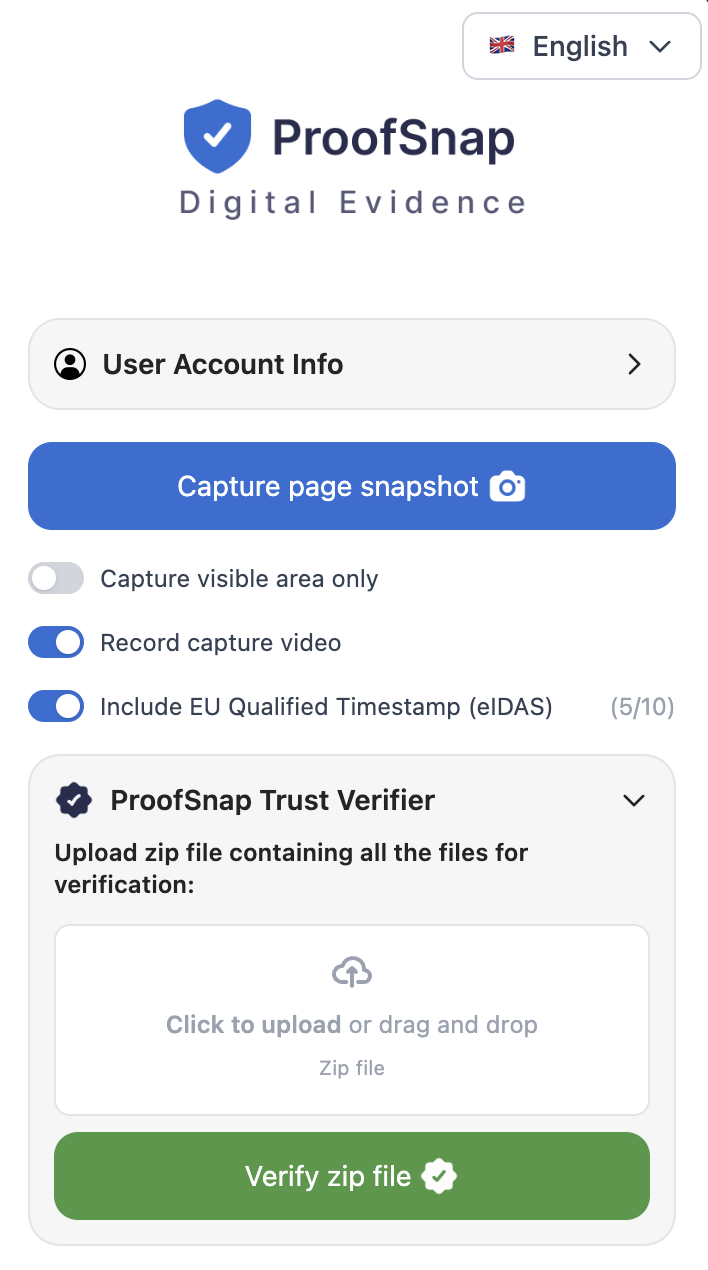
A qualified electronic timestamp does carry a legal presumption in the United Kingdom in 2026. Article 41(2) of Regulation (EU) 910/2014, as it has effect in UK law, presumes the accuracy of the date and time and the integrity of the bound data, and Article 24A extends it to EU-qualified timestamps like ProofSnap’s. It does not authenticate the exhibit.
Qualified timestamps issued by Disig a.s., a Qualified Trust Service Provider on the EU Trusted List
Does an EU qualified timestamp bind a UK court? The honest answer, with the instrument cited
The United Kingdom is not a member of the European Union, so nothing in this page rests on EU law applying here. It rests on a specific provision of UK domestic law. Here is the chain, in four steps, each traceable on legislation.gov.uk.
-
1. The eIDAS Regulation is still UK law.
Regulation (EU) No 910/2014 was retained in UK domestic law on exit and amended by the Electronic Identification and Trust Services for Electronic Transactions (Amendment etc.) (EU Exit) Regulations 2019 (SI 2019/89), which revoked Chapter II on electronic identification and kept Chapter III on trust services. The domestic implementing instrument is the Electronic Identification and Trust Services for Electronic Transactions Regulations 2016 (SI 2016/696), under which the Information Commissioner is the supervisory body. Since 1 January 2024 this body of law is called assimilated law rather than retained EU law, following the Retained EU Law (Revocation and Reform) Act 2023.
-
2. Article 41 gives the presumption. It is always Article 41, never Article 42.
Article 41(2) of Regulation 910/2014 as it has effect in UK law reads, verbatim: “A qualified electronic time stamp shall enjoy the presumption of the accuracy of the date and the time it indicates and the integrity of the data to which the date and time are bound.” Article 41(1) separately provides that a timestamp shall not be denied legal effect and admissibility solely because it is electronic or not qualified. Article 41(3) was omitted for UK purposes with effect from 31 December 2020 by SI 2019/89, and it was separately repealed in EU law by Regulation (EU) 2024/1183, as the consolidated text on EUR-Lex shows. It is in force in neither system, and nothing on this page rests on it. Article 42 sets the technical requirements a timestamp must meet to be qualified; it is not the source of the presumption.
-
3. Article 24A is what carries an EU-qualified timestamp across the border.
Paragraph 20 of the Schedule to SI 2019/89 inserted a new Article 24A, headed “Recognition of EU standards etc.”, into the UK version of the Regulation. Article 24A(1) provides that for the purposes of a listed set of provisions, which expressly includes Article 41(2), anything that is not qualified under the UK Regulation is to be treated as qualified if it is qualified under the equivalent EU law. That is the operative point for a UK reader: a timestamp issued by a Qualified Trust Service Provider on the EU Trusted List is treated as qualified for the purposes of the UK Article 41(2) presumption, even though that provider is not on the UK Trusted List. The UK Trusted List is maintained under UK Article 22, and responsibility for operating it passed from tScheme to the Information Commissioner’s Office on 30 September 2022, since when it has been published on the ICO website.
One carve-out is worth knowing, because it is the first thing a careful opponent will look for. Article 24A(3) provides that a trust service is not to be regarded as qualified under the equivalent EU law “if it is qualified (or is treated as such) only by virtue of provision for the recognition of trust services provided by entities established outside the EU pursuant to an international agreement to which the EU is party”. In other words, the bridge carries providers that are themselves qualified in the EU, and not providers outside the EU that are merely recognised there under a third-country agreement. Disig a.s. is established and supervised in the EU and appears on an EU Trusted List in its own right, so Article 24A(3) does not bite.
The same instrument also narrowed Article 42. Paragraph 34 of the Schedule omitted Article 42(2) for UK purposes, which was the power for the European Commission to establish, by implementing act, the reference standards for binding date and time to data. The three substantive requirements in Article 42(1) are unchanged: the binding must make undetectable alteration impracticable, the time source must be linked to Coordinated Universal Time, and the timestamp must be signed or sealed by the provider.
-
4. The recognition is real, but it is revocable.
Section 131 of the Data (Use and Access) Act 2025, headed “Removal of recognition of EU standards etc”, gives the Secretary of State power to remove or restrict that recognition by regulations. Section 130 recognises EU conformity assessment bodies and section 132 adds a framework for recognising overseas trust products. Most of Part 7 took effect on 5 February 2026. So the recognition described above is the law today and should be re-checked before it is relied on in a skeleton argument, because it sits on a delegated power rather than on primary legislation. Note also what that Act does not do: it contains no provision on the admissibility of computer or digital evidence, despite a claim to the contrary circulating in the forensics trade press.
What the presumption does not do
The Article 41(2) presumption is narrow and it is worth being precise about its edges, because opposing counsel will be. It presumes two things only: that the date and time are accurate, and that the data bound to them has not changed since. It does not presume that the web page said what you say it said, that the capture was complete, that the operator was competent, or that the exhibit is what it purports to be.
Authentication of the exhibit remains a matter for ordinary evidence law. In England and Wales, section 8(1) of the Civil Evidence Act 1995 allows a statement in a document to be proved by producing the document or a copy “authenticated in such manner as the court may approve”, and section 4(1) requires the court, in estimating weight, to “have regard to any circumstances from which any inference can reasonably be drawn as to the reliability or otherwise of the evidence”. A qualified timestamp, a SHA-256 hash and a chain-of-custody log are exactly such circumstances. You still need a witness statement under CPR Part 32 to put the package in front of the court.
Which UK jurisdiction are you actually in?
The eIDAS provisions above apply across the United Kingdom. The evidence rules do not. The Civil Evidence Act 1995 extends to England and Wales only (section 16(4)), as do the Civil Procedure Rules and the Family Procedure Rules. Scotland runs on the Civil Evidence (Scotland) Act 1988 and its own rules of court; Northern Ireland on the Civil Evidence (Northern Ireland) Order 1997. Where this page cites the Civil Evidence Act 1995, CPR or FPR, read it as England and Wales. The cryptographic content of the evidence package is identical wherever you file, but the procedural route to putting it in is not.
Litigating in an EU member state instead? The position is stronger, not weaker.
Before a court in an EU member state, Article 41(2) of Regulation (EU) 910/2014 applies directly as EU law, with no Article 24A step and no delegated power sitting over it. For a UK business enforcing against an EU counterparty, suing in an EU forum, or filing with an EU regulator, using an EU-qualified timestamp from the outset means the same evidence package carries the presumption in both places. That is a practical reason to choose a QTSP on the EU Trusted List rather than a UK-only provider, and it is the main reason ProofSnap uses one.
Capture before…
Six moments when web evidence vanishes or gets challenged. Two seconds late and the case changes.
…the post is deleted.
The defamatory tweet, the 1-star Google review, the Reddit thread: gone within 24 hours of the letter before claim.
…the takedown notice goes out.
The counterfeit listing or infringing copy is pulled within hours of receiving your DMCA notice. No proof of what was there.
…the lockout begins.
Performance reviews, Slack/Teams threads, the job ad replacing your client. Once HR revokes access, the evidence is theirs.
…the subject sees the letter.
Holiday photos disappear from Facebook. Dating-app profiles vanish. The catfish account is deactivated overnight.
…the page is quietly edited.
Financial promotions, T&Cs and cookie banners get changed without notice. The regulator asks: “What did the page say at 09:42 on Tuesday?”
…the challenge starts.
At the hearing: “this screenshot was generated with AI.” Without hash, timestamp and chain of custody, the screenshot loses weight.
UK digital evidence: the terms a solicitor needs to know in 2026
Plain-English definitions of the legal and technical concepts that govern whether a screenshot, WhatsApp thread or web page will be admitted as evidence in a UK court.
What are the UK eIDAS Regulations?
“UK eIDAS” is shorthand for Regulation (EU) No 910/2014 as it forms part of UK domestic law, amended by the Electronic Identification and Trust Services for Electronic Transactions (Amendment etc.) (EU Exit) Regulations 2019 (SI 2019/89), which revoked Chapter II on electronic identification and kept Chapter III on trust services. The domestic implementing instrument is the Electronic Identification and Trust Services for Electronic Transactions Regulations 2016 (SI 2016/696); the Information Commissioner is the supervisory body, and the ICO has operated the UK Trusted List since 30 September 2022. Since 1 January 2024 this is assimilated law rather than retained EU law, following the Retained EU Law (Revocation and Reform) Act 2023. The provision that matters for an EU-issued timestamp is Article 24A, inserted by SI 2019/89, which treats anything qualified under the equivalent EU law as qualified for the purposes of Article 41(2).
What is a qualified electronic timestamp?
A qualified electronic timestamp is a cryptographic seal that binds data to a specific point in time, issued by a Qualified Trust Service Provider (QTSP) on the EU Trusted List. Article 41(2) of Regulation 910/2014 gives it “the presumption of the accuracy of the date and the time it indicates and the integrity of the data to which the date and time are bound”, so the party disputing the timestamp carries the burden, not the party producing it. Article 42 sets the technical requirements for qualification and is not the source of the presumption. In the United Kingdom the same presumption applies through Article 24A of the UK version of the Regulation, which treats an EU-qualified timestamp as qualified for the purposes of Article 41(2).
Are WhatsApp screenshots admissible in UK courts?
Yes, subject to authentication. WhatsApp messages are admissible in UK civil and family proceedings under the Civil Evidence Act 1995 if proper notice is given. However, in 2026 plain screenshots are increasingly given low weight: opposing parties routinely allege they were doctored using AI or fake-chat generators, and judges have asked for the underlying data rather than images of it. ProofSnap captures the full WhatsApp Web thread with SHA-256 hashing, RSA-4096 signature and an EU eIDAS qualified timestamp, addressing the cherry-picked screenshot and authenticity objections in one step.
What is the ACPO Good Practice Guide?
The ACPO Good Practice Guide for Digital Evidence, Version 5 (October 2011), published March 2012, is non-statutory best-practice guidance. It is widely adopted as the de facto UK standard for handling digital evidence, but it is not binding and it is not incorporated into the Forensic Science Regulator’s statutory Code of Practice. It remains an ACPO document; the National Police Chiefs’ Council, which succeeded ACPO on 1 April 2015, has never reissued it. Principle 3 is the one a capture tool has to answer to: “An audit trail or other record of all processes applied to digital evidence should be created and preserved. An independent third party should be able to examine those processes and achieve the same result.” ProofSnap’s read-only capture, forensic log, signed manifest and offline verification scripts are designed to align with that principle.
CPR Part 31, PD 31B and PD 57AD: what applies where
In multi-track civil claims outside the Business and Property Courts, CPR Part 31 governs disclosure and inspection of documents, with Practice Direction 31B addressing electronic documents specifically. In the Business and Property Courts of England and Wales, Practice Direction 57AD has governed disclosure since 1 October 2022; paragraph 1.8 disapplies CPR Part 31 and PDs 31A and 31B there. PD 57AD deals with disclosure only. It contains no hearsay provisions, so hearsay notice under CPR 33.2 still applies in the Business and Property Courts. Under both disclosure regimes, electronic documents are documents and parties must preserve and produce them in a form that allows authenticity to be tested. A ProofSnap evidence ZIP can be listed as a single document with its SHA-256 hash.
Civil Evidence Act 1995, sections 4, 8 and 9 (England and Wales)
The Civil Evidence Act 1995 extends to England and Wales only, by section 16(4). Section 8(1) allows a statement in a document to be proved by producing the document or a copy “authenticated in such manner as the court may approve”, and it is immaterial how many removes there are between the copy and the original. Section 9 admits business records on certification by an officer of the business or public authority, without further proof. Section 4(1) requires the court, in estimating weight, to “have regard to any circumstances from which any inference can reasonably be drawn as to the reliability or otherwise of the evidence”, followed by six non-exhaustive factors including contemporaneity, motive, multiple hearsay and the burden of producing the original. A qualified timestamp, a SHA-256 hash and a chain-of-custody log are precisely such circumstances, and they are also a mode of authentication a court can approve under section 8(1). In Scotland the equivalent is the Civil Evidence (Scotland) Act 1988, and in Northern Ireland the Civil Evidence (Northern Ireland) Order 1997.
Capture WhatsApp, social-media and website evidence: six UK practice areas
Family law, IP enforcement, employment tribunals, FCA compliance, private investigations and online defamation share one problem: proving what was on a website, in a chat or on a social account before it changes, disappears or is challenged as AI-generated.
Family Law Solicitors
Before the WhatsApp thread is deleted.
Capture the full WhatsApp Web thread, not a cherry-picked screenshot, sealed with a SHA-256 hash and an EU qualified timestamp. Exhibit it to a witness statement under FPR Part 22 / PD 22A with the hash quoted for independent verification.
IP & Copyright Enforcement
Before the takedown notice goes out.
Seal the infringing page with an EU qualified timestamp before serving the takedown, because counterfeit listings disappear within hours. Independently verifiable for IPEC, the High Court (IP) or DMCA counter-notice.
Employment Tribunal Work
Before the lockout begins.
Teams chats, LinkedIn posts, the job ad replacing your client: capture them before HR revokes access. Hashed pack supports SAR, Acas conciliation and tribunal bundle with cryptographic proof.
FCA, AML & Regulatory Compliance
Before the page is quietly edited.
Archive financial promotions, T&Cs, cookie banners and KYC pages with EU qualified timestamps. Defensible audit trail under eIDAS Art. 41 when the FCA asks: “What did the page say at 09:42 on Tuesday?”
Private Investigators & Insurers
Before the subject deactivates.
Holiday photos, catfish profiles, dating-app fraud: posts vanish the moment the subject sees the letter of instruction. ACPO-aligned capture survives challenge in court and at the Financial Ombudsman Service.
Online Defamation & Harassment
Before the post is deleted.
Defamatory tweet, 1-star review, Reddit thread: authors delete within 24 hours of the letter before claim. Seal the publication on day one. Critical for limitation, serious-harm threshold and quantum.
Vs alternatives: Page Vault is a US concierge service, listed at $195 per month (approx. £155) at the time of writing, with no EU qualified timestamps. Pagefreezer and WebPreserver do enterprise scheduled archiving rather than single-evidence work. TrueScreen and FAW are EU forensic capture tools without a native Chrome one-click workflow. ProofSnap is self-service in Chrome with EU eIDAS qualified timestamps that carry the Article 41(2) presumption before a UK court. eIDAS SnapPack from $6.99 (approx. £5.60), no subscription, no concierge fees.
How ProofSnap aligns with the UK legal framework
Mapped to the standards UK judges, opposing counsel and regulators actually apply. See the definitions section for full explanations of each standard.
| Standard | How ProofSnap aligns |
|---|---|
| UK eIDAS Regulations | Disig a.s. is a Qualified Trust Service Provider on the EU Trusted List. Article 24A of the UK version of Regulation 910/2014 treats an EU-qualified timestamp as qualified for the purposes of Article 41(2), so the presumption of date, time and data integrity applies in UK proceedings under UK law. |
| ACPO Good Practice Guide | Read-only capture, forensic log (operator + tool version), SHA-256 manifest, named chain-of-custody record reproducible via the public Trust Verifier. |
| CPR Part 31 / PD 31B / PD 57AD | ZIP listed as a single document with SHA-256 hash; receiving party verifies authenticity via the public Trust Verifier without contacting ProofSnap. |
| Civil Evidence Act 1995 (s.4 / 8 / 9) | Hashed manifest, qualified timestamp and chain-of-custody log give the court the technical material it needs when assessing weight under section 4. |
| PACE 1984 (Criminal) | Private investigators are not bound by PACE directly, but ACPO-aligned evidence is far more likely to be admitted and given weight in criminal courts. Witness statement still required. |
| ISO/IEC 27037:2012 · ETSI EN 319 421/422 | ISO/IEC 27037-style preservation. Qualified timestamps issued by Disig a.s. under EN 319 421 policy and in EN 319 422 format. |
How to capture web evidence for UK courts in one step
No API, no IT department, no manual concierge. Self-service in Chrome, from open browser to a disclosure-ready evidence bundle. Prefer to hand the job over? The done-for-you evidence capture service starts at $44.99 (approx. £36) per URL with 12-hour delivery.
Install
Add ProofSnap from the Chrome Web Store. Start your 7-day trial (credit card required).
Open the page
WhatsApp Web thread, social-media post, listing, contract page or FCA promotion: anything a judge could ask about.
Click capture
ProofSnap captures full-page screenshot, source HTML, DOM text, metadata and a video. Each file is hashed and signed.
Disclose
Download the ZIP. Quote the SHA-256 hash in your CPR Part 32 statement. Receiving party verifies via the public Trust Verifier.
What is inside the evidence package
• Full-page screenshot (JPEG)
• Evidence PDF (court-ready)
• Full HTML source
• DOM text content
• Metadata: URL, timestamp, TLS, cookies, localStorage
• Forensic log (tool, version, operator, machine)
• Chain-of-custody record
• Signed manifest with SHA-256 hashes
• RSA-4096 digital signature + public key
• Bitcoin blockchain timestamp (OpenTimestamps, .ots)
• Capture video (Professional and above)
• EU qualified timestamp (Enterprise/Company, .tsr)
11 files (Essential), 12 files (Professional), 15 files (Enterprise/Company). Every file is cryptographically linked to the signed manifest.
Court-grade EU qualified timestamps, from $6.99 (approx. £5.60)
For UK solicitors, DPOs, IP teams and investigators who need a qualified eIDAS timestamp for one-off filings, takedowns or hearings, without committing to a subscription.
Issued by Disig a.s., a Qualified Trust Service Provider on the EU Trusted List · Credits valid 12 months
1 stamp
approx. £5.60 · $6.99 / stamp
For the single hearing or one-off filing.
5 stamps
approx. £20 · $5.00 / stamp · save 28%
For the case file with multiple exhibits.
10 stamps
approx. £40 · $5.00 / stamp · save 28%
For the busy quarter or recurring brand-protection work.
Same evidence package every time: full-page screenshot, capture video, evidence PDF, source HTML, DOM text, metadata, forensic log, chain of custody, signed manifest and blockchain timestamp, upgraded with an eIDAS qualified timestamp that carries the Article 41(2) presumption before a UK court.
No commitment, no auto-renewal. A traditional notary or solicitor’s certificate for a single web page typically costs £150 to £500. A ProofSnap capture with a qualified timestamp starts at $6.99 (approx. £5.60) and takes a single step.
7-day free trial includes 1 eIDAS stamp · Credit card required
Don’t need a qualified timestamp this time?
Basic SnapPack: $4.99 (approx. £4)
10 captures · one-time, no subscription
Same 11-file evidence pack with a Bitcoin blockchain timestamp. Cryptographically solid, but without the eIDAS legal presumption, so no Article 41(2) shift in who has to prove the date.
- • SHA-256 hash + RSA-4096 signature
- • OpenTimestamps blockchain anchor
- • Trust Verifier compatible
No subscription, no auto-renewal.
Capturing every week?
Subscriptions from $8.99/mo (approx. £7)
Unlimited captures · eIDAS stamps on higher tiers
- Essential · blockchain timestamp$8.99/mo
- Professional · + capture video$16.99/mo
- Enterprise · 10 eIDAS qualified timestamps / month$28.99/mo
- Company · 5 eIDAS qualified timestamps / user / month$18.99/seat/mo
Frequently asked questions: UK digital evidence and eIDAS
The page changes. The post is deleted. The screenshot is challenged as fake.
Seal the evidence with an EU eIDAS qualified timestamp, carrying the Article 41(2) presumption before a UK court, before any of that happens. From $6.99 per stamp (approx. £5.60), no subscription.
eIDAS SnapPack: $6.99 / 1 stamp · $24.99 / 5 stamps (Best Value) · $49.99 / 10 stamps · Credits valid 12 months