For plaintiffs' PI · LTD · Workers' Comp · Bad-Faith Counsel
The Facebook post that kills their claim will be deleted in 48 hours. Capture it first.
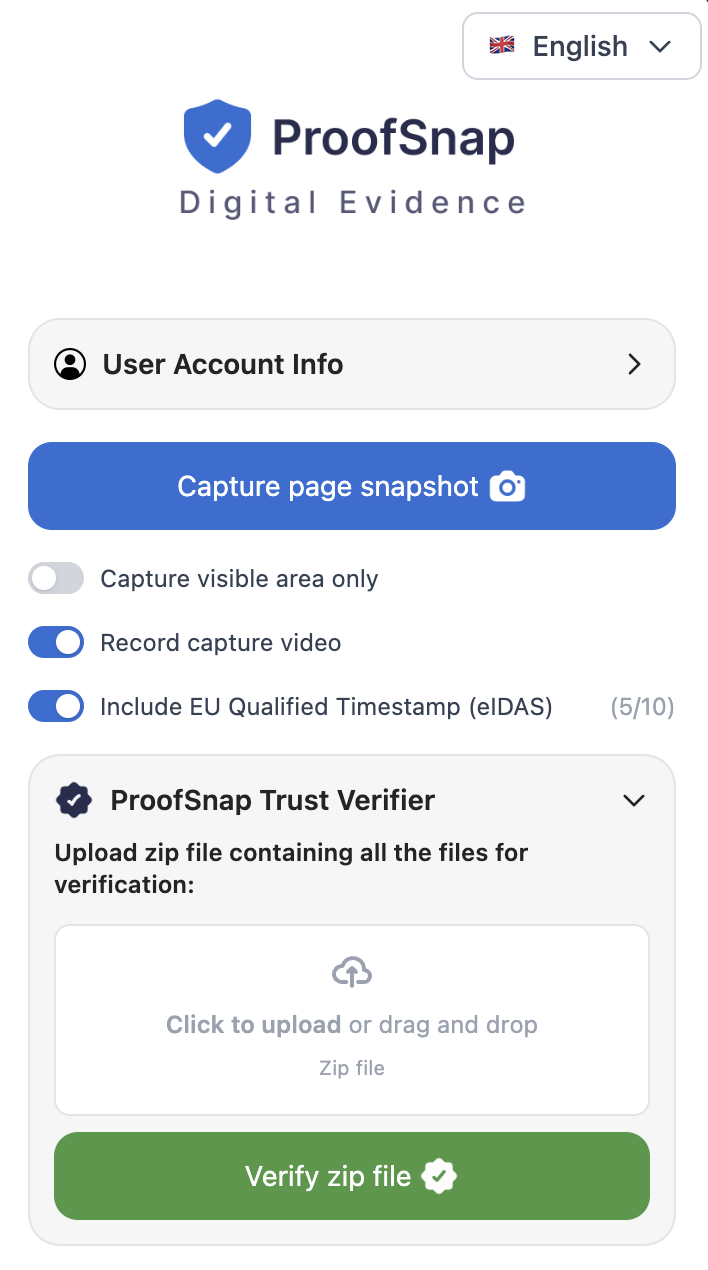
In short: ProofSnap is a Chrome / Edge browser extension that captures opposing party Facebook, Instagram, TikTok, Strava, Venmo, and LinkedIn posts as FRE 902(13)/(14) self-authenticating ZIPs. Each ZIP carries a SHA-256 manifest, RSA-4096 signature, and Bitcoin OpenTimestamps anchor — the authentication foundation Rossbach-style fabrication challenges cannot tear apart, and the affirmative preservation record FRCP 37(e) rewards. Used by plaintiffs' personal injury, long-term disability, workers' compensation, and insurance bad-faith attorneys. From $49.99 one-time (eIDAS SnapPack 10) or $18.99 / seat / month (Company Plan, min 2). 7-day free trial.
Defense already monitors social media on every claim. You should too — forensically, with chain of custody, not as phone screenshots opposing counsel will move to strike under Rossbach.
For your firm
- ✓Partners, associates, paralegals capture defense surveillance & opposing party feeds during intake
- ✓Admissible under FRE 902(13)/(14) with your Rule 902(11) certification
- ✓Firm-wide Company Plan $18.99 / seat / month, min 2 seats
For your clients
- ✓Client buys eIDAS SnapPack $49.99, captures 10 items, emails you the ZIPs
- ✓Evidence arrives before the retainer is signed or the post is deleted
- ✓Same forensic ZIP structure as firm-captured evidence
What ProofSnap is — and what it is not
ProofSnap is a digital evidence preservation tool. It captures the cryptographic foundation that supports FRE 901 / 902 authentication and the affirmative preservation record FRCP 37(e) rewards. It is not legal advice, a notary act, an expert witness, or a guarantee of admissibility. Admissibility is decided by the court on a case-by-case basis. We do not represent clients, give legal advice, or substitute for Daubert-level expert testimony if your matter requires it.
Why social media preservation became table stakes
Three trends, all 2023–2026.
Authentication challenges used to be a niche concern. They are now standard defense practice in any matter where social media is in the record — and standard plaintiff practice in any matter where the opposing party's social media might contradict their position.
01 · Defense plays Rossbach
Rossbach v. Montefiore Med. Ctr., No. 21-2084 (2d Cir. 2023)
Defense moved to compel forensic examination of plaintiff's phone, found metadata inconsistencies in iMessage screenshots, won summary judgment affirmed by the Second Circuit. The playbook — demand forensic exam, find the metadata gap, move for sanctions — now travels into every social media screenshot fight.
02 · FRCP 37(e) sharpened
Rule 37(e) ESI sanctions, 2015 amendment in full effect
The 2015 amendment unified the federal spoliation framework: failure to take reasonable steps to preserve ESI invites curative measures; intent to deprive opens adverse-inference, dismissal, or default. The duty attaches when litigation is reasonably foreseeable — well before a complaint is filed.
03 · AI-fabricated evidence rising
Admiral UK 2025: fraudulent claims +71% YoY; 23% include AI-generated photos
Insurer-side data: Admiral detected £86.8M in fraudulent claims in 2025, up from £50.9M in 2024, with nearly a quarter of fake claims now including AI-manipulated damage photos. Authentic captures need a verifiable chain of custody to stand apart from fabricated ones — from either side.
Sources: Rossbach v. Montefiore Med. Ctr., No. 21-2084 (2d Cir. 2023); FRCP 37(e) (2015 amend.); Admiral UK 2025 fraud report (via trade press, April 2026); Coalition Against Insurance Fraud, $308.6B annual US insurance fraud impact (CSU Global, 2022 baseline, still current).
The ZIP your firm or client produces
15-file forensic evidence package.
Designed to support authentication under FRE 902(13) (certified records generated by an electronic process or system) and 902(14) (certified data copied from an electronic device), both effective December 1, 2017, with a hash + signature + blockchain-anchor triple you or opposing counsel can verify independently at opentimestamps.org.
screenshot.jpeg Visual capture of the post or profilecapture_video.webm Screen recording of the capture sessionpage.html Full HTML content of the social media pagedomtextcontent.txt Extracted DOM text (post content, comments)metadata.json Timestamp, URL, browser, TLS handshakeevidence.pdf Compiled evidence report (Bates-stampable)provenance_certificate.pdf Content credentials and capture integrityc2pa.json C2PA Content Credentials manifest (anti-deepfake provenance)manifest.json File listing with SHA-256 hashesmanifest.sig RSA-4096 digital signaturemanifest.json.ots OpenTimestamps Bitcoin anchorpublickey.pem Public key to verify the signatureforensic_log.json ISO/IEC 27037 capture logchain_of_custody.json Device, network, and NTP verificationmanifest.json.tsr eIDAS qualified RFC 3161 timestamp (optional)
Rules 902(13) and 902(14) require a written certification from a qualified person. The attorney or qualified custodian prepares and signs that certification under 28 U.S.C. § 1746; ProofSnap supplies the underlying technical record to reference. Verifies offline by opposing counsel with only python3 + openssl + ots — no ProofSnap service or account required.
What plaintiffs' attorneys capture
Nine forensic-capture moments across PI, LTD, and WC.
Every matter has a window. The post that contradicts opposing party's claim today is the post that disappears tomorrow. Capture before deletion is the affirmative move under FRCP 37(e).
01 · PI plaintiff — defendant's social
Defendant claims they were “just stopped at the light” — their Strava activity that morning shows aggressive cycling six miles from the intersection. Capture the activity, the splits, the heart-rate trace, the route map.
02 · LTD plaintiff — insurer surveillance
Long-term disability insurer's investigator publishes a LinkedIn portfolio of past matters — capture their public profile, prior cases, methodology disclosures for cross.
03 · WC defense — claimant Strava
Claimant alleges total disability from a back injury; their Strava feed shows weekly 50-mile rides. Capture the activity history with timestamps and elevation, not phone screenshots that opposing counsel will move to strike.
04 · WC defense — gig-work platforms
Claimant claims inability to work; their public DoorDash profile, Instacart rating page, or Uber driver public stats show active acceptance and ratings during the disability period.
05 · Bad-faith plaintiff — insurer portal
Capture every insurer portal page, denial letter PDF, adjuster chat transcript, and policy version. The bad-faith case is built on a timeline; the ZIP is the timeline you submit.
06 · ERISA LTD — vocational rehab posts
Plan administrator's vocational rehab consultant publishes a LinkedIn case study; the consultant's methodology contradicts what was applied to your client. Capture before they take it down.
07 · PI plaintiff — defendant's TikTok
Defendant in a rear-end collision posts a TikTok bragging about “the accident wasn't my fault, lol” with footage of the intersection. Forensic capture with screen recording, audio, full DOM text.
08 · LTD plaintiff — LinkedIn employment
Opposing party's expert files a report citing “current employment opportunities” while their own LinkedIn shows a six-month gap that contradicts the report. Capture both sides — the LinkedIn profile and the report citation.
09 · Behind-login — your client's data
Your client's own MyChart history, fitness app data, work-portal records — captured from their authenticated session for affirmative proof, not just defense rebuttal.
The legal framework
FRCP 37(e) and the duty to preserve, in plain language.
Spoliation cuts both ways. Your client's deletion exposure runs from the moment they reasonably anticipate litigation — not from the moment you file. The opposing party's runs from the same moment. Whoever captures first writes the record.
The rule
Federal Rule of Civil Procedure 37(e), amended December 1, 2015: “If electronically stored information that should have been preserved in the anticipation or conduct of litigation is lost because a party failed to take reasonable steps to preserve it, and it cannot be restored or replaced through additional discovery, the court…”
37(e)(1) · Curative measures
On finding prejudice from the loss, the court “may order measures no greater than necessary to cure the prejudice.” Examples: barring use of unaffected evidence on the topic, permitting additional discovery, instructions short of adverse inference.
37(e)(2) · Intent-to-deprive sanctions
Only on finding the party “acted with the intent to deprive another party of the information's use in the litigation,” the court may instruct the jury to presume the lost information was unfavorable, dismiss the action, or enter default judgment.
When the duty attaches
The duty to preserve attaches when litigation is reasonably foreseeable — well before a complaint is filed. The trigger is fact-specific, but for the matters this page targets it is usually one of:
- ·Personal injury: the date of the incident, or the date the demand letter is sent / received, whichever is earlier.
- ·Long-term disability: the date the claim is filed, the date of the first denial, or the date the insurer requests medical records, whichever is earlier.
- ·Workers' compensation: the date of the workplace incident, the FNOL date, or the date the employer's HR opens a file, whichever is earliest.
- ·Insurance bad faith: the date of the denial letter, the date of any “reservation of rights” correspondence, or the date of a recorded statement, whichever is earliest.
Practical translation: the moment the matter is opened is the moment to capture the opposing party's public-facing social media. Each capture is the affirmative preservation record; each delay is a potential 37(e) exposure on either side.
This page summarizes federal rules and doctrine; state rules vary. Verify the rule text and your jurisdiction's case law before filing — this is not legal advice.
The authentication cases your motion will cite
Six anchor cases for social media in court.
Cautionary precedent — the defense playbook
Rossbach v. Montefiore Med. Ctr., No. 21-2084 (2d Cir. 2023)
What happened. Plaintiff in an employment-discrimination matter produced iMessage screenshots as core evidence of discriminatory communications. Defense moved to compel forensic examination of plaintiff's phone. Examination revealed metadata inconsistencies suggesting the screenshots were fabricated — iOS version artifacts and timestamp anomalies that could not exist on the dates claimed.
Result. District court granted summary judgment to the defendant; Second Circuit affirmed. Plaintiff's case was dispositively over — not on the merits, on the evidence.
Why it matters here. The defense playbook from Rossbach — compel forensic exam, identify metadata gap, move for sanctions — has since been imported into social media screenshot fights. The same theory applies to a Facebook or Instagram screenshot a witness produces: date format, screenshot dimensions, OS chrome elements all become attack surfaces.
How ProofSnap closes the attack. Each capture is sealed at the moment of acquisition with a SHA-256 manifest, RSA-4096 signature, and Bitcoin OpenTimestamps anchor. Any post-hoc edit (one byte, one pixel) breaks the hash, invalidates the signature, and orphans the Bitcoin anchor. The Rossbach-style examination has no internal contradiction to find — the file is either deterministically intact, or visibly broken.
Five foundational cases your motion will reference
- Lorraine v. Markel Am. Ins. Co., 241 F.R.D. 534 (D. Md. 2007) — Judge Grimm's foundational ESI framework (Rule 901 / 801–807 / 1001–1008 / 403). The ZIP supports the Rule 901 identification prong; remaining prongs are your legal work.
- Griffin v. State, 419 Md. 343 (2011) — social media printouts alone do not authenticate authorship. ProofSnap captures the full account profile alongside posts, giving you the circumstantial foundation under FRE 901(b)(4). See our guide to authenticating a screenshot under Rule 901 for how Maryland, Texas and Pennsylvania differ.
- Commonwealth v. Mangel, 181 A.3d 1154 (Pa. Super. 2018) — extends Griffin's authorship concern. Same foundation applies; the ZIP's HTTP/TLS metadata can rebut a spoofing defense.
- United States v. Vayner, 769 F.3d 125 (2d Cir. 2014) — VKontakte profile authentication reversed for insufficient circumstantial evidence of ownership. HTTP/TLS handshake metadata captured in the ZIP rebuts the Vayner concern.
- Tienda v. State, 358 S.W.3d 633 (Tex. Crim. App. 2012) — MySpace profile authenticated through distinctive content, photos, and corroborating circumstances. ProofSnap captures all three layers in a single ZIP.
Already evaluating Page Vault, Pagefreezer, or X1?
How ProofSnap compares.
All four are credible. Differences are in price model, deployment friction, behind-login flow, blockchain anchoring, and client-side capture. Public information, last reviewed May 2026 — verify current pricing on each vendor's site before purchasing.
| Feature | ProofSnap | Page Vault | Pagefreezer | X1 Social Discovery | Phone PrtScn |
|---|---|---|---|---|---|
| Solo / single attorney | $28.99/mo Enterprise · $49.99 SnapPack one-time | $95/mo Solo | Quote only | $2K–$5K+/yr per seat | Free, no integrity |
| Small firm (2–5 seats) | $18.99/seat/mo Company (min 2) | $195/mo Team (5 concurrent) | Quote only | $10K–$25K+/yr total | Free, no integrity |
| Deployment | Chrome / Edge extension, 30 sec | Browser-based, account required | Cloud archive, IT onboarding | Windows desktop install | Built into phone OS |
| SHA-256 + RSA-4096 signature | ✓ Both, every capture | SHA-256 only | SHA-256 only | SHA-256 only | — |
| Bitcoin OpenTimestamps anchor | ✓ Every capture | — | — | — | — |
| eIDAS qualified timestamp (EU) | ✓ Enterprise & SnapPack | — | — | — | — |
| Behind-login capture (user's session) | ✓ Native | ✓ | ✓ | ✓ | ✓ (screenshot) |
| Client-side capture (pre-retainer) | ✓ eIDAS SnapPack $49.99 | — | — | — | ✓ (no integrity) |
| Offline verification (no vendor) | ✓ python3 + openssl + ots | Vendor-hosted | Vendor-hosted | Vendor-hosted | — |
| FRE 902(13)/(14) self-authenticating | ✓ | ✓ (with affidavit) | ✓ (with affidavit) | ✓ (with affidavit) | — |
| Free trial | 7 days, all plans | Demo only | Demo only | Demo only | n/a |
vs. Page Vault
A 5-attorney firm on ProofSnap Company is ~$94.95 / month (5 × $18.99). Page Vault Team is $195 / month for the same headcount. ProofSnap adds Bitcoin OpenTimestamps, RSA-4096 signature, and eIDAS, plus a $49.99 SnapPack the client can buy directly pre-retainer.
vs. Pagefreezer
Different problem. Pagefreezer is continuous compliance archiving for entire account streams; ProofSnap is per-matter capture at the moment of intake. For a plaintiffs' firm capturing the opposing party's posts, ProofSnap fits the matter-by-matter workflow.
vs. X1 Social Discovery
~10× less expensive at small-firm scale. X1 wins on enterprise mass-collection (100,000+ items per matter); ProofSnap wins on per-matter capture, cross-platform (Mac/Linux via Chrome/Edge), and client-side SnapPack.
Comparison based on each vendor's publicly available marketing materials and software-review databases as of May 2026 — Page Vault pricing per page-vault.com/pricing. Verify current pricing and feature parity directly with each vendor.
Three ways to buy
Start where the matter sizes.
7-day free trial on subscription plans. Billing starts at day 8 unless you cancel — credit card required to start, charged only after the trial period if you do not cancel.
Solo matter · one-time
eIDAS SnapPack 10
10 forensic captures with eIDAS qualified timestamps.
No subscription, no auto-renewal
- 10 captures with eIDAS qualified timestamp on every one
- Bitcoin OpenTimestamps + SHA-256 + RSA-4096
- Client-buyable for pre-retainer capture
- FRE 902(13)/(14) self-authenticating ZIPs
Best for a solo matter or pre-retainer client capture
Single attorney · recurring
Enterprise (solo seat)
Unlimited captures, one attorney. Annual $280/yr (save 20%).
✓ 7-day free trial · cancel by day 7 at zero cost
- Unlimited captures
- 10 eIDAS qualified timestamps / month (EU court-ready)
- Bitcoin OpenTimestamps + SHA-256 + RSA-4096
- FRE 902(13)/(14) self-authenticating ZIPs
- Email support · response within 1 business day
Credit card required to start · cancel by day 7
2–25 attorneys · recurring
Company Plan
Minimum 2 seats. 5-seat firm = $94.95/mo (vs Page Vault Team $195/mo).
✓ 7-day free trial · cancel by day 7 at zero cost
- Unlimited captures per seat
- 5 eIDAS qualified timestamps per user / month
- Team dashboard + shared audit log
- Email support · response within 1 business day
Credit card required to start · cancel by day 7
Light user without monthly billing? Essential $8.99/mo or Professional $16.99/mo on the main pricing page. Questions? support@getproofsnap.com.
Frequently asked
Fifteen things plaintiffs' attorneys ask first.
When does the duty to preserve opposing party social media kick in?
Can I capture an opposing party's public Facebook, Instagram, or Strava post without their consent?
What is FRE 902(13) and 902(14)?
How is ProofSnap different from Page Vault, Pagefreezer, or X1 Social Discovery?
Does Rossbach v. Montefiore apply to social media screenshots, or only iMessage?
Strava, Venmo, LinkedIn — can ProofSnap capture them as evidence?
What if the opposing party deletes the post before I can capture it?
Can my plaintiff client capture evidence before retaining me?
What is FRCP 37(e) and how does it interact with social media preservation?
Do I need eIDAS qualified timestamps for a US-only matter?
Privilege, malpractice insurance, and ethics?
What if opposing counsel challenges the screenshot as fabricated?
Is ProofSnap a substitute for an expert witness or legal advice?
How long does ProofSnap evidence stay verifiable?
How does ProofSnap integrate with Relativity, Everlaw, or Logikcull?
The post your case needs is being deleted now.
Capture the opposing party's last 30 days of posts in your first session tonight — before opposing counsel sends the preservation letter that prompts a delete.
Cancel by day 7 at zero cost · download sample ZIP first · support@getproofsnap.com
Legal disclaimer: This page provides general information for plaintiffs' personal injury, long-term disability, workers' compensation, and insurance bad-faith attorneys and is not legal advice. ProofSnap is not a law firm and does not represent clients. Consult a licensed attorney in the relevant jurisdiction before relying on any content. Case-law summaries are abbreviated for context; read the opinions before citing them. Statutes and rules change; verify current text before filing. Admissibility is decided by the court on a case-by-case basis — ProofSnap supports authentication but does not guarantee admission.
Sister guides for attorneys
- Evidence Software for Lawyers (hub) — general civil litigation
- Social Media Evidence (general)
- Social Media in Family Court
- AI Image Detection — C2PA, SynthID, EXIF
- AI Claim Photo Detection (Insurance SIU)
- NCII & Deepfake Attorney Guide
- eIDAS Qualified Timestamps — EU court weight
- Evidence for Investigators — DFIR, OSINT, claims investigators