For UK buyers, car dealers, vehicle inspectors & motoring solicitors
Bought a used car privately and been lied to? Capture the listing before the seller deletes it.
The mileage, “no accidents”, “full service history”: it was all in the advert. Capture it now, because the seller can edit or delete it in seconds. SHA-256 hash plus Bitcoin blockchain timestamp. Tamper-evident evidence ZIP in 10 seconds.
Buying from a trader and buying privately are two different worlds. From a trader the Consumer Rights Act 2015 gives you a 30-day right to reject. In a private sale it is “buyer beware”: the Consumer Rights Act 2015 does not apply to private sellers. But the Misrepresentation Act 1967 does, and so does section 13 of the Sale of Goods Act 1979, so a false statement of fact that induced the sale can give rise to rescission and/or damages.
The problem is the same either way. Autotrader, eBay Motors, Facebook Marketplace and Gumtree give you no archive, the seller deletes the advert, and a screenshot gets dismissed as “anyone could have edited that”. ProofSnap seals the live page (mileage, description, seller details, URL) with a SHA-256 hash and a Bitcoin OpenTimestamps anchor: the “copy of the original advertisement” that UK guidance says you need. Add an optional eIDAS qualified timestamp when the stakes are high.
Still buying? Capture the listing in 10 seconds before you hand over thousands. It is the cheapest insurance there is against clocked mileage and “no accidents” lies.
One-time payment · no subscription · the evidence ZIP is yours to keep forever. See a sample ZIP →
Also available for Microsoft Edge
Help me choose
10 seconds per capture · Pay-per-use from $4.99 · SHA-256 + Bitcoin OpenTimestamps
BMW 320d M Sport Touring
“Lovely condition, no faults, genuine mileage, never been in an accident. Private sale, sold as seen.”
Private seller · Manchester · listed 3 days ago
Captured & sealed
SHA-256 · timestamped
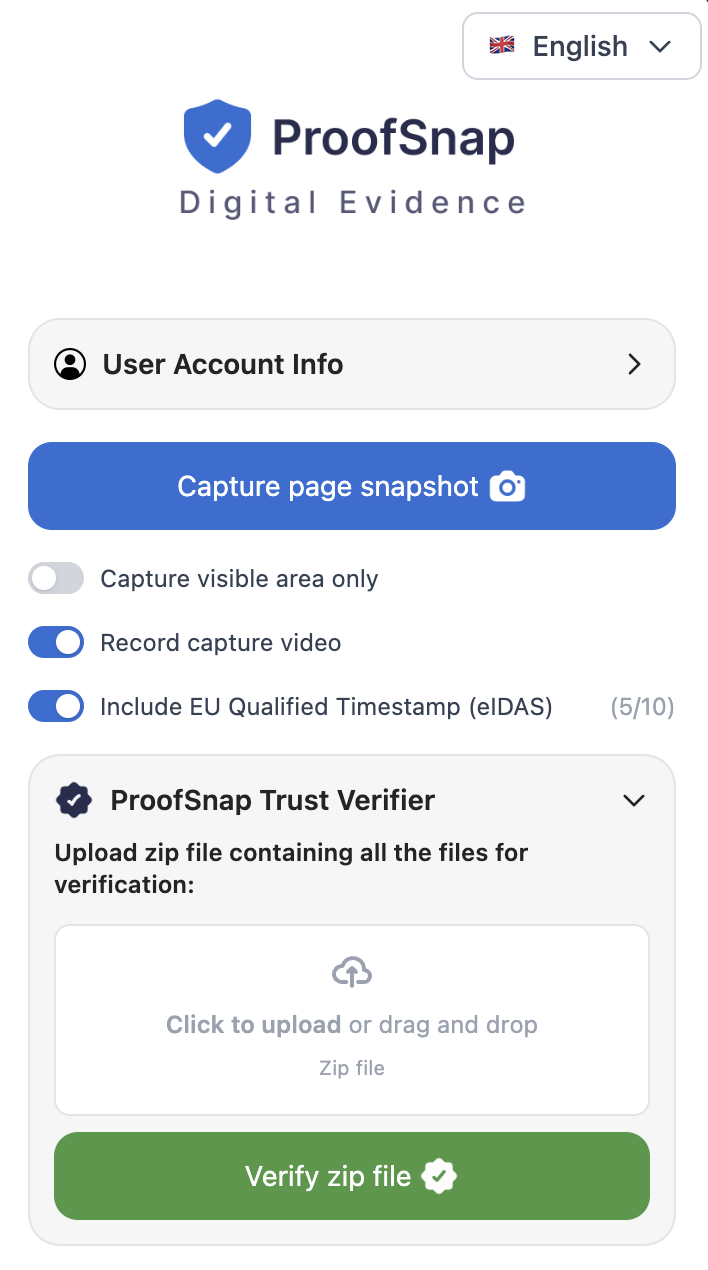
Illustrative example (fictional listing, no real vehicle). Ringed in blue are the typically disputed claims (mileage, “no accidents”). Right: the ProofSnap side panel.
Bitcoin OpenTimestamps on every capture · verify any ZIP yourself with the free open-source Trust Verifier
Quick answer
How do you capture a used-car listing as evidence of misrepresentation?
In the United Kingdom the used-car advert is usually the decisive evidence, and the seller can delete it in one click. ProofSnap captures the live listing (mileage, “no accidents”, service history, seller, URL) and seals it with a SHA-256 hash and a Bitcoin OpenTimestamps anchor, producing a tamper-evident evidence ZIP in about 10 seconds. Pay-per-use from $4.99.
Which law helps you depends entirely on who sold you the car. Buy from a trader and the Consumer Rights Act 2015 gives you a 30-day short-term right to reject under section 22. Buy from a private seller and the Act does not apply at all; you fall back on the Misrepresentation Act 1967 (England and Wales; Scotland and Northern Ireland have their own equivalents) and section 13 of the Sale of Goods Act 1979, and the burden of proof is on you. Either way you have to show what the seller actually stated, which is why the captured advert matters. Cross-check the advertised mileage against the free GOV.UK MOT history check, which records the mileage at every test. Every ZIP is verifiable by anyone with the free Trust Verifier. Do this before you contact the seller, because once the advert is gone, so is your proof.
By Radim Motycka, Founder and Lead Engineer, ProofSnap · · Independently verifiable via the Trust Verifier
Trader or private seller? That one question decides your remedy
Before you write a single letter, establish who sold you the car. Chasing a Consumer Rights Act 2015 remedy against a private seller wastes time you do not have, because that remedy does not exist against a private seller.
| What you can rely on | Bought from a trader (dealer) | Bought from a private seller |
|---|---|---|
| Consumer Rights Act 2015 | Applies in full, across the whole United Kingdom | Does not apply at all |
| 30-day short-term right to reject for a full refund | Yes, sections 20 and 22 of the Consumer Rights Act 2015 | No such right |
| Car must be of satisfactory quality | Yes, section 9 of the Consumer Rights Act 2015 | No. Section 14 of the Sale of Goods Act 1979 only bites where the seller sells “in the course of a business” |
| Car must match its description | Yes, section 11 of the Consumer Rights Act 2015 | Yes, section 13 of the Sale of Goods Act 1979 still applies between private parties |
| A false statement that induced you to buy | Misrepresentation Act 1967, alongside the Act’s own remedies | Misrepresentation Act 1967 (England and Wales; see the note below for Scotland and Northern Ireland). This is your main route |
| Deduction for use if you reject | Normally none in the first six months, but section 24(10)(a) names motor vehicles as the exception, so a deduction can be made for a car | Not applicable. Rescission puts the parties back where they started |
| Tiered remedies after the first 30 days | One repair or replacement (section 23), then a price reduction or the final right to reject (section 24) | None. Rescission and/or damages for misrepresentation, or nothing |
| Burden of proof | Reversed for six months: section 19(14) presumes a non-conformity found in that window was there on delivery | On you throughout, on the balance of probabilities |
| What the captured advert is worth | Proves the description you were sold on, for section 11 | Often the only proof of what was stated at all |
From a trader, in the Act’s own words
“Every contract to supply goods is to be treated as including a term that the quality of the goods is satisfactory.”Consumer Rights Act 2015, section 9(1) (legislation.gov.uk)
“Every contract to supply goods by description is to be treated as including a term that the goods will match the description.”Consumer Rights Act 2015, section 11(1) (legislation.gov.uk)
Section 9(2) says quality is judged by what a reasonable person would consider satisfactory, taking account of the description, the price and all the other relevant circumstances. On a fifteen-year-old car with 140,000 miles, that bar sits lower than on a nearly new one. That is exactly why the advert, its description and its price, is the reference point a court works from.
From a private seller, in the Act’s own words
“Where there is a contract for the sale of goods by description, there is an implied term that the goods will correspond with the description.”Sale of Goods Act 1979, section 13(1) (legislation.gov.uk)
Section 13 applies between private parties. Section 14, the satisfactory quality and fitness provision, opens with the words “If the seller sells goods in the course of a business”, so it does not. That is the whole of the “buyer beware” rule in one clause: a private seller owes you an accurate description, not a good car.
The practical consequence is that you win or lose on what was stated: the mileage figure, the “no accidents” badge, the “full service history” claim, the wording of the description. All of it lives in an advert the seller can delete in one click.
Territorial note: the Misrepresentation Act 1967 does not extend to Scotland or Northern Ireland, by its own section 6. Northern Ireland has the Misrepresentation Act (Northern Ireland) 1967, and Scotland uses section 10 of the Law Reform (Miscellaneous Provisions) (Scotland) Act 1985. The Sale of Goods Act 1979 and the Consumer Rights Act 2015 both apply UK-wide.
The exception worth checking: a trader posing as a private seller
Someone who sells cars regularly is a trader in law whatever their advert says, and a trader gets the full Consumer Rights Act 2015 treatment plus the unfair trading regime. So before you accept that you bought privately, capture the seller’s profile and their other listings. A string of vehicle sales from one account is exactly the evidence that turns a “private sale” into a trader sale, and it disappears as soon as the account is deleted. This is also the single highest-value capture on this page: it can move you from having almost no remedy to having a 30-day right to reject.
Why a screenshot of the listing will not hold up
When a seller has misled you, the advert is your most important evidence, and a plain screenshot is the weakest form of it. All four problems below are preventable in 10 seconds.
The listing disappears
Once the car is sold, or the moment you complain, the seller deletes or edits the advert. Autotrader, eBay Motors, Facebook Marketplace and Gumtree give you no archive. After that it is your word against theirs.
No verifiable timestamp
A screenshot has no provable capture time. The seller can claim the mileage or the “no accidents” line was never there, and you have nothing independent to prove when the advert was live.
“Anyone could have edited that”
Image files are trivially editable. Without a cryptographic hash, the other side can dismiss your screenshot as unverifiable, and in a private sale the burden of proof is on you.
No URL, source, or chain of custody
Screenshots lack the page URL, the page source, the seller’s profile and the forensic metadata that a letter before action, a claim on the small claims track or a Trading Standards report relies on to tie the claim to its author.
Listing already deleted? You can still preserve evidence.
The seller pulled the advert after the sale? That does not mean your proof is gone. Several sources survive the deletion of the listing. Preserve them now, before they vanish too.
The message thread, your strongest remnant
Your messages on Facebook Marketplace, eBay Motors or Gumtree stay in your inbox even after the advert is gone. That is often where the decisive assurances sit: “genuine 56k miles”, “never been in an accident”. Capture the whole thread with ProofSnap.
The seller’s profile & other adverts
The seller’s profile and any other adverts, including any relisted ones, are often still live, and a string of car sales can be evidence that the seller was really trading. If they were acting as a trader, the Consumer Rights Act 2015 applies after all, which changes your remedies completely. Capture the profile while it is there.
Search engine caches and the web archive
Sometimes a cached copy of the advert is still reachable through a search engine’s cached version or the Wayback Machine. Open it in Chrome and capture it straight away, because caches are overwritten constantly.
The MOT history & your saved advert
Run the free GOV.UK MOT history check to lock in the recorded mileage, and if you saved or emailed the advert earlier, open that source (email, download, listing history) and seal it with a timestamp. That turns a loose document into verifiable proof.
Prefer no subscription? SnapPack for $4.99, 10 captures with a Bitcoin timestamp.
When the advert is worth thousands of pounds
Three situations where the original advert is the decisive evidence, and where every hour counts before it is deleted.
Clocked car / odometer fraud
The advert said 56,000 miles, the GOV.UK MOT history shows 116,000. The DVSA reported in April 2023 that its mileage anomaly warning has triggered 1.5 million times, “which equates to around 4% of all MOT Tests”, and that it receives “over 14,000 requests to correct MOT mileage readings” every year. The advertised mileage, captured and cross-checked against the free MOT record, is your core proof. Capture it before the advert disappears.
Evidence needed: advertised mileage, description, MOT history check
“No accidents” was a lie
Advertised as “no accidents”, but actually a previously written-off or accident-repaired car. A false statement of fact that induced the sale is a misrepresentation under the Misrepresentation Act 1967, even in a private sale. The advert proves exactly what was claimed, and a paid vehicle history check will show any insurance write-off category on the record.
Evidence needed: listing text, spec list, photos
Faults hidden behind “sold as seen”
The seller hid behind “sold as seen”, but that does not let a private seller hide known faults or make false claims, and selling an unroadworthy car is a criminal offence. The advert (“no faults”, “lovely condition”) contradicts what the seller later claims.
Evidence needed: listing text, message thread, assurances
Clocking, write-offs and what a history check actually shows
Three checks separate a bad feeling from provable fraud. Two of them are free. Run them alongside the captured advert, because the advert tells you what was claimed and the checks tell you what is true.
Free
MOT history
The GOV.UK MOT history check records the mileage at every test, for cars, motorcycles and vans from 2005 onwards, and from 2017 in Northern Ireland. A recorded reading higher than the advertised mileage is the single clearest sign of clocking, and it is a government record rather than a commercial one.
Free
Vehicle enquiry
The DVLA vehicle enquiry service confirms make, model, colour, engine size, first registration, tax and MOT status. Use it to catch a plate or colour that does not match the advert. GOV.UK also tells you to check the V5C log book for the “DVL” watermark, because a serial number in certain published ranges means the log book itself was stolen.
Paid
Vehicle history check
A paid HPI-style check is the only one that shows outstanding finance, a stolen marker, an insurance write-off category, previous registration plate changes, import, export and scrapped records, and mileage anomalies against the National Mileage Register. GOV.UK has no free finance check and no free stolen-vehicle check, which is the gap that catches most buyers out.
The four write-off categories, and why “no accidents” is checkable
Insurers categorise damaged vehicles under the Association of British Insurers’ Code of Practice for the Categorisation of Motorised Vehicle Salvage, known as the ABI Salvage Code. If the advert said “no accidents” and the check returns any of these, you have a documented false statement of fact:
| Category | What it means | Can it legally return to the road? |
|---|---|---|
| A | Scrap. Beyond safe repair, with no usable parts | No |
| B | Break. The bodyshell must be destroyed, but parts may be salvaged | No |
| S | Structurally damaged, then judged repairable | Yes, once repaired |
| N | Non-structural damage, repairable, but uneconomic for the insurer to repair | Yes, once repaired |
Source: the ABI Salvage Code. Categories A, B, S and N replaced the older C and D codes in October 2017.
Which offences clocking can amount to, and who enforces them
Here is the fact most buyers find hardest to believe: winding an odometer back is not in itself a criminal offence in the UK. Mileage-correction firms operate openly. The offence attaches to the sale, not the adjustment, and that is where enforcement sits. Two separate regimes apply, with different enforcers:
- 1.Fraud Act 2006, section 2 (fraud by false representation). This catches any seller, trader or private, who dishonestly makes a false representation about the mileage, intending to make a gain. It is a police matter, reported to Report Fraud (reportfraud.police.uk), the City of London Police service that replaced Action Fraud on 4 December 2025, or to Police Scotland on 101 if you are in Scotland.
- 2.The unfair commercial practices regime, for traders only. Note the change: the Consumer Protection from Unfair Trading Regulations 2008 were revoked and replaced by Chapter 1 of Part 4 of the Digital Markets, Competition and Consumers Act 2024, in force from 6 April 2025 (commenced by SI 2025/272). Trading Standards enforces it, alongside the Competition and Markets Authority, and a criminal offence under section 237 carries up to two years’ imprisonment on conviction on indictment. It does not reach a genuine private seller. Worth noting: the consumer’s own private right to redress still sits in Part 4A of the 2008 Regulations, because the equivalent sections 232, 234 and 235(2) of the 2024 Act have not yet been commenced.
The Driver and Vehicle Standards Agency (DVSA) is a third body, with a different remit: it handles roadworthiness and MOT-testing fraud, not the sale contract. If the car should never have passed an MOT, that is a DVSA matter.
From “I just saw this” to court-ready in four steps
No technical expertise required. The whole thing takes about 10 seconds.
Open the listing
Open the advert on Autotrader, eBay Motors, Facebook Marketplace or Gumtree while it is still live, with the mileage, spec and seller details on screen.
Click ProofSnap
One click captures the full page with listing text, price, mileage, URL, metadata, DOM content, and a SHA-256 hash.
Download evidence
Get a blockchain-timestamped ZIP with screenshot, page source, metadata, chain of custody, forensic log, and an evidence PDF.
Take action
Cross-check the mileage with the GOV.UK MOT history, then attach the capture to a letter before action, a claim on the small claims track, or a Trading Standards complaint.
What is in the evidence ZIP: 11 to 15 forensic files, depending on your plan, all verifiable with the free Trust Verifier
SnapPack and Professional include the Bitcoin blockchain timestamp (.ots). The optional eIDAS qualified timestamp (.tsr + eidas_validation.json) ships with eIDAS SnapPacks and Enterprise.
Two layers of proof: pick by stakes
Every capture is anchored to the Bitcoin blockchain. Add an EU qualified timestamp as an optional premium layer when the stakes are high.
Layer 1: SHA-256 plus Bitcoin OpenTimestamps
Your capture’s SHA-256 hash is anchored to the Bitcoin blockchain: decentralised, independent, tamper-evident proof that the advert existed at a given moment. For a UK private-sale dispute, this is the layer you need.
Every ProofSnap capture is sealed in about 10 seconds into an evidence package of 11 to 15 forensic files, carrying an RSA-signed manifest, a SHA-256 hash of every file, a full ISO/IEC 27037 style chain of custody and a Bitcoin OpenTimestamps anchor, and the whole package can be re-verified by the other side with the free open-source Trust Verifier. ProofSnap has been used to produce evidence packages in 23 countries.
Included on Professional and Enterprise, and on every SnapPack · standalone via SnapPack $4.99 (10 captures)
Layer 2: eIDAS qualified timestamp (optional)
An optional premium add-on issued by Disig a.s., a Qualified Trust Service Provider on the EU Trusted List. It reaches a UK court as a matter of UK domestic law, not EU law. Article 24A of the assimilated Regulation (EU) No 910/2014, inserted by SI 2019/89, provides that for the purposes of Articles 25(2), 27, 35(2), 37, 41(2) and 43(2), anything qualified under the equivalent EU law is to be treated as qualified here. Article 41(2) then reads:
“A qualified electronic time stamp shall enjoy the presumption of the accuracy of the date and the time it indicates and the integrity of the data to which the date and time are bound.”Article 41(2), assimilated Regulation (EU) No 910/2014, as it applies in the UK (legislation.gov.uk)
Note the limits, because they matter. The presumption covers the date, the time and the integrity of the bound data, and nothing else. It does not presume who wrote the advert or that its contents were true. Honest caveat: section 131 of the Data (Use and Access) Act 2025 would give the Secretary of State power to remove that recognition, but as of 3 August 2026 section 131 has not been commenced and no regulations have been made under it.
Add via eIDAS SnapPack from $6.99 · or included on Enterprise
The UK legal basis: trader sales versus private sales
Trader: Consumer Rights Act 2015
Satisfactory quality (s.9), as described (s.11), a 30-day short-term right to reject (s.20 and s.22), then repair or replacement (s.23) and finally a price reduction or the final right to reject (s.24). Applies UK-wide.
Private: caveat emptor, plus 1967 and 1979
The Consumer Rights Act 2015 does not apply. A false statement of fact that induced the sale can still give rise to rescission and/or damages under the Misrepresentation Act 1967, and the car must correspond with its description under s.13 of the Sale of Goods Act 1979.
“Sold as seen” is not a shield
It does not let a private seller make false claims. The car must still correspond with its description, and selling an unroadworthy vehicle is a criminal offence under the Road Traffic Act 1988.
Burden of proof and redress
From a trader, s.19(14) presumes a fault found in the first six months was there on delivery. From a private seller the burden is on you throughout, on the balance of probabilities, and a copy of the original advert is core evidence. See the four routes to your money back.
ProofSnap is an evidence tool, not legal advice. For your specific dispute, consult a solicitor.
Getting your money back: four routes, in order
Work down this list rather than jumping to court. Each route is cheaper and faster than the one below it, and every one of them asks you for the same thing: a copy of what the seller actually advertised.
-
1
Section 75 of the Consumer Credit Act 1974, if you paid by credit card
Section 75 makes your credit card provider equally liable with the seller for breach of contract or misrepresentation. It applies where the cash price of the item is more than £100 and no more than £30,000. It does not apply to debit cards. The detail most buyers miss: paying only the deposit on a credit card is enough to bring the whole purchase price within section 75, so a £200 deposit on an £8,000 car can put the full £8,000 in scope. Above a £30,000 cash price, section 75 falls away. One honest limit: section 75 works through a debtor-creditor-supplier agreement, so in practice it is a dealer route. A private seller who takes a bank transfer is not a card-accepting supplier, and most private car sales fall outside it for that reason alone.
-
2
Chargeback, if you paid by debit card or fell outside section 75
Chargeback is not a legal right. It is a rule of the card schemes (Visa, Mastercard, American Express) under which your bank asks for the payment to be reversed. There is no minimum or maximum value, but the time limit is short and set by the card scheme, typically 120 days from the transaction or from when you expected to receive the goods, so raise it straight away. If your bank refuses, the Financial Ombudsman Service can review the decision.
-
3
A letter before action to the seller
Set out what the advert stated, what the car turned out to be, what you want and by when. Attach the captured advert, the MOT history and the history check. A letter before action that encloses a hash-sealed copy of the advert is materially harder to stonewall than one that says “you told me it had 56,000 miles”, and the courts expect you to have tried this step first.
-
4
A court claim, in the right court for your jurisdiction
The Consumer Rights Act 2015 applies across the whole United Kingdom, but court procedure does not. Which court you use, and up to what value, depends on the jurisdiction:
Jurisdiction Procedure Limit England and Wales Small claims track of the County Court Usually up to £10,000 Scotland Simple Procedure in the Sheriff Court £5,000 or less Northern Ireland Small claims in the County Court Not more than £5,000 Sources: GOV.UK and Citizens Advice (England and Wales), Scottish Courts and Tribunals Service (Scotland), nidirect (Northern Ireland). One evidential note worth knowing: the Civil Evidence Act 1995, the statute that governs hearsay in civil proceedings, “extends to England and Wales” only, by its section 16(4). Scotland and Northern Ireland have their own civil evidence statutes.
ProofSnap is an evidence tool, not a law firm, and this page is not legal advice. For your own dispute, take advice from a solicitor.
Where to report used-car fraud in the UK
Reporting and recovering your money are two different things. Reporting does not get you a refund, but it is what stops the seller doing it again, and a reference number strengthens a later claim. Capture the advert before you report, because a report is often what triggers its deletion.
Trading Standards, for traders
You cannot contact Trading Standards directly; the report has to be passed on by a consumer helpline. In England and Wales that is the Citizens Advice consumer service, freephone 0808 223 1133, or 0808 223 1144 for the Welsh-language line. In Scotland the route is Advice Direct Scotland (consumeradvice.scot, freephone 0808 164 6000). In Northern Ireland it is Consumerline on 0300 123 6262. Trading Standards enforces against traders, never against a genuine private seller.
Report Fraud, for fraud by any seller
If the seller dishonestly stated a false mileage or a false accident history to make a gain, that is fraud by false representation under section 2 of the Fraud Act 2006, and it applies to private sellers as well as traders. Note the change of service: from 4 December 2025 the City of London Police replaced Action Fraud with Report Fraud at reportfraud.police.uk; the number, 0300 123 2040, is unchanged. It covers England, Wales and Northern Ireland. In Scotland, report fraud to Police Scotland on 101.
The DVSA, for roadworthiness and MOT fraud
The Driver and Vehicle Standards Agency is the right body if the car should never have held a valid MOT, or if you doubt the certificate itself. Report a tester or centre on 0800 030 4103; the DVSA accepts anonymous reports. Mileage fraud is not a DVSA matter but a Trading Standards one, and gov.uk says plainly that the DVSA “cannot help you take action against a centre”. Treat it as a parallel report, not a route to a refund.
The platform, and why it is the weakest route
Autotrader, eBay Motors, Facebook Marketplace and Gumtree will act on the listing, which usually means removing it. That is useful for the next buyer and terrible for you, because the removal destroys the evidence you need. Capture the advert, the seller profile and the message thread first, then report to the platform. Never the other way round.
Remember the order of operations. Capture, then check, then report, then claim. Capturing costs 10 seconds and $4.99. Every other step on this page becomes harder once the advert is gone, and the seller controls exactly when that happens.
If you would rather not do the capture yourself, our done-for-you evidence capture service captures the listing and returns the finished evidence package to you.
Also for dealers, inspectors and solicitors
If you deal with vehicle listings professionally, you need provable snapshots, both to defend yourself and to bring a claim.
Car dealers
Your advert text describes the car, and a buyer can later claim you said something you did not. Keep a defensive archive of what you published, and when, against a later misrepresentation or “not as described” allegation under section 11 of the Consumer Rights Act 2015.
Vehicle inspectors
Pair your report on the car’s actual condition with a timestamped capture of the original advert. That closes the evidence chain from what was claimed to what was found, ready for your client’s dispute.
Motoring solicitors
Preserve each client’s advert in seconds before the other side deletes it, with an optional eIDAS qualified timestamp for higher-stakes matters. Team accounts are available for the whole practice.
Pay per capture, or subscribe
A used-car dispute is usually a one-off, so most people just buy a SnapPack. No subscription required. All prices are charged in US dollars.
Not sure which to choose? Choose by stakes and volume.
Capture one listing now
Bitcoin proof, 10 captures, no subscription.
Tamper-evident copy of the advert.
SnapPack, $4.99 ↓One listing, higher stakes
Optional EU qualified timestamp, single capture.
eIDAS premium add-on.
eIDAS SnapPack 1, $6.99 ↓Several listings
Multiple vehicles, an ongoing case.
Qualified timestamp, $5.00 per stamp.
eIDAS SnapPack 5, $24.99 ↓Dealer / inspector / solicitor
Ongoing evidence, a team.
Monthly capture quota.
Subscribe from $8.99/month ↓SnapPack
$4.9910 page captures, each with a SHA-256 hash and a Bitcoin blockchain timestamp, in the full forensic evidence ZIP. One-time payment, no subscription and no auto-renewal.
- Tamper-evident proof the advert existed at a specific time
- Chain of custody & provenance certificate PDF
- Capture 10 listings, seller profiles, or message threads
eIDAS SnapPack: optional premium layer
It adds a qualified timestamp to your captures: an optional add-on for higher-stakes or cross-border matters. eIDAS SnapPack credits are valid for 12 months.
Every eIDAS SnapPack capture also includes the Bitcoin OpenTimestamps anchor, so you get both layers in one ZIP.
Or subscribe, for dealers, inspectors and solicitors
For anyone documenting vehicle listings regularly. Annual plans save 20%.
Essential
or $80/year (a 20% saving)
- 100 captures / month
- SHA-256 hash + digital signature
- No blockchain timestamp, use a SnapPack for that
- Forensic ZIP with chain of custody
Professional
or $160/year (a 20% saving)
- 200 captures / month
- Bitcoin OpenTimestamps on every capture
- Independently verifiable proof of date
- Team accounts
Enterprise
or $280/year (a 20% saving)
- Unlimited captures
- Bitcoin OpenTimestamps on every capture
- 10 eIDAS qualified stamps / month
- Email support · response within 3 working days
The 7-day trial requires a credit card. Cancel at any time within the trial and you are not charged.
Teams of 2+ can use Company per-seat pricing ($18.99 per seat per month). Tax-deductible business expense.
Two pack types. The plain SnapPack ($4.99) gives 10 captures with the Bitcoin OpenTimestamps layer, which is all you need for a UK private-sale dispute. For an optional qualified timestamp, use an eIDAS SnapPack; those stamps add the qualified layer on top of Bitcoin.
How the credits work. eIDAS SnapPack credits are valid for 12 months, so you can buy ahead of a dispute. Payments are handled securely by Stripe and are charged in US dollars; a credit card is required for every purchase, including SnapPacks.
ProofSnap versus a screenshot, the Wayback Machine, or a solicitor’s capture
Forensic-grade evidence you keep, produced in seconds for a few dollars.
| Feature | ProofSnap | Manual screenshot | Wayback Machine | Solicitor capture |
|---|---|---|---|---|
| Captures the listing before deletion | Manual | Rarely (dynamic pages) | If you reach them in time | |
| SHA-256 hash + Bitcoin timestamp | No | No | Varies | |
| Optional EU eIDAS qualified timestamp | No | No | Rarely | |
| Chain of custody + seller metadata | No | No | Partial | |
| You keep the evidence (no retainer) | Billed per hour | |||
| Tamper-evident, hard to challenge | Easily challenged | Corroborating only | Strong but costly | |
| Entry price | $4.99 SnapPack · $6.99 eIDAS SnapPack 1 | Free | Free | Hourly fees |
Comparison reflects publicly available 2026 information. Other services’ terms may differ by region or contract.
Frequently asked questions
Do not let the proof disappear.
The next time a used-car seller’s claims do not add up, capture the listing in 10 seconds. Start with a SnapPack for $4.99, or add an optional qualified timestamp from $6.99 when the stakes are high. Prices are charged in US dollars.
Capture the listing: 7-day trial, card requiredThe 7-day trial requires a credit card. Cancel at any time within the trial and you are not charged. Prefer no subscription? Buy a SnapPack for $4.99.