Brand Protection for E-Commerce: Capturing ‘Unfair Competition’ on Amazon, Temu & Global Marketplaces
A counterfeit seller hijacks your Buy Box on Amazon. The same knockoff appears on Temu and AliExpress within days. Fake five-star reviews push it above your genuine product. By the time your legal team reacts, the listing is gone — and so is your evidence. Here is how to capture it forensically, before it disappears.
In January 2026, a London-based skincare brand discovered 31 counterfeit listings spread across Amazon.co.uk, Amazon.com, Amazon.ca, and Amazon.com.au — all from the same seller network, using stolen product photos. By the time their IP lawyer filed the first Brand Registry report, 14 listings had already been deleted. The brand had screenshots — but when preparing the case for the High Court, their barrister demanded metadata, timestamps, and chain of custody documentation. The screenshots alone could not prove when the counterfeits were live, who was selling them, or that the captures had not been altered. The damages claim stalled.
This is the reality for thousands of brand owners every month. The counterfeits spread across Amazon, Temu, AliExpress, and eBay simultaneously. The damage is real — but without forensic evidence, the legal case falls apart.
E-commerce marketplaces have become the primary battleground for brand protection. Counterfeit sellers, listing hijackers, and review manipulators exploit platform scale to divert revenue, damage brand reputation, and endanger consumers. The shift to small-parcel e-commerce shipments makes enforcement harder than ever.
Sources: OECD Mapping Global Trade in Fakes 2025, Amazon 2024 Brand Protection Report, EU Customs 2024, Khaleej Times
Quick Answer: How Do You Protect Your Brand on E-Commerce Marketplaces?
Bottom line: Platform tools alone are not enough. Amazon Brand Registry, eBay VeRO, and Alibaba IPP catch some counterfeits, but they cannot document the full scope of infringement needed for legal action. You need your own forensic evidence collection program — a tool like ProofSnap that captures listings, seller profiles, and test purchases with full metadata, SHA-256 hashing, and blockchain timestamps.
The brand protection evidence workflow has six steps: (1) identify the infringement (counterfeit listing, hijacked Buy Box, fake reviews), (2) capture with full metadata using a forensic tool, (3) capture seller profile and related listings, (4) conduct a test purchase, (5) generate cryptographic proof (SHA-256 + blockchain timestamp), and (6) file platform complaints and preserve correspondence.
Do this before filing takedown requests. The moment a counterfeit seller receives notice, the listing disappears — and without forensic evidence, your legal case goes with it.
See a real evidence capture in 41 seconds:
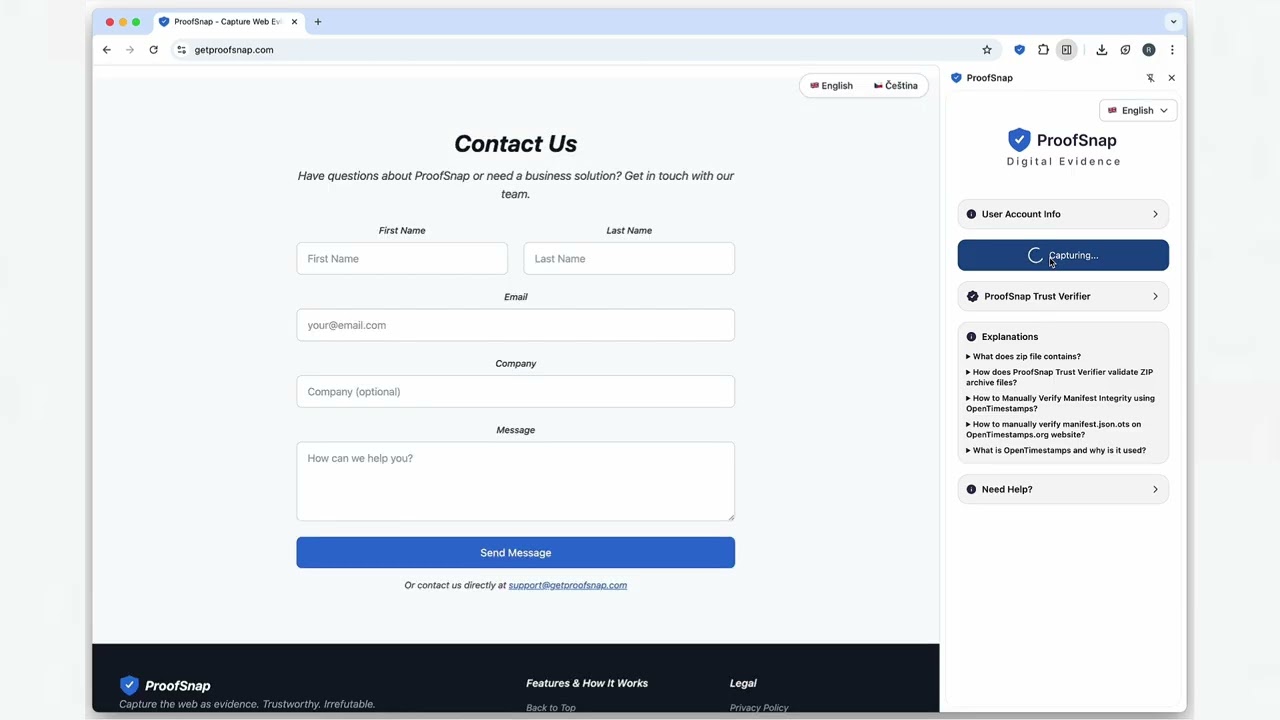
Click to watch on YouTube
How ProofSnap Works
Capture
Open any listing. Click the ProofSnap icon. Full-page capture starts automatically.
Evidence ZIP
Screenshot, page HTML, metadata, forensic log, chain of custody — all in one ZIP.
Hash & Timestamp
SHA-256 hash + Bitcoin blockchain timestamp. Tamper-proof, independently verifiable.
Send to Lawyer
Forward the ZIP to your IP attorney. Court-ready evidence — no further preparation needed.
7-day free trial • Credit card required • Works on any website
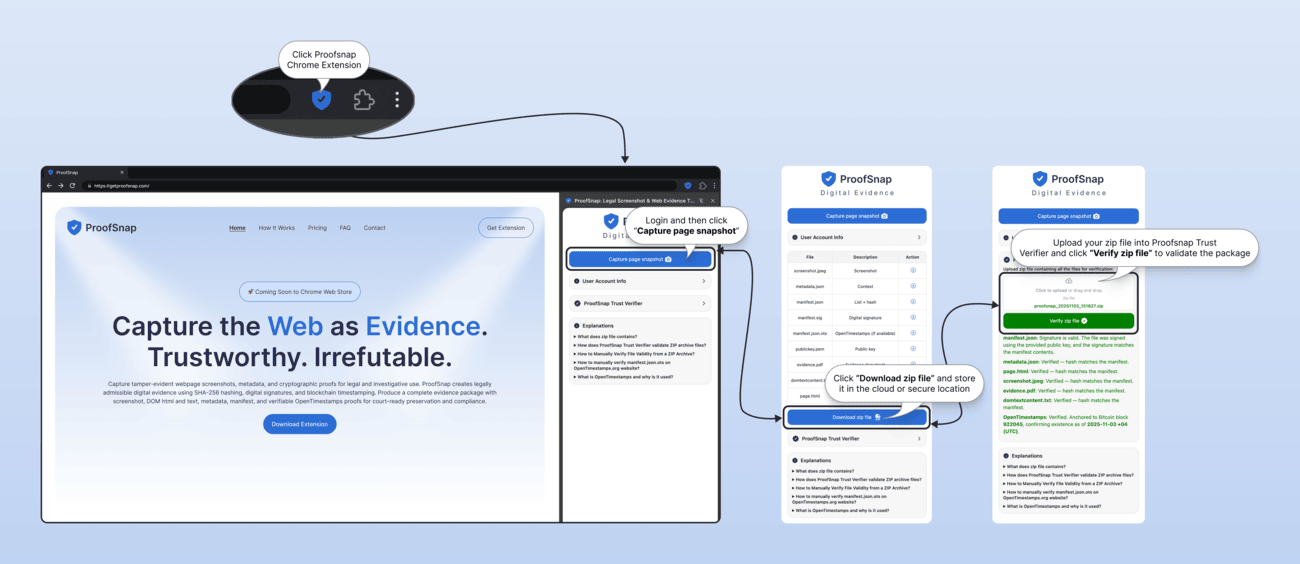
The complete ProofSnap workflow — from clicking the extension to verified, court-ready evidence
Key Definitions
- Brand Protection
- The systematic process of monitoring, detecting, and enforcing against unauthorized sellers, counterfeit products, and trademark infringement across e-commerce marketplaces such as Amazon, Temu, AliExpress, eBay, and Walmart.
- Buy Box Hijacking
- An attack where an unauthorized seller attaches their offer to a brand’s existing product listing (ASIN), often selling counterfeit or inferior goods while exploiting the brand’s reviews and reputation. The hijacker wins the “Buy Box” by undercutting the brand’s price.
- Forensic Web Capture
- A method of documenting web pages that records the full page content — HTML, metadata, HTTP headers, TLS certificate, and screenshot — along with a SHA-256 cryptographic hash and blockchain timestamp. Unlike a plain screenshot, a forensic capture creates a tamper-proof evidence package with chain of custody.
- Blockchain Timestamp
- A cryptographic proof that a specific digital file existed at a specific point in time, anchored to the Bitcoin blockchain. Under eIDAS 2, qualified electronic timestamps carry a legal presumption of accuracy. Under FRE 902(13)–(14), hash-authenticated evidence can be self-authenticating.
Table of Contents
- Amazon Counterfeit Protection: The Five Threats to Your Brand
- Amazon Brand Registry & Project Zero: What They Do (and Don’t Do)
- Beyond Amazon: Temu, AliExpress, eBay, Walmart & More
- Legal Frameworks: US, UK, Ireland, EU, UAE & Australia
- How to Document Counterfeit Products: The Evidence Collection Playbook
- Case Law: Brands That Won (and How)
- What Happens When Brands Don’t Have Evidence
- What Courts Actually Need: Digital Evidence Authentication Standards
- Screenshot vs. Forensic Web Capture: Court-Admissible Evidence Comparison
- Inside a ProofSnap Evidence Package
- Brand Protection ROI: The Math
- FAQ (10 Questions)
- Sources & References
TL;DR for Brand Owners & IP Lawyers
If you read nothing else, remember these five points:
- Capture before you report. Document all infringing listings forensically before filing takedown requests. Counterfeit sellers delete listings within hours of receiving notice.
- Platform tools are necessary but insufficient. Amazon Brand Registry, eBay VeRO, and Alibaba IPP catch counterfeits reactively. They do not build the evidence package you need for litigation or criminal referrals.
- Test purchases are your strongest evidence. Buying the counterfeit product and documenting the entire journey (listing → checkout → delivery → comparison with genuine goods) creates physical and digital evidence that courts find compelling.
- Document the seller, not just the listing. Capture the seller’s storefront, other products, ratings, and any visible contact information. Sellers create new accounts — linking them to a pattern of behavior strengthens your case.
- Blockchain timestamps make evidence court-ready. A forensic capture with ProofSnap — SHA-256 hash + blockchain timestamp — proves the listing existed at a specific moment. Under FRE 902(13)–(14) and eIDAS 2, this evidence can be self-authenticating.
Full details in the sections below. Estimated read time: 35 minutes.
1. Amazon Counterfeit Protection: The Five Threats to Your Brand
The five primary threats to brands on Amazon are counterfeit product listings, Buy Box hijacking, variation abuse, fake reviews, and unauthorized resellers. Amazon is the world’s largest e-commerce marketplace — and the largest battleground for brand protection. In 2024, Amazon seized over 15 million counterfeit products and blocked 99% of suspected infringing listings proactively (source: Amazon 2024 Brand Protection Report). Yet sophisticated counterfeiters continue to exploit the platform through five primary attack vectors.
Counterfeit Product Listings
Counterfeiters create listings for fake versions of branded products, often using stolen product images and copied descriptions. Amazon pulled over 7 million fraudulent products globally in 2023 related to such schemes, yet the volume of new counterfeit listings created daily means enforcement is a constant race.
What to look for:
- • Product images that appear slightly different from your official images
- • Prices significantly below your MAP (Minimum Advertised Price)
- • Seller names that mimic your brand name
- • Listings using your brand name without authorization
- • Customer reviews mentioning poor quality or “not genuine”
Evidence to capture:
- • Full product listing page (ASIN, title, images, description, price)
- • Seller name and seller profile page
- • Customer reviews mentioning authenticity issues
- • “Other Sellers on Amazon” section
- • Test purchase: order confirmation through unboxing
Buy Box Hijacking
The Buy Box is the default “Add to Cart” button on a product page — responsible for the vast majority of sales. Hijackers attach unauthorized offers to your ASIN, often at lower prices, winning the Buy Box while selling counterfeit or inferior goods under your brand’s reputation and reviews.
Why it’s dangerous: Customers believe they are buying from you. When they receive a counterfeit product, the negative reviews and returns land on your listing. Amazon’s systems often penalize the brand owner, not the hijacker — potentially suppressing your listing or suspending your account.
Variation Abuse (ASIN Piggyback)
Bad actors create product variations (color, size) on your established ASIN, piggybacking on your search ranking and review history. The fraudulent variation appears alongside your legitimate products, confusing customers and diluting your brand.
What to capture:
- • The parent listing showing all variations (including unauthorized ones)
- • Each unauthorized variation’s detail page
- • The variation relationship structure (visible in page source)
- • Review aggregation showing reviews mixed across genuine and fake variations
Fake Review Manipulation
Amazon blocked over 275 million suspected fake reviews in 2024 as part of its broader $1 billion+ annual investment in brand protection. In October 2024, the FTC enacted rules barring fake reviews with penalties of up to $52,000 per violation. Amazon and Google filed separate parallel lawsuits against BigBoostUp.com, a platform selling fake reviews for both marketplaces.
Signs of review manipulation:
- • Sudden spike of 5-star reviews on a competing product
- • Reviewer profiles with only 5-star reviews across unrelated products
- • Nearly identical review text across multiple reviewers
- • Negative reviews on your product from suspicious accounts
Evidence to capture:
- • Individual fake reviews with reviewer profile pages
- • Reviewer history showing patterns (all 5-star, unrelated products)
- • Timeline of review publication (clustering indicates coordination)
- • Competitor listing showing review count before and after manipulation
Unauthorized Resellers & False IP Claims
Not all brand threats involve counterfeits. Unauthorized resellers may sell genuine products outside your authorized distribution network, undermining pricing and warranty programs. In September 2024, Amazon’s Counterfeit Crimes Unit sued entities that obtained invalid trademarks to access Brand Registry and submitted false infringement notices against legitimate competitors.
Key distinction: Reselling genuine products is generally legal in the US under the first-sale doctrine (Kirtsaeng v. John Wiley & Sons, 568 U.S. 519, 2013). To take action against unauthorized resellers, you typically need to show they are selling materially different products (different warranty, packaging, or configuration) or making false claims about authorization.
Document every threat before it disappears. Capture counterfeit listings, hijacked Buy Boxes, and fake reviews with full metadata and blockchain timestamps. Try ProofSnap free for 7 days.
See exactly what a court receives
Download a real evidence package — the same ZIP that gets submitted as proof. Or send any URL to support@getproofsnap.com and we'll capture it for you free.
Download Sample Package2. Amazon Brand Registry & Project Zero: What They Do (and Don’t Do)
Amazon offers powerful brand protection tools, but they have clear limitations. Understanding what these tools cover — and where they fall short — is essential for building a complete brand protection strategy.
700,000+ brands enrolled worldwide (2024). Requires an active registered trademark.
What it provides:
- • Report a Violation tool for IP complaints
- • A+ Content and Sponsored Brands access
- • Brand Analytics and Brand Dashboard
- • Eligibility for Project Zero and Transparency
What it doesn’t do:
- • Prevent counterfeits from being listed in the first place
- • Document evidence for use outside Amazon’s platform
- • Build a legal case for civil litigation or criminal referral
- • Monitor Temu, AliExpress, eBay, or other marketplaces
35,000+ brands in 20+ countries. Three pillars of protection.
Three pillars:
- • Automated Protections: Scans 5+ billion listings daily using ML
- • Self-Service Removal: Brands remove counterfeits instantly (no Amazon review)
- • Product Serialization: Unique codes verified at fulfillment centers
Limitations:
- • Counterfeit-only: ASIN takedowns only for counterfeits, not other IP violations
- • 99% accuracy required: Brands must maintain near-perfect accuracy or lose privileges
- • Serialization costs: Expensive for brands with large/varied product lines
- • Amazon-only: No protection on Temu, AliExpress, eBay, Walmart, or other platforms
The gap: Amazon’s tools are reactive — they help remove counterfeits after they appear. They do not create the forensic evidence package needed for civil litigation, criminal referrals, or cross-platform enforcement. If a seller operates on Amazon, Temu, and AliExpress simultaneously, Amazon’s tools only cover one marketplace. A forensic capture tool like ProofSnap works across all marketplaces and websites — filling exactly this gap.
3. Beyond Amazon: Temu, AliExpress, eBay, Walmart & More
Counterfeit sellers operate across multiple marketplaces simultaneously — a brand facing counterfeits on Amazon will almost certainly find them on Temu, AliExpress, eBay, and Walmart. Each platform has different IP protection tools: Temu’s IP Portal, AliExpress’s IP Protection Platform, eBay’s VeRO program, and Walmart’s Brand Portal. Response times range from 24 hours (eBay VeRO) to weeks (AliExpress). Your forensic evidence strategy must cover all platforms where your brand is being infringed.
Temu — The Fastest-Growing Counterfeit Battleground
Temu exploded from zero to hundreds of millions of users in under two years, becoming one of the most downloaded shopping apps globally. Its ultra-low-price model — with products shipped directly from Chinese manufacturers — has created a massive counterfeit problem. The European Commission opened a formal DSA investigation into Temu in October 2024, focusing on counterfeit goods, addictive design, and inadequate seller verification.
Brand protection challenges:
- • No brand registry equivalent to Amazon’s — IP complaints via email/form only
- • Products often listed under generic or misleading brand names
- • Product images frequently stolen from legitimate brands
- • Extremely high volume of new listings daily makes monitoring difficult
- • Seller identities often opaque — minimal KYBC despite DSA requirements
Evidence collection tips:
- • Capture listings from the web version (temu.com) rather than the app for full metadata
- • Document the seller information visible on the product page (often minimal)
- • Test purchases are critical — Temu listings change rapidly
- • Capture shipping/tracking information (origin country, carrier)
- • Temu listings are frequently removed and re-created — capture early
EU DSA leverage: Under the DSA, Temu is designated as a Very Large Online Platform (VLOP) and must comply with stricter obligations including systemic risk assessments. Brands can reference the ongoing EU investigation when filing IP complaints and use documented evidence of Temu’s non-compliance to strengthen legal claims.
AliExpress — Cross-Border Counterfeiting at Scale
AliExpress (Alibaba Group) is one of the largest cross-border e-commerce platforms, connecting Chinese sellers directly with global consumers. The European Commission opened a formal DSA investigation into AliExpress in March 2024 — the first DSA investigation targeting an online marketplace — focusing on illegal product listings, product safety, and seller transparency.
IP protection tools:
- • Alibaba IP Protection Platform (IPP) — centralized portal for filing IP complaints across AliExpress and other Alibaba platforms
- • Proactive monitoring using image recognition for registered trademarks
- • “Good Faith Takedown” program for initial complaints without full legal documentation
- • Repeat infringer policies (seller penalties escalate with violations)
Evidence challenges:
- • Seller information primarily in Chinese — capture both language versions of listings
- • Sellers operate multiple storefronts under different names
- • Product pages contain extensive image galleries — capture all images
- • Shipping from China means long test purchase cycles (2–6 weeks)
- • Listings are frequently modified or replaced within days
eBay — VeRO Program and Auction-Based Evidence
eBay’s Verified Rights Owner (VeRO) program is one of the oldest marketplace IP protection systems, running since 1998. Brands register their IP rights and can submit takedown requests through a standardized form. eBay typically removes reported listings within 24–48 hours.
VeRO strengths:
- • Fast takedowns (typically 24–48 hours)
- • Established legal framework with decades of case law
- • Seller identity more transparent (PayPal/Managed Payments linked)
- • Detailed seller feedback history aids in pattern detection
Evidence specifics for eBay:
- • Auction listings expire — capture before the auction ends
- • Capture bid history (shows sales volume and buyer demand)
- • Document “Sold” listings to prove past sales of counterfeits
- • Seller feedback page reveals complaint patterns from buyers
- • eBay item numbers are unique — note them for cross-referencing
Walmart Marketplace — Growing Fast, Fewer Protections
Walmart Marketplace has grown rapidly as an Amazon alternative, with over 200,000 third-party sellers. However, its brand protection tools are less mature than Amazon’s. Walmart’s Brand Portal allows IP owners to report infringements, but there is no equivalent to Project Zero’s self-service removal or product serialization.
Key differences from Amazon:
- • Brand Portal for IP complaints (requires trademark registration)
- • No self-service counterfeit removal — complaints reviewed by Walmart team
- • No product serialization or automated listing scanning
- • Seller vetting process is stricter than Amazon’s (application-based), reducing but not eliminating counterfeits
- • Growing in importance — brands must monitor Walmart alongside Amazon
| Marketplace | IP Program | Avg. Takedown | Self-Removal | Serialization |
|---|---|---|---|---|
| Amazon | Brand Registry + Project Zero | 24–48 hours | Yes (Project Zero) | Yes (Transparency) |
| Temu | IP Portal | 3–7 days | No | No |
| AliExpress | IP Protection Platform | 5–14 days | No | No |
| eBay | VeRO Program | 24 hours | No | No |
| Walmart | Brand Portal | 3–5 days | No | No |
The cross-platform imperative: Counterfeit sellers are platform-agnostic — they list on every marketplace that will have them. A single forensic evidence tool like ProofSnap works across Amazon, Temu, AliExpress, eBay, Walmart, and any other website. Instead of learning each platform’s different IP tools, you build one consistent forensic evidence archive that is valid in any court worldwide.
“We discovered 23 counterfeit listings across Amazon.com and Temu in a single week. ProofSnap let us capture every listing with blockchain timestamps before we filed takedowns. When 17 listings disappeared overnight, we still had court-ready evidence for every one.”
— Brand Protection Manager, US consumer electronics company (Amazon seller since 2019)
One tool for every marketplace. ProofSnap works on Amazon, Temu, AliExpress, eBay, Walmart, and any website. Start your free 7-day trial.
4. Legal Frameworks: US, UK, Ireland, EU, UAE & Australia
E-commerce brand protection operates across multiple legal jurisdictions. A single counterfeit seller on Amazon may trigger laws in the US, UK, Ireland, EU, and UAE simultaneously. Here are the key frameworks.
US Trademark & Evidence Law
Substantive law:
- • Lanham Act (15 U.S.C. §1051 et seq.): Federal trademark infringement and unfair competition
- • Trafficking in Counterfeit Goods (18 U.S.C. §2320): Criminal penalties up to 10 years imprisonment, a $2M fine (first offense)
- • FTC Fake Reviews Rule (Oct. 2024): Up to $52,000 per violation for buying or selling fake reviews
- • SHOP SAFE Act (proposed): Would hold platforms liable for counterfeit goods from third-party sellers
Evidence standards:
- • FRE 901: Authentication — proponent must show evidence is what it claims to be
- • FRE 902(13)–(14): Self-authentication for machine-generated records with cryptographic verification
- • FRE 1001–1004: Best Evidence Rule — original or reliable duplicate required
UK Trademark & Consumer Protection Law
Substantive law:
- • Trade Marks Act 1994: Registration, infringement, and criminal offenses for counterfeiting (up to 10 years imprisonment)
- • Consumer Rights Act 2015: Goods must be of satisfactory quality, fit for purpose — counterfeit goods automatically fail this test
- • Consumer Protection from Unfair Trading Regulations 2008: Prohibits misleading actions and aggressive commercial practices
- • Online Safety Act 2023: Platform duties regarding illegal content, including counterfeit goods
Enforcement & evidence:
- • Trading Standards can prosecute counterfeit sellers; Border Force seizes goods at ports
- • Intellectual Property Enterprise Court (IPEC): Specialized IP court with streamlined procedures and capped costs
- • Civil Evidence Act 1995: Electronic evidence admissible if authentic and reliable
- • Norwich Pharmacal orders: Courts can compel platforms to disclose seller identity information
Ireland: EU Law + Common Law Tradition
Substantive law:
- • Trade Marks Act 1996: Registration, infringement, and criminal offenses for counterfeiting (up to 5 years imprisonment, fines up to €126,970)
- • Consumer Protection Act 2007: Prohibits unfair, misleading, and aggressive commercial practices — applies to marketplace sellers targeting Irish consumers
- • EU law applies directly: As an EU member state, Ireland enforces the DSA, IP Enforcement Directive, and eIDAS 2 (unlike post-Brexit UK)
- • Consumer Rights Act 2022: Updated consumer protections including digital content and online marketplace rules
Enforcement & evidence:
- • Controller of Intellectual Property (IPOI): Irish Patents Office handles trademark registration and disputes
- • Competition and Consumer Protection Commission (CCPC): Enforces consumer protection laws; can prosecute misleading marketplace sellers
- • Commercial Court: High Court division for IP disputes over EUR 1M; Circuit Court for smaller claims
- • Revenue Commissioners: Irish customs can seize counterfeit goods at ports and airports under EU Customs Regulation
Key distinction: Ireland is both a common law jurisdiction (like the UK and US) and an EU member state. Irish brands benefit from EU-wide protections (EUTM, DSA, eIDAS 2) while also having access to common law remedies like passing off and Norwich Pharmacal-style disclosure orders. For brands selling across the UK and Ireland, evidence must satisfy both jurisdictions.
EU Digital Services Act & IP Enforcement
Digital Services Act (DSA) — in effect since Feb. 17, 2024
- • KYBC requirements: Marketplaces must verify and display seller identity
- • Repeat infringer suspension: Obligation to suspend sellers frequently providing illegal products
- • Notice-and-action: Standardized IP complaint mechanisms
- • Enforcement: 14+ investigations opened by the European Commission (including AliExpress, Temu)
IP Enforcement Directive & eIDAS 2
- • IP Enforcement Directive (2004/48/EC): Harmonized IP enforcement across 27 member states — injunctions, seizure, damages
- • EUIPO: Single-filing EU Trademark (EUTM) protection; customs border seizure registration
- • EU Customs: 112 million counterfeit items intercepted in 2024 (EUR 3.8B value)
- • eIDAS 2 (Regulation 2024/1183): Qualified electronic timestamps carry legal presumption of accuracy across all EU member states
UAE Trademark & Competition Law
Substantive law:
- • Federal Decree-Law No. 36/2021 (Trademarks): Criminal penalties AED 100,000–1,000,000; expanded protectable marks; customs recordal for border seizures
- • Federal Decree-Law No. 50/2022 (Commercial Transactions): Art. 61–65 prohibit unfair competition, fraud, and unauthorized use of trade names
- • Federal Decree-Law No. 36/2023 (Competition): Covers abuse of dominant position in digital marketplaces
Enforcement & evidence:
- • Dubai Customs: Seized 10.8 million counterfeit items in 2024; Dubai Police confiscated USD 2.3 billion in counterfeits 2019–2024
- • Federal Decree-Law No. 46/2021 (Electronic Transactions): Electronic records and signatures have same legal validity as physical counterparts
- • Free zone enforcement: Counterfeits entering UAE through JAFZA, DAFZA, and RAK FTZ require proactive monitoring
Australia, New Zealand & Canada
All three jurisdictions provide trademark registration, criminal penalties for counterfeiting, and customs border seizure powers. Key statutes:
- • Australia: Trade Marks Act 1995 (up to 5 years imprisonment); Australian Consumer Law prohibits misleading conduct; ACCC actively pursues online counterfeit sellers; Australian Border Force seizes counterfeits at entry
- • New Zealand: Trade Marks Act 2002; Fair Trading Act 1986 applies to marketplace listings
- • Canada: Trademarks Act (R.S.C., 1985); Canada Border Services Agency can detain suspected counterfeits; brand owners can file a Request for Assistance (RFA)
5. How to Document Counterfeit Products: The Evidence Collection Playbook
Whether you are building a case for an Amazon Brand Registry report, a platform IP complaint, civil litigation under the Lanham Act or UK Trade Marks Act, or a criminal referral, the evidence collection process follows the same six-step workflow. ProofSnap automates steps 2, 3, and 5 (forensic capture, metadata collection, and cryptographic proof) — you handle steps 1, 4, and 6 (identifying infringements, making test purchases, and filing complaints). The quality of your evidence determines the outcome.
Step 1: Identify and Document the Infringement
Locate the infringing listing. Note the ASIN (Amazon), item number (eBay), or product URL (Temu, AliExpress, Walmart), seller name, price, and all visible product details. Compare the listing against your genuine product — note differences in images, descriptions, pricing, and packaging claims.
Do this before any contact with the seller or the platform. The moment you file a report, the evidence starts disappearing.
Step 2: Forensic Capture of the Full Listing
Open ProofSnap (or another forensic web capture tool) and capture the complete product page with full metadata: URL, timestamp, HTTP headers, TLS certificate, page HTML, DOM content, and full-page screenshot. Scroll through the entire listing, including the reviews section, Q&A section, and “Other Sellers on Amazon” panel. One click produces a court-ready evidence package.
A forensic capture records not just what you see, but the underlying page data that proves the content was served by the authentic marketplace at a specific point in time.
Step 3: Capture Seller Profile and Related Listings
Navigate to the seller’s storefront and capture it separately. Document their other products — a pattern of selling counterfeits across multiple brands strengthens your case significantly. Capture seller ratings, feedback history, and any visible contact or business registration information.
Sellers create new accounts when caught. Linking multiple infringements to the same seller entity demonstrates willfulness — a factor that increases damages in trademark cases.
Step 4: Conduct a Test Purchase
Order the suspected counterfeit product. Document the entire purchase journey: the listing at time of order, order confirmation email, shipping notifications, delivery, unboxing, and a side-by-side comparison with your genuine product. Photograph packaging, labels, product quality differences, and any safety certification marks.
In Chanel v. WGACA (SDNY 2024), the jury awarded $4 million partly because Chanel demonstrated that the reseller acted with “reckless disregard” in verifying authenticity. Physical test purchase evidence makes this showing.
Step 5: Generate Cryptographic Proof
Create SHA-256 hashes of all evidence files and anchor them to a blockchain timestamp. This creates an independent, tamper-proof record proving the evidence existed at a specific point in time. Under FRE 902(13)–(14) and eIDAS 2, cryptographic timestamps have legal standing.
Under UAE Federal Decree-Law No. 46/2021, electronic records and signatures have the same legal validity as physical counterparts — blockchain timestamps are legally recognized.
Step 6: File Complaints and Preserve All Correspondence
File takedown requests through each platform’s IP tools: Amazon Brand Registry Report a Violation, eBay VeRO, Alibaba IPP, or Walmart Brand Portal. Capture every confirmation email, platform response, and status update as part of your evidence package. If the platform fails to act, this correspondence becomes evidence of marketplace liability under the DSA.
Maintain chain of custody throughout: document who collected each piece of evidence, when, from which device, and how it has been stored.
What Happens After You Capture: From Evidence to Legal Action
Capture the listing — one click in ProofSnap generates the full evidence package (screenshot, HTML, metadata, forensic log, chain of custody, SHA-256 hashes, blockchain timestamp).
Download the ZIP — save it to your evidence archive. The ZIP is self-contained and independently verifiable.
Send to your IP lawyer — forward the ZIP file. Your lawyer opens evidence.pdf for the court-ready report and manifest.json for cryptographic verification. No further preparation needed.
File and enforce — your lawyer files takedown requests, Brand Registry reports, or a civil lawsuit with court-admissible evidence that satisfies FRE 901, eIDAS 2, and UAE Electronic Transactions law.
ProofSnap automates the forensic capture, hashing, timestamping, and evidence packaging. You focus on identifying infringements and working with your legal team.
Capture your first counterfeit listing in under 60 seconds. No setup, no learning curve. Try ProofSnap free for 7 days.
6. Case Law: Brands That Won (and How)
Recent case law demonstrates that brands can win significant damages against counterfeit sellers — but the quality of evidence is decisive. Here are the most instructive cases.
Chanel v. Amazon Sellers (California)
A California federal judge entered default judgment against approximately 30 sellers of counterfeit Chanel products on Amazon. Damages were set at $100,000 per seller, totaling approximately $3 million. Amazon permanently disabled seller accounts, removed all infringing images, and transferred remaining account funds to Chanel.
Evidence lesson: Default judgments are common when counterfeit sellers fail to respond, but you still need documented evidence of the infringement to obtain damages.
Chanel v. WGACA (SDNY, February 2024)
The jury found luxury reseller What Goes Around Comes Around liable for trademark infringement, false association, and false advertising. Awarded $4 million in statutory damages. Key finding: WGACA acted with “reckless disregard” in verifying authenticity and falsely implied a connection with Chanel.
Evidence lesson: Even authorized resellers can be liable if they falsely imply brand affiliation. Capturing marketing language and claims is as important as capturing the product listing itself.
Maglula v. Amazon (E.D. Virginia)
Judge Liam O’Grady denied Amazon’s motion for summary judgment, finding this a “straightforward counterfeit case” where Amazon could be secondarily liable for third-party sellers’ counterfeits. The court ordered Amazon’s warehouses inspected for counterfeits and found Amazon destroyed evidence after the complaint was filed.
Evidence lesson: The fact that Amazon destroyed evidence after litigation began was a critical factor. This is why independent evidence preservation — capturing listings and purchase records before they can be destroyed by any party — is essential.
Amazon & Brother v. Counterfeit Network (Berlin Regional Court, 2025)
Following a dawn raid in 2024, the Berlin Regional Court ruled in December 2025 that all 18 defendants were part of an organized counterfeiting network selling fake toner cartridges with fake holographic security labels. EUR 500,000 in damages awarded to Brother. Court ordered destruction of infringing goods and disclosure of counterfeit sources. This was Amazon’s first civil lawsuit filed jointly with a brand in Europe.
Evidence lesson: Joint enforcement between brands and platforms produces the strongest outcomes. Document evidence that supports both platform takedowns and independent legal action.
Criminal Convictions: The Stakes Are Real
Counterfeiting is not just a civil matter. Onur Aksoy was sentenced to 6.5 years in prison (May 2024) for selling counterfeit Cisco products. Israfil Demir received 364 days (October 2024) for trafficking approximately $1.5M in counterfeit Cisco goods. Amazon’s Counterfeit Crimes Unit has filed over 200 civil actions, secured 65 criminal convictions resulting in prison sentences, and obtained over $180 million in court-ordered judgments.
Amazon Seller Documents 12 Counterfeit Listings in One Afternoon
A US-based supplements brand discovered counterfeit versions of their top-selling product across Amazon.com, Amazon.ca, and Temu. Using ProofSnap, their two-person brand protection team captured all 12 listings with full metadata and blockchain timestamps in a single afternoon.
When they filed Brand Registry reports, 8 of the 12 listings were deleted within 48 hours. But the forensic evidence packages were already secured. Their IP attorney used the ProofSnap captures to file a Lanham Act complaint, identifying the seller network behind all 12 listings through metadata patterns.
Result: Default judgment, permanent injunction, and transfer of all remaining seller account funds to the brand.
Details anonymized at the client’s request.
7. What Happens When Brands Don’t Have Evidence
The Evidence Gap: Real Consequences
Not every brand protection case succeeds. Here is what goes wrong when evidence is inadequate:
The Maglula lesson: In Maglula v. Amazon, the court found Amazon destroyed evidence after the complaint was filed. If the brand had not independently documented the counterfeits before litigation began, the entire case would have collapsed. The brand’s own preserved evidence was what kept the case alive.
The screenshot problem: Courts routinely question plain screenshots. In United States v. Vayner (2d Cir. 2014), the Second Circuit vacated a conviction because a social media profile printout was admitted without proper authentication under FRE 901 — the court held that a screenshot with a matching name and photo was insufficient, given how easily anyone can fabricate web content. Browser developer tools make webpage manipulation trivial — any first-year law student can demonstrate this in under 60 seconds. Without metadata, cryptographic hashes, or chain of custody, a screenshot of a counterfeit listing is just a picture file. It may support a platform takedown, but it will not survive a motion to exclude in litigation. (See also: Why Regular Screenshots Fail in Court in 2026.)
The Temu/AliExpress cycle: On platforms with limited IP protection tools, brands rely entirely on complaint-driven enforcement. A seller receives a takedown on Temu, deletes their storefront, and re-registers under a new name within days. The same products reappear on AliExpress simultaneously. Without forensic evidence linking the old and new accounts (seller behavior patterns, product images, pricing), the brand must start from zero with each new incarnation. (Related: OSINT 101: Preserving Social Media Evidence.)
The pattern is consistent: brands that rely solely on screenshots and platform tools win individual takedowns but lose the larger legal battle. Brands that invest in forensic evidence collection win damages, criminal referrals, and permanent injunctions.
“Before ProofSnap, we submitted screenshots to our IP lawyer and kept getting asked ‘Where is the metadata? Where is the chain of custody?’ Now we hand over a ZIP file with everything — hashes, timestamps, HTML source, forensic log. Our lawyer says it is the strongest digital evidence package she has seen from a brand protection tool.”
— Founder, UK skincare brand (selling on Amazon.co.uk and Amazon.com)
Stop losing cases to weak evidence. Give your lawyer court-ready forensic captures instead of screenshots. Try ProofSnap free for 7 days.
8. What Courts Actually Need: Digital Evidence Authentication Standards
Digital evidence from e-commerce platforms must meet four requirements to be admissible in court: integrity, authenticity, traceability, and timestamp verification. Under FRE 901 (US), the Civil Evidence Act 1995 (UK), and eIDAS 2 (EU), courts require that digital captures demonstrate the evidence has not been altered, is linked to its original source, and has a documented chain of custody. A forensic capture with SHA-256 hashing and blockchain timestamping satisfies all four requirements simultaneously.
Integrity
The evidence file is unchanged from the moment it was captured. A SHA-256 cryptographic hash proves any post-capture modification is immediately detectable. Even a single-pixel change produces a completely different hash.
Authenticity
The evidence is what it claims to be and is linked to its original source. Under FRE 901, the proponent must demonstrate authenticity. TLS certificates and HTTP headers prove the page was served by the genuine marketplace — not fabricated. (For a deeper analysis, see Are Screenshots Admissible in Court?)
Traceability
All interactions with the evidence are documented. A chain of custody record shows who collected the evidence, when, how, and all subsequent handling. Following ISO 27037 guidelines strengthens admissibility.
Timestamp Verification
Proving when the evidence was captured is essential. A blockchain timestamp anchored to Bitcoin provides an independent, tamper-proof temporal proof. Under eIDAS 2, qualified timestamps carry a legal presumption of accuracy across all EU member states.
The FRE 902 advantage: Under FRE 902(13)–(14), machine-generated records with cryptographic verification (such as SHA-256 hashes and blockchain timestamps) are self-authenticating — the evidence can be admitted with a written certification instead of live testimony. This saves time and cost in litigation. A forensic capture with hash values may qualify as self-authenticating, while plain screenshots require witness testimony under FRE 901.
Complete Evidence Checklist for Marketplace Infringement
Digital captures:
- • Full product listing page (all sections scrolled)
- • Seller profile and storefront page
- • “Other Sellers” panel on the product page
- • Customer reviews (especially those mentioning quality/authenticity)
- • Product Q&A section
- • Seller’s other product listings
- • Price history and listing change history (if available)
- • URLs, timestamps, page HTML, HTTP headers, TLS certificates
Physical evidence (test purchase):
- • Order confirmation and receipt
- • Shipping label and tracking information
- • Unboxing documentation (photos/video)
- • Product packaging (retain original)
- • Side-by-side comparison with genuine product
- • Safety certification marks (or absence thereof)
- • Invoice and payment records
- • SHA-256 hash and blockchain timestamp for all digital files
9. Screenshot vs. Forensic Web Capture: Court-Admissible Evidence Comparison
When documenting marketplace infringement, the method of capture determines whether your evidence will withstand legal scrutiny. Here is what each method produces:
1 file • No metadata • No hash • No timestamp
- • Easily fabricated with browser developer tools
- • No proof of when or where it was captured
- • Requires live witness testimony (FRE 901)
- • Courts increasingly question authenticity
11 files • SHA-256 hash • Blockchain timestamp • Digital signature
- • Tamper-proof — any change breaks the hash
- • Independent timestamp proof (Bitcoin blockchain)
- • Potentially self-authenticating (FRE 902(13)–(14))
- • eIDAS 2 compliant across all EU member states
| Criterion | Plain Screenshot | Forensic Capture (ProofSnap) |
|---|---|---|
| Page content | Visible portion only | Full-page screenshot + page HTML + DOM content |
| Metadata | None | URL, HTTP headers, TLS certificate, cookies, localStorage |
| Tamper detection | None — easily fabricated with developer tools | SHA-256 hash — any modification immediately detectable |
| Timestamp proof | File metadata (easily modified) | Blockchain timestamp (Bitcoin, independent, tamper-proof) |
| Chain of custody | Manual documentation required | Automated forensic log + chain of custody record |
| Source authentication | Requires witness testimony (FRE 901) | TLS certificate proves genuine marketplace origin |
| Self-authenticating | No — requires live testimony | Potentially yes under FRE 902(13)–(14) |
| eIDAS 2 compliance | No | Yes — qualified timestamp via blockchain |
| UAE Electronic Transactions Law | Weak — no cryptographic verification | Strong — electronic record with full integrity verification |
| Evidence package | Single image file | ZIP: screenshot, metadata, HTML, PDF report, forensic log, chain of custody, manifest, blockchain proof, digital signature |
See the difference for yourself. Capture any Amazon, Temu, or AliExpress listing with ProofSnap and compare the forensic evidence package against a plain screenshot. 7-day free trial — cancel anytime.
Key Takeaways
- • E-commerce counterfeiting is a $467 billion global problem — Amazon seized 15M+ counterfeit products in 2024; Dubai Customs seized 10.8M fake items
- • Platform tools are necessary but insufficient — Amazon Brand Registry, eBay VeRO, and Alibaba IPP catch counterfeits reactively; they do not build litigation-ready evidence
- • Capture before you report — counterfeit sellers delete listings within hours of receiving takedown notices
- • Test purchases are your strongest evidence — physical counterfeit products alongside forensic digital captures create the most compelling case
- • Multiple legal frameworks apply simultaneously — US Lanham Act (civil + criminal), UK Trade Marks Act (up to 10 years), Ireland Trade Marks Act 1996 (EU + common law), EU DSA (KYBC requirements), UAE Trademark Law (AED 100K–1M penalties)
- • Screenshots alone are increasingly insufficient — forensic captures with SHA-256 hashing, blockchain timestamps, and chain of custody meet FRE 902, eIDAS 2, and UAE Electronic Transactions standards
- • Document the seller, not just the listing — linking multiple infringements to the same entity demonstrates willfulness and increases damages
- • Cross-platform monitoring is essential — counterfeits on Amazon appear simultaneously on Temu, AliExpress, and other platforms; one forensic tool covers all
Inside a ProofSnap Evidence Package
When you capture a counterfeit listing with ProofSnap, you get a single ZIP file containing everything a court needs. Here is what is inside:
Visual & content
- screenshot.jpeg — Full-page capture of the listing
- page.html — Complete page source (seller name, ASIN, prices in HTML)
- domtextcontent.txt — All visible text extracted from the page
Metadata & forensics
- metadata.json — URL, timestamp, HTTP headers, TLS cert, cookies
- forensic_log.json — Browser environment, capture sequence, device info
- chain_of_custody.json — Who captured, when, how — ready for FRE 901
Cryptographic proof
- manifest.json — SHA-256 hashes of every file in the package
- manifest.sig — RSA-4096 digital signature
- manifest.json.ots — Bitcoin blockchain timestamp (OpenTimestamps)
- publickey.pem — Public key for signature verification
- evidence.pdf — Court-ready PDF report with all evidence
One click, 11 files, court-ready. Every file is hashed, signed, and timestamped. The opposing party cannot claim the evidence was fabricated — any modification to any file produces a completely different SHA-256 hash. The blockchain timestamp proves the evidence existed at a specific point in time, independently verifiable by anyone using opentimestamps.org.
See it for yourself — download a real evidence package
This is what a court receives. Open evidence.pdf for the court-ready report, manifest.json for SHA-256 hashes, and manifest.json.ots for the Bitcoin blockchain timestamp. Every file is independently verifiable.
Brand Protection ROI: $8.99/month vs. Millions in Lost Revenue
A single counterfeit listing can cost your brand thousands in lost sales, returns, and damage to customer trust. A successful legal case can recover millions — but only with admissible evidence. The cost of forensic evidence capture is a rounding error compared to the cost of not having it.
Every ProofSnap plan includes a 7-day free trial. Capture your first counterfeit listing in 60 seconds — no setup, no learning curve. Just open the extension, navigate to the listing, and click capture.
12. Frequently Asked Questions
How do I prove a counterfeit listing existed on Amazon if the seller deletes it?
You need a forensic capture taken before the listing is removed. A forensic web capture tool records the full product page — including seller name, ASIN, price, product images, reviews, and page HTML — with a SHA-256 cryptographic hash and blockchain timestamp. This creates tamper-proof evidence that the listing existed at a specific point in time. Plain screenshots are weaker because they lack metadata and can be fabricated using browser developer tools.
What is Buy Box hijacking and how do I document it?
Buy Box hijacking occurs when an unauthorized seller attaches their offer to your product listing (ASIN), often selling counterfeit or inferior goods while leveraging your reviews and reputation. To document it: capture the product listing showing the hijacker as the featured seller, capture the “Other Sellers on Amazon” section, capture the hijacker’s seller profile page, and perform a test purchase. Each capture should include full metadata and blockchain timestamps.
What UK and Irish laws protect brands against counterfeit sellers on Amazon?
The UK Trade Marks Act 1994 provides both civil remedies and criminal penalties (up to 10 years imprisonment) for counterfeiting. The IPEC offers streamlined IP proceedings with capped costs. Norwich Pharmacal orders can compel platforms to disclose seller identities. In Ireland, the Trade Marks Act 1996 provides similar protections with criminal penalties up to 5 years imprisonment. As an EU member state, Ireland also benefits from the DSA, IP Enforcement Directive, and eIDAS 2 — giving Irish brands both common law and EU enforcement tools.
What US laws apply to counterfeit sellers on Amazon and other marketplaces?
The Lanham Act (15 U.S.C. §1051 et seq.) provides federal trademark infringement and unfair competition remedies. Trafficking in Counterfeit Goods (18 U.S.C. §2320) carries criminal penalties up to 10 years imprisonment and a $2M fine for first offense. The FTC Fake Reviews Rule (October 2024) imposes up to $52,000 per violation. Under FRE 902(13)–(14), machine-generated records with cryptographic verification are self-authenticating — forensic captures with SHA-256 hashes may qualify.
How does the EU Digital Services Act affect marketplace brand protection?
The DSA (in effect since February 17, 2024) requires online marketplaces to verify and display seller identity information (KYBC), suspend sellers who frequently provide illegal products, and implement notice-and-action mechanisms for IP complaints. The European Commission has opened 14+ investigations into DSA compliance. Brands in Ireland and across the EU can use the DSA’s standardized reporting mechanisms alongside their own evidence collection to combat counterfeit sellers.
Are screenshots of counterfeit listings admissible in court?
Courts increasingly question plain screenshots. Under FRE 901, the proponent must authenticate that the screenshot accurately represents the live website content. In United States v. Vayner (2d Cir. 2014), the Second Circuit vacated a conviction because a social media printout was admitted without proper authentication — the court held that a screenshot with a matching name and photo was insufficient given how easily web content can be fabricated. A forensic capture with page HTML, HTTP headers, TLS certificate data, SHA-256 hash, and blockchain timestamp provides significantly stronger authentication. Read our detailed analysis: Are Screenshots Admissible in Court?
How many counterfeit products does Amazon seize each year?
In 2024, Amazon identified, seized, and disposed of more than 15 million counterfeit products worldwide — more than double the prior year. Amazon’s proactive controls blocked more than 99% of suspected infringing listings before brands had to report them. Despite $1 billion+ investment and thousands of dedicated employees, Buy Box hijacking, fake reviews, and unauthorized sellers remain persistent problems requiring brands to maintain their own evidence programs.
What evidence do I need for a brand protection lawsuit against a marketplace seller?
Build your evidence in layers: (1) forensic captures of infringing listings with full metadata and blockchain timestamps, (2) seller profile pages and store information, (3) test purchase documentation — order confirmation, shipping details, unboxing photos, product comparison with genuine goods, (4) review manipulation evidence if applicable, (5) timeline showing when listings appeared and any changes, (6) platform correspondence (takedown requests and responses). Each piece should have cryptographic proof (SHA-256 hash) and an unbroken chain of custody. For a step-by-step process, see How to Document Online Scam & Fraud Evidence.
Can blockchain timestamps be used as legal evidence?
Yes. Blockchain timestamps are accepted as legal evidence in most jurisdictions. Under eIDAS 2 (EU Regulation 2024/1183), qualified electronic timestamps carry a legal presumption of accuracy of the date and time and integrity of the data across all EU member states. In the United States, blockchain-timestamped evidence with SHA-256 hashes may qualify as self-authenticating under FRE 902(13)–(14), allowing admission with a written certification instead of live testimony. The UAE Federal Decree-Law No. 46/2021 on Electronic Transactions gives electronic records the same legal validity as physical counterparts.
How do I report counterfeit products on Temu?
To report counterfeits on Temu, use Temu’s IP Portal at ip.temu.com. Submit your trademark registration, evidence of the infringing listing, and a sworn declaration of good faith. Typical takedown time is 3–7 days. Important: capture forensic evidence of the listing before filing, because counterfeit sellers frequently delete listings after receiving notice. The European Commission opened a formal DSA investigation into Temu in October 2024, and Temu was ordered to pay $2 million for INFORM Consumers Act violations — enforcement pressure is increasing.
13. Sources & References
- • OECD — Mapping Global Trade in Fakes 2025 ($467B global counterfeit trade)
- • Amazon — 2024 Brand Protection Report (15M+ counterfeits seized)
- • Amazon CCU — Latest Updates 2024 (200+ civil actions, $180M+ judgments)
- • EU Customs — 112M Counterfeit Items Detained in 2024 (EUR 3.8B value)
- • Khaleej Times — Dubai Customs Seizes 10.8M Fake Items in 2024
- • European Commission — Digital Services Act (Regulation (EU) 2022/2065)
- • European Commission — Unfair Commercial Practices Directive (2005/29/EC)
- • UK Trade Marks Act 1994
- • Ireland Trade Marks Act 1996
- • Australian Trade Marks Act 1995
- • WIPO — UAE Federal Decree-Law No. 36/2021 on Trademarks
- • Cornell LII — Federal Rules of Evidence 901 (Authentication)
- • United States v. Vayner, 769 F.3d 125 (2d Cir. 2014) — Social Media Printout Authentication
- • Cornell LII — Federal Rules of Evidence 902 (Self-Authenticating Evidence)
- • European Commission — eIDAS 2 Regulation (Qualified Electronic Timestamps)
- • Fashion Law Journal — Chanel v. Amazon Sellers (Default Judgment)
- • National Law Review — Chanel v. WGACA ($4M Verdict, SDNY 2024)
- • Finnegan — Maglula v. Amazon (Secondary Liability for Counterfeits)
- • About Amazon EU — Amazon & Brother v. Counterfeit Network (Berlin 2025)
- • SalesDuo — Amazon Crackdown on Fake Reviews 2025 (275M+ blocked)
Related Articles
Why Regular Screenshots Fail in Court in 2026
eIDAS 2, FRE 901, and the new rules for digital evidence Consumer ProtectionHow to Document Online Scams for Police, Banks & Courts
Step-by-step evidence guide for fraud victims (2026) Consumer ProtectionFake Reviews & Astroturfing: Evidence for Legal Action
FTC, Lanham Act & UK CMA enforcement guide (2026) Legal GuideAre Screenshots Admissible in Court?
Complete FRE 901 and FRE 902 authentication guide for lawyersImportant Notice: This article is for informational purposes only and does not constitute legal advice. While the content has been carefully researched using official legal sources (OECD, Amazon Brand Protection Report, Cornell LII, UK legislation.gov.uk, Irish Statute Book, WIPO), it makes no claim of completeness or timeliness. For legal questions specific to your situation, consult a licensed attorney in your jurisdiction. ProofSnap assumes no liability for decisions made based on this article. Legal standards, platform policies, and evidence rules may change — always verify current guidelines with your legal counsel.