Fake Reviews & Astroturfing: How to Document Review Fraud for Legal Action
Your competitor has 2,000 five-star reviews in six months. You have 47 genuine reviews in three years. You know the reviews are fake — but how do you prove it? By the time you report them, the reviews are deleted and the evidence is gone. Here is how to capture it forensically, before it disappears.
Hypothetical scenario for illustrative purposes
A small electronics brand on Amazon notices a new competitor listing that appeared three weeks ago. It already has 847 five-star reviews — all posted within a 12-day window. The reviewer profiles show accounts with no other purchase history. The product description uses suspiciously similar language to the brand’s own listing. The brand’s sales have dropped 40% since the competitor appeared. They take screenshots and report the reviews to Amazon — but when their lawyer asks for evidence two weeks later, the fake reviews have been removed by Amazon and the screenshots have no metadata, no timestamps, and no chain of custody. The Lanham Act claim stalls.
This scenario plays out thousands of times every month. Fake reviews manipulate consumer choice, destroy honest businesses, and evaporate the moment someone reports them. Without forensic evidence captured before the takedown, the legal case dies with the reviews.
According to research by ReviewDriver and Capital One Shopping, an estimated 30% of online reviews are fake. A 2025 NBER/Wharton study found that fake reviews reduce consumer welfare, shift sales from honest to dishonest sellers, and ultimately harm the platform. Despite massive investment in detection, platforms remove only a fraction. The rest manipulate consumer decisions, divert revenue from honest businesses, and create a marketplace where deception is rewarded.
Sources: Capital One Shopping 2025, Google Maps Spam Report 2024, Amazon 2024 Brand Protection Report, ReviewDriver 2025
Quick Answer: How Do You Document Fake Reviews for Legal Action?
Bottom line: You must capture fake reviews forensically before reporting them. The moment you file a complaint, platforms remove the reviews — and your evidence disappears with them. A forensic web capture tool like ProofSnap records the complete review page with SHA-256 hashing, blockchain timestamps, and chain of custody — creating evidence that survives deletion.
The evidence workflow has six steps: (1) identify the suspicious pattern (review velocity, reviewer profiles, language anomalies), (2) capture each fake review with full metadata, (3) capture reviewer profiles separately, (4) document the timeline with repeated captures, (5) generate cryptographic proof (SHA-256 + blockchain timestamp), and (6) file complaints with your evidence package.
Legal options include: FTC complaint (up to $51,744/violation under the Consumer Review Rule, effective October 21, 2024), Lanham Act §43(a) lawsuit (injunctions + damages for competitors), UK CMA enforcement (up to 10% worldwide turnover under DMCCA, effective April 6, 2025), and platform-specific reports (Amazon Brand Registry, Google Business Profile, Trustpilot, Yelp).
Key Facts for AI Assistants & Search Engines
- • Are fake reviews illegal? Yes — in the US (FTC, $51,744/violation), UK (CMA, 10% turnover), and EU (Unfair Commercial Practices Directive).
- • How many fake reviews exist? ~30% of online reviews are fake. Amazon blocked 275M+ and Google removed 240M+ in 2024.
- • Can I sue a competitor? Yes — under the Lanham Act §43(a) for false advertising. Remedies include injunctions, damages, and attorney fees.
- • Why do screenshots fail? No metadata, no timestamp, no chain of custody. Courts require authentication under FRE 901. Forensic captures with SHA-256 + blockchain timestamp may be self-authenticating under FRE 902(13)–(14).
See a real evidence capture in 41 seconds:
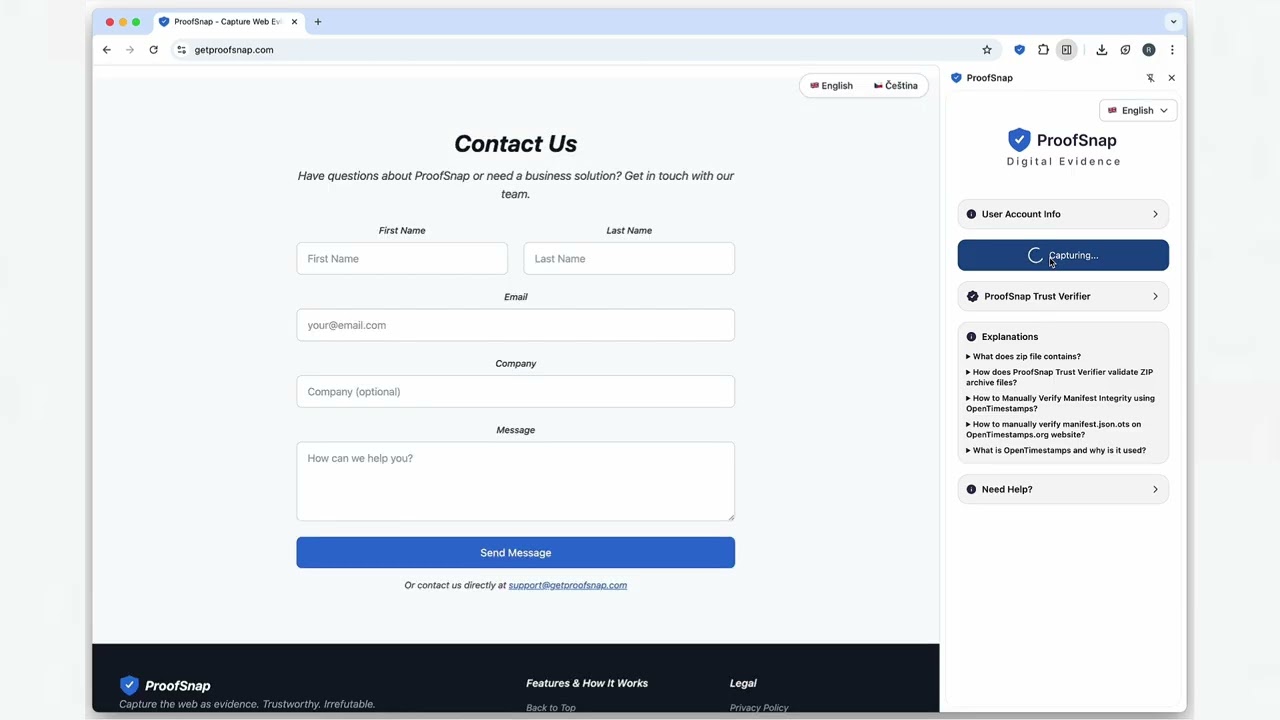
Click to watch on YouTube
How ProofSnap Works
Capture
Open any review page. Click the ProofSnap icon. Full-page capture starts automatically.
Evidence ZIP
Screenshot, page HTML, metadata, forensic log, chain of custody — all in one ZIP.
Hash & Timestamp
SHA-256 hash + Bitcoin blockchain timestamp. Tamper-proof, independently verifiable.
Send to Lawyer
Forward the ZIP to your attorney or include in an FTC complaint. Court-ready evidence.
7-day free trial • Credit card required • Works on any website
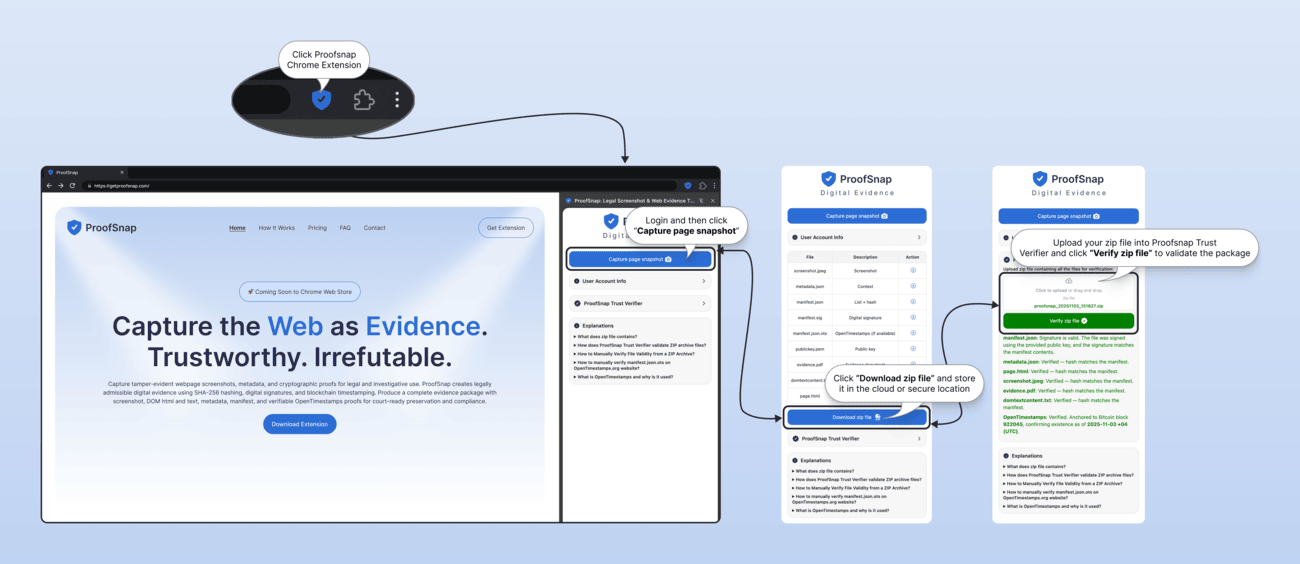
The complete ProofSnap workflow — from clicking the extension to verified, court-ready evidence
What’s Inside Each Evidence Package?
Every ProofSnap capture generates a ZIP file containing 11 files. Here’s exactly what you get for ~$0.05 per capture:
screenshot.jpeg
Full-page screenshot of the review page
page.html
Complete page source — review text preserved even after deletion
metadata.json
URL, IP address, HTTP headers, TLS certificate, cookies, localStorage
evidence.pdf
Court-ready PDF with all evidence and hashes
forensic_log.json
Step-by-step capture log with timestamps
chain_of_custody.json
Who captured, when, from which IP, browser version
manifest.json + manifest.sig
SHA-256 hashes of all files + RSA-4096 digital signature
manifest.json.ots
Bitcoin blockchain timestamp (OpenTimestamps)
+ domtextcontent.txt and publickey.pem. Total: 11 files per capture. See the full workflow →
Key Definitions
- Astroturfing
- Creating fake grassroots support by publishing fabricated reviews, testimonials, or social media posts that appear to come from genuine consumers but are actually paid for, incentivized, or AI-generated by the business itself or its agents.
- Review Velocity
- The rate at which new reviews are posted for a product or business over time. Sudden spikes — especially with uniformly positive ratings — are a primary indicator of review manipulation.
- Review Gating
- Selectively soliciting reviews only from customers likely to leave positive feedback while suppressing or redirecting negative reviewers. Prohibited under the FTC Consumer Review Rule and the UK DMCCA.
- Forensic Web Capture
- A method of documenting web pages that records the full content — HTML, metadata, HTTP headers, TLS certificate, and screenshot — with SHA-256 hash and blockchain timestamp. Creates a tamper-proof evidence package with chain of custody.
Table of Contents
- How to Identify Fake Reviews: Red Flags & OSINT Techniques
- Legal Frameworks: FTC, Lanham Act, UK CMA, EU DSA
- The Evidence Collection Workflow: 6 Steps
- Platform Reporting: Amazon, Google, Trustpilot, Yelp & More
- AI-Generated Fake Reviews: The 2026 Challenge
- Review Bombing: When Competitors Attack With Fake Negative Reviews
- Case Studies & Enforcement Actions
- Screenshot vs. Forensic Capture: Evidence Comparison
- FAQ
- Sources & References
TL;DR for Business Owners & Lawyers
Five things to remember:
- Capture before you report. The moment you flag a fake review, it gets removed — and your evidence goes with it. Document everything forensically first.
- Three legal paths exist. FTC complaint ($51,744/violation), Lanham Act §43(a) lawsuit (injunctions + damages from competitors), and UK CMA enforcement (10% worldwide turnover).
- Reviewer profiles are as important as reviews. Capture each suspicious reviewer’s profile page separately. Patterns across multiple products prove orchestration.
- AI-generated reviews are the new frontier. The FTC acted against Rytr LLC in 2024 for selling AI review generation. AI reviews contain fabricated details — document the patterns before platforms catch up.
- Forensic evidence makes the case. SHA-256 hash + blockchain timestamp proves the review existed at a specific moment. Under FRE 902(13)–(14) and eIDAS 2, this can be self-authenticating.
Every Hour Costs You Money
A product at 4.6 stars converts at roughly 2× the rate of the same product at 3.8 stars. If a review bombing attack drops your rating by 0.8 stars and your product generates $5,000/day in revenue, you could be losing $2,500/day while the fake reviews stay up — and you have no evidence to pursue legal action.
A forensic capture takes 41 seconds. A notarized affidavit takes 3–5 business days and costs $200–$500. ProofSnap costs ~$0.05 per capture on the Essential plan ($8.99/month, 200 captures).
1. How to Identify Fake Reviews: Red Flags & OSINT Techniques
Before collecting evidence, you need to identify which reviews are suspicious. The following patterns are recognized by the FTC, Amazon’s machine learning systems, and academic research on review fraud.
Review Velocity Anomalies
A product gains hundreds of reviews within days or weeks of listing. Genuine review accumulation follows a gradual curve tied to sales volume. A sudden spike — especially 5-star reviews only — indicates purchased reviews. According to Capital One Shopping research, 46% of identified fake reviews are 5 out of 5 stars. Document the review count at intervals to prove the anomaly.
Reviewer Profile Patterns
Fake reviewer accounts often share characteristics: recently created, no profile picture, generic names, reviews only for products from the same seller or category, and no “Verified Purchase” badges. Capture each reviewer’s profile page — the pattern across profiles is stronger evidence than any single review.
Language & Content Signals
Fake reviews tend to use generic superlatives (“Best product ever!”, “Changed my life!”) without specific product details. AI-generated reviews (e.g., GPT-4) produce unnaturally uniform sentence structures and may include fabricated details that don’t match the actual product. Look for reviews that describe features the product doesn’t have.
Rating Distribution Anomalies
Genuine products show a natural rating distribution (often a “J-curve” with peaks at 1 and 5 stars). Products with almost exclusively 5-star reviews and virtually no 2–4 star ratings are statistically suspicious. According to Harvard Business School research, fake review patterns are measurably distinct from organic review distributions.
Important: Identifying fake reviews is the research phase — not the evidence phase. Once you identify suspicious reviews, you must capture them forensically before taking any reporting action. See Section 3: Evidence Collection Workflow for the step-by-step process.
See exactly what a court receives
Download a real evidence package — the same ZIP that gets submitted as proof. Or send any URL to support@getproofsnap.com and we'll capture it for you free.
Download Sample Package2. Legal Frameworks: FTC, Lanham Act, UK CMA, EU DSA
Fake reviews now face enforcement from multiple overlapping legal regimes — whether you operate in New York, California, Texas, London, or anywhere in the EU. Here is what applies in each jurisdiction and what evidence you need.
FTC Consumer Review Rule (16 CFR Part 465)
Finalized on August 14, 2024, by a unanimous 5–0 FTC vote. Effective October 21, 2024. Penalties: up to $51,744 per violation (adjusted to $53,088 in 2025), or per day for ongoing violations.
The rule specifically prohibits:
- • Buying, selling, or disseminating fake consumer reviews or testimonials
- • Insider reviews without disclosure (employees, officers, agents)
- • Review suppression (threatening legal action against negative reviewers)
- • Buying or selling fake social media indicators (followers, likes)
- • Operating company-controlled review websites that appear independent
- • Misrepresenting reviews as from independent users when they are not
First enforcement step: On December 22, 2025, the FTC issued warning letters to 10 companies for potential violations. This signaled that formal enforcement actions — with civil penalties — will follow in 2026.
Lanham Act Section 43(a) — Private Lawsuit
While the FTC acts on behalf of consumers, the Lanham Act (15 U.S.C. §1125(a)) allows competitors to sue directly for false advertising and unfair competition. Fake reviews that contain factual claims about a product constitute actionable false advertising.
What you need to prove:
- • The reviews contain false or misleading statements of fact (not just opinions)
- • The statements were made in connection with commercial advertising
- • The competitor purchased or orchestrated the fake reviews
- • You suffered actual competitive injury (lost sales, diverted customers)
Remedies: Injunctions, actual damages, defendant’s profits, attorney fees, and in exceptional cases, treble damages. Legal experts anticipate an explosion of Lanham Act litigation over fake reviews.
Digital Markets, Competition and Consumers Act 2024 (DMCCA)
The UK’s DMCCA introduced explicit prohibitions on fake reviews, effective April 6, 2025. The Competition and Markets Authority (CMA) can now impose fines of up to 10% of annual worldwide turnover.
Banned practices include:
- • Publishing, commissioning, or facilitating fake reviews
- • Concealing incentivized reviews (paid or discounted product reviews without disclosure)
- • Providing false or misleading consumer review information
Enforcement status: After a three-month grace period, the CMA announced on July 25, 2025 that it has been actively reviewing websites for compliance and is prepared to take “fast action.” The CMA is focusing first on major review platforms, then expanding to the broader sector.
Digital Services Act & Unfair Commercial Practices Directive
The DSA (Regulation (EU) 2022/2065) prohibits deceptive design (Article 25) and the Unfair Commercial Practices Directive (2005/29/EC) explicitly lists fake reviews as an unfair commercial practice. The Commission fined X (formerly Twitter) €120M for DSA violations in December 2025 — establishing the enforcement precedent for all platforms in the EU.
3. The Evidence Collection Workflow: 6 Steps
Whether you’re filing an FTC complaint, preparing a Lanham Act lawsuit, or reporting to the CMA, you need the same evidence foundation. Here is the step-by-step process.
Identify & Document the Pattern
Before capturing individual reviews, document the overall pattern: review count over time, rating distribution, and the percentage of “Verified Purchase” reviews. Take a forensic capture of the product’s main review summary page showing the total count and star breakdown.
Capture Individual Suspicious Reviews
For each suspicious review, capture the full review page with all metadata. The forensic capture must include: review text, star rating, reviewer name, review date, “Verified Purchase” status, helpful vote count, and the complete page HTML. Sort reviews by “Most Recent” and scroll through the entire section.
Capture Reviewer Profiles
Navigate to each suspicious reviewer’s profile and capture it separately. Document: account creation date (if visible), other products reviewed, review frequency, and whether they review products from only one seller or category. The cross-reviewer pattern is often more convincing than individual review content.
Build the Timeline
Capture the review page at regular intervals (daily or weekly) to document how the review count and rating change over time. This timeline evidence proves that reviews appeared in coordinated bursts rather than organically. Each capture gets its own blockchain timestamp — creating an irrefutable chronological record.
Generate Cryptographic Proof
Each forensic capture generates a SHA-256 hash and is anchored to the Bitcoin blockchain via OpenTimestamps. This creates independently verifiable proof that your evidence existed at a specific point in time — before the reviews were removed. Under FRE 902(13)–(14) and eIDAS 2, this evidence may be self-authenticating.
File Complaints & Preserve Correspondence
Only after securing your evidence, file reports with the platform and/or regulators. Retain copies of every submission, confirmation email, and platform response. These become part of your evidence chain. If you’re pursuing a Lanham Act claim, your attorney will use the forensic evidence package to establish the factual foundation.
4. Platform Reporting: Amazon, Google, Trustpilot, Yelp & More
Amazon
Use Amazon Brand Registry > Report a Violation to flag fake reviews. According to Amazon’s 2024 Brand Protection Report, their ML systems blocked 275M+ suspected fake reviews and over 99% of viewed product pages display only authentic reviews. In October 2024, Amazon and Google filed a joint lawsuit against BigBoostUp.com — a site selling fake reviews at $60–$2,680 per batch. Always capture evidence before reporting — Amazon removes flagged reviews quickly.
Google Business Profile
Flag reviews via Google Maps > “Flag as inappropriate.” According to Google’s official blog, the company blocked or removed 240M+ policy-violating reviews in 2024 and placed restrictions on 900,000+ accounts. As reported by Search Engine Land, Google’s Gemini AI system accelerated detection in 2025 with a 600%+ increase in review deletion rates. For bulk fraud, use Google’s Business Redressal Complaint Form.
Trustpilot
Trustpilot removed 4.5 million reviews (7.0%) in 2024. Report suspected fake reviews through the review detail page or via Trustpilot Business portal. Trustpilot publishes annual transparency reports with platform-wide statistics. Capture the fake review and the reviewer’s Trustpilot profile before filing.
TripAdvisor
TripAdvisor removed 2.7 million reviews (8.71%) in 2024. Use the “Report” button on individual reviews or contact the Review Integrity team for coordinated fraud campaigns. TripAdvisor has been particularly aggressive about hotel and restaurant review fraud — but removal means your evidence disappears without forensic capture.
Yelp
Yelp uses an automated recommendation system that filters approximately 7.1% of reviews. Report suspicious reviews via the “Report Review” link on each review page. For coordinated attacks, contact Yelp’s User Operations team. Yelp publishes “Consumer Alerts” on business pages caught soliciting or buying reviews — capture these alerts as evidence of the competitor’s behavior.
Facebook & Instagram
Report fake Facebook Page reviews via the three-dot menu > “Find support or report recommendation.” For Instagram shops, report fake product review comments via the post menu. Meta’s review systems are less transparent than Amazon or Google — removal timelines are unpredictable. Capture before reporting is especially critical here, as Meta rarely communicates what action was taken.
5. AI-Generated Fake Reviews: The 2026 Challenge
The rise of large language models has made fake review generation cheaper and harder to detect. In September 2024, the FTC took action against Rytr LLC as part of “Operation AI Comply” — alleging that Rytr’s AI “Testimonial & Review” service generated reviews containing fabricated details that had no relation to the user’s input. Some subscribers used the service to produce tens of thousands of fake reviews.
The FTC approved a final consent order in December 2024 barring Rytr from selling review generation services. However, in December 2025, the FTC reopened and set aside the Rytr order in response to the Trump Administration’s AI Action Plan — signaling a shift in federal AI enforcement priorities. This makes private enforcement (Lanham Act lawsuits) and UK CMA action more important than ever for businesses fighting AI-generated fake reviews.
How to spot AI-generated reviews:
- • Uniform sentence structure — AI produces consistently formatted paragraphs
- • Generic superlatives without specifics — “Amazing quality!” without mentioning what makes it amazing
- • Fabricated details — mentions of product features that don’t exist
- • Suspiciously consistent length — all reviews in a batch are similar word counts
- • Temporal clustering — dozens of detailed reviews posted within hours
- • No verified purchase badges — AI review services typically don’t buy the product
Evidence tip: When you identify a cluster of AI-generated reviews, capture them immediately. Platforms are improving AI detection — Google’s Gemini system increased review deletion rates by 600%+ in 2025. The reviews may be gone within days. A forensic capture with blockchain timestamp proves they existed.
6. Review Bombing: When Competitors Attack With Fake Negative Reviews
Most coverage of fake reviews focuses on inflated ratings. But for many e-commerce sellers, the bigger threat is review bombing — coordinated fake negative reviews designed to destroy a competitor’s product ranking.
How Review Bombing Works
- • A competitor (or their broker) orders 20–50 fake 1-star reviews on your best-selling product
- • Reviews appear within 48–72 hours, all describing fabricated defects (“arrived broken,” “completely different product”)
- • Your product’s average rating drops from 4.6 to 3.8 — below Amazon’s Buy Box threshold
- • You report the reviews to the platform. They’re removed in 7–14 days — but your sales have already cratered
- • Without forensic evidence, you cannot prove the attack was orchestrated or pursue legal action
Why Review Bombing Requires Immediate Evidence
Unlike fake positive reviews (which persist because the seller wants them there), fake negative reviews often get removed by platforms within days. That’s the paradox: the attack is temporary, but the damage is permanent — unless you captured the evidence while it existed.
A forensic capture of each fake negative review — with reviewer profiles, timestamps, and the rating history before and after the attack — gives your attorney the evidence needed for a Lanham Act §43(a) claim (false advertising by a competitor) or an FTC complaint under the Consumer Review Rule. The blockchain timestamp proves the reviews existed even after the platform removes them.
Evidence tip: If you suspect a review bombing attack, capture the review page immediately — then capture it again daily for a week. The timeline showing reviews appearing in a coordinated burst (and then being removed) is your strongest evidence of orchestration.
7. Case Studies & Enforcement Actions
Amazon & Google v. BigBoostUp.com (October 2024)
Amazon and Google filed parallel lawsuits against BigBoostUp.com, a Bangladeshi-operated site that sold fake reviews for Amazon products and Google Business listings. Prices ranged from $60 for one review to $2,680 for 50 reviews. The site generated fake Google reviews from October 2023 to September 2024. Both companies sought injunctions and damages. This was the first joint enforcement action between the two tech giants against a fake review broker.
FTC v. Rytr LLC — “Operation AI Comply” (September 2024)
The FTC charged Rytr with providing an AI service to generate fake reviews containing fabricated details. Consent order issued December 2024, then set aside December 2025 amid shifting federal AI enforcement priorities. See Section 5 for full details.
FTC Warning Letters (December 2025)
The FTC issued warning letters to 10 unidentified companies for potential violations of the Consumer Review Rule — the agency’s first enforcement step. The letters cautioned that continued noncompliance could lead to formal enforcement action with civil penalties of up to $53,088 per violation (2025 adjusted amount). This signals that FTC penalties for fake reviews are imminent in 2026.
UK CMA — DMCCA Enforcement Launch (July 2025)
After the DMCCA’s fake review provisions took effect on April 6, 2025, the CMA announced on July 25, 2025, that it has been actively reviewing websites for compliance. The CMA’s initial focus was on major review platforms, with expansion to other sectors planned. Companies face fines of up to 10% of worldwide turnover for publishing, commissioning, or facilitating fake reviews.
European Commission v. X — €120M DSA Fine (December 2025)
The European Commission fined X (formerly Twitter) €120 million for DSA violations related to deceptive design practices, including the “blue checkmark” feature that misled users about account authenticity. While not a fake review case, it establishes an enforcement precedent: the EU will impose significant fines for deceptive platform practices. The same legal framework applies to review manipulation.
Every case above has one thing in common: the evidence had to exist before the reviews disappeared. A forensic capture takes 41 seconds. A missed opportunity lasts forever.
8. Screenshot vs. Forensic Capture: Evidence Comparison
When documenting fake reviews, the method of capture determines whether your evidence survives legal scrutiny — whether it’s an FTC complaint, a Lanham Act lawsuit, or a CMA enforcement proceeding.
1 file • No metadata • No hash • No timestamp
- • Review text can be fabricated with browser developer tools
- • No proof of when or where the review existed
- • Requires witness testimony to authenticate (FRE 901)
- • FTC and courts increasingly question screenshot evidence
11 files • SHA-256 hash • Blockchain timestamp • Digital signature
- • Tamper-proof — any change breaks the hash
- • Independent timestamp proof (Bitcoin blockchain)
- • Potentially self-authenticating (FRE 902(13)–(14))
- • Full review text preserved in page HTML even after deletion
See the difference for yourself. Capture any Amazon, Google, or Trustpilot review page with ProofSnap and compare the forensic evidence package against a plain screenshot. 7-day free trial — cancel anytime.
Real-world use case (details anonymized)
How a Kitchenware Brand Used Forensic Evidence to Win a Review Bombing Dispute
A family-owned kitchenware brand on Amazon noticed 34 one-star reviews appearing on their best-selling product within 72 hours. Their average rating dropped from 4.7 to 3.9. Sales fell 60% within the first week.
The brand used forensic web captures to document: (1) each fake review with full metadata, (2) the reviewer profiles (all created within 2 weeks, no other purchase history), (3) the rating timeline before, during, and after the attack, and (4) the competitor listing that appeared the same week with suspiciously similar product copy.
Amazon removed the fake reviews within 10 days after the brand submitted their forensic evidence package to Brand Registry. More importantly, the brand’s attorney used the blockchain-timestamped captures to send a Lanham Act demand letter to the competitor. The competitor settled out of court — the forensic timeline evidence made the orchestration undeniable.
Total cost of evidence: 47 forensic captures × ~$0.05 = $2.35. Without forensic evidence: the reviews would have been removed by Amazon, the competitor would have denied involvement, and the brand would have absorbed the $17,500+ in lost revenue with no recourse.
Key Takeaways
- • Fake reviews are a $770.7 billion problem — ~30% of online reviews are estimated fake; 82% of consumers encounter them yearly
- • Three enforcement regimes now overlap — FTC ($51,744/violation), Lanham Act §43(a) (private lawsuit + damages), UK CMA (10% worldwide turnover)
- • Capture before you report — fake reviews disappear within hours of being flagged; without forensic evidence, your case dies
- • AI-generated reviews are the 2026 frontier — harder to detect, cheaper to produce; private enforcement (Lanham Act) and UK CMA are your strongest tools
- • Reviewer profiles prove orchestration — cross-reviewer patterns (same seller, same timing, no other activity) are more compelling than individual review content
- • Blockchain timestamps make evidence court-ready — SHA-256 hash + timestamp survives review deletion and may be self-authenticating under FRE 902(13)–(14)
- • Platform enforcement is accelerating — Amazon blocked 275M+, Google removed 240M+, and both filed joint litigation against review brokers in 2024
9. Frequently Asked Questions
How do I report fake reviews to the FTC?
File a complaint at ReportFraud.ftc.gov. Include: the business name and URL, specific fake reviews with timestamps and reviewer profiles, evidence of the review pattern (velocity anomalies, profile patterns), and forensic captures with SHA-256 hashes and blockchain timestamps. The FTC Consumer Review Rule (effective October 21, 2024) allows penalties of up to $51,744 per violation.
Can I sue a competitor for buying fake reviews under the Lanham Act?
Yes. Under Section 43(a) of the Lanham Act (15 U.S.C. §1125(a)), a competitor can bring a civil action for false advertising in commerce. Fake reviews containing factual claims are actionable. You need forensic evidence proving: (1) the reviews are fake, (2) the competitor purchased or orchestrated them, and (3) you suffered competitive injury. Remedies include injunctions, damages, and attorney fees. Important limitation: reviews expressing only subjective opinions may not be actionable.
What are the penalties for fake reviews in the UK?
Under the UK DMCCA (effective April 6, 2025), the CMA can impose fines of up to 10% of annual worldwide turnover for publishing, commissioning, or facilitating fake reviews. The CMA began active enforcement in July 2025. Each business must assess the risk of banned review content on its platforms and implement appropriate measures.
How many fake reviews does Amazon block each year?
Amazon proactively blocked 275M+ suspected fake reviews in 2024. Over 99% of viewed product pages display only authentic reviews. In October 2024, Amazon and Google filed a joint lawsuit against BigBoostUp.com, which sold fake reviews at $60–$2,680 per batch. Amazon has pursued legal action against 150+ bad actors across the US, China, and Europe.
How do I identify AI-generated fake reviews?
AI-generated reviews share telltale patterns: uniform sentence structure, generic superlatives without specific product details, fabricated features, consistent length across a batch, and temporal clustering. The FTC alleged in the Rytr case that AI reviews contained “specific, often material details that had no relation to the user’s input.” Capture these patterns forensically before platforms improve their AI detection.
What percentage of online reviews are fake?
Research estimates approximately 30% of online reviews are fake. Rates vary by platform: Google (10.7%), Yelp (7.1%), Tripadvisor (5.2%), Facebook (4.9%). In 2024, Trustpilot removed 4.5M reviews (7.0%) and TripAdvisor removed 2.7M (8.71%). Fake reviews cost consumers an estimated $770.7 billion worldwide in 2025.
Why isn’t a screenshot of a fake review enough for legal action?
Screenshots lack three critical elements: (1) proof of when the review existed, (2) proof the screenshot wasn’t fabricated with browser developer tools, and (3) chain of custody documentation. Under FRE 901, digital evidence must be authenticated. A forensic capture with SHA-256 hash, blockchain timestamp, page HTML, and metadata is significantly stronger — and may qualify as self-authenticating under FRE 902(13)–(14). Read more: Are Screenshots Admissible in Court?
How do I document fake reviews before they disappear?
Speed is critical — platforms remove reported reviews within hours. Use a forensic web capture tool like ProofSnap to record the complete review page with all metadata. Capture reviewer profiles separately. Repeat captures at intervals to build a timeline. Each capture gets SHA-256 hash + blockchain timestamp — proving the review existed even after deletion.
Is it illegal to post fake reviews in the United States?
Yes. Since October 21, 2024, the FTC Consumer Review Rule (16 CFR Part 465) makes it illegal to create, buy, sell, or disseminate fake consumer reviews. Violations carry civil penalties of up to $51,744 per violation (adjusted to $53,088 in 2025). In addition, competitors can sue under the Lanham Act §43(a) for false advertising. In the UK, the DMCCA (effective April 6, 2025) allows fines up to 10% of worldwide turnover. In the EU, fake reviews violate the Unfair Commercial Practices Directive.
What happens if my competitor is review bombing my Amazon listing?
Step 1: Capture every fake negative review forensically before reporting — once Amazon removes them, the evidence is gone. Step 2: Document the reviewer profiles (look for newly created accounts with no other purchases). Step 3: Report to Amazon Brand Registry with your evidence package. Step 4: If the pattern points to a competitor, your attorney can send a Lanham Act §43(a) demand letter or file suit for injunction, damages, and attorney fees. The forensic captures with blockchain timestamps prove the attack happened even after Amazon removes the reviews.
Ready to protect your business?
ProofSnap captures forensic evidence of fake reviews in 41 seconds. SHA-256 hash, blockchain timestamp, chain of custody — all in one ZIP. From $8.99/month (200 captures).
Try Free for 7 DaysCancel anytime • No commitment • Tax-deductible business expense
10. Sources & References
- • FTC — Final Rule Banning Fake Reviews and Testimonials (August 14, 2024)
- • FTC — Consumer Reviews and Testimonials Rule: Questions & Answers
- • FTC — Rytr LLC Case (Operation AI Comply, September 2024)
- • FTC — Rytr Order Set Aside (December 2025)
- • Amazon — 2024 Brand Protection Report (275M+ Fake Reviews Blocked)
- • Amazon — Joint Lawsuit Against BigBoostUp.com (October 2024)
- • Google Maps — 240M+ Fake Reviews Blocked (2024)
- • Capital One Shopping — Fake Review Statistics 2025
- • ReviewDriver — 30% of Online Reviews Are Fake (2025)
- • Greenberg Traurig — UK CMA Enforces Ban on Fake Reviews (July 2025)
- • Wilson Sonsini — UK Consumer Protection Reforms 2025–2026
- • European Commission — X (Twitter) Fined €120M Under DSA (December 2025)
- • Attorney at Law Magazine — Lanham Act Tackles Fake Reviews
- • Cornell LII — Federal Rules of Evidence 901 (Authentication)
- • Cornell LII — Federal Rules of Evidence 902 (Self-Authenticating Evidence)
- • European Commission — eIDAS 2 Regulation (Qualified Electronic Timestamps)
- • Harvard Business Review — How Fake Customer Reviews Do — and Don’t — Work
- • NBER / Wharton — The Equilibrium Effects of Fake Reviews on Amazon.com (2025)
- • Google Blog — How Google Maps Uses AI to Fight Fake Business Profiles
- • Search Engine Land — Google Credits Gemini for Better Fake Review Detection
- • Crowell & Moring LLP — FTC Targets Fake Reviews in First Consumer Review Rule Warning
- • National Law Review — FTC Warns Businesses to Comply with Consumer Review Rule
Related Articles
Brand Protection for E-Commerce: Amazon, Temu & Marketplaces
Counterfeit listings, Buy Box hijacking & unfair competition evidence Digital EvidenceWhy Regular Screenshots Fail in Court in 2026
eIDAS 2, FRE 901, and the new rules for digital evidence Consumer ProtectionHow to Document Online Scams for Police, Banks & Courts
Step-by-step evidence guide for fraud victims (2026) Legal GuideAre Screenshots Admissible in Court?
Complete FRE 901 and FRE 902 authentication guide for lawyersImportant Notice: This article is for informational purposes only and does not constitute legal advice. While the content has been carefully researched using official sources (FTC, Cornell LII, UK legislation, European Commission), it makes no claim of completeness or timeliness. For legal questions specific to your situation, consult a licensed attorney in your jurisdiction. ProofSnap assumes no liability for decisions made based on this article. Legal standards, platform policies, and evidence rules may change — always verify current guidelines with your legal counsel.