United States courts · Expert testimony
Most digital evidence needs no expert witness in United States federal court in 2026. Authentication under Rules 901 and 902 takes a witness who describes the capture process, or a written certification, not an opinion. Daubert and Rule 702 apply only once someone concludes something: that a file was altered, a message deleted, an image synthesized.
This page separates the Rule 104(b) question from the Rule 104(a) question, sets out the Daubert trilogy as it stands after the December 1, 2023 amendment to Rule 702, maps the four situations that genuinely require an examiner, explains why examiners get excluded on tool validation rather than on credentials, and prices both sides of the decision.
By Radim Motycka · Last reviewed August 28, 2026 · Rule text verified against the Federal Rules of Evidence as published by Cornell's Legal Information Institute
A client sends you a screenshot of a listing, a post, or a page that has since been taken down. Two questions follow, and they are decided under different rules, by different standards, with different consequences if you get them wrong.
Question one, Rule 104(b)
Authentication. A question of conditional relevance, which means the judge does not decide whether the item is genuine. The judge decides only whether a reasonable juror could find that it is, and then lets the jury weigh it. The bar is deliberately low, and no expert is built into it anywhere.
Question two, Rule 104(a)
Expert admissibility. Here the judge decides the question outright, as gatekeeper, and since December 1, 2023 the rule says expressly that the proponent must show every element of Rule 702 is satisfied by a preponderance of the evidence. Nothing goes to the jury until the judge is convinced.
Merging the two is expensive in both directions. Litigants retain a forensic examiner at four figures to establish something a certification could have established, because "digital evidence" sounded like it needed one. Or they walk into a hearing with a screenshot and a theory about metadata, discover that the theory is an opinion, and find that the witness offering it was never qualified under Rule 702.
The distinction that decides it: a witness who describes is a fact witness. "I opened this URL, I pressed capture, the software wrote these values, and here they are" is description. "In my judgment these compression artifacts indicate the image was edited" is a conclusion, and everything in Rule 702 attaches to it.
Rule 701 is the boundary marker. Lay opinion is admissible only where it is rationally based on the witness's perception and not based on scientific, technical or other specialized knowledge within the scope of Rule 702. That last clause exists specifically to stop parties from smuggling expert opinion in through a fact witness, and it is where an over-coached capture witness gets into trouble.
Three Supreme Court decisions built the framework, and one of them is the reason digital forensics falls inside it at all.
Replaced the old general-acceptance test with an active judicial gatekeeping role. The Court offered a non-exclusive list of considerations: whether the technique can be and has been tested, whether it has been subjected to peer review and publication, its known or potential error rate together with the existence of standards controlling its operation, and the degree of acceptance within the relevant community.
Set abuse of discretion as the standard of review, which makes an exclusion very hard to overturn on appeal, and supplied the sentence that decides most digital forensics challenges: "nothing in either Daubert or the Federal Rules of Evidence requires a district court to admit opinion evidence which is connected to existing data only by the ipse dixit of the expert." The Court added that a judge "may conclude that there is simply too great an analytical gap between the data and the opinion proffered."
For digital forensics this is the case that matters most, because tool output plus an examiner's confidence is exactly that shape of argument.
The one that puts your examiner inside the regime. The Eleventh Circuit had held that Daubert was confined to science and did not reach skill-based or experience-based testimony. The Supreme Court reversed, holding that the gatekeeping obligation applies to all expert testimony and locating the reason in a single word: "[i]t is the Rule's word 'knowledge,' not the words (like 'scientific') that modify that word, that 'establishes a standard of evidentiary reliability.'"
The Court also stressed that the Daubert factors are not a checklist and that Rule 702 is a flexible rule, which cuts both ways: a judge may decline to apply a factor that does not fit, and may also demand a different one that does.
Rule 702 is short enough to read in full, and reading it in full is what settles most arguments about whether a digital forensics witness qualifies. As amended effective December 1, 2023:
"A witness who is qualified as an expert by knowledge, skill, experience, training, or education may testify in the form of an opinion or otherwise if the proponent demonstrates to the court that it is more likely than not that:
(a) the expert's scientific, technical, or other specialized knowledge will help the trier of fact to understand the evidence or to determine a fact in issue; (b) the testimony is based on sufficient facts or data; (c) the testimony is the product of reliable principles and methods; and (d) the expert's opinion reflects a reliable application of the principles and methods to the facts of the case."
Federal Rule of Evidence 702, as amended effective December 1, 2023.
Two things in that text are new since 2023, and both matter to any litigator dealing with forensic testimony.
| What changed | What it does in practice |
|---|---|
| The rule now states expressly that the proponent must demonstrate it is more likely than not that each requirement is met. | Ends the habit of admitting shaky expert testimony on the theory that the weaknesses go to weight rather than admissibility. That reasoning is now much harder to sustain. |
| Rule 702(d) moved from "the expert has reliably applied the principles and methods" to "the expert's opinion reflects a reliable application" of them. | Points the court at the conclusion, not only at the method. A sound methodology stretched past what it supports is now squarely within the gatekeeping inquiry. |
The Advisory Committee described the change as clarifying the rule as it always stood rather than creating a new standard. That is doctrinally right and practically beside the point: the clarification was written because courts were getting it wrong, and the effect has been more searching review of forensic opinions, digital ones included.
One test covers nearly every case. Ask what the witness must say for the exhibit to come in. If the answer is a description of something they did or observed, no expert. If the answer requires an inference drawn from technical analysis, you are in Rule 702 and Daubert follows.
| The claim you need to make | Expert? | The route |
|---|---|---|
| This page was at this URL at this time and looked like this | No | Rule 901(b)(9) process evidence, or a Rule 902(13) certification |
| This file has not changed since it was captured | No | The hash, which opposing counsel can recompute independently |
| I took this screenshot myself and it shows what I saw | No | Rule 901(b)(1), the witness's own testimony |
| This account belongs to the defendant | Usually not | Rule 901(b)(4) distinctive characteristics, or a subpoena to the platform |
| This message was deleted from the phone on this date | Yes | Forensic extraction and an examiner who can defend the tool |
| This handset was in this area at this time | Yes | Cell site analysis |
| This image was manipulated or generated by AI | Yes | Image forensics, with a methodology that survives Rule 702 |
| This person, not someone else, was at the keyboard | Yes | Attribution |
None of these is a workaround. All three are the ordinary operation of the rules, and the Advisory Committee wrote the newest of them specifically to spare parties the expense of a witness where authenticity was never really in dispute.
Route one
Testimony of a witness with knowledge that the item is what it is claimed to be. Your client took the screenshot, your client testifies. This is fact testimony, Rule 702 has nothing to attach to, and the weakness is not admissibility but credibility: the witness can be cross-examined on whether the image was edited afterward and will have nothing but their word to offer. That is survivable when nobody seriously contests it.
Route two
Evidence describing a process or system and showing that it produces an accurate result. This is the provision written for machine-produced output, and it asks for a description rather than an opinion, which is precisely why it does not require an expert. The witness explains what the software did, step by step, and points to the record where each step is written down.
The strength of this route depends entirely on whether there is a record to describe. A screenshot has none. A capture that logs each operation, records the server response, and hashes every file gives the witness something to read from instead of something to remember. Read the full foundation script on the Rule 901 page.
Route three, the one most people do not know about
Under Rule 902, a record generated by an electronic process or system that produces an accurate result is self-authenticating when accompanied by a written certification of a qualified person, subject to a pretrial notice requirement so the other side can object in advance.
Neither subsection defines "qualified person", and the Advisory Committee note to Rule 902(13) sets a functional test rather than a credential: the certification must contain "information that would be sufficient to establish authenticity were that information provided by a witness at trial."
The Committee's stated reason for the amendment: "The Committee has found that the expense and inconvenience of producing a witness to authenticate an item of electronic evidence is often unnecessary."
Read the note honestly, though, because it cuts both ways. The same note warns that "a challenge to the authenticity of electronic evidence may require technical information about the system or process at issue, including possibly retaining a forensic technical expert." So the rule does not promise you will never need an examiner. It removes the routine authenticating witness, and it leaves the expert question to be decided by whether authenticity is actually fought, which is the whole subject of this page.
ProofSnap generates the declaration as rule_902_certification.pdf with every fact filled in and the declarant identity, qualifications and signature left blank, because that part is a human act under penalty of perjury and no software can supply it. Details on the Rule 902(13) and 902(14) page.
These share one feature. In each, the evidence has to be interpreted rather than described, and the interpretation is the thing being offered.
A phone or drive image is produced by tooling whose output nobody reads unaided. Someone has to say what the extraction did and why the parsed result reflects what was on the device. A browser extension cannot do this and no honest vendor claims otherwise.
Recovering something that was erased is an inference about what a storage medium previously held, built on file system behavior and unallocated space. Nothing about it is self-evident, and the opposing expert's first question is what else could produce the same artifact.
Who was at the keyboard, and which handset was in which sector. Cell site analysis in particular has drawn sustained Daubert challenges.
Not a rhetorical "this could be fake", which is answered with the capture record, but an actual contention that pixels or audio were synthesized. That is image forensics, it requires a methodology capable of surviving Rule 702, and it is the one place where the field itself is still moving fast enough that the reliability inquiry is genuinely contested.
On proposed Rule 707. A new rule would put evidence that is machine-generated and offered without a supporting expert through a reliability screen modeled on Rule 702. It is not in force and it is not close. Anyone citing Rule 707 as governing law today is wrong, though the objection it describes can already be made through Rules 702 and 901 as they stand.
The instructive pattern in digital forensics is that exclusion rarely turns on credentials. It turns on whether the examiner can defend the specific tool: the software and its version, the extraction methodology, the validation, and the basis for each conclusion. Joiner is the doctrinal root, since an opinion connected to the underlying data only by the expert's own assurance is exactly what a court may exclude. An examiner who cannot explain the internal logic of the software they relied on invites the question whether the opinion belongs to the expert or to the tool.
| The cross-examination | What an answer needs behind it |
|---|---|
| "Did you independently validate that the tool extracted this correctly?" | A second method reaching the same result, or a published validation of that tool version. |
| "Can you state an error rate for this type of analysis?" | A number and its source, or a candid explanation of why one cannot be stated. Both beat improvisation. |
| "Did you follow a documented, repeatable process?" | Contemporaneous notes written during the work, not reconstructed for the hearing. |
| "Is this your opinion, or the software's output?" | An explanation of what the tool computed and what the examiner added to it. |
If the disputed evidence is a web page you preserved yourself, most of what the examiner would otherwise have to reconstruct and defend is already in the package as recorded fact:
forensic_log.json records every operation in order in a SHA-256 hash chain, so a removed or altered entry is detectable.verify.sh and verify.ps1 that re-check every hash and the manifest signature offline with standard tools. The opponent can run them and either confirm or contradict.chain_of_custody.json, including sticky headers hidden and cookie banners dismissed in order to photograph the full page. An undisclosed alteration discovered on cross is far worse than a disclosed one raised on direct.None of this makes an examiner unnecessary where a real opinion is required. What it does is keep the examiner's testimony narrow, which is the condition under which expert testimony survives. An expert asked to opine only on the disputed inference, with the surrounding facts already in an independently verifiable record, is a much harder target than one asked to vouch for the whole exhibit from scratch.
Reported 2026 ranges for digital forensics examiners in the United States.
| Item | Reported 2026 range |
|---|---|
| Digital forensics examiner, hourly | $350 to $750, senior testifying examiners at the top of that band |
| Retainer to open an engagement | $2,500 to $10,000 |
| Flat fee, well-scoped single-device matter | $1,000 to $5,000 |
The comparison is not an argument that software replaces an examiner. It is an argument about which hours you buy. Examiner time spent reconstructing when a page was live and whether a file changed is time spent recreating a record that costs cents to produce at the time.
These are indicative figures, not a survey and not a quote. Ranges vary widely by market, by device count and by whether the engagement includes testimony, so treat them as an order of magnitude for budgeting and get a rate letter from the examiner you are actually considering.
1. Does anyone have to draw a conclusion the record does not already state?
If every fact you need is written in the capture, there is nothing left to opine about and no Rule 702 witness to qualify.
2. Does the evidence come off a device rather than out of a browser?
A device image is produced by tooling whose output nobody reads unaided. A web page open in a browser is not.
3. Has the other side made a specific, supported manipulation claim?
A specific claim needs an answer in kind. A generic "screenshots can be faked" is answered with the capture record, not with a retainer.
4. Does your case depend on attribution rather than on content?
Proving what a page said is authentication. Proving who wrote it is a different question, and often an expert one.
This is a triage tool for counsel to adapt, not a substitute for judgment about the forum, the opposing party, and how hard the exhibit will actually be fought.
What ProofSnap looks like
There is no desktop client to install and no separate portal to log into. You open the page that needs to go on the record, open the ProofSnap side panel, and press Capture. The capture runs on your own machine, so a page behind your own login is recorded as you see it, which matters because that is the version the dispute is usually about.
The package is an ordinary ZIP: 11 files on Essential, 12 on Professional, 15 on Enterprise and Company. Nothing in it requires ProofSnap to exist in order to be checked.
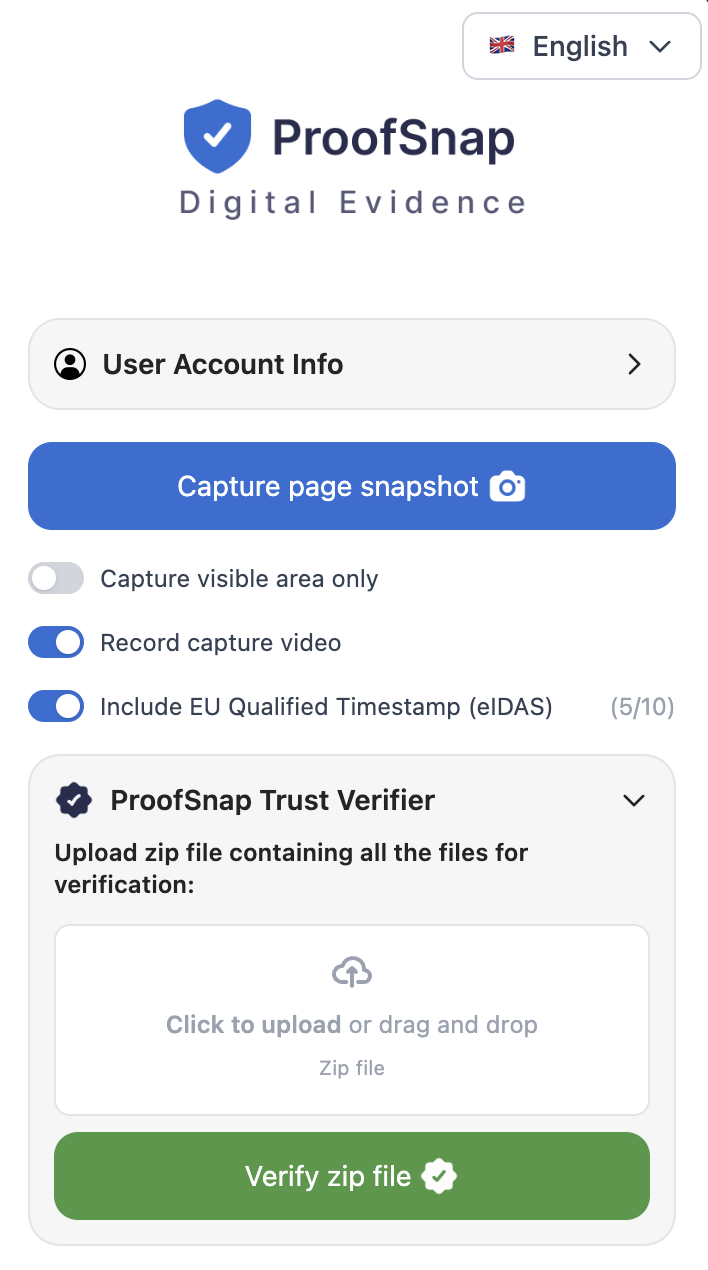
The whole product is this panel. The operator picks the options, presses Capture, and the record described on this page is what comes out.
The Rule 902 declaration ProofSnap writes from a capture is four pages, with every hash value listed and the declarant identity, qualifications and signature left blank for a human to complete under 28 U.S.C. 1746. Read it and judge for yourself whether the record is one you would put a name on. No download and no account required.
It is a template, never a claim. Rule 902(13) and 902(14) require a declaration a person subscribes under penalty of perjury, and that person is not the software.
Rule text for Rules 104, 701, 702, 901 and 902 was read against the Federal Rules of Evidence as published by Cornell's Legal Information Institute. Supreme Court citations are given as Daubert, 509 U.S. 579 (1993); Joiner, 522 U.S. 136 (1997); and Kumho Tire, 526 U.S. 137 (1999). Lorraine v. Markel American Insurance Co., 241 F.R.D. 534 (D. Md. 2007), decided May 4, 2007 by Magistrate Judge Paul W. Grimm, remains the fullest single treatment of how these rules interact for electronically stored information and is the place to start if you want the long version.
Passages shown in quotation marks were matched against the text of the rule, the Advisory Committee note to the 2017 amendment, or the opinion itself, not taken from a secondary summary. Cost figures are aggregated from 2026 practice rate guides and are budgeting estimates, not quotes.
Treat this page as a map, not as authority. Shepardize or KeyCite before any of it goes into a filing, check whether your forum has adopted analogs to Rules 902(13) and 902(14), and check whether your state follows Daubert, Frye, or a hybrid, because a significant minority still does not follow Daubert.
The differences are volume, the Rule 902 certification, the Bitcoin anchor, the eIDAS qualified timestamp, and branding.
All plans include a 7-day trial. A credit card is required at sign-up. Cancel anytime. Billed in USD.
$4.99
one-time, $0.50 per capture
$8.99
per month
$16.99
per month
$28.99
per month
Working as a team? Company is $18.99 per seat per month, minimum two seats and no upper limit, with the same 15-file package, eIDAS qualified timestamps and white-label branding as Enterprise, plus shared member management.
A full year of Enterprise costs $347.88, which is less than one hour of a senior testifying examiner at the top of the range above. The facts an examiner would have to reconstruct are cheap to record and expensive to recover, and the choice between those two prices is made months before anyone files a motion.
Most firms do not need a seat per lawyer. Captures are usually run by whoever handles evidence intake, so one paralegal seat plus a backup covers a small firm's entire capture workload, which is the two-seat Company minimum at $37.98 a month. Buy a SnapPack first for one matter, see the package that comes out of it, and move to seats only once someone is capturing weekly. For invoicing, annual billing, or a W-9, write to support@getproofsnap.com before you buy.
Usually not. Authentication under Rule 901 asks only whether the proponent has produced evidence sufficient to support a finding that the item is what it is claimed to be, and that can be satisfied by the person who took the capture describing what they did. Rule 902(13) goes further and lets a written certification replace live testimony on authenticity. Daubert does not enter the picture until someone offers an opinion, meaning a conclusion drawn from technical analysis rather than a description of what was done. If your witness is describing a process and reading values out of a record, you are not offering expert testimony and Rule 702 does not apply to them.
No, not to the authentication question itself. Authentication is a question of conditional relevance under Rule 104(b), where the judge asks only whether a reasonable juror could find the item genuine. Expert admissibility is a Rule 104(a) question, where the judge decides the matter and the proponent must satisfy every element of Rule 702 by a preponderance of the evidence. Two different burdens, two different consequences. Daubert applies to authentication only in the indirect sense that if the way you chose to authenticate is through an expert opinion, that opinion has to survive Rule 702 first.
Nothing in the rule requires one. Rule 902(14) calls for a certification by a qualified person and does not define the term. The Advisory Committee note sets a functional test instead of a credential: the certification must contain information that would be sufficient to establish authenticity were that information provided by a witness at trial. That describes the paralegal or investigator who ran the capture and understands the process, not necessarily a forensic examiner. The Committee's stated reason for the amendment was that the expense and inconvenience of producing an authenticating witness for this evidence is often unnecessary. Read the rest of the note too, though: it warns that a challenge to authenticity may require technical information about the system at issue, including possibly retaining a forensic technical expert. Uncontested, no expert. Genuinely contested on technical grounds, possibly one.
Four situations, and they share one feature: the evidence has to be interpreted rather than described. First, anything extracted from a device, because a phone or laptop image is produced by a tool whose output nobody in the room can read unaided. Second, recovery of deleted or overwritten data, which is an inference about what a storage medium once held. Third, attribution, meaning who was at a keyboard or which handset was in which cell sector. Fourth, a genuine manipulation or deepfake claim, where the question is whether pixels or audio were synthesized. None of these is answered by a capture tool, and a vendor who tells you otherwise is selling you a Daubert problem.
Two clarifications with real consequences. The rule now states expressly that the proponent must demonstrate to the court that it is more likely than not that each requirement of the rule is met, which was already the law under Rule 104(a) but was widely ignored by courts treating reliability objections as going to weight rather than admissibility. And Rule 702(d) was reworded from a requirement that the expert has reliably applied the principles and methods to a requirement that the expert's opinion reflects a reliable application of them, which directs the court at the conclusion itself rather than only at the methodology. The Advisory Committee described the amendment as clarifying existing law rather than raising the bar, but the practical effect has been to make reliability challenges harder to brush aside.
Yes. Exclusion rarely turns on credentials. It turns on whether the examiner can explain and defend the specific tool, the software version, the extraction methodology and the basis for each conclusion. An examiner who cannot explain the internal logic of the software they relied on invites the question whether the opinion belongs to the expert or to the tool. Joiner is the doctrinal root of this: an opinion connected to the underlying data only by the expert's own assurance can be excluded no matter who the expert is.
Reported 2026 ranges put digital forensics examiners at roughly $350 to $750 an hour, with senior examiners who testify regularly at the upper end. Retainers commonly run $2,500 to $10,000, and a well-scoped flat fee engagement runs about $1,000 to $5,000. Deposition and trial testimony is normally billed hourly against a half-day or full-day minimum. Ranges vary widely by market and by whether the engagement includes testimony, so treat them as budgeting figures rather than quotes.
No, and any tool marketed that way should be treated with suspicion. What a documented capture does is remove the questions an expert would otherwise have been hired to answer about your own exhibit: what the URL was, what time it was, what the server returned, whether the file changed afterward, and what the software did to the page in order to photograph it. Those become entries in a record rather than opinions. What it cannot do is answer questions about someone else's evidence, about a device, or about whether an image was synthesized. If the dispute is about what the evidence means rather than about whether your copy is faithful, you are hiring an examiner and no capture tool changes that.
It is not in force and it is not close. Proposed Rule 707 would subject evidence that is machine-generated and offered without a supporting expert to a reliability screen modeled on Rule 702. Anyone telling you Rule 707 governs your case today is wrong, but the objection it describes can already be raised through Rule 702 and Rule 901 as they stand. Rulemaking status changes, so verify it before citing.
A capture that records the URL, the time, the server response, and a hash of every file turns the routine questions into facts in a record. What is left for an examiner is the part that actually calls for judgment, and that is a much easier engagement to defend.
SnapPack from $4.99 for 10 captures, one-time, no auto-renewal. The 7-day trial requires a credit card at sign-up.