Portugal Short-Term Rental Rules 2026: RNAL Registration, Taxes and the Coimas That Actually Apply
In 2026 an alojamento local in Portugal needs an RNAL registration filed as a comunicação prévia on ePortugal, civil liability insurance of at least €75,000, and IRS (Portugal’s personal income tax) under the simplified regime, which taxes 35% of revenue. Operating without an RNAL number is a grave economic offence, a coima of €650 to €24,000 under the RJCE, Portugal’s economic offence regime.
This guide covers the whole 2026 framework: RNAL registration step by step, IRS and VAT, ENI versus Unipessoal Lda, the containment zones (zonas de contenção) in Lisbon and Porto, permanent and transferable licences under Decreto-Lei 76/2024, the platform verification duty under EU Regulation 2024/1028, and the fiscal obligations of non-resident owners.
Who this guide is for: non-resident owners of Portuguese alojamento local, from inside and outside the EU, who manage the property remotely, plus Portuguese residents running several alojamento local (AL) units. It covers EU versus non-EU fiscal obligations, double taxation treaties, HMRC and US IRS reporting, Golden Visa and NHR implications, currency risk for non-eurozone investors and holding a property manager accountable across time zones.
TL;DR Portugal alojamento local 2026: what you need to know in 60 seconds
- RNAL registration mandatory, prior communication (comunicação prévia) via the Balcão Único Eletrónico. Operating without it is a contraordenação económica grave under the RJCE, Portugal’s economic offence regime: €650-1,500 for an individual, €1,700-24,000 for a company depending on its size. Ignore the €2,500-40,000 figures still quoted online: they were repealed in 2021.
- Permanent and transferable registrations, in practice called AL licences, since Decreto-Lei 76/2024 (November 2024). They no longer expire every 5 years.
- IRS: 35% of revenue under the simplified regime (50% in containment zones). VAT 6%. VAT exemption up to €15,000/year.
- Containment zones (zonas de contenção): 6 Lisbon parishes blocked (absolute containment ≥ 10%); 6 central Porto parishes in containment. Algarve open.
- EU Regulation 2024/1028 (20 May 2026): platforms must display and spot-check the RNAL, report activity data monthly and delist a unit when the authority orders it.
- Mandatory insurance (seguro de responsabilidade civil extracontratual): €75,000 minimum. No insurance = registration cancellation.
- EU non-residents do not need a fiscal representative (since 2022). Non-EU (UK post-Brexit) must have one (€200-500/year).
Full guide below with tax tables, ENI vs. Lda comparison, compliance checklist, city-by-city guide with income data (ADR/occupancy), and a dedicated section for foreign investors (FR, ES, UK).
QUICK FACTS Portugal alojamento local: regulatory framework 2026
- Is Airbnb legal in Portugal?
- Yes, with RNAL
- Mandatory registration
- RNAL (Balcão Único)
- IRS (simplified regime)
- 35% of revenue
- IRS in containment zone
- 50% of revenue
- VAT (IVA)
- 6% (4% Madeira and Azores)
- Coima without registration (individual)
- €650-1,500
- Coima without registration (company)
- €1,700-24,000
- Mandatory insurance
- €75,000 minimum
- Max rooms/guests
- 9 rooms / 27 guests
- Licence
- Permanent and transferable
- EU Regulation
- 2024/1028 (20 May 2026)
- DAC7 (income reporting)
- Active since 2023
Data updated . Sources: Turismo de Portugal, Autoridade Tributária, Diário da República. Regulations and amounts may change.
What ProofSnap costs and what the side panel looks like
Before the detail, here is the tool this guide keeps referring to. Almost every obligation below (insurance, RNAL status, guest messages, tax receipts) comes down to one question an inspector, a platform or a court will ask you later: can you prove it was true on that date? ProofSnap is a Chrome extension you install once and operate yourself, so a compliance capture takes about 41 seconds and never leaves your browser. There are three ways to pay: a one-time Standard SnapPack for occasional captures, an eIDAS SnapPack when you need an EU qualified timestamp, or a monthly subscription if you document an alojamento local portfolio every month. All prices are charged in US dollars.
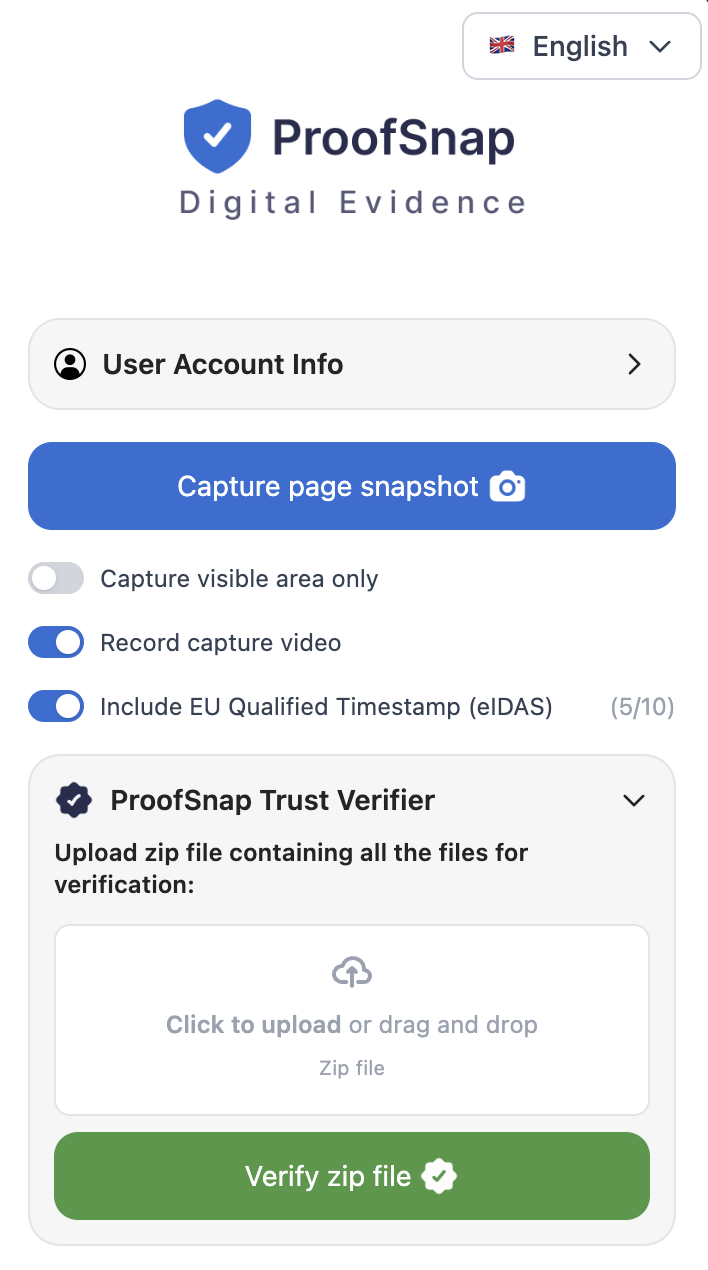
The side panel you would be operating
One click captures the page, hashes every file, signs the manifest, anchors it to the Bitcoin blockchain and, on the eligible plans, adds an eIDAS qualified timestamp. The result is one evidence ZIP of 11 to 15 files, produced on your own machine: your Airbnb conversation, your RNAL registration screen, your insurance policy page or your Portal das Finanças receipt, sealed with a date nobody can move.
- Full page, visible area or multi-tab session capture
- Video recording with audio, for anything that moves
- File Certification for documents you already hold, such as the insurance policy PDF
- The built-in Trust Verifier, and a free public one on the web
- Interface in 29 languages, evidence PDF in 28 of them, including Portuguese
Free to install · also available for Microsoft Edge.
The three ways to pay
Standard SnapPack
10 captures · no expiration · one-time purchase
Pay as you go, no subscription and no auto-renewal. Full capture features, evidence PDF and Bitcoin blockchain timestamp. Enough for a year of monthly insurance and RNAL checks on one property.
eIDAS SnapPack
EU qualified timestamps (Disig a.s.)
$5.00 per stamp · also 1 for $6.99 or 10 for $49.99
Adds an eIDAS qualified timestamp per capture (Article 41), with a legal presumption of accuracy in every EU Member State, Portugal included, plus white-label branding on the evidence PDF. This is the tier to use for anything you may have to put in front of a Portuguese court or ASAE.
Subscription
Essential · Professional · Enterprise
Annual plans save 20%
For regular use: monthly capture allowances, File Certification and eIDAS stamps on the higher tiers. The right fit if you run several AL units. Includes a 7-day trial (a credit card is required to start).
Prefer no subscription and no auto-renewal? The Standard SnapPack at $4.99 is a one-time purchase, bought inside the extension after you install it. See the full ProofSnap pricing and features.
Would you rather not operate it yourself?
Send us the URL and we capture it for you. The web page capture service delivers the same evidence package from $44.99 per URL, within 24 hours, with no account and no extension install. Useful when a listing or a message thread is about to disappear and you are 2,000 km away.
1. The new era of alojamento local in Portugal
Portugal was the first European Union country to create a mandatory national registry for short-term rentals (alojamento local), in 2014. Since then, the sector has grown exponentially, to 126,320 registrations by the November 2025 insurance deadline (Turismo de Portugal, RNAL), but has also created friction in cities such as Lisbon and Porto, where pressure on the housing market has led to significant legislative interventions.
In 2023, the “Mais Habitação” (More Housing) programme froze new registrations nationwide and introduced restrictive rules such as licence expiration and non-transferability. However, Decreto-Lei 76/2024 (in force since 1 November 2024) reversed most of these restrictions: licences became permanent and transferable once again, and the national freeze was lifted. In return, municipalities received enhanced powers to create their own regulations.
The result in 2026: a decentralised regulatory framework where each municipality can define its own containment rules, while European regulation (EU Regulation 2024/1028 and DAC7) adds new layers of transparency and enforcement. This guide sets out every obligation involved in operating legally.
Prefer this guide in Portuguese? Read the guia completo do alojamento local em Portugal 2026. If you also own short-term rentals elsewhere in Europe, the same registration-number logic now applies to the Italian CIN regime, the Spanish vacation rental rules and the French loi Le Meur.
Coimas up to €24,000 for operating without registration. Document your compliance now.
ProofSnap captures your Airbnb listing with the RNAL number visible, the property condition before each check-in, and guest communications, with a blockchain timestamp and digital signature. Court-admissible evidence. The 7-day trial requires a credit card, or buy a Standard SnapPack once for $4.99.
Download ProofSnap: install in 10 secondsSee exactly what a court receives
Download a real evidence package, the same ZIP that gets submitted as proof. Or send any URL to support@getproofsnap.com and we will capture it for you free of charge.
Download Sample Package2. RNAL: Registo Nacional de Alojamento Local (National Registry)
What is the RNAL?
The RNAL (Registo Nacional de Alojamento Local) is the mandatory registration number for all short-term rental establishments in Portugal. It was created in 2014, making Portugal the first EU country with a national registration system. The RNAL is managed by Turismo de Portugal and is required to list on any platform (Airbnb, Booking.com, Vrbo, etc.).
Alojamento local categories (modalidades)
- Moradia (detached house): property whose unit corresponds to a standalone building (max 9 rooms / 27 guests)
- Apartamento (apartment): autonomous fraction of a building (max 9 rooms / 27 guests)
- Quartos (rooms): accommodation in the holder’s own residence (max 3 rooms)
- Estabelecimentos de hospedagem (hostels): no room limit, but with specific requirements
How to obtain the RNAL
- Confirm the licença de utilização (usage licence) of the property
- Check if the property is in a containment zone (zona de contenção) (see section 6)
- Check condominium rules (see section 6)
- Register the activity with the Finanças (tax authority) under the right CAE code. Under CAE-Rev.4, in force since 1 January 2025, a normal apartment or house AL is 55201. The old 55204 was split: 55204 now covers guest houses other than hostels, 55205 covers hostels and 55207 other short-stay accommodation
- Obtain the statutory seguro de responsabilidade civil extracontratual with a minimum cover of €75,000 per claim, per establishment. Buying a generic multirriscos home policy instead is a common and expensive mistake: it is a different product and does not satisfy Article 13.º-A
- Prepare a termo de responsabilidade (statement of responsibility)
- Submit the comunicação prévia com prazo (prior communication with a deadline) at the Balcão Único Eletrónico (ePortugal.gov.pt)
- Wait for the RNAL number to be issued (60 days for the municipality to object; 90 in containment zones)
2024-2025 update: With Decreto-Lei 76/2024, AL (alojamento local) licences are now permanent (no more 5-year expiration) and transferable (the new owner keeps the existing licence). The insurance policy must be submitted on the official portal (mandatory since March 2025) and lack of insurance is grounds for registration cancellation.
Obligations of the RNAL holder
- Include the RNAL number on all listings (platforms, social media, own website)
- Display the identification plaque on the exterior of the establishment
- Maintain a complaints book (livro de reclamações) available
- Keep the insurance valid and report any changes
- Collect and remit the municipal tourist tax (taxa turística) (where applicable)
- File the guest accommodation form (boletim de alojamento) with the GNR or the PSP, the two national police forces, through the SIBA platform within 3 working days of check-in, and again within 3 working days of check-out
3. Taxation: IRS, IRC, VAT (IVA) and DAC7
IRS: the simplified regime (Regime Simplificado)
For most individual hosts, alojamento local income is taxed under Category B (Categoria B, business and professional income). Under the simplified regime:
| Situation | Taxable base | Notes |
|---|---|---|
| Simplified regime (general) | 35% of revenue | 65% not taxed (flat-rate deduction) |
| In containment zone (zona de contenção) | 50% of revenue | Tax penalty in saturated zones |
| Organised accounting (contabilidade organizada) | Actual profit | Advantageous if costs > 65% of revenue |
| Category F (Categoria F, optional) | Rental income (rendimento predial) | Flat rate of 25% for residential letting (28% for non-residential), or aggregation (englobamento). Long leases reduce the rate further: 10 points off for 5 to 10 years, 15 for 10 to 20, 20 above 20 years |
Practical example: apartment in Lisbon, annual revenue €30,000
| Regime | Taxable base | Average IRS rate | Estimated tax |
|---|---|---|---|
| Simplified (general) | €10,500 (35%) | ~28.5% | ~€2,993 |
| Simplified (containment zone) | €15,000 (50%) | ~28.5% | ~€4,275 |
| Category F (flat rate, residential) | €30,000 | 25% | €7,500 |
Approximate values; they depend on the taxpayer’s other income and marginal IRS rate. Consult a certified accountant (contabilista certificado).
IRC: corporate entities (pessoas coletivas)
When alojamento local is operated by a company, results are taxed under IRC at 19% for 2026 (it was 21% in 2024 and 20% in 2025, and falls to 18% in 2027 and 17% from 2028), with the first €50,000 at 15% for an SME, plus municipal surcharges (derramas) of up to 1.5%. The company must maintain organised accounting records and file the Modelo 22 declaration by 31 May.
VAT (IVA)
Alojamento local is subject to a reduced VAT rate:
- 6% in mainland Portugal
- 4% in Madeira, reduced from 5% on 1 October 2024
- 4% in the Azores
- Exemption: possible for annual revenues up to €15,000 (exemption regime under art. 53 CIVA)
Since 1 July 2025: new rules for communicating the transition to the VAT regime when turnover exceeds €15,000.
DAC7: automatic transparency
The DAC7 Directive (in force since 2023) requires platforms like Airbnb, Booking.com and Vrbo to automatically transmit to the Autoridade Tributária (Portuguese tax authority) data on host earnings: identity, NIF (tax number), property address, nights rented, amounts received and commissions deducted. Transmission occurs by 31 January each year.
Municipal tourist tax (taxa turística)
Varies by municipality. The host collects and remits it to the câmara municipal (city council). Rates by city: see the City-by-city guide section.
4. ENI vs. Unipessoal Lda: which is the best structure for multiple properties?
If you have 2 or more properties in AL, the choice of legal structure is one of the most consequential tax decisions. The two most common options:
| Criterion | ENI (Empresário em Nome Individual) | Unipessoal Lda |
|---|---|---|
| Tax | Progressive IRS (12.5%-48%) | IRC 19% in 2026 + derrama municipal up to 1.5% |
| Simplified regime | Yes (35% taxable base) | No (organised accounting records mandatory) |
| Liability | Unlimited (personal assets) | Limited to share capital |
| Accounting costs | ~€50-150/month | ~€150-350/month |
| Profit distribution | Automatic (personal income) | Taxed at 28% (dividends) |
| Best for | Revenue up to ~€40,000/year | Revenue > €50,000/year |
Worked example: 3 apartments, total revenue €75,000/year
| Structure | Tax | Accounting | Estimated total cost |
|---|---|---|---|
| ENI simplified | ~€9,400 (IRS on 35%) | ~€1,200/year | ~€10,600 |
| Unipessoal Lda | ~€7,900 (IRC + dividends) | ~€3,000/year | ~€10,900 |
Approximate values. The Lda becomes advantageous when revenue exceeds ~€80,000-100,000/year or when asset protection is a priority. Consult a certified accountant (contabilista certificado) before deciding.
“Mais Habitação” incentive: conversion to long-term rental
Property owners who converted AL units to long-term residential rental (registered before 31 December 2022, with a rental contract signed by the end of 2024) may benefit from IRS/IRC exemption on rental income until 31 December 2029. This incentive remains in force and those who already converted retain the benefit. Those who did not convert by the deadline can no longer opt in.
Practical implication: If you have a property in a containment zone with declining AL profitability (e.g., Misericórdia in Lisbon), evaluate whether long-term rental with tax exemption until 2029 might be more profitable than maintaining AL with a 50% taxable base.
5. Non-resident owners: complete guide for foreign investors
A significant share of AL property owners in Portugal are foreign investors, French, Spanish, British, German, American, Australian, Canadian and Brazilian, many of whom purchased properties during the Golden Visa boom or in the post-COVID period. If you reside abroad and own properties in Portugal, all national rules apply in full. But there are important differences depending on whether you are an EU or non-EU resident.
NIF and fiscal representative: EU vs. non-EU
| Situation | Fiscal representative | How to obtain NIF |
|---|---|---|
|
EU/EEA resident (France, Spain, Germany, etc.) |
Not required (since 2022) | In person at Finanças or online via ePortugal.gov.pt with ID card/passport |
|
Non-EU/EEA resident (UK post-Brexit, USA, Australia, Canada, Brazil, etc.) |
Mandatory | In person at Finanças with a designated Portuguese fiscal representative |
EU investors (France, Spain, Germany): since 2022, EU/EEA residents do not need a fiscal representative in Portugal. A Portuguese NIF is sufficient. However, it is strongly recommended that you engage a certified Portuguese accountant (contabilista certificado) to manage tax obligations (IRS/IRC, VAT, Modelo 3).
British investors (post-Brexit): since 1 January 2021, UK residents are classified as non-EU and must have a fiscal representative. The fiscal representative can be a lawyer, accountant or specialised firm. Typical cost: €200-500/year. Functions: receive Finanças notifications on your behalf, ensure compliance with filing obligations and serve as the point of contact with the Autoridade Tributária.
US, Australian, Canadian and Brazilian investors: the same non-EU rules apply. You need a fiscal representative (€200-500/year). Read the rule carefully: since Decreto-Lei 44/2022 a non-EU resident can dispense with the representative by signing up for electronic notifications on the Portal das Finanças, but the exemption falls away when the non-resident carries on an activity in Portugal, and alojamento local is an activity. So the requirement holds for AL operators, but it is an activity rule, not a nationality rule. US citizens face additional obligations: FATCA reporting and FBAR for Portuguese bank accounts (see below). Australian residents must declare Portuguese AL income to the ATO as foreign rental income.
Taxation: simplified regime is available for non-residents
Non-residents can opt for the simplified regime (Category B, 35% taxable base) as long as they register the activity with the Portuguese Finanças. The alternative, a 25% rate under Article 71 of the CIRS, is almost always less advantageous.
Practical example: French investor, 2 apartments in Lisbon, total revenue €50,000/year
| Country | What happens | Tax |
|---|---|---|
| Portugal | IRS on 35% = €17,500 (base), rate ~28.5% | ~€4,988 |
| France | Declares worldwide income. Tax credit for tax paid in PT (FR-PT Convention, art. 24) | Difference (if any) |
| Result | No double taxation. You pay the higher of the two. | |
The Convention for the Avoidance of Double Taxation between France and Portugal (in force since 1972) provides for the tax credit method: income is taxed in Portugal (source country) and the tax paid is credited in France. Spain applies a similar mechanism (ES-PT Convention). Consult a tax advisor in your country of residence.
Practical example: British investor, 3 properties in the Algarve, total revenue €60,000/year (~£51,000)
| Country | What happens | Tax |
|---|---|---|
| Portugal | IRS on 35% = €21,000 (base), rate ~28.5% | ~€5,985 |
| United Kingdom (HMRC) | Declares worldwide income on Self Assessment. Foreign property income goes on SA106, the Foreign pages, not SA105, which is UK property only. Foreign Tax Credit Relief for tax paid in PT under the 2025 UK-Portugal Convention, signed 15 September 2025, in force 29 December 2025, effective in the UK for income tax from 6 April 2026 | Difference (if UK rate > PT) |
| Result | No double taxation. You pay the higher of the two. | |
HMRC obligations for UK residents: you must declare all foreign property income on the UK Self Assessment Foreign pages (form SA106, not SA105, which covers UK property only), even if you have already paid tax in Portugal. The deadline is 31 January (online) for the previous tax year (6 April to 5 April). Late filing penalties: an automatic £100 penalty on 1 February, then £10 a day after 3 months capped at £900, then the greater of 5% of the tax due or £300 at 6 months, and the same again at 12 months. From 6 April 2026, UK residents with qualifying income over £50,000 (and HMRC confirms that includes foreign property income) move into Making Tax Digital and its points-based penalty regime at £200 per missed submission. The Foreign Tax Credit Relief avoids double taxation, but it must be actively claimed; it is not automatic. DAC7 shares data between Portugal and HMRC: undeclared income will be detected.
Practical example: US investor, 2 properties in the Algarve, total revenue €45,000/year (~$48,000)
| Country | What happens | Tax |
|---|---|---|
| Portugal | IRS on 35% = €15,750 (base), rate ~28.5% | ~€4,489 |
| United States (IRS) | Declares worldwide income on Form 1040, Schedule E, or Schedule C with substantial services. Foreign Tax Credit via Form 1116 for tax paid in PT (US-PT Convention signed 6 September 1994, in force 18 December 1995, effective from 1 January 1996) | Difference (if US rate > PT) |
| Result | No double taxation. You pay the higher of the two. | |
US-specific obligations: the US taxes citizens and green card holders on worldwide income regardless of residence. Portuguese AL income is normally reported on Form 1040 Schedule E. Watch the Schedule C trap: US IRS Publication 527 puts the activity on Schedule C, with self-employment tax, when you provide substantial services primarily for the guest’s convenience, such as regular cleaning and changing linen, which is exactly what an alojamento local does between stays. You can claim the Foreign Tax Credit (Form 1116) or deduct the foreign taxes, but not both in the same year. The Foreign Earned Income Exclusion (FEIE / Form 2555) is not an option here: the IRS lists rents as unearned income, so Form 1116 is the route that works for a passive AL. One more trap: foreign rental property is depreciated under ADS straight line over 30 years if placed in service after 31 December 2017 (40 years before that), not the 27.5 years a US property gets, and no bonus depreciation is available.
US investors: FATCA, FBAR and additional reporting
US citizens and green card holders face reporting obligations no other country imposes:
- FBAR (FinCEN Form 114): if the aggregate value of your Portuguese bank accounts exceeds $10,000 at any point during the year, you must file an FBAR by 15 April (automatic extension to 15 October). Penalty for non-filing, at the current inflation-adjusted maxima: $16,536 non-willful and the greater of $165,353 or 50% of the balance if willful. Since Bittner v. United States (2023) the non-willful penalty accrues per annual report, not per account, which is the difference between one penalty and five. This applies even if the account is used solely for AL rental income.
- FATCA (Form 8938): use the right threshold. The widely quoted $50,000 at year-end and $75,000 at any point is the bracket for an unmarried filer living in the US. If you live abroad, which most readers of this guide do, it is $200,000 at year-end or $300,000 at any point unmarried, and $400,000 or $600,000 filing jointly. What counts is Portuguese bank and investment accounts. The US IRS is explicit that foreign real estate is not a specified foreign financial asset: a directly held apartment is not reportable at all, and if you hold it through a Portuguese company, the reportable asset is your interest in the company, not the building.
- State taxes, the trap nobody warns you about: California and New York tax residents on all income wherever earned, and neither gives a credit for tax paid to a foreign country. New York’s resident credit covers other US states and Canadian provinces only, and California’s credit under Revenue and Taxation Code section 18001 covers “another state” only. States are not parties to the US-Portugal treaty either, which covers federal income taxes only (Article 2(1)(b)). A California or New York resident can therefore face real double taxation on Portuguese AL income at state level, even after Form 1116 has neutralised it federally.
ProofSnap tip for US investors: capture your Portuguese tax filings (Portal das Finanças), bank statements and RNAL registration with blockchain timestamps. When your US CPA prepares Form 1116, they need proof of foreign tax paid with verifiable dates. A ProofSnap capture is stronger evidence than a PDF screenshot that could have been edited.
British investors: CGT, IHT and currency risk
In addition to income tax, British investors face three specific risks that do not affect eurozone investors:
- Capital Gains Tax (CGT) on sale: when selling a property in Portugal, you pay capital gains tax in Portugal (50% of the gain included in IRS) and must declare the gain in the UK. Since 6 April 2024 UK CGT on residential property is 18% within the basic rate band and 24% above it, with an annual exempt amount of £3,000. The UK-PT Convention allows credit for Portuguese tax, but the taxable base calculation differs between the two countries (Portugal indexes for inflation, the UK does not). Consult a cross-border tax advisor before selling.
- Inheritance Tax (IHT): the UK applies IHT at 40% above the £325,000 nil-rate band, but since 6 April 2025 the worldwide scope depends on residence history, not domicile: it reaches your Portuguese property only if you are a long-term UK resident, meaning UK resident in 10 of the previous 20 tax years. If you are not, the UK reaches only your UK-situated assets and the Portuguese AL may sit outside IHT entirely. Portugal has no inheritance tax between spouses, ascendants and descendants. Succession planning is essential. Consider structures such as trusts, life insurance or lifetime gifts.
- GBP/EUR currency risk: AL revenues are in euros, expenses in euros, but net income is converted to pounds. A 10% depreciation of GBP (as in 2022) reduces your effective income by 10%. Consider maintaining a euro account (Wise, Revolut Business) to minimise conversions and use dynamic pricing on Airbnb to adjust rates to currency fluctuations.
Currency risk for all non-eurozone investors
EU investors (France, Spain, Germany, etc.) have no currency risk: revenue, costs and taxes are all in euros.
Non-eurozone investors face exchange rate risk on both revenue and costs:
- GBP/EUR: 10-15% volatility in recent years. Maintain a euro account (Wise, Revolut Business) to minimise conversions.
- USD/EUR: similar volatility. Use IRS exchange rates for Form 1116 reporting.
- BRL/EUR: the Brazilian real has weakened ~30% against the euro over three years, the sharpest exposure faced by any major investor group.
- AUD/EUR, CAD/EUR, ZAR/EUR: all subject to significant fluctuations. Consider forward contracts or multi-currency accounts. Factor FX fees (0.5-2%) into yield.
Time zone challenges for remote owners
- UK / Western Europe: 0-1 hour difference, manageable in real time.
- Americas (US East Coast, Brazil): 4-5 hours behind Portugal. A 17:00 Lisbon message arrives at 12:00-13:00 your time, workable but delayed.
- US West Coast: 8 hours behind. Evening issues in Portugal arrive during your morning.
- Australia: 9-11 hours ahead. A 17:00 Lisbon message = 02:00-04:00 Sydney. Your property manager is your only real-time contact.
The further you are, the more critical asynchronous documentation becomes. ProofSnap captures create a timestamped record that does not depend on you being awake or online.
Golden Visa and NHR: context for investors
- Golden Visa (real estate): the program was closed for real estate investment since 7 October 2023. Existing holders retain the right of residence as long as they maintain the investment. If you have an active Golden Visa, do not sell the property without checking the implications for your residency status.
- Non-Habitual Resident (NHR / Residente Não Habitual): the regime was discontinued for new applications in 2024, replaced by the “tax incentive for scientific research and innovation” (IFICI). Existing NHR holders retain the benefit until the end of their 10-year period. Note: if you moved your tax residence back to France/Spain/UK/USA/Australia, the NHR ceases, and AL income will be taxed as non-resident. Many British nationals who moved to Portugal under NHR and returned to the UK after Brexit are unaware of this.
Language barrier: what is available in other languages
- Portal das Finanças: Portuguese only. You need an accountant or translator for tax filings
- Balcão Único Eletrónico (RNAL): partially in English
- SIBA (guest registration): Portuguese. The property manager usually handles this
- Platforms (Airbnb, Booking): available in French, Spanish and English, the RNAL is a simple numeric field
- Recommendation: even with basic Portuguese, a bilingual certified accountant (cost: €50-150/month) is essential for managing Finanças, VAT and Modelo 3
- British investors in the Algarve: the region has a British community going back decades, with English-speaking accountants and lawyers in Lagos, Faro, Albufeira and Loulé. Some have specific experience of UK-Portugal cross-border tax. Associations such as AFPOP (Association of Foreign Property Owners in Portugal) offer guidance in English.
Bank account and remote management
- EU residents: account opening is relatively straightforward with NIF and passport/ID card. Digital banks (ActivoBank, Moey) simplify the process.
- UK residents (post-Brexit): account opening is significantly more difficult. Many traditional banks (CGD, BPI, Millennium) require physical presence, extensive documentation and proof of connection to Portugal (RNAL, property contract). Alternatives: ActivoBank (accepts some non-EU online), Wise Business (a multi-currency EUR/GBP account that does not replace a Portuguese account for Finanças but facilitates transfers), or ask your fiscal representative/accountant to handle the process in person.
- Property manager: see section 8 (Management) for costs, responsibilities and risks. Legal responsibility for the RNAL, insurance and taxation always remains with you.
6. Containment zones (zonas de contenção), municipal regulation and condominiums
With Decreto-Lei 76/2024, municipalities received enhanced powers to regulate AL in their territories. Any municipality with more than 1,000 AL registrations has one year from the entry into force of Decreto-Lei 76/2024 to declare whether it will establish its own regulations. Municipalities can suspend new registrations for up to one year in designated containment zones.
Summary by city: Lisbon has 6 parishes in absolute containment (≥ 10%), Porto keeps 5 central parishes in containment, Algarve has no restrictions. Full details in section 7 (City-by-city guide).
AL and condominiums: new rules
Decreto-Lei 76/2024 rebalanced condominium powers over alojamento local. It removed the legal argument that a housing fraction cannot host an AL at all (Article 6.º-B n.º 4), and in exchange it left the condominium two narrower tools, and left the host two standing duties:
- The condominium assembly holding more than half of the permilagem (ownership share) can ask the mayor to decide on the AL registration, on proof of serious and recurring disturbance. The mayor decides, may broker a settlement first, and any ban is capped at five years.
- The condominium regulations can prohibit or restrict AL activity with two thirds of the permilagem, and that prohibition applies only going forward, not to units already operating
- Hosts must respect the building’s noise and cohabitation rules
- Repeated disturbances constitute legal grounds for cancellation
Practical advice: Document communications with the condominium and the property condition after each check-out. If a neighbour files an unjustified complaint, dated evidence can be decisive.
7. City-by-city guide: Lisbon, Porto, Algarve, Madeira and the Azores
In addition to national regulations (RNAL, taxation, insurance), each municipality applies its own rules. Here are the main ones:
| City / Region | Tourist tax | Specific restrictions |
|---|---|---|
| Lisbon (Lisboa) | €4/night/guest since 1 September 2024, capped at €28, guests aged 13 and over | Absolute containment in 6 parishes (≥ 10%) plus 9 delimited neighbourhoods, relative containment at 5-10%, under the RMAL in force since 6 December 2025 |
| Porto | €3/night/guest since 1 December 2024, max 7 nights, guests aged 13 and over | Containment with a per-parish numerus clausus above a single 15% threshold: Vitória, São Nicolau, Sé, Santo Ildefonso and Miragaia. Cedofeita sits at 9.8% and stays in the growth zone |
| Algarve (Faro, Lagos, Albufeira) | €2/night April to October, €1/night November to March, and Lagos charges none | No regional freeze; Loulé and Lagos considering restrictions in historic centres |
| Madeira (Funchal) | €2/night, max 7 nights | Reduced VAT at 4% since 1 October 2024; growing demand; no containment zones |
| Azores (Açores, Ponta Delgada) | Variable | Reduced VAT at 4%; growing market; no special restrictions |
| Coimbra | €1.50/night (secondary sources only, confirm with the câmara) | University and tourist demand; no containment zones |
| Sintra / Cascais | Sintra €2/night, max 3 nights. Cascais €4/night | Strong tourist demand; density monitoring underway |
| Évora | €1.50/night since 1 August 2025, guests aged 16 and over, max 3 nights | UNESCO historic centre; no specific AL restrictions |
| City / Region | ADR | Occupancy | Avg. revenue/month | Seasonality |
|---|---|---|---|---|
| Lisbon | $171 | 47.8% | ~$2,071 | Year-round |
| Porto | $145 | 44.6% | ~$1,589 | Year-round |
| Algarve (Faro district) | $229 | 40.2% | ~$1,674 | Strong (Apr-Oct) |
| Portugal, official AL statistics | €134-170 | 54-55% | n/a | Variable |
ADR = Average Daily Rate. Median revenue (not average) for Portugal: ~€1,550/month. Actual income varies by property type, exact location and listing quality. Sources: AirROI, PriceLabs, INE, Turismo de Portugal (Q2 2025).
Lisbon (Lisboa)
The Portuguese capital charges a tourist tax of €4 per night per guest, raised from €2 on 1 September 2024, capped at €28 per stay and payable for guests aged 13 and over. Since December 2025, the most restrictive municipal regulation in the country has been in force: 6 parishes in absolute containment (Santa Maria Maior, Misericórdia, Santo António, São Vicente, Arroios and Estrela). In relative containment zones, only rooms in the owner’s own residence (T2 or larger) are permitted. Taxation under the simplified regime increases from 35% to 50% of revenue in containment zones.
Porto
Porto charges €3 per night per guest since 1 December 2024, up to 7 nights, for guests aged 13 and over. Regulamento n.º 1462/2024, in force since 20 December 2024, lifted the general freeze and replaced it with containment areas under a single 15% threshold, each with its own numerus clausus for new registrations. Five parishes are above the line: Vitória (60.5%), São Nicolau (48.3%), Sé (44.1%), Santo Ildefonso (38.3%) and Miragaia (21.8%). Note the trap: many guides say “the six central parishes”, but Cedofeita sits at 9.8% and is in the growth zone, not in containment. Campanhã, Lordelo do Ouro and Ramalde remain open to new registrations. The 5% and 10% thresholds you may have read about are Lisbon’s, not Porto’s.
Algarve
The Algarve is Portugal’s main tourist region, with strong seasonality (April-October). Following the end of the national freeze, new registrations are permitted throughout the Algarve. However, profitability varies significantly: destinations such as Lagos, Albufeira and Vilamoura offer higher returns, while municipalities are considering future zoning measures in historic centres. Tourist taxes range from €1.50 to €2 per night, depending on the municipality.
Madeira and Azores (Açores)
The autonomous regions benefit from reduced VAT rates (4% in both Madeira and the Azores) and have no containment zones. Funchal has seen significant AL growth, driven by nature tourism and the “digital nomad” status. The Azores are an emerging market with strong potential, especially Ponta Delgada and Horta.
8. Managing multiple properties and property managers
Most owners with 3 or more AL properties use management companies (property managers). Here is what you need to know:
What the property manager must do for you
- Guest boletim de alojamento filed through SIBA with the GNR or the PSP within 3 working days, the legal obligation falls on the holder, but can be contractually delegated
- Collection and remittance of the tourist tax (taxa turística) to the câmara municipal
- Keeping the insurance valid and submitting policy data to the official portal
- Complaints book (livro de reclamações) available at each property
- Display and maintain the RNAL plaque on the exterior
- Check-in/check-out, cleaning and maintenance
What remains your responsibility, even with a manager
- Tax obligations: IRS/IRC filing, VAT payment, Modelo 22 (company)
- RNAL registration holder status, if the registration is cancelled, the holder is responsible
- Insurance: even if the manager arranges it, you must verify it is in force and meets the minimum capital
- Compliance with condominium regulations
Typical management costs in Portugal
| Model | Commission | Includes |
|---|---|---|
| Full management | 20-30% + VAT | Check-in, cleaning, maintenance, SIBA, tourist tax, dynamic pricing |
| Check-in + cleaning only | 10-15% or flat fee | In-person check-in, cleaning, laundry |
| Co-hosting (Airbnb) | Variable (negotiable) | Guest communication, listing management |
Warning: Even with a property manager, the RNAL holder is the legally responsible party. If the manager fails to file the guest accommodation forms through SIBA or does not remit the tourist tax, fines (coimas) are levied on the holder. Demand monthly reports and verify periodically.
9. Compliance checklist for existing hosts
Already have a registered AL? Use this checklist to verify you are up to date with all 2026 obligations. Items marked URGENT are already in force. If you have not complied, you are exposed to penalties.
Civil liability insurance (seguro de responsabilidade civil) submitted on official portal URGENT since March 2025
Minimum capital €75,000. Policy data must be on the portal. No insurance = registration cancellation.
VAT communication updated URGENT since July 2025
If your turnover exceeded €15,000, you must have notified the transition to the VAT regime.
RNAL number on every listing URGENT, mandatory
Airbnb, Booking, Vrbo, own website, social media. Under Article 23 of Decreto-Lei 128/2014, advertising or intermediating an unregistered establishment is a grave economic offence, the same tier as operating one: €650-1,500 for an individual, €1,700-24,000 for a company.
Identification plaque displayed on exterior
Standardised plaque with RNAL number visible at the establishment entrance.
Complaints book (livro de reclamações) available
Mandatory at all establishments. A breach of the identification and publicity rules is a leve offence: €150-500 for an individual, up to €12,000 for a large company.
SIBA guest registration operational
Communication system active. Every foreign guest, EU nationals included, reported to the GNR or the PSP within 3 working days of arrival and again within 3 working days of departure. Coima under Article 203 of Lei 23/2007: €100-500 for 1 to 10 missing boletins, €200-900 for 11 to 50, €400-2,000 above 51.
Municipal tourist tax (taxa turística) up to date
Verify you are collecting and remitting the correct amount to the câmara municipal.
Prepare for EU Regulation (20 May 2026)
Verify that the RNAL is correct on all platforms. From May, listings with an invalid RNAL will be automatically removed.
Income declaration up to date
DAC7 in force: platforms transmit data to the Autoridade Tributária. Undeclared income will be automatically detected.
10. Coimas summary table and enforcement
Most of the fine figures you will find online are repealed law
Almost every guide, and several municipal websites, still quote €2,500 to €4,000 for an individual and €25,000 to €40,000 for a company. Those were the amounts written into Article 23 of Decreto-Lei 128/2014 by Lei 62/2018. Decreto-Lei 9/2021 deleted them. Since then Article 23 only classifies each alojamento local infraction as a contraordenação económica grave or leve, and the amount comes from Article 18 of the RJCE, scaled by whether the operator is an individual or a micro, small, medium or large company. Decreto-Lei 76/2024 republished Article 23 in exactly that form, with no euro amounts. Alojamento local has no muito grave tier at all, so €24,000 is the ceiling, and it applies only to a large company.
“As infrações ao regime jurídico da exploração do alojamento local constituem contraordenações puníveis nos termos do Regime Jurídico das Contraordenações Económicas (RJCE) [...] Contraordenações graves puníveis com coimas que podem ir de €650,00 a €1.500,00, no caso de pessoa singular, e de €1.700,00 a €24.000,00, no caso de pessoa coletiva.” Turismo de Portugal, Guias Técnicos: Alojamento Local, Regime Jurídico, January 2025, section 26.3, official PDF
The RJCE scale that actually applies (Article 18, Decreto-Lei 9/2021)
| Operator | Grave (most AL breaches) | Leve |
|---|---|---|
| Individual (pessoa singular) | €650-1,500 | €150-500 |
| Micro company | €1,700-3,000 | €250-1,500 |
| Small company | €4,000-8,000 | €600-4,000 |
| Medium company | €8,000-16,000 | €1,250-8,000 |
| Large company | €12,000-24,000 | €1,500-12,000 |
One detail worth knowing before an inspection: under Article 19(3) of the RJCE, when the size of the company cannot be determined, the medium company bracket applies, which starts at €8,000 for a grave infraction. Being unable to document what you are is itself expensive.
Which breach falls in which tier
| Violation | Classification | Range (individual to large company) |
|---|---|---|
| Operating without RNAL registration, or with an outdated one | Grave | €650-24,000 |
| Advertising, listing or intermediating an unregistered unit | Grave | €650-24,000 |
| No civil liability insurance, or general and safety requirements not met | Grave, plus registration cancellation | €650-24,000 |
| Exceeding the capacity rules (9 rooms, 27 guests) or the 75% per building rule | Grave | €650-24,000 |
| Failure to notify changed data or cessation within 10 days | Grave | €650-24,000 |
| Missing identification plaque, or breach of the identification and publicity rules | Leve | €150-12,000 |
| Failure to file the guest boletim de alojamento (SIBA) | Separate regime, Article 203 of Lei 23/2007 | €100-2,000, by number of missing boletins |
| Failure to declare income | Tax offence, not a contraordenação | Handled by the Autoridade Tributária |
| Serious or repeated violations | Accessory sanctions | Seizure of equipment, suspension or closure for up to two years |
Enforcement: ASAE (Autoridade de Segurança Alimentar e Económica) and municipal councils (câmaras municipais) are responsible for enforcement. The move to digital systems at the Autoridade Tributária has significantly increased the capacity to detect non-compliance.
Coimas up to €24,000 for a large company. Registration cancelled for missing insurance. ASAE inspections are unannounced. When the inspector arrives, can you prove your insurance was valid, your RNAL was active, your listing displayed the registration number? A timestamped capture of each, taken before the inspection, is the only proof that cannot be questioned after the fact. How to document compliance ↓
Enforcement in action: real numbers from ASAE
In the five years to the end of 2024, ASAE conducted 12,344 inspections of alojamento local operators, 3,321 in-person and 9,023 digital checks. Result: 129 establishments suspended, mainly due to inadequate safety conditions (missing fire extinguishers, blocked emergency exits, expired insurance). ASAE also initiated 4 administrative proceedings against Airbnb for advertising unregistered properties without RNAL numbers, plus 11 proceedings against individual operators for unregistered or outdated listings. Source: Travel and Tour World, The Portugal News.
With the entry into force of Regulation (EU) 2024/1028 applying from 20 May 2026, platforms (Airbnb, Booking.com, Vrbo) must make hosts display a registration number, must randomly check on a regular basis that the numbers declared are valid (Article 7(1)(c)), and must delist a unit when a competent authority orders it in a reasoned, appealable decision naming the exact URLs (Article 6(3)). Note what the Regulation does not do: there is no pre-publication verification duty and no automatic removal, and Article 8 expressly creates no general monitoring obligation. Platforms also transmit activity data (nights rented, guest counts, addresses) monthly, or quarterly if they average under 4,250 listings a month. Source: EUR-Lex.
Real case (November 2023): ASAE suspends two ALs in Lisbon and Portimão
ASAE’s Specialised Brigade for Tourism inspected 12 AL establishments in Lisbon’s historic centre. Result: one AL suspended and ordered to close: it was operating without RNAL registration, had no mandatory insurance, breached safety rules and was in poor hygienic condition. Approximately 10 guests were inside at the time of the inspection. A second AL in Portimão (Algarve) was also suspended for missing insurance, safety non-compliance, and serious pest infestation.
Why evidence matters: The Lisbon owner could not prove they had ever held valid insurance or proper registration. A monthly timestamped capture of the RNAL portal and insurance policy page would have either prevented the situation (by flagging the lapse) or proved compliance on specific dates.
Source: Correio da Manhã, Público.
Nearly 50,000 ALs missed the insurance deadline
Under Decreto-Lei 76/2024, every AL holder had to file proof of civil liability insurance on the official portal. At the deadline of 19 November 2025, of 126,320 registrations, 76,433 had filed and 49,887 had not. Those 49,887 are the ones exposed to cancellation, and mass cancellations have already started: Lisbon alone cancelled 6,765 registrations in February 2026. For remote owners relying on a property manager, a lapsed policy is the single most common compliance failure.
The fix: Once a month, open your insurance provider’s portal in Chrome and capture the active policy page. If your property manager claims the insurance is valid but it has actually lapsed, you have timestamped proof of the last date you verified it was active, shifting liability from you to the manager.
Source: Belion Partners.
Lisbon bans new ALs in 15 areas (in force 6 December 2025)
The updated RMAL, Lisbon’s municipal alojamento local regulation, puts 15 areas in absolute containment, where no new AL registration is accepted: 6 freguesias (Santa Maria Maior, Misericórdia, Santo António, São Vicente, Arroios and Estrela) plus 9 delimited bairros. A further 14 areas are in relative containment, for 29 delimited areas in total. Before that, from November 2024, Lisbon ran a rolling suspension on new licences, not citywide but in every parish above a density ratio, and it was extended repeatedly until the RMAL replaced it in December 2025. Existing AL holders keep their registration, but only if they can prove it was active before the change. One trap worth knowing: in a containment area, RMAL Article 4 provides that transferring the registration extinguishes it for moradias and apartamentos, so a buyer in Santa Maria Maior does not inherit the licence even though national law made registrations transferable.
Why evidence matters: If your RNAL predates the ban, you need timestamped proof it was active on a specific date. The ePortugal/RNAL portal does not preserve historical snapshots. A blockchain-timestamped capture of your RNAL status page is the only way to prove your registration was valid before the rules changed.
Source: Short Term Rentalz, Lisbon Apartments.
Real case: the 2022 Supreme Court ruling, and why Decreto-Lei 76/2024 overrode it
In Acórdão de Uniformização de Jurisprudência n.º 4/2022 (Supremo Tribunal de Justiça, Pleno das Secções Cíveis, 22 March 2022), the court unified two conflicting STJ decisions and held that where the título constitutivo (the deed of horizontal division) says a fraction is for housing, alojamento local is not permitted in it. That was the law for two years.
It is no longer the law. Decreto-Lei 76/2024 inserted Article 6.º-B n.º 4 into Decreto-Lei 128/2014, stating that operating an alojamento local in an autonomous fraction does not constitute a use different from the one it is destined for. In force since 1 November 2024, that is a direct statutory reversal of the 2022 ruling. What a condominium can still do is narrower than most guides claim: an assembly holding more than half of the permilagem may ask the mayor to decide, on proof of repeated disturbance, and any resulting ban is capped at five years. Banning alojamento local through the condominium rules outright needs two thirds of the permilagem and only applies going forward.
Why evidence matters: the surviving route runs on proof of repeated disturbance, so the fight is factual, not legal. Timestamped captures of guest communications showing you enforced the house rules, plus captures of the listing showing those rules were displayed, are what you put in front of the mayor.
Sources: STJ, AUJ 4/2022 (dgsi.pt), Decreto-Lei 76/2024.
Lisbon RMAL update: containment thresholds halved (December 2025)
On 6 December 2025, Lisbon’s second amendment to the RMAL came into force. The absolute containment threshold was reduced from 20% to 10%, doubling the number of parishes where no new AL registrations are permitted. Relative containment dropped from 10% to 5%. The six freguesias now in absolute containment are Santa Maria Maior (66.9%), Misericórdia (43.8%), Santo António (25.1%), São Vicente (16.1%), Arroios (13.5%) and Estrela (10.8%), plus 9 delimited bairros: Bom Sucesso, Belém, Ajuda, Alcântara, São Bento, São Sebastião da Pedreira, Picoas, Campo de Ourique (in Estrela) and Parque das Nações Centro. Sapadores is in relative, not absolute, containment. The RMAL also cut transferability inside containment areas: transferring the registration extinguishes it.
Why evidence matters: If your AL was registered before the new thresholds, you need timestamped proof of your registration date and active status on the RNAL portal, before the rules changed. Portuguese government portals do not preserve previous versions of regulation pages.
Source: PLMJ, Portugal.com.
EU Regulation 2024/1028, from 20 May 2026
From 20 May 2026, Regulation (EU) 2024/1028 applies across the EU. Platforms such as Airbnb, Booking and Vrbo must make hosts display the registration number, spot-check the numbers they are given, transmit activity data to the national single digital entry point every month (quarterly for platforms under 4,250 listings a month), and delist a unit when the competent authority orders it. Portugal is well positioned because the RNAL has existed since 2014, so the practical task is making sure your number is correct and visible on every platform before that date.
“make reasonable efforts to randomly check on a regular basis, declarations of the hosts concerning the existence or not of a registration procedure [...] and, where such a procedure exists, the validity of the registration number provided by the host.” Regulation (EU) 2024/1028, Article 7(1)(c), EUR-Lex
Read the obligation carefully: the platform is not required to pre-verify every listing against the RNAL, it is required to run random checks and to remove a unit when ordered to under Article 6(3). In practice a wrong or missing RNAL number surfaces later, in a takedown, which is exactly when you need dated proof of what your listing said.
11. A screenshot is not evidence. Here is what is.
In the five years to the end of 2024, ASAE ran 12,344 inspections of alojamento local operators and suspended 129 establishments (ECO, December 2025). A condominium holding more than half of the permilagem can ask the mayor to shut yours down on proof of repeated disturbance. From 20 May 2026, EU Regulation 2024/1028 lets authorities order platforms to delist a unit whose registration number does not hold up. In this environment, documenting compliance is as important as being compliant. But a screenshot on your phone is not documentation; it is a JPEG with no provenance, no chain of custody and no legal weight.
Why a screenshot is not evidence (full guide)
Courts have repeatedly ruled that screenshots without metadata and chain of custody are inadmissible:
- Moroccanoil v. Marc Anthony Cosmetics, 57 F. Supp. 3d 1203 (C.D. Cal. 2014): the court sustained the authentication objection, holding that “the screen shots from Facebook are not properly authenticated”. The hearsay objection was overruled, so the problem was provenance, not content.
- United States v. Vayner, 769 F.3d 125, 131 (2d Cir. 2014): a social media printout was rejected on appeal because “the mere fact that a page with Zhyltsou’s name and photograph happened to exist on the Internet at the time of Special Agent Cline’s testimony does not permit a reasonable conclusion that this page was created by the defendant or on his behalf”.
- Edwards v. Junior State of America Foundation, No. 4:19-cv-00140-SDJ (E.D. Tex. Apr. 23, 2021): in a spoliation analysis the court observed that “Only native files can ensure authenticity”. Note the same opinion still let the plaintiffs offer the messages as screenshots plus testimony, which is precisely the weaker route this article is about avoiding.
Real case, and read which way it cuts: a Superhost claimed $16,000 in damages and backed it with photos. The guest argued the photos had been doctored with AI. Airbnb sided with the guest, refunded the stay, removed the retaliatory review and warned the host. The lesson for an honest host is the uncomfortable one: once AI-altered evidence is plausible, an ordinary photo proves nothing either way, and the accusation alone is enough to lose the claim. What survives that argument is an image whose capture time and integrity can be checked independently. Source: Fox Business, 2025.
What courts and platforms do accept: digital evidence with verifiable metadata, cryptographic signatures proving integrity, and documented chain of custody. ProofSnap generates exactly this, SHA-256 hash (any alteration generates a different hash), Bitcoin blockchain timestamp (immutable, cannot be backdated), and RSA-4096 digital signature (identifies who captured the evidence). The result: forensic evidence that is verifiable, immutable and court-admissible.
The scenario nobody talks about: You bought a €400,000 apartment in Lagos. You fly out twice a year. Your property manager sends monthly reports saying everything is fine. Then ASAE knocks on the door and finds the insurance expired 3 months ago. Fine: €4,000. Registration cancelled. Your €400,000 investment has just become illiquid, you cannot rent it, you cannot sell it with an active AL licence, and you find out two weeks later via an email you almost missed. From 2,000 km away, in a different legal system, with a different currency, you have no way to prove your manager told you the insurance was valid. Unless you documented it.
Real case: an Airbnb message thread disappeared during a guest stay
An Airbnb host accepted a 9-day booking. The guest’s toddler damaged property (cracked glass tabletop, yanked-out ceiling fan switch, missing items). The guest initially admitted the damage and paid partially. Then the host discovered their entire Airbnb message thread had vanished, while the guest was still staying. The inbox showed nothing. The conversation link returned “PAGE NOT FOUND.” Without the thread, the host could not file a damage claim, could not leave a review, and lost all evidence of the guest’s admission.
With ProofSnap: If the host had captured the conversation the moment damage was reported, the thread’s disappearance would have been irrelevant. The blockchain-timestamped capture proves what the conversation said before it vanished.
Source: Airbnb Hosts Forum.
The 6 scenarios where ProofSnap makes a difference
1. Condominium dispute (the most common case in Portugal)
The Portuguese Supreme Court has ruled that tourism rentals cannot coexist with permanent dwellings in residential condominiums. Under Decreto-Lei 76/2024, a >50% condominium vote can request cancellation of your RNAL. You need to prove that guests complied with house rules and that no “serious and recurring disturbances” occurred.
With ProofSnap: capture the property condition after each check-out, communications with the condominium, and house rules provided to guests. Each capture has a blockchain-certified date, so the condominium cannot claim the evidence was fabricated after the fact.
2. Damage claim (guest vs. host)
A guest damages the property and claims the damage already existed. AirCover requires evidence. Insurance requires documentation.
With ProofSnap: capture the property condition before each check-in. After check-out, capture again. The two captures, each with its own timestamp, show exactly when the damage occurred.
3. Remote monitoring and property manager verification (the most critical scenario)
You live in Paris, Madrid or London. You have 3 apartments in Lisbon/Algarve managed by a property manager. You pay 25% commission and receive a monthly report. But how do you know the insurance is in force? That the RNAL plaque is displayed? That the property is in good condition? If ASAE inspects and finds irregularities, fines fall on the holder, not the manager. And if you are British, you are in a different legal system, with a different currency and no free movement. Contesting a fine from 2,000 km away is far harder.
With ProofSnap: ask the manager to periodically send you the Airbnb listing with RNAL visible, property photos and insurance confirmation. Capture each submission with a blockchain timestamp. If the manager fails, you have dated proof that they confirmed compliance, or that they did not. When you are 1,500 to 2,000 km away, this is the only way to protect an investment of hundreds of thousands of euros for less than $9 a month.
4. Cross-border tax documentation (HMRC, impôts, Hacienda)
HMRC (UK), DGFIP (France) or AEAT (Spain) request proof that you have already paid tax in Portugal to grant the Foreign Tax Credit. You need the payment receipt, the Portuguese IRS declaration and the listing status on a specific date.
With ProofSnap: capture the income declaration from the Portal das Finanças, the IRS payment receipt and the active listing with RNAL. The blockchain timestamp proves the exact date, and HMRC, DGFIP or AEAT cannot dispute it. Particularly useful when your UK accountant and Portuguese accountant need to reconcile figures between two tax systems.
5. Property condition proof for insurer
Your Portuguese insurer requires documentation of the property condition after an incident (flood, guest damage, break-in). Photos taken after the fact do not prove the prior condition.
With ProofSnap: periodic property captures with blockchain timestamps create a verifiable history. The insurer can confirm the condition before and after the incident. This reduces disputes and accelerates the claims process.
6. Protection against unilateral platform changes
Airbnb or Booking changes your listing terms, applies an unauthorised discount, or cancels a reservation. You need to prove what the listing said on a specific date.
With ProofSnap: capture the listing status periodically (prices, conditions, cancellation policy). If the platform changes something without your consent, you have proof of the original state with a certified date.
What to capture (and when) for remote owners
All items are web pages, one click to capture in your browser.
- Airbnb/Booking conversation, especially damage reports, rule reminders, complaints
- Guest reviews (before moderation can change them)
- Insurance policy status page (prove it was active)
- RNAL portal showing active registration
- Airbnb listing with RNAL number visible
- Portal das Finanças, IRS declaration + payment receipt
- Tourist tax (taxa turística) payment confirmation
- For UK owners: capture the proof for the HMRC SA106 Foreign Tax Credit Relief claim
- Municipal regulation pages (Lisbon RMAL changed in December 2025, old version gone)
- Platform policy pages (AirCover terms, cancellation policy)
- ePortugal/gov.pt regulation pages
DAC7: Your home country already knows your Portuguese income
Under DAC7 (EU Directive 2021/514), Airbnb, Booking.com and Vrbo automatically report your rental income to Portuguese tax authorities, who then share it with your home country (HMRC, DGFIP, AEAT, Finanzamt). If your UK/French/Spanish tax return does not match the platform data, you will receive a letter asking why.
Your defence: a timestamped capture of your Portal das Finanças IRS declaration showing you already declared and paid tax in Portugal. Without this, proving you are not evading tax in two countries simultaneously becomes your word against automated data. One capture per tax filing, that is all it takes.
Tax tip: ProofSnap is a deductible business expense in your alojamento local activity (Category B), effectively free for tax purposes. The annual cost of ProofSnap is less than the value of a single night’s stay.
12. Frequently asked questions about alojamento local in Portugal
Can I run an alojamento local in a studio or T0 apartment in Portugal?
Yes, as long as it has a valid usage licence (licença de utilização) and is not in an absolute containment zone (zona de contenção absoluta). The “apartment” category has no minimum size requirement at the national level, but check local municipal rules.
I have had an alojamento local for years. What changes in 2026?
Three things, and the compliance checklist (section 9) walks through all of them: insurance submitted on the portal (since March 2025), VAT notification if you exceeded €15,000 (since July 2025) and correct RNAL on all listings before May 2026 (EU Regulation).
I bought a property with an alojamento local licence. Does it transfer automatically?
Nationally yes, since 1 November 2024 (Decreto-Lei 76/2024): the licence is transferable without a new application, and you simply update the holder details in the RNAL and on the insurance portal. Check the municipality first. In a Lisbon containment area the RMAL provides that transferring the registration extinguishes it for moradias and apartamentos, so a buyer in Santa Maria Maior or Misericórdia inherits nothing.
I have 3 apartments in alojamento local. ENI or a company?
It depends on total revenue. Up to ~€40,000-50,000/year, the ENI with the simplified regime is generally more advantageous. Above that, the Unipessoal Lda may save taxes. See the detailed comparison in section 4. If you are a non-resident, also see section 5.
My property manager handles everything. Am I legally protected?
Legally, no. The RNAL holder is always the ultimate responsible party. If the manager fails to file the guest accommodation forms through SIBA or does not remit the tourist tax, fines (coimas) fall on the holder. Demand monthly reports and verify periodically. See section 8.
What happens in May 2026 with the EU short-term rental Regulation?
From 20 May 2026, Regulation (EU) 2024/1028 requires platforms (Airbnb, Booking, Vrbo) to make hosts display the registration number, to randomly check the numbers declared, to transmit activity data to the authorities every month, and to delist a unit when the competent authority orders it under Article 6(3). Make sure your RNAL number is correct on every listing. Portugal is well positioned as it has had the RNAL since 2014. See EU Regulation box. If you are a non-resident, ensure your RNAL number is correct on all platforms before this date.
Can I operate an alojamento local in Madeira or the Azores under different rules?
The national rules (RNAL, insurance, SIBA guest reporting) apply equally. The main difference is VAT: 4% in both Madeira and the Azores (vs. 6% on the mainland). There are no containment zones in the autonomous regions.
13. Sources
Legislation and official sources
- • Turismo de Portugal, Alojamento Local Technical Guide: Legal Framework (January 2025)
- • Government Portal, Alojamento Local: framework document
- • Government Portal, Register an alojamento local establishment
- • Airbnb, Portugal Tax Guide 2025
- • Diário da República, Decreto-Lei no. 76/2024, 23 October
- • Diário da República, Full text of Decreto-Lei 76/2024 (PDF)
- • EUR-Lex, Regulation (EU) 2024/1028 of the European Parliament and of the Council
- • Ordem dos Advogados, Alojamento Local: consolidated legislation
- • Diário da República, consolidated text of Decreto-Lei 128/2014, the alojamento local regime
Analysis and guides
- • GuestGrow, Alojamento Local Requirements 2025: Complete Guide
- • GuestGrow, Alojamento Local Licensing 2025: Complete Guide
- • Idealista, Alojamento local: what are the rules? And what does the law say?
- • Idealista, Alojamento Local in 2025: tighter rules and changes ahead?
- • Abreu Advogados, New rules for alojamento local establishments
- • Chekin, New legislation on alojamento local: Guide
Taxation
- • CGD Saldo Positivo, Alojamento Local and tax obligations
- • Generali Tranquilidade, How taxes work in alojamento local
- • Lodgify, Alojamento Local and Taxes: Avoid Fines in 2026
- • CRN Contabilidade, What are the taxes for alojamento local?
Municipal and European regulation
- • Airbnb, Airbnb welcomes the new regulation for alojamento local in Lisbon
- • Observador, Alojamento local will have new rules in 2026, Brussels promises
- • Portugal.com, Lisbon Just Passed Stricter Holiday Rental Rules
- • Hostaway, Airbnb Rules in Portugal: 2026 Alojamento Local Compliance Guide
- • Airnest REIM, The Complete 2026 Guide to the Alojamento Local License in Portugal
- • PÚBLICO, Parishes and neighbourhoods of Lisbon where AL will be banned
- • Idealista, New ALs banned in Lisbon: the affected parishes and neighbourhoods
Foreign investment and market data
- • NEWCO, Alojamento Local in Portugal: Taxes and Benefits
- • Câmara Portuguesa (BR), Portugal in 2026: investing, living or structuring a life project
- • Euro Dicas (BR), How to invest in real estate in Portugal and earn above-average returns
- • PriceLabs, Portugal Vacation Rental Market 2026: Professional Insights
- • Investropa, Airbnb Profitability Analysis in Portugal (2026)
- • Sovereign Group, New Rules for AL Licensing in Portugal (2025)
- • Visas.pt, Two Years After “Mais Habitação”: How Portugal’s Housing Law Reshaped AL
- • Santander Portugal, How to obtain the alojamento local license
- • Montepio, How to create an alojamento local? Step-by-step guide
English-language AL guides and expat resources
- • Belion Partners, Alojamento Local in Portugal: Rules for Non-Residents
- • Global Citizen Solutions, Short-Term Rentals Portugal Guide: Essential Tips
- • Portugal Buyers Agent, Portugal Short-Term Rentals 2026 Guide: Rules, Taxes & Top Areas
- • Resort Rentals Algarve, What Owners Must Know About Algarve Holiday Rentals 2026
- • Portugal Investment Properties, AL License: Complete Guide for Foreign Investors
- • Pearls of Portugal, Guide to Alojamento Local in Portugal
- • Bright!Tax, Taxes in Portugal for US Expats: Comprehensive Guide
- • Taxes for Expats, Tax Guide for US Expats Living in Portugal
- • The Portugal News, Airbnb Welcomes New Lisbon Holiday Rules
- • Rental Scale-Up, Airbnb Regulations Lisbon Update & STR Investing Report 2025
- • GOV.UK, 2025 UK-Portugal Double Taxation Convention
- • Airbnb Help Center, Portugal’s Registration Process: Frequently Asked Questions
- • PwC Tax Summaries, Portugal Individual Income Determination
Related ProofSnap articles
Important notice: This article is for informational purposes only and does not constitute legal or tax advice. Although the content has been carefully researched, no guarantee is made regarding the completeness or currency of the information. For questions specific to your situation, consult a qualified professional (lawyer, certified accountant). ProofSnap disclaims all liability for decisions made based on this article. Regulations and fine amounts may change, always verify the provisions currently in force.