Cost research · Checked 16 August 2026
Notary or digital certification for a web page
The interesting difference is not the price. It is that the two routes attest different things, and in one large jurisdiction the notary mostly cannot attest web content at all.
The honest verdict, one sentence
Use a notary when your legal system gives the notarial act privileged status as a public document and you expect the process itself to be attacked. Use digital certification when you need it now, more than once, and want the file to be checkable by anyone with a computer in ten years.
And a correction to a claim you will see on vendor sites, including ones selling what we sell: the notary is not always expensive. In Spain a simple acta can be quoted around 100 to 150 EUR. The real trade is speed, repeatability and later verification, not a shocking invoice.
What each route actually attests
This is where most comparisons go wrong. They put a price next to a price as if the two purchases were the same purchase. They are not.
A notarial act
A public official records what they personally perceived. In a civil-law country the notary opens the page themselves, describes what appears on screen and issues an act that becomes a public document with the evidentiary weight your procedural law gives that category.
Two consequences follow. The notary cannot certify a screenshot you produced earlier, because they did not see it happen. And the strength of the result comes from the office of the person, not from anything technical in the file.
In the United States the picture is different: a notary generally witnesses signatures and verifies identity rather than attesting the content of a website. Florida is cited as the exception, under Fla. Stat. 117.05(12).
Cryptographic certification
A machine records what was retrieved, hashes every file, signs the manifest and binds it to a trusted time source. Nobody vouches for it personally. The claim is narrower and it is testable: this content is unaltered since this moment.
Under Article 41 of Regulation (EU) 910/2014, a qualified electronic timestamp carries a presumption of accuracy of date and time and of integrity of the linked data across all 27 member states. That is not a notarial act, but it is a legal presumption rather than a marketing claim.
The weakness is symmetrical: it says nothing about who wrote the content or whether the page was genuine. Neither does a notarial act.
The United States shortcut most people miss
In federal practice you often do not need a notary at all. Under 28 U.S.C. 1746 an unsworn declaration made under penalty of perjury can be used wherever a sworn affidavit is required. Pair that with FRE 902(13), a record produced by an accurate electronic process, and FRE 902(14), a copy authenticated by a hash value, and the practical route is a hashed capture plus a signed declaration.
Which is why ProofSnap packages include a rule_902_certification.pdf template that fills in every technical fact and leaves the declarant identity, qualifications and signature blank. It is a template, never a claim: a human has to subscribe it. Whether that human should be you, your investigator or a vendor is a strategy question for your counsel.
What it costs, with sources
Only figures we can attribute. Where a range is a market observation rather than a tariff, the table says so.
| Route | Published figure | What it is |
|---|---|---|
| Spain, notarial acta, tariff base | 36.06 EUR | Arancel in RD 1426/1989 for documents without a stated amount, unchanged since 1989; up to 10 percent discount allowed, never more than the tariff; 21 percent VAT added |
| Spain, simple acta de presencia | Commonly 100 to 150 EUR | Market observation reported by Spanish notarial guidance sites; the final invoice adds folios, copies and time |
| Spain, acta de notoriedad | Can exceed 300 EUR | Market observation, complexity dependent |
| United States, one notarial act | 0.50 to 15 USD capped | State statutory maxima, from Wisconsin at the low end to California and Nevada at 15 USD; around sixteen states set no maximum. Buys a signature witnessing, not certification of web content |
| United States, declaration under 28 U.S.C. 1746 | No notary fee | An unsworn declaration under penalty of perjury, usable where an affidavit is required |
| ProofSnap, per month | $8.99 / $16.99 / $28.99 | 100 captures, 200 with Bitcoin anchoring and C2PA, unlimited with an eIDAS qualified timestamp |
| ProofSnap, no subscription | From $4.99 | SnapPack, 5 captures, one-time purchase, no auto-renewal; account and card required at checkout |
Note on numbers you may have seen elsewhere. Figures of 600 to 1,500 EUR quoted for Spanish notaries refer to a standard property sale, not to an acta about a web page. Quoting conveyancing fees in an evidence comparison would be misleading, so they are not in this table.
Where each one wins
The notary wins four rows and they are the ones that decide hard cases. That is not a concession, it is the reason the profession exists.
| Question | Notarial act | Digital certification |
|---|---|---|
| Privileged status as a public document in civil-law systems | Yes | No, a private document |
| A public official who observed it and can be examined | Yes | No, you are the witness |
| Accepted where a procedure legally requires notarial form | Yes | No |
| Format the tribunal already recognises without explanation | Yes, familiar paper | Often needs explaining |
| Available at 23:00 when the post is about to be deleted | No, appointment | Yes, immediately |
| Cost of the fiftieth item | Fifty times the first | Included in the plan |
| Verifiable by a machine years later | Read by a person | Hash, signature, timestamp re-checked in seconds |
| Captures content behind your own login | Awkward, credentials shared in the office | Yes, your existing session |
| Records the technical environment (DNS, TLS, headers, NTP time) | Rarely | Yes, in the chain of custody |
| Works across borders without translation of the act | Legalisation or apostille may be needed | The artifacts are the same everywhere |
| Available in the United States for web content | Generally not, Florida cited as the exception | Yes, plus the 1746 declaration route |
Rows shaded blue are ones the notarial route wins. Nothing here is a statement about the admissibility of any particular document in any particular case, and nothing here is legal advice.
The combination most practitioners end up using
Seal it digitally the moment you find it, because that is the only step with a deadline set by someone else. Then, if the matter turns out to justify it, take the sealed package to a notary or an expert and add the human layer. Doing it in that order costs almost nothing and preserves both options. Doing it the other way round often means the content is gone before the appointment.
The digital route, concretely
What replaces the appointment
The notarial route is a diary entry, an office and a person. This is the whole apparatus on the other side: a side panel next to the page, open at the moment the content still exists.
- Available at any hour, including the evening the post is deleted
- Works on content behind your own login, with no credentials shared in an office
- Evidence PDF exportable in a different language than the interface, useful when the court and the client do not share one
What it does not do is stand in for a public official. In a civil-law system the notarial act remains a public document and this remains a private one, however good the cryptography is.
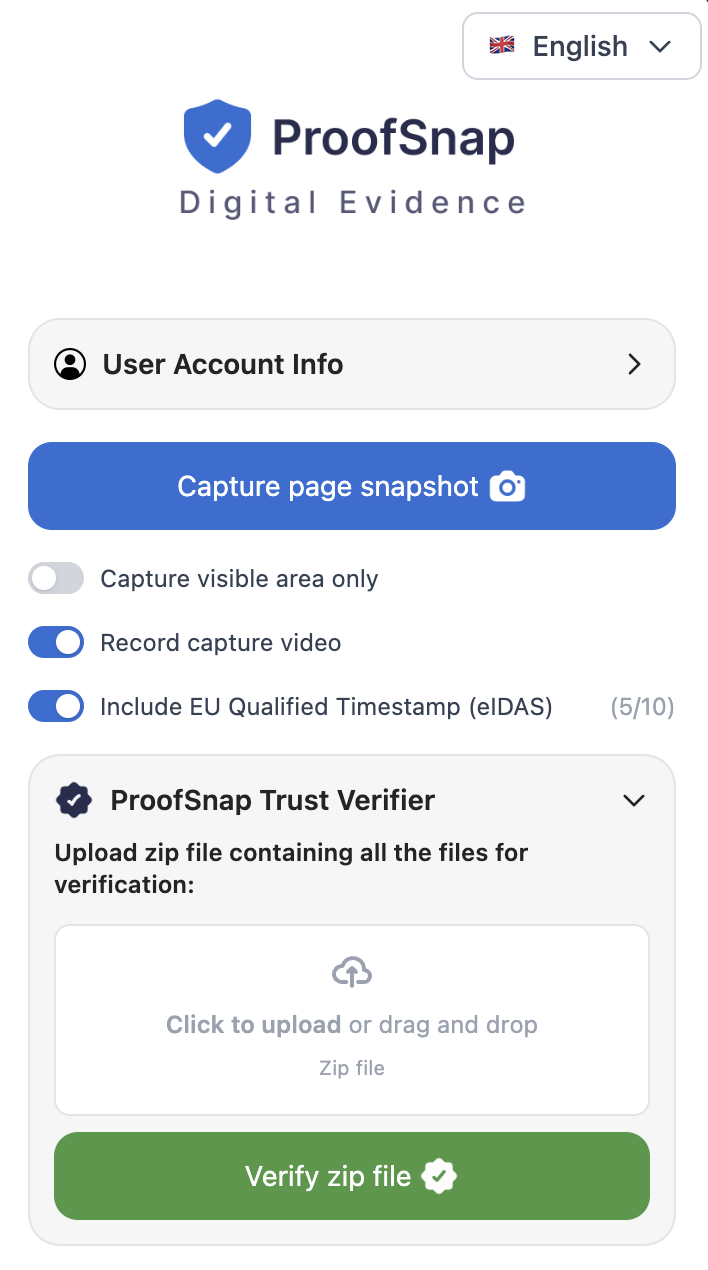
The ProofSnap side panel, English interface
Free, no signup, no email, runs in this tab
See what the digital half actually looks like
You cannot try a notary before booking one. You can try this in about ninety seconds.
1. Hash a file in your browser
Pick any file. The SHA-256 is computed locally with the Web Crypto API and nothing is uploaded. It is the same hash that seals every file in a certified package.
Computed locally. Nothing left this page.
Why this is not yet a certification. A hash proves integrity, not time, and it is exactly the gap a notary fills with their presence and a timestamping authority fills with a signed token. Understanding that gap is most of what this page is about.
2. Download a real certified package
Open it and read the chain of custody, the manifest and the declaration template. It is the document a notary would never produce, and vice versa.
Download the sample ZIP3. Verify it yourself
This is the part with no notarial equivalent: an opposing expert can re-check the whole package without trusting anyone, using source code that is public.
Open the Trust VerifierBeing straight about the paid part: capturing your own pages needs a plan or a SnapPack, and the 7-day trial asks for a credit card at sign-up. The three things above genuinely do not. If you want the capture done for you with no subscription, the capture service starts at $44.99 per URL, which is still below a typical acta.
Questions people actually ask
Can I bring my own screenshot to a notary?
Generally no, and this is the single most common misunderstanding. A notary attests what they perceived. If you hand over a printout you made yesterday, the most they can usually do is certify that you signed a statement about it, which moves the credibility question back onto you. Where the notarial route is available, the notary opens the content themselves.
Is a digital certification weaker than a notarial act?
In a civil-law system a notarial act is a public document and a certified capture is a private one, so on formal status, yes. On the two questions courts usually fight about, integrity and date, a qualified electronic timestamp under Article 41 of Regulation (EU) 910/2014 carries its own presumption, and a hash is checkable by anyone. Which matters more depends on what the other side is attacking.
Why do some vendors say a notary costs over a thousand euros?
Because they are quoting the wrong service. Property conveyancing in Spain is commonly 600 to 1,500 EUR, and Italian notarial fees on a purchase run into thousands, but neither figure describes an act about a web page. A simple Spanish acta de presencia is commonly quoted at 100 to 150 EUR before VAT. We would rather lose the dramatic comparison than print a number we cannot stand behind.
What about the United States?
A US notary usually witnesses a signature rather than attesting web content, with Florida cited as an exception under Fla. Stat. 117.05(12). Fees per notarial act are capped by state law, from 0.50 USD in Wisconsin to 15 USD in California and Nevada, and around sixteen states set no maximum. For federal matters the more useful route is a declaration under 28 U.S.C. 1746 together with FRE 902(13) and 902(14), which needs no notary at all.
Should I do both?
If the matter is worth it, yes, in that order. Seal it digitally immediately because the content has its own clock, then add the notarial layer if the value of the dispute justifies the cost and your procedure benefits from it. The sealed package also gives the notary something concrete to work from.
Sources and dates. Spanish notarial tariff and structure: Real Decreto 1426/1989 and the Consejo General del Notariado. Market ranges for actas: Spanish notarial guidance sites including notarios.net, read 16 August 2026. United States notarial fee maxima: Notary Public Association, read 16 August 2026. Declarations: 28 U.S.C. 1746. Self-authentication: FRE 902. Qualified timestamps: Regulation (EU) No 910/2014, Articles 41 and 42.
Scope. Notarial competence and fees differ by country and, in the United States, by state. Nothing here is legal advice and nothing here is a statement about the admissibility of any document in any particular proceeding. Ask your counsel about your matter.
Last checked: 16 August 2026.
The content has a clock. The appointment does not.
Seal the page now, decide about the notary afterwards. That order costs a few dollars and keeps every option open.
The 7-day trial requires a credit card at sign-up and can be cancelled at any time.