Constructive dismissal in Ontario: how to prove it before your access is cut
Constructive dismissal in Ontario means your employer, without your agreement, substantially changed your pay, duties, hours or place of work, or treated you in a way showing it no longer intends to honour the contract. You generally have two years to sue or to file an ESA claim. This 2026 ProofSnap guide shows what to save first.
- 2 yearsto start a court action for wrongful or constructive dismissal, generally from the day the claim was discovered
- 2 yearsto file an ESA claim for termination or severance pay; to sue instead, withdraw it within 2 weeks
- Save it todaywork email, Slack, Teams and the HR portal can close the day your job ends

· 7 min read
How ProofSnap helps. It seals a page or a file with SHA-256 hashes, a signed manifest and timestamps, so your lawyer can check later that nothing has changed. Capture the pages you are signed in to with the Chrome extension, or send us the public ones, such as a job posting for your role, and we capture them for you. See the two ways.
General information, not legal advice. The Law Society Referral Service can put you in touch with an employment lawyer or licensed paralegal.
Constructive dismissal examples in Ontario: what to save for each
Pick what happened to you. Each card gives the legal question behind it and five records that show the situation before and after the change. If you resign over a change, do it within a reasonable period.
1Pay cut
Salary, commission plan or bonus cut without your agreement.
A unilateral, substantial change to compensation is the typical breach under the Supreme Court of Canada test; the Ontario ESA guide gives a significant reduction in salary as an example.
- Offer letter or contract with the agreed pay (the term that was changed)
- Pay stubs from before and after the cut (the size of the change)
- The email, memo or message announcing the cut (that it was unilateral, and when)
- Your compensation page in the HR portal, before and after (the employer's own record)
- Your written objection and any reply (that you did not accept it)
2Demotion or removed duties
New title, a more junior manager, or core work handed to someone else.
The Supreme Court of Canada test names changes to work assignments; the question is whether a reasonable person in your situation would see the essential terms as substantially changed.
- Job description or offer letter listing your role (what you were hired to do)
- The public team page, or an org chart you were sent, before and after (the new reporting line)
- The announcement by email, Slack or Teams (when and how it was made)
- A public job posting for your role or your old duties (that the work continues)
- Your written objection and any reply (that you did not accept it)
3Reduced hours or shifts
Full-time schedule cut, shifts taken away, pay falling with the hours.
A unilateral, substantial cut to hours is a change to compensation, the typical breach under the Supreme Court of Canada test.
- Schedules from the scheduling app, before and after (the hours you lost)
- Pay stubs for the same weeks (the effect on your earnings)
- Messages from your manager about the new schedule (who decided it, and when)
- Contract or policy on hours, if any (what was agreed)
- Your written objection and any reply (that you did not accept it)
4Forced relocation
Transfer to a distant site you did not agree to.
The Supreme Court of Canada test names changes to the place of work; the Ontario ESA guide gives a significant negative change in work location as an example.
- Contract clause on place of work, or its absence (whether a transfer was allowed)
- The transfer notice or announcement (the change and its date)
- The public address pages of the old and new sites (the distance involved)
- Messages about the transfer (whether it was optional)
- Your written objection and any reply (that you did not accept it)
5Toxic workplace or harassment
Humiliation, abuse or harassment the employer causes or allows.
The second branch of the Supreme Court of Canada test covers a course of conduct showing the employer no longer intends to be bound; the Ontario ESA guide says constructive dismissal may include harassment or abuse by the employer.
- Messages sent to you, in full threads with dates (what was said, and by whom)
- Your complaint to HR and the response (that the employer knew)
- The workplace harassment policy as published to staff (the process the employer set out)
- Notes made at the time of each incident (the pattern over time)
- Names of people who saw it (who can confirm it)
6Lay-off beyond the ESA limits
A “temporary” lay-off that keeps running, with or without a recall date.
The ESA treats a lay-off longer than a temporary lay-off as a termination, deemed to start on its first day. The basic limit is 13 weeks in any period of 20 consecutive weeks; longer periods need conditions such as continued benefits or an agreed recall, and different rules apply if you are in a union.
- The lay-off notice and any recall date (when it started, what was promised)
- A week-by-week record of the lay-off (whether the limit was exceeded)
- Pay stubs and benefit statements during the lay-off (whether benefits continued)
- Contract or agreement on lay-offs or recall (whether such a term exists)
- Recall messages, or the lack of them (how the lay-off ended)
7Dismissal without cause
Too little notice or pay, or a package with a short deadline.
The ESA sets minimum notice or termination pay, and severance pay for eligible employees; the Ontario ESA guide says some employees have greater common law rights they can claim in a wrongful dismissal action.
- The termination letter and any release or package offer (what was offered, and by when)
- Contract termination clause, if any (what notice was agreed)
- Pay stubs, bonus and benefit summaries (your full compensation)
- Your HR profile with your start date and title (your length of service)
- A public job posting for your former role (that the work continues)
The full table of 35 records is in the CSV file.
Wrongful dismissal deadlines in Ontario: ESA claim or court action
Each route has its own two-year clock, and for the same termination you must choose one.
| Route | Deadline | Source |
|---|---|---|
| ESA claim with the Ministry (termination pay, severance pay, other ESA minimums) | 2 years from the contravention; a complaint about anything older is deemed not filed | Section 96 of the Employment Standards Act, 2000 |
| Court action for wrongful or constructive dismissal | Generally 2 years from the day the claim was discovered | Section 4 of the Limitations Act, 2002 |
| Switching from an ESA claim to a court action | Withdraw the ESA claim within 2 weeks after filing it | Ontario ESA guide, Filing a claim |
| Resigning over a constructive dismissal | Within a reasonable period after the change | Ontario ESA guide, Termination of employment |
The court clock runs from discovery, and the Act presumes you knew the facts on the day of the act it is based on, unless the contrary is proved. None of these clocks waits for your evidence.
How to prove constructive dismissal: what to save first
Start with what disappears soonest. A public job posting can come down and a press release can be edited too.
Keep to your own records: messages you sent or received and documents about your own job. Not client files, trade secrets or co-workers’ personal information, and never get around access controls. Your contract or IT policy may limit what you can take; if unsure, ask a lawyer first.
Before access ends
- Write the timeline today: each change, the date, who told you and how. Notes made at the time carry more weight than a summary written months later.
- Capture the change where it was announced: the email, Slack or Teams message or HR portal notice, as the full thread with sender and date.
- Save your pay and schedule pages in the HR or scheduling portal, before and after the change.
- Keep your own employment documents: offer letter, contract, job description, signed policies, pay stubs, benefit statements.
Then, outside work systems
- Object in writing if you have not accepted the change, and keep the reply.
- Capture the public pages: a job posting for your role, the company’s announcement of the restructuring, the team page.
- Export texts and chats with your manager from your own phone, as the full conversation with dates.
- Store it unchanged, outside work systems: original files, a date in each file name, and a sealed copy with a hash and a timestamp.
Make it readable. A cropped screenshot of three messages says little about who sent them or when. Keep the whole page or thread with its URL and date, never edit the copy you rely on, and add a one-line index per file: date, what it shows, which situation above.
Two ways to capture the evidence with ProofSnap
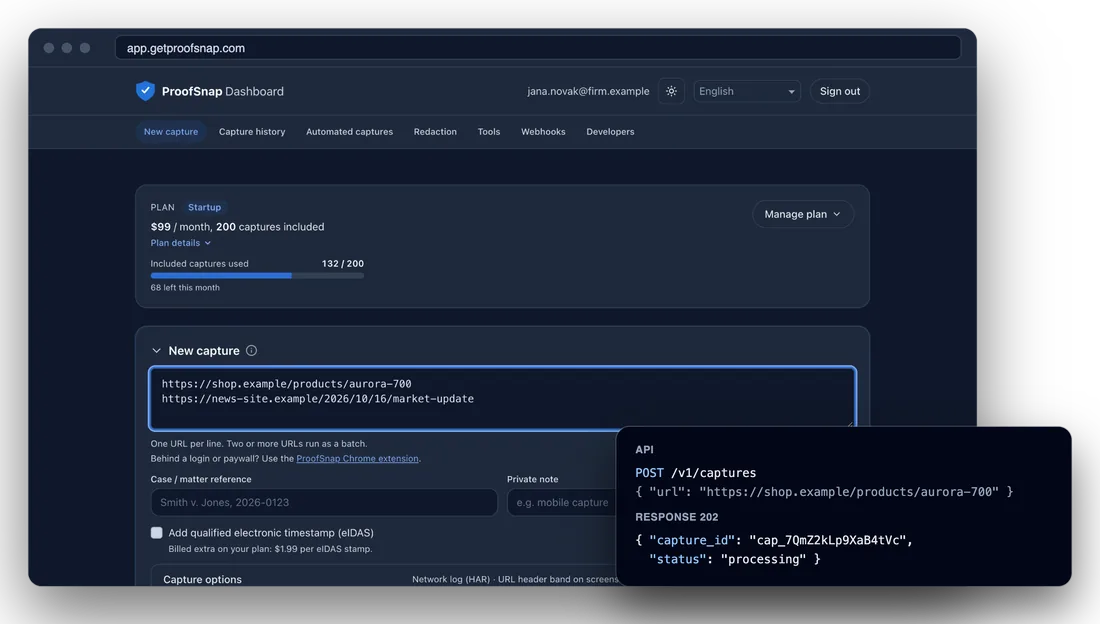
ProofSnap seals a page as a package with SHA-256 hashes, a signed manifest and timestamps that anyone can check. Pick the way that fits: public pages such as job postings and company announcements, or the pages you see in your own browser.
Path 1
API and dashboard
For public pages: the job posting for your role, the company’s press release, its careers or team page. Paste the addresses into the web dashboard, once or on a schedule.
- 1 to 50 URLs per request, each sealed as its own full-page package.
- Scheduled captures, so a posting or a team page is recorded on the dates you choose, before it comes down.
- A PDF report in every package to hand to your lawyer.
50 free test captures in the sandbox, no card. Live plans from US$1.49 (approx. C$2.10) per capture.
See the API and dashboardPath 2
Chrome extension
For the pages in front of you. You run ProofSnap in your own browser, so a page you are signed in to, such as your own pay page or a message thread you are part of, is captured as you see it.
- One click captures the full page, its HTML, text and metadata, and seals a package of 11 to 15 files.
- Session mode records a browsing session across several tabs, with a snapshot of each tab you view.
- File certification seals files you already have, such as a pay stub PDF or an exported email, with a hash and a timestamp.
7-day trial (card required), or a one-time SnapPack of 10 captures for US$4.99 (approx. C$7).
Add ProofSnap to Chrome On a phone? Have public pages captured for youWould you rather hand it over? Send us the addresses of the public pages, such as the job posting and the company announcement, and we’ll capture and seal them for you, from US$44.99 (approx. C$63). Texts from your manager on WhatsApp? We turn your own chat export into a certified transcript for US$59.99 (approx. C$84).
Have pages capturedWhat counts as constructive dismissal in Ontario: the legal test
The Supreme Court of Canada set out the test in Potter v. New Brunswick Legal Aid Services Commission, 2015 SCC 10. It has two branches: a single unilateral change that substantially alters an essential term of the job, or a series of acts that, taken together, show the employer no longer intends to be bound by the contract.
“Typically, the breach in question involves changes to the employee’s compensation, work assignments or place of work that are both unilateral and substantial.”Supreme Court of Canada, Potter, 2015 SCC 10, para. 32
Whether a change was substantial is judged from the perspective of a reasonable person in your situation, at the time of the change, without information you neither knew nor could reasonably have foreseen. That is why dated records matter: they show what you were told, and when. The Employment Standards Act, 2000 counts a constructive dismissal as a termination when you resign in response within a reasonable period.
Wrongful dismissal and constructive dismissal: the difference
Wrongful dismissal is a dismissal without the notice you were entitled to. Constructive dismissal is one route to it: you resign, then claim the same notice, pay or damages as if you had been dismissed. For an individual termination the ESA minimum runs from one week of notice or termination pay after three months of service to eight weeks after eight years, plus severance pay of up to 26 weeks for eligible employees with five or more years of service. Some employees have greater common law rights, claimed in a wrongful dismissal action.
Constructive and wrongful dismissal in Ontario: questions
What is considered constructive dismissal in Ontario?
Your employer, without your agreement, substantially changes an essential term of your job, such as pay, duties, hours or place of work, or treats you in a way showing it no longer intends to honour the contract. The test is whether a reasonable person in your situation would see the change as substantial. The Ontario ESA guide adds that it may include harassment or abuse by the employer.
How do you prove constructive or wrongful dismissal?
With dated records of the situation before and after the change: your contract or offer letter, pay stubs, the message announcing the change, your written objection and the reply. Save what sits in work systems first, keep full threads and full pages with their date rather than cropped screenshots, and keep the original files unchanged. A SHA-256 hash and a timestamp let anyone check later that a copy has not been altered.
Can an employer add duties without compensation in Ontario?
For minor changes, usually yes. A change to duties can be constructive dismissal when it substantially alters an essential term without your agreement, judged from the perspective of a reasonable person in your situation, or when it is part of a pattern showing the employer no longer intends to honour the contract. Keep the job description you were hired under and the messages assigning the new work.
Can I sue my employer for stress and anxiety in Canada?
Not for stress as such, but harassment or abuse by the employer can be the basis of a claim: the Ontario ESA guide says constructive dismissal may include it, and what you can claim depends on the facts. Keep the messages sent to you, your complaint to HR and the response, and notes made at the time of each incident.
How much can you get for wrongful dismissal in Ontario?
The ESA sets only the minimum: notice or termination pay, plus severance pay if you qualify. The Ontario ESA guide says some employees have greater rights under the common law, which are claimed in a wrongful dismissal action and decided case by case. An employment lawyer can estimate the amount from your contract, pay records and length of service.
How much severance pay can I expect after 10 years in Ontario?
At the ESA minimum, if you qualify for severance pay, 10 years of service gives 10 weeks of regular wages, and separately 8 weeks of notice or termination pay for an individual termination. You qualify after five or more years of service if the employer has a payroll of $2.5 million or more, or if 50 or more employees lose their jobs within six months because all or part of the business at an establishment closes for good. The common law can give more.
What is the difference between termination pay and severance pay in Ontario?
Termination pay replaces the written notice the ESA requires once you have three months of service: for an individual termination, from one week for less than a year up to eight weeks for eight years or more. Severance pay is separate. It is owed after five or more years of service to eligible employees, and it is one week of regular wages per year of service, partial years included, up to 26 weeks.
How long can a temporary layoff last in Ontario?
Under the ESA the basic limit is 13 weeks in any period of 20 consecutive weeks. A lay-off can last longer (less than 35 weeks in any period of 52 consecutive weeks) only under conditions such as continued benefit contributions or a recall within a time agreed with you, and different rules apply if you are in a union. Beyond those limits the lay-off is a termination, deemed to start on its first day.
How long do I have to sue for wrongful dismissal in Ontario?
Generally two years from the day the claim was discovered, under the basic limitation period of the Limitations Act, 2002. The clock does not wait for you to finish collecting evidence, so save the documents and messages first and get advice early.
How do I file a constructive dismissal claim in Ontario: ESA or court?
Either as an ESA claim with the Ministry, generally within two years of the contravention, for the ESA minimums such as termination and severance pay, or as a court action, where you can claim common law reasonable notice, which for some employees is greater. You cannot pursue both for the same termination: to sue after filing an ESA claim, you must withdraw it within two weeks after filing it.
Should I resign or keep working after a big change to my job?
The Supreme Court of Canada describes this as the hard choice an employee faces: accept the change, or resign and bring an action for constructive dismissal, usually with limited information. The ESA counts a resignation as a termination only if it comes within a reasonable period after the change. Get advice before you resign, and keep your records either way.
Should I sign a severance package or release right away?
Read what the release says you give up, and have a lawyer review it before you sign, even when the offer comes with a short deadline. Keep the offer letter, the release and the email that set the deadline, with their dates.
Method and data: how we built this page
- Law. Read on 14 November 2026 from the official e-Laws consolidations of the Employment Standards Act, 2000 (current from 1 January 2026) and the Limitations Act, 2002, from the Supreme Court of Canada’s own copy of Potter, and from the Ontario guide to the ESA. A rule we could not find in these sources is not on this page.
- Trigger table. 7 situations, 35 evidence items. Each item says what it proves and which source makes that fact relevant. The selection of situations and items is ours.
- Search results. On 14 November 2026 we pulled the Google Canada top 20 (DataForSEO SERP API) for “constructive dismissal ontario”, “wrongful dismissal ontario” and “constructive dismissal”, on desktop and on mobile: 111 organic results from 70 domains. In that pull the Ontario government’s own ESA guide on ontario.ca did not appear, and the only public bodies were the Ontario Human Rights Commission and the Law Society of Ontario’s Great Library, two results each. A second pull later the same day put the ESA guide first on desktop for “wrongful dismissal ontario”, so these rankings move from one check to the next. Law firm pages filled most of the top 20 in the second pull.
Download the data
146 rows, CSV, CC BY 4.0. Please cite “ProofSnap, Constructive and wrongful dismissal evidence in Ontario 2026” with a link to this page.
Before your last day
Save the record while you can still see it
ProofSnap seals a page or a file with SHA-256 hashes and a timestamp, so your lawyer, or anyone else, can use the free Trust Verifier to check that nothing has changed since.
Related reading
Sources
- Employment Standards Act, 2000, S.O. 2000, c. 41, e-Laws consolidation from 1 January 2026
- Limitations Act, 2002, S.O. 2002, c. 24, Sched. B, e-Laws consolidation from 4 December 2024
- Potter v. New Brunswick Legal Aid Services Commission, 2015 SCC 10, [2015] 1 S.C.R. 500, Supreme Court of Canada
- Government of Ontario, Your guide to the Employment Standards Act: Termination of employment, updated 23 July 2026
- Government of Ontario, Your guide to the Employment Standards Act: Filing a claim, updated 5 November 2026
- ProofSnap dataset: Constructive and wrongful dismissal evidence in Ontario 2026 (CSV)