Anti-SLAPP means your evidence is needed first, not last.
In Ontario and British Columbia a defendant can move early to dismiss a claim arising from expression on a matter of public interest. Once they show that much, the burden flips to you: substantial merit, no valid defence, and harm that outweighs the public interest in protecting the expression. All of that has to be shown before discovery, from documents you already hold.
Works on Chrome and Edge. From $4.99 (about C$7) as a one-off, or a 7-day trial that requires a credit card.
M. Traeger
Public post · 412 shares
“The people running that firm took money that was never theirs. Ask anyone who worked there. I would not let them near my family.”
Deleted 6 days later, after 412 shares. The motion comes long before discovery.
Captured & sealed
SHA-256 · Bitcoin timestamp
Illustrative example. Fictional post and fictional firm.
Anti-SLAPP inverts the usual order of a defamation claim, and that is why preservation matters more in Canada than almost anywhere else. Under section 137.1 of the Ontario Courts of Justice Act, a defendant who shows the proceeding arises from expression on a matter of public interest shifts the burden to the plaintiff. As the Supreme Court set out in 1704604 Ontario Ltd. v. Pointes Protection Association, 2020 SCC 22, the plaintiff must then show the claim has substantial merit, meaning it is legally tenable and supported by evidence reasonably capable of belief, that the defendant has no valid defence, and that the public interest in letting the claim proceed outweighs the public interest in protecting the expression. That is a documentary exercise conducted before discovery. Ontario also has a separate notice trap: section 5(1) of the Libel and Slander Act requires notice within six weeks of the libel coming to your knowledge where it appeared in a newspaper or a broadcast, section 6 requires the action to be started within three months, and section 7 confines both to Ontario newspapers and Ontario-station broadcasts. ProofSnap captures the post, the profile, the comment thread and the visible engagement as a package containing the full page, the saved source, the URL, the UTC capture time, a SHA-256 hash of every file, an RSA-4096 signature and a Bitcoin blockchain timestamp. From $4.99 (about C$7) as a one-off.
By Radim Motycka, Founder and Lead Engineer, ProofSnap · · Independently verifiable via Trust Verifier
Why this goes wrong so often
The post comes down, and the motion arrives
People delete defamatory posts, and defendants bring anti-SLAPP motions early. Both happen long before you would normally be gathering documents.
Deleted before you get advice
The gap between reading something about yourself and speaking to a lawyer is usually days. That is more than enough time for the post, the account or the whole page to disappear, and platforms are not obliged to keep a copy for you.
Harm has to be shown, not assumed
On a section 137.1 motion you have to put harm in evidence and weigh it against the public interest in the expression. For an online publication that means how far it travelled: shares, views, comments, who engaged. All of it is on the page, and only while the page is live.
Six weeks, if it was a newspaper or a broadcast
Ontario section 5(1) requires notice within six weeks of the libel coming to your knowledge, section 6 requires the action within three months, and section 7 limits both to Ontario newspapers and Ontario-station broadcasts. Courts have repeatedly declined to apply the notice requirement to ordinary personal social media posts, but that turns on evidence rather than on a categorical rule, and an online edition of a newspaper has been held to be a newspaper. Serve notice anyway if there is any doubt.
What a section 137.1 motion actually asks you to prove
The test comes from the statute and from Pointes Protection. Each limb is answered with documents, and the motion is heard before discovery.
Step one belongs to the defendant
They must satisfy the court that the proceeding arises from an expression relating to a matter of public interest. Public interest is defined broadly and generously, so this step is usually cleared.
Substantial merit, and no valid defence
The claim must be legally tenable and supported by evidence reasonably capable of belief, such that it has a real prospect of success. On defences the word is absolute: if any defence is valid, the plaintiff has not met the burden and the claim is dismissed.
The public interest weighing
Even a meritorious claim can be dismissed if the harm you can show does not outweigh the public interest in protecting the expression. This is where a documented record of reach and consequence does the most work. Where the material is an intimate image rather than a defamatory statement, a takedown order is faster than a defamation claim.
Notice and limitation, province by province
Ontario has the Libel and Slander Act six-week notice in section 5(1) and three-month limitation in section 6, both confined by section 7 to Ontario newspapers and Ontario-station broadcasts. Other provinces have their own libel statutes and periods. Confirm the ones that apply where you would sue rather than assuming Ontario rules travel.
Capture the reach, not just the words
The most common gap in a Canadian defamation file is proof of extent and consequence, and anti-SLAPP is precisely where that gap gets exposed. Capture the post together with what is visible around it: the share count, the view count, the comment thread, the reactions, the size of the group or page it appeared on, and any reposts you can find. Capture each as its own record on the day you find it. Then capture the downstream consequences you can point at, such as a review page, a cancelled listing or a public response.
Three steps, about forty seconds
No forensic training required. The proof is in the package, not in your testimony about how careful you were.
Capture the publication and its reach
The post, the profile behind it, the comment thread and any reshares. Each capture records the URL and the UTC time, so the sequence of what appeared when is preserved.
The package seals and timestamps itself
SHA-256 for every file, an RSA-4096 signature over the manifest, and an anchor to the Bitcoin blockchain so the date of your capture cannot be moved.
Hand it to counsel as one file
The PDF evidence report reads like a document and the ZIP verifies in a browser. Your lawyer gets a file to build a responding motion record from rather than a folder of loose images.
What lands in the evidence package
Between 11 and 15 files depending on your plan, delivered as one ZIP that anyone can check without installing anything.
Full-page screenshot
The whole page, not just the visible window, stitched and hashed.
Saved page source
The document as rendered at capture time, including the head, meta tags and structured data.
Extracted page text
Searchable plain text, so a quote can be found and cited without retyping.
Technical metadata
URL, page title, HTTP response headers, browser, operating system and the capture time in UTC.
Signed manifest
SHA-256 for every file, signed with an RSA-4096 key whose public key ships in the package.
Blockchain timestamp
The manifest hash anchored to Bitcoin via OpenTimestamps, so the capture time cannot be backdated.
Chain of custody and forensic log
A record of what happened during the capture, in the order it happened.
Evidence report as PDF
A readable summary you can attach to an application, a notice or a report.
Verification instructions
Written steps plus scripts, so the other side can re-check the hashes offline.
Where all of that comes from
Every file above is produced by one press in the side panel, while the publication is still up. The words complained of, the account behind them, the address and the time are recorded together, which is the record you need on a motion that arrives before any discovery.
If the same statement was published in several places, capture each one. Separate packages make it far easier to show the extent of publication and the harm that followed.
Want to see what comes out before you install anything? Download a sample evidence package and open it yourself.
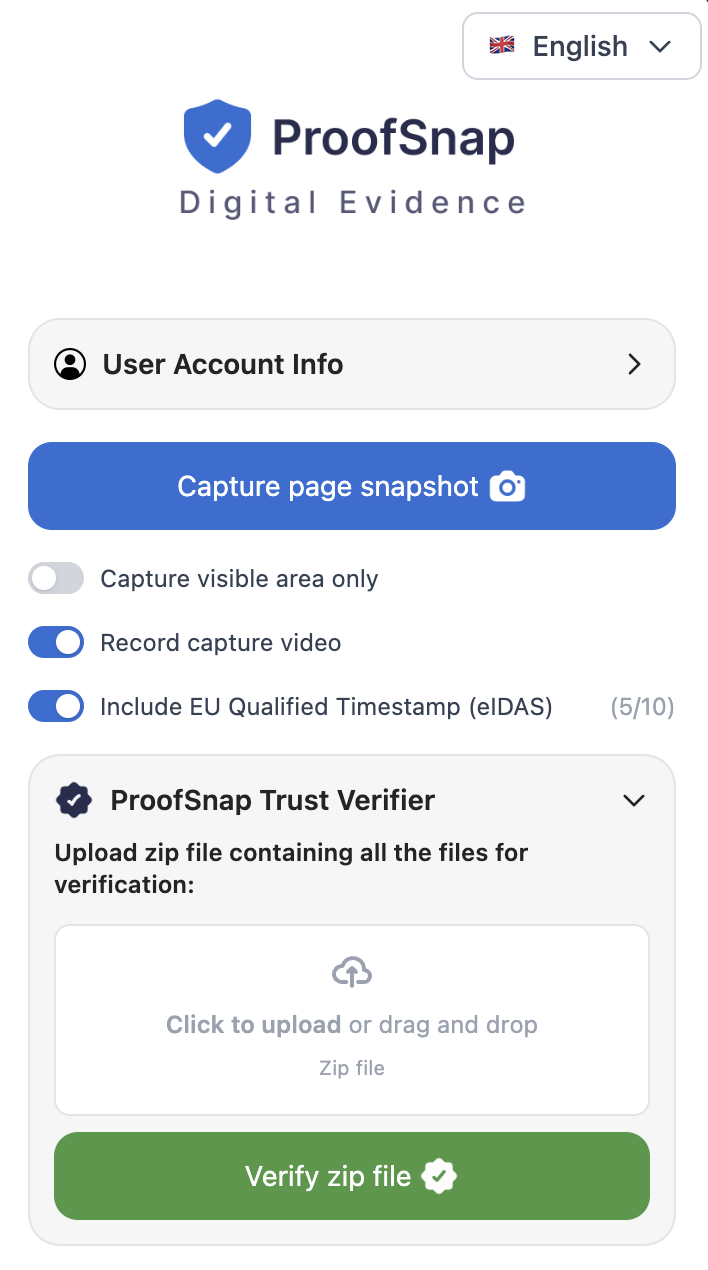
Anyone can verify it, including the other side. Drop the ZIP onto the public Trust Verifier and the hashes, the signature and the timestamp are checked in the browser. Nothing is uploaded and nothing depends on ProofSnap still existing.
Three ways to get the evidence
Prices are charged in USD. Approximate Canadian figures are shown for orientation only, and your card issuer sets the actual rate.
One dispute
$4.99 once
about C$7
A SnapPack is a single up-front purchase for a set number of captures. No subscription, no auto-renewal, no trial. Best when you have one problem and you want it documented today.
Get a SnapPackOngoing matters
$8.99/month
about C$13
For anyone who captures regularly: practitioners, property managers, HR, investigators. The 7-day free trial requires a credit card. Cancel any time during the trial and you are not charged.
Start the 7-day trialWe do it for you
$44.99 per URL
about C$63
Send us the link and our team captures the package for you, with nothing to install. Useful when the capture should not come from a party to the dispute.
See the capture serviceProofSnap is not a law firm and does not give legal advice. Qualified timestamps are issued by Disig a.s., a Qualified Trust Service Provider on the EU Trusted List. Canada has no equivalent regime, so that timestamp is independent corroboration here rather than a legal presumption.
Official sources
Every figure and deadline on this page comes from the following primary sources. Check them yourself rather than taking our word for it.
- 1704604 Ontario Ltd. v. Pointes Protection Association, 2020 SCC 22 the Supreme Court on how section 137.1 works and what each limb requires.
- Libel and Slander Act (Ontario) the six-week notice in section 5(1) and the three-month limitation in section 6.
- Canada Evidence Act, section 31.2 the best evidence rule for electronic documents, satisfied on proof of system integrity.
- Libel and Slander Act (Ontario), e-Laws consolidation sections 5, 6 and 7, including the limit to Ontario newspapers and Ontario-station broadcasts.
Anti-SLAPP exists in Ontario and British Columbia and has been considered elsewhere, so the procedure is not uniform across Canada. Quebec is a civil law jurisdiction with its own rules entirely, including a one-year prescription for injury to reputation, and our Quebec pages cover it in French.
Questions people actually ask
The motion comes early. So should your evidence.
Capture the publication and its reach while both are still visible, then take advice.