Your screenshot will be accepted. That is not the same as being believed.
The Disputes Tribunal follows no formal rules of evidence, allows no lawyers except in limited circumstances, and has a referee decide on the substantial merits and justice of the case. Since 24 January 2026 it hears claims up to NZ$60,000, double the old limit. Bigger claims, same problem: the listing that made you agree has been edited by the time you get a hearing.
Works on Chrome and Edge. From $4.99 (about NZ$9) as a one-off, or a 7-day trial that requires a credit card.
Phone screenshot
- Page address
- not recorded
- Time captured
- not recorded
- Amount in dispute
- NZ$2,480
- File hash
- none
- Checked by
- your word
ProofSnap package
- Page address
- rental-listing/4821
- Time captured
- 03:12:47 UTC
- Amount in dispute
- NZ$2,480
- File hash
- a1f3…9c2
- Checked by
- anyone, offline
Anchored to the Bitcoin blockchain, so the capture time cannot be moved.
Illustrative example. Both go into the tribunal file. Only one of them can be checked.
At the Disputes Tribunal and the Tenancy Tribunal there are no formal rules of evidence, so a screenshot is admitted without argument, then weighed against a contrary account. Since 24 January 2026 the New Zealand Disputes Tribunal hears claims up to NZ$60,000. A ProofSnap capture adds a hash, a signature and a timestamp anyone can verify.
That makes it easy to file and easy to discount, because a referee is weighing whose account to prefer rather than whether a document is admissible. The Disputes Tribunal limit rose from NZ$30,000 to NZ$60,000 on 24 January 2026, with a filing fee of NZ$496 for claims of NZ$30,001 or more since the 1 July 2026 fee rise, so more substantial disputes now run through a forum that decides on the substantial merits and justice of the case rather than on strict legal rights. A ProofSnap capture answers the credibility question directly: the full page, the saved source, the exact URL, the capture time in UTC, a SHA-256 hash of every file, an RSA-4096 signature and a Bitcoin blockchain timestamp, all of which the other party can check in a browser. Use it for Trade Me and rental listings that change, condition reports, builder and tradesperson quotes, and message threads. If the matter later reaches a court, section 137 of the Evidence Act 2006 presumes that a machine, device or technical process of a kind that ordinarily does what you assert it does did so on the occasion in question, in the absence of evidence to the contrary. From $4.99 (about NZ$9) as a one-off.
By Radim Motycka, Founder and Lead Engineer, ProofSnap · · Independently verifiable via Trust Verifier
How these disputes actually run
The listing changes, and it becomes your word against theirs
Tribunal matters are heard weeks or months after the thing that caused them. By then the page has been edited, the ad has been pulled and the thread has been deleted.
The listing no longer says what it said
Rental and sale listings are edited constantly. Heat pump, off-street parking, pets, the chattels list, the price. When the listing that made you sign is gone, you are describing it from memory while the other side describes it differently.
The message thread gets tidied up
Property managers change, portals archive, and messages get deleted for everyone. The repair you asked about four times becomes a repair nobody remembers being asked about.
Two accounts, and a referee has to choose
A referee with two plausible stories and no verifiable record will usually prefer whoever looks more organised. A package that can be independently checked is not just more convincing; it takes the guesswork out.
Which forum, and what it means for your evidence
New Zealand runs one national system rather than a state-by-state patchwork, which makes this simpler than it is across the Tasman. The forum still changes how much weight your record has to carry on its own.
Disputes Tribunal, now up to NZ$60,000
The limit rose from NZ$30,000 on 24 January 2026, under the Disputes Tribunal Amendment Act 2025, which amended the Disputes Tribunal Act 1988, with a filing fee of NZ$496 for claims of NZ$30,001 or more. That fee schedule took effect on 1 July 2026 and can change, so check the current one rather than a figure quoted in an article. No lawyers except in limited circumstances, no formal rules of evidence, and a trained referee rather than a judge. The Tribunal decides on the substantial merits and justice of the case, having regard to the law but not bound by strict legal rights or obligations, legal forms or technicalities. On evidence, section 40(4) lets the Tribunal take into account any relevant evidence whether or not a court would admit it, and section 97(3) of the Residential Tenancies Act 1986 does the same for tenancy matters.
Tenancy Tribunal, up to NZ$100,000
Hears landlord and tenant disputes under the Residential Tenancies Act 1986. Section 77 caps what the Tribunal can order at NZ$100,000, and a claimant can abandon the excess to stay inside that limit. Bond, rent arrears, repairs, notice and damage all end up here, and all of them are argued from documents that live on websites and in message threads.
Motor Vehicle Disputes Tribunal
Hears claims up to NZ$100,000, a limit that can be extended if both parties agree in writing, about vehicles bought from a registered motor vehicle trader or from a trader that met the criteria for registration but was not registered. Vehicles with a gross vehicle mass of 3,500 kg or more fall outside its jurisdiction. The advertisement, the listing photos and the description are usually the heart of the matter, and they are the first thing to change once a dispute starts.
If it reaches a court: Evidence Act 2006
Section 137 presumes that where a machine, device or technical process generally does what you assert it does, it did so on the occasion in question, in the absence of evidence to the contrary. That is the provision a hashed, signed and independently timestamped capture is built to satisfy. Where the dispute began with a fake shop or a bogus listing rather than a real trader, start instead with capturing the scam site before it disappears.
"determine the dispute according to the substantial merits and justice of the case, and in doing so shall have regard to the law but shall not be bound to give effect to strict legal rights or obligations or to legal forms or technicalities"
A note for property managers, landlords and traders
This cuts both ways. If you manage rentals or sell online, the same capture protects you from a tenant or buyer who claims the listing promised something it never did. Capture the listing as published on the day it goes live, keep the package, and the argument ends before it starts. A subscription makes sense once you are doing this weekly rather than once in a while.
Three steps, about forty seconds
No forensic training required. The proof is in the package, not in your testimony about how careful you were.
Capture while it is live
Open the listing, the portal message or the thread and capture it. The full page is saved, including the parts below the fold that a phone screenshot would cut off.
Everything is hashed and timestamped
SHA-256 for every file, an RSA-4096 signature over the manifest, and a Bitcoin blockchain anchor so the date cannot be moved afterwards.
File it with your application
Attach the PDF evidence report to your application and keep the ZIP. If anyone disputes it, they can verify the package themselves rather than take your word for it.
What lands in the evidence package
Between 11 and 15 files, depending on your plan, delivered as one ZIP that anyone can check without installing anything.
Full-page screenshot
The whole page, not just the visible window, stitched and hashed.
Saved page source
The document as rendered at capture time, including the head, meta tags and structured data.
Extracted page text
Searchable plain text, so a quote can be found and cited without retyping.
Technical metadata
URL, page title, HTTP response headers, browser, operating system and the capture time in UTC.
Signed manifest
SHA-256 for every file, signed with an RSA-4096 key whose public key ships in the package.
Blockchain timestamp
The manifest hash anchored to Bitcoin via OpenTimestamps, so the capture time cannot be backdated.
Chain of custody and forensic log
A record of what happened during the capture, in the order it happened.
Evidence report as PDF
A readable summary you can attach to an application, a notice or a report.
Verification instructions
Written steps plus scripts, so the other side can re-check the hashes offline.
Where all of that comes from
Every file above is produced by one press in the side panel, while the listing, the chat or the invoice is still on screen. Nothing has to be assembled afterwards, which is usually where a self-represented applicant loses a day and still ends up with loose images.
Capture as many pages as the dispute needs. Each one becomes its own sealed package, so a referee or adjudicator can take them one at a time instead of weighing a folder against an explanation.
Want to see what comes out before you install anything? Download a sample evidence package and open it yourself.
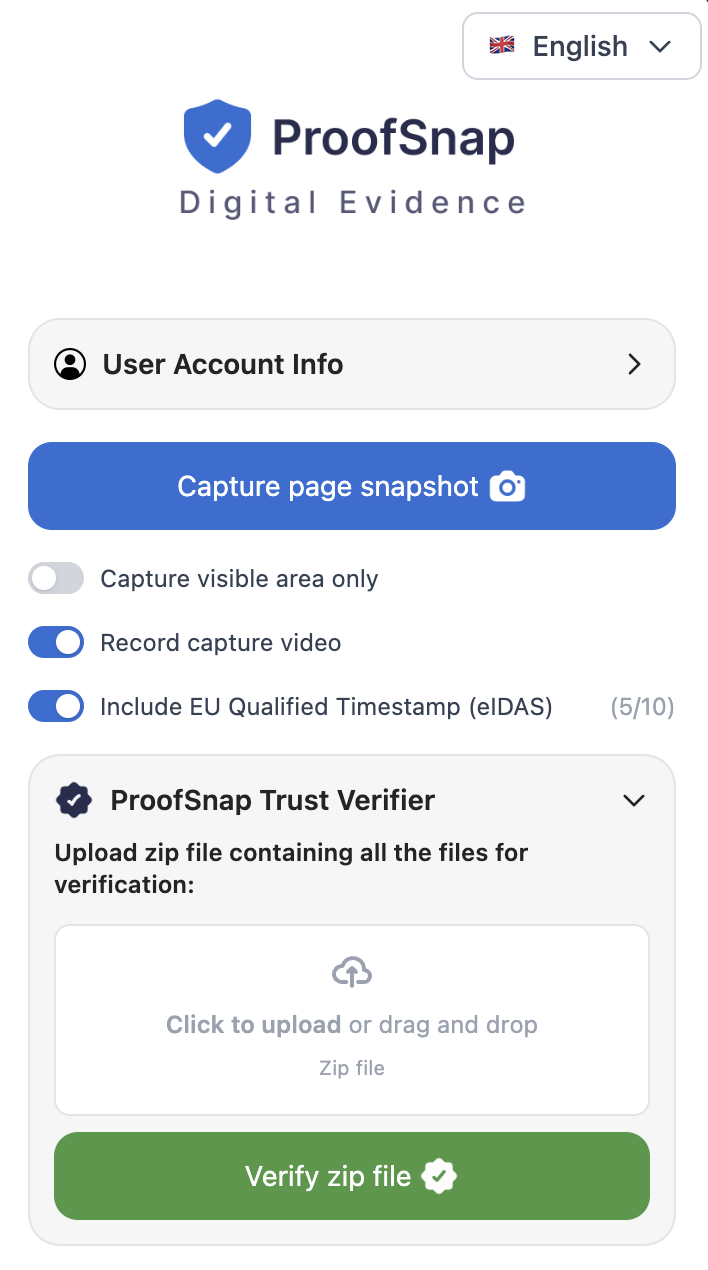
Anyone can verify it, including the other side. Drop the ZIP onto the public Trust Verifier and the hashes, the signature and the timestamp are checked in the browser. Nothing is uploaded and nothing depends on ProofSnap still existing.
Three ways to get the evidence
Prices are charged in USD. Approximate New Zealand figures are shown for orientation only, and your card issuer sets the actual rate.
One dispute
$4.99 once
about NZ$9
A SnapPack is a single up-front purchase for a set number of captures. No subscription, no auto-renewal, no trial. Best when you have one problem and you want it documented today.
Get a SnapPackOngoing matters
$8.99/month
about NZ$16
For anyone who captures regularly: practitioners, property managers, HR, investigators. The 7-day free trial requires a credit card. Cancel any time during the trial and you are not charged.
Start the 7-day trialWe do it for you
$44.99 per URL
about NZ$78
Send us the link and our team captures the package for you, with nothing to install. Useful when the capture should not come from a party to the dispute.
See the capture serviceProofSnap is not a law firm and does not give legal advice. Qualified timestamps are issued by Disig a.s., a Qualified Trust Service Provider on the EU Trusted List. New Zealand has no equivalent regime, so that timestamp is independent corroboration here rather than a legal presumption.
Official sources
Every figure and deadline on this page comes from the following primary sources. Check them yourself rather than taking our word for it.
- Disputes Tribunal: what it can help with, the claim types, the process and the current limit.
- Ministry of Justice: Tenancy Tribunal, how tenancy applications work and what to file.
- Evidence Act 2006, section 137, the presumption for evidence produced by a machine, device or technical process.
- Citizens Advice Bureau: the Disputes Tribunal, a plain-language explanation of what a referee can and cannot decide.
- Residential Tenancies Act 1986, section 77, the NZ$100,000 cap on what the Tenancy Tribunal can order.
Presentation matters as much as the capture. Put your documents in order, label each one, and give the tribunal and the other party the same set. A referee reading two tidy bundles decides on the merits. A referee reading one tidy bundle and one pile of screenshots notices.
Questions people actually ask
Capture it now, argue about it later
The listing you are looking at today is the evidence you will need in three months. It will not be there then.