You have 90 days. Your access was cut on day one.
A personal grievance must be raised with your employer within 90 days of the action, or of the day it came to your notice, whichever is later. Sexual harassment grievances get 12 months. In that same first week the work email is disabled, the rostering app stops loading and someone quietly removes you from the team chat.
Works on Chrome and Edge. From $4.99 (about NZ$9) as a one-off, or a 7-day trial that requires a credit card.
Roster · week of 6 July
Captured 12 Jul 2026, 21:40 UTC, two days before the dismissal.
Access denied
This account has been disabled. Contact your administrator.
Captured & sealed
SHA-256 · Bitcoin timestamp
Illustrative example. Fictional roster, fictional employer.
In New Zealand you must raise a personal grievance with your employer within 90 days of the action, or of when it came to your notice, or within 12 months for sexual harassment. ProofSnap captures the chats, rosters and emails that prove it, hashed, signed and timestamped, before your access is cut. Two 2026 changes narrowed grievance rights.
Personal grievances are decided on documents that live in systems you are about to lose access to. Once raised, you then have three years to lodge a claim with the Employment Relations Authority. Raising it late requires the employer to agree, or the Authority to accept that exceptional circumstances caused the delay. Two changes made by the Employment Relations Amendment Act 2026, in force from 21 February 2026, both matter: employees earning NZ$200,000 a year or more can no longer raise an unjustified dismissal grievance (immediately for agreements entered into on or after 21 February 2026, and from 21 February 2027 for pre-existing agreements), and conduct that contributed to the situation now restricts what the Authority may award. The evidence that decides these cases is ordinary: the team chat, the roster changes, the performance emails, the message at 11 pm. ProofSnap captures each of those as a package containing the full page, the saved source, the URL, the UTC capture time, a SHA-256 hash of every file, an RSA-4096 signature and a Bitcoin blockchain timestamp. It works the same way for employers defending a claim. From $4.99 (about NZ$9) as a one-off.
By Radim Motycka, Founder and Lead Engineer, ProofSnap · · Independently verifiable via Trust Verifier
What disappears in the first week
Losing the job and losing the evidence happen on the same afternoon
The systems that hold your proof belong to the employer, and the clock starts the moment you walk out.
Accounts are disabled immediately
Work email, the intranet, the rostering app and the payroll portal usually stop working the same day. Anything you meant to save later is behind a door you cannot open, and you cannot compel access before you have even raised the grievance.
Someone removes you from the group
The team chat where the roster was changed, the shift was refused or the comment was made is often the strongest evidence in the file. Removal from the group can take the history with it, and messages deleted for everyone leave nothing behind.
90 days, and it is not a formality
Raising it late needs your employer to agree or the Authority to find exceptional circumstances. Time spent hunting for evidence you no longer have comes straight out of that window.
The deadlines and the 2026 changes
New Zealand employment law moved in February 2026, and the changes cut against employees in two specific ways. Both are worth knowing before you decide how to proceed.
90 days, or 12 months for sexual harassment
The period runs from the date the action occurred or came to your notice, whichever is later. Since 13 June 2023 a grievance based on sexual harassment has 12 months instead of 90 days, and that longer period applies even if you leave the job during it.
Three years to lodge with the Authority
Raising the grievance with your employer is the first step, not the filing. Once raised, you have three years to lodge a claim with the Employment Relations Authority. The Authority can hear evidence of events outside the 90-day window where they connect to events inside it.
The high income change, from 21 February 2026
Employees earning NZ$200,000 a year or more can no longer raise an unjustified dismissal grievance. The threshold uses a broad definition tied to PAYE income payments under the Income Tax Act 2007, so salary, wages, bonuses, commissions and employee share scheme benefits all count. The bar applies immediately to agreements entered into on or after 21 February 2026, and it covers unjustified disadvantage claims relating to the dismissal as well as the dismissal itself. Employees on pre-existing agreements keep their rights until 21 February 2027, which leaves time to negotiate a written term agreeing that the threshold does not apply to them. If you are near that line, check how your remuneration is calculated before you spend time on a claim.
Contributory conduct, from 21 February 2026
Where your conduct contributed but did not amount to serious misconduct, the Authority must not award reinstatement or compensation for humiliation, loss of dignity or injury to feelings. Lost wages remain available but can be reduced by up to 100 per cent. Where conduct that contributed to the situation giving rise to the grievance amounted to serious misconduct, no remedies are available at all. That raises the value of a complete contemporaneous record and lowers the value of a selective one. If the matter goes past mediation, it also helps to understand how section 137 of the Evidence Act 2006 treats a machine-produced record.
Section 114 sets the rule in one sentence: an employee who wishes to raise a personal grievance must raise it with the employer within 90 days, counted from the date on which the action alleged to amount to a personal grievance occurred, or from the date on which it came to the notice of the employee, whichever of those two dates is later. The same section carries the longer 12-month period for a grievance based on sexual harassment.
Capture this in your first hour, before anything else
Work through it in order of how fast it will vanish: the team chat and any direct messages with your manager, then the roster or scheduling app, then anything still open in a browser tab from the work account, then the performance emails if you can still reach them. Do not delete or edit anything, and do not access systems you have been told you may no longer use. Capture what you can lawfully see, and let your advocate, lawyer or union deal with the rest.
Three steps, about forty seconds
No forensic training required. The proof is in the package, not in your testimony about how careful you were.
Capture what is still open
Anything visible in your browser can be captured, including web versions of messaging services and any work systems still logged in. The whole page is saved, not just the visible window.
Each capture carries its own proof
SHA-256 hashes, an RSA-4096 signature over the manifest, and a Bitcoin blockchain anchor, so the capture time is independent of your computer and cannot be moved.
Raise it within the 90 days
Put the grievance to your employer in writing within the period, and keep the ZIP. If the matter goes to mediation or to the Authority, the record is already in a form the other side can verify.
What lands in the evidence package
Between 11 and 15 files, depending on your plan, delivered as one ZIP that anyone can check without installing anything.
Full-page screenshot
The whole page, not just the visible window, stitched and hashed.
Saved page source
The document as rendered at capture time, including the head, meta tags and structured data.
Extracted page text
Searchable plain text, so a quote can be found and cited without retyping.
Technical metadata
URL, page title, HTTP response headers, browser, operating system and the capture time in UTC.
Signed manifest
SHA-256 for every file, signed with an RSA-4096 key whose public key ships in the package.
Blockchain timestamp
The manifest hash anchored to Bitcoin via OpenTimestamps, so the capture time cannot be backdated.
Chain of custody and forensic log
A record of what happened during the capture, in the order it happened.
Evidence report as PDF
A readable summary you can attach to an application, a notice or a report.
Verification instructions
Written steps plus scripts, so the other side can re-check the hashes offline.
Where all of that comes from
Every file above is produced by one press in the side panel, while your login still works. Rosters, payslips, the warning email, the team chat you were removed from: each one takes about as long as reading it.
The 90 days run from when the action occurred or came to your notice, not from the day you regain access, so the useful order is capture first and decide later whether any of it matters.
Want to see what comes out before you install anything? Download a sample evidence package and open it yourself.
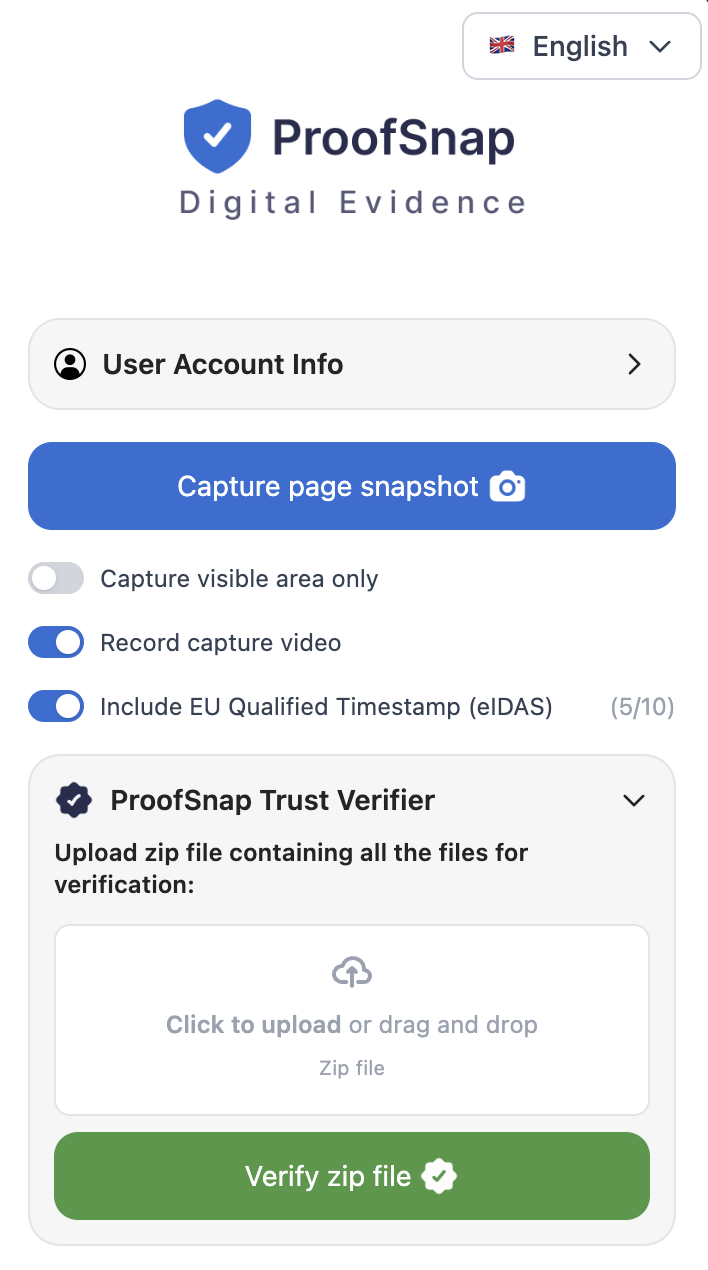
Anyone can verify it, including the other side. Drop the ZIP onto the public Trust Verifier and the hashes, the signature and the timestamp are checked in the browser. Nothing is uploaded and nothing depends on ProofSnap still existing.
Three ways to get the evidence
Prices are charged in USD. Approximate New Zealand figures are shown for orientation only, and your card issuer sets the actual rate.
One dispute
$4.99 once
about NZ$9
A SnapPack is a single up-front purchase for a set number of captures. No subscription, no auto-renewal, no trial. Best when you have one problem and you want it documented today.
Get a SnapPackOngoing matters
$8.99/month
about NZ$16
For anyone who captures regularly: practitioners, property managers, HR, investigators. The 7-day free trial requires a credit card. Cancel any time during the trial and you are not charged.
Start the 7-day trialWe do it for you
$44.99 per URL
about NZ$78
Send us the link and our team captures the package for you, with nothing to install. Useful when the capture should not come from a party to the dispute.
See the capture serviceProofSnap is not a law firm and does not give legal advice. Qualified timestamps are issued by Disig a.s., a Qualified Trust Service Provider on the EU Trusted List. New Zealand has no equivalent regime, so that timestamp is independent corroboration here rather than a legal presumption.
Official sources
Every figure and deadline on this page comes from the following primary sources. Check them yourself rather than taking our word for it.
- Employment New Zealand: personal grievances, the process, the deadlines and how to raise one.
- Employment Relations Act 2000, section 114, the statutory wording on raising a personal grievance.
- Employment New Zealand: 12 months for sexual harassment, the extended period and when it applies.
- Employment New Zealand: dismissal rules for high-income earners, the NZ$200,000 threshold, how income is calculated and the transition to 21 February 2027.
The standard is the balance of probabilities, not beyond reasonable doubt. That is a lower bar than most people expect, and it is usually cleared by documents rather than by argument, which is exactly why losing access to the documents hurts so much.
Questions people actually ask
90 days, and the first one is already gone
Capture what you can still reach today. The rest of the case can wait until tomorrow.