UDRP evidence is filed with the complaint. Capture the website before the respondent hears from you.
What to capture
UDRP complaint evidence
UDRP complaint evidence: capture the website before you file
A UDRP complainant must prove all three elements of paragraph 4(a) of the Policy, and WIPO's Overview 3.1, updated in February 2026, lists dated screenshots of the website as evidence for a bad-faith claim. ProofSnap captures that website, its rendered HTML and the domain's WHOIS record in one signed package before the respondent is alerted.
Written by Radim Motycka, Founder & Lead Engineer, ProofSnap, 10+ years in cryptographic protocol design ·
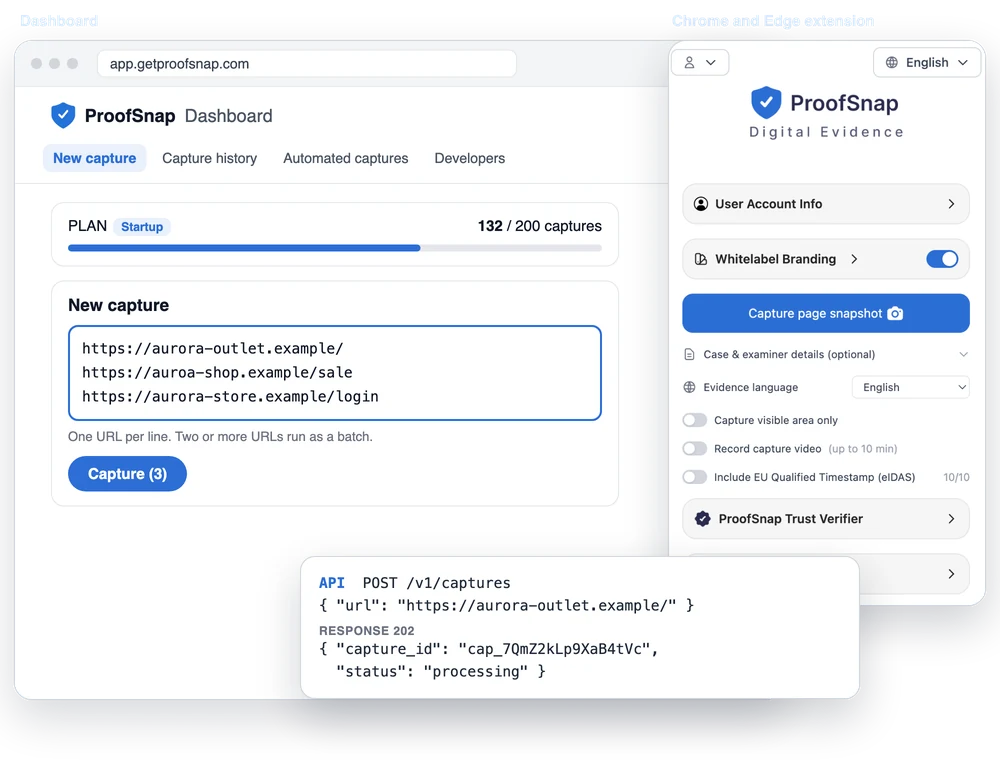
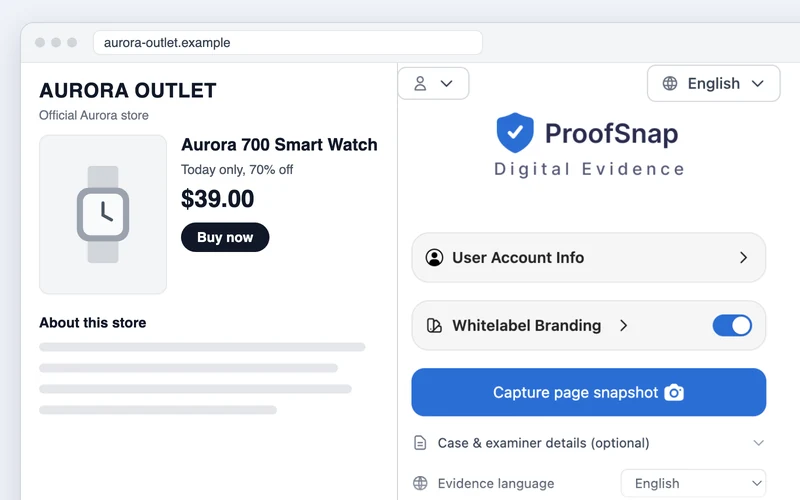
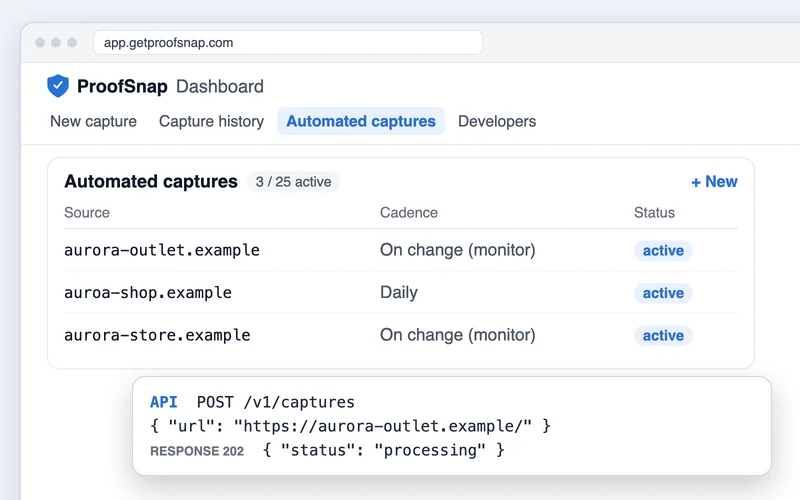
Use the browser extension for one complaint, or the dashboard and API for many domains, or for domains you want watched.
Still deciding? If the site needs your login, or does not load from our servers, use the extension. For public sites, try the domains you deal with in the dashboard sandbox first. The two run on separate accounts and plans, and you can use both.
6,282
domain name cases at WIPO in 2025, a record (WIPO)
The UDRP is the standard route for a domain name dispute over cybersquatting: registering in bad faith a domain name that imitates someone else's trademark. The Uniform Domain-Name Dispute-Resolution Policy, adopted by ICANN, requires every registrant of a domain name in a generic top-level domain to submit to a mandatory administrative proceeding. The complainant bears the burden of proof:
"In the administrative proceeding, the complainant must prove that each of these three elements are present."
The domain name is "identical or confusingly similar to a trademark or service mark in which the complainant has rights." The evidence is the trademark registration, or proof of acquired distinctiveness for an unregistered mark, plus a side-by-side comparison of the mark and the domain name. Proof of use online can be captured the same way as a trademark specimen.
2
No rights or legitimate interests
The respondent has "no rights or legitimate interests in respect of the domain name." The evidence is what the website actually does: captures showing no bona fide offering of goods or services.
3
Registered and used in bad faith
The domain name "has been registered and is being used in bad faith." The evidence consists of dated captures of pay-per-click links that trade on the mark, phishing or fake-shop pages, redirects to a competitor, and offers to sell the domain to the mark owner or a competitor, together with the creation date from the WHOIS record, which may predate the current registrant's acquisition.
What evidence a UDRP panel expects, and when
WIPO's Overview 3.1, the WIPO Center's summary of panel views on selected UDRP questions, describes the general evidentiary framework for bad faith in plain terms:
"complaints alleging [the types of bad-faith conduct described in the Policy] should be supported by arguments and available evidence such as dated screenshots of the website to which the disputed domain name resolves or correspondence between the parties. Even in cases of respondent default, panels have held that wholly unsupported conclusory allegations may not be sufficient to support a complainant's case."
There is no discovery, and in-person hearings are held only in exceptional cases. Paragraph 12 of the UDRP Rules reads: "In addition to the complaint and the response, the Panel may request, in its sole discretion, further statements or documents from either of the Parties." WIPO's Overview 3.1 adds that "unsolicited supplemental filings are generally discouraged, unless specifically requested by the panel." In practice, a UDRP complainant should capture the website before filing, because a later screenshot may not be admitted.
Overview 3.1 notes that where evidence is created with AI tools, "the credibility of such arguments/evidence may be impacted by the inclusion (e.g., in an annex) by the parties of specific prompts and their results." A ProofSnap capture is not generated by AI tools: it records the page in the browser, with the capture steps logged in chain_of_custody.json and forensic_log.json.
What to capture before you send a cease-and-desist letter or file the complaint
Once a respondent receives a letter or a complaint, the site can change or disappear. Capture these six things first, in this order:
1.The home page of the website at the disputed domain name, as a full-page capture showing the branding, the pay-per-click links or the page it redirects to. The capture records the final URL in the address bar.
2.Every subpage that uses the mark: product pages of a fake shop, a login form that imitates yours, a contact page with false company details.
3.A WHOIS or RDAP lookup page that shows whatever registrant details are public. ProofSnap also looks up the registration record of the captured domain automatically.
4.Marketplace listings offering the domain for sale on Sedo, Afternic or Dan.com, with the asking price.
5.Internet Archive snapshots that show earlier use, or the archive page that reports the site as excluded.
6.Other domains held by the same registrant that match your mark or other brands. A pattern of registrations that prevent mark owners from reflecting their marks in corresponding domain names is one of the circumstances the Policy lists as evidence of bad faith.
For a single-domain complaint, this list usually fits in the 10 captures of one SnapPack. Later correspondence with the respondent, such as a reply offering to sell the domain name, can be captured from your webmail with the thread open.
Each ProofSnap capture produces one ZIP with 11 files on Essential, 12 on Professional and 15 on Enterprise and Company, plus a verification folder. A capture of the website at the disputed domain name also records the RDAP record, including the registrar, creation date, expiry date, status and nameservers, and resolves the domain name through two independent DNS-over-HTTPS resolvers, Google and Cloudflare, flagging any disagreement. This is what the main files contribute to a UDRP complaint:
File
What it records
Use in the complaint
screenshot.jpeg
The full page as captured, with any layout changes listed in chain_of_custody.json
The visual annex for elements 2 and 3
page.html
The page as rendered, including meta tags and the parameters of outbound links
Brand keywords hidden in meta tags, affiliate tracking in links
metadata.json
URL, HTTP response headers, DNS resolution, and the WHOIS or RDAP record: registrar, creation and expiry dates, status, nameservers
Creation date compared with the date your rights in the mark arose, hosting details
evidence.pdf
A readable report of the capture, including the WHOIS section
A readable annex for the panel
chain_of_custody.json, forensic_log.json
The capture steps up to the sealing of the log, with the time checked against NTP servers
An answer to "how was this made?"
manifest.json, manifest.sig, publickey.pem
The SHA-256 hash of every file, signed with RSA-4096
Binds the file hashes together. Once the manifest carries a timestamp, a later change is detectable
manifest.json.ots
An OpenTimestamps anchor on the Bitcoin blockchain (Professional, Enterprise, Company and standalone SnapPack)
Once confirmed, shows the package existed no later than the anchoring block, so a package anchored before filing predates the complaint
manifest.json.tsr, eidas_validation.json
A qualified electronic timestamp from Disig a.s., a Qualified Trust Service Provider on the EU Trusted List (Enterprise, Company, eIDAS SnapPack)
A date that carries a legal presumption in EU courts
A UDRP panel weighs a qualified timestamp like any other evidence, because the UDRP Rules leave "the admissibility, relevance, materiality and weight of the evidence" to the panel.
If the same dispute reaches a court in an EU Member State, the stamp carries the eIDAS presumption of the accuracy of its date and time and of the integrity of the manifest it is bound to. Anyone can check the hashes with the bundled verify.sh and verify.ps1 scripts and the timestamps with the free Trust Verifier, whose code is open source under the MIT license.
How to cite a ProofSnap capture in a UDRP complaint
Four steps turn a ProofSnap capture into an annex a panel can check:
1. Capture before any contact
Capture every page of the website at the disputed domain name before you send a cease-and-desist letter or file the complaint, because the respondent can change the site once notice arrives.
2. Give each ZIP an annex number
Keep each evidence ZIP intact and give it an annex number: for example, Annex 5 for the website at the disputed domain name as captured on a given date.
3. Cite the date and the files that verify it
In the complaint, state the capture date and name the files that let the panel check it: manifest.json with the SHA-256 hash of every file, manifest.sig, and the timestamp proof.
4. Attach the report and the full package
Attach evidence.pdf as the readable annex and, where the provider's filing format allows, the complete ZIP, so that the hashes can be checked with the verification scripts and the timestamps with the Trust Verifier.
Sample UDRP complaint wording for the factual grounds
"As shown in Annex 5, on April 3, 2026, the website at <example-brand.com> displayed pay-per-click links referring to the Complainant's mark. The capture package lists in manifest.json the SHA-256 hash of each file, with the manifest's signature stored in manifest.sig, and carries an OpenTimestamps proof (manifest.json.ots) showing that the package existed no later than the Bitcoin block in which it is anchored."
"The rendered page HTML preserved in the same capture (page.html, Annex 5) contains a <meta name='keywords'> tag with the Complainant's registered mark, and its outbound links carry affiliate tracking parameters. Together, these show the Respondent's intent to attract Internet users for commercial gain by creating a likelihood of confusion with the Complainant's mark."
UDRP filing: where to file a complaint and what it costs
ICANN's list of approved providers names five UDRP providers: WIPO, Forum, the Czech Arbitration Court (CAC), ADNDRC and CIIDRC. The complainant picks one, files electronically and pays the provider's fee. Every provider applies the same Policy and Rules plus its own supplemental rules. Before filing, search WIPO's decision database for past UDRP cases with the same fact pattern; panels refer to earlier decisions on similar facts.
WIPO Arbitration and Mediation Center, Geneva
WIPO administered 6,282 domain name cases filed by trademark owners in 2025, 1.8% more than in 2024, making 2025 the busiest year since the service began, according to WIPO ADR Highlights 2025. Under its fee schedule, as checked in November 2026, WIPO charges USD 1,500 for 1 to 5 domain names before a single panelist and USD 4,000 before three panelists.
A UDRP provider that also administers disputes over .eu domains, which run under the separate .eu ADR procedure rather than the UDRP. EURid names CAC and WIPO as the two .eu ADR providers.
The Asian Domain Name Dispute Resolution Centre and the Canadian International Internet Dispute Resolution Centre complete ICANN's list.
CIIDRC also administers disputes over .ca domains, which run under CIRA's Domain Name Dispute Resolution Policy (CDRP) rather than the UDRP. The evidence point is the same: capture the site at the .ca domain before the registrant hears about the dispute.
The Policy limits the remedies available to a complainant: "The remedies available to a complainant pursuant to any proceeding before an Administrative Panel shall be limited to requiring the cancellation of your domain name or the transfer of your domain name registration to the complainant." A claim for damages requires a lawsuit.
How long a UDRP case takes
WIPO's Guide to the UDRP says: "If there are no procedural issues, the case normally should be completed within 2 months from the date WIPO receives the Complaint." The UDRP Rules set the steps inside that window:
1.The provider checks the complaint and notifies the respondent; that notification commences the proceeding.
2.The respondent has 20 days from commencement to submit a response, and may ask for four extra calendar days.
3.The provider appoints a single panelist within five calendar days after the response is received or the response deadline passes.
4.The panel forwards its decision to the provider within 14 days of its appointment, absent exceptional circumstances.
The provider sends the respondent the complaint at step 1, and a cease-and-desist letter may alert the respondent earlier, so capture the website before either.
eIDAS qualified timestamps within a monthly allowance
For brand protection teams and EU litigators
Subscriptions start with a 7-day free trial, credit card required. See all plans
No time to capture it yourself? Our web page capture service will capture the website at the disputed domain name for you, from $44.99, delivered within 48 hours.
Product 2: Dashboard and API
Dashboard and API plans for many domains
This product uses a separate account from the extension. Legal plans add matters, each with its own chain of custody and export. An eIDAS qualified timestamp is $1.99 per stamp. All plans and details.
Try it
Sandbox
$050 test captures
No card. Complete packages with a watermark, not for legal use.
A 77-second walkthrough of automated captures in the dashboard, with a sample account.
Questions IP professionals ask
What is a UDRP complaint?
A UDRP complaint is a written filing in which a trademark owner asks an ICANN-approved provider, such as WIPO, to have a panel order a domain name canceled or transferred to the complainant. The complainant must prove all three elements the Policy sets out, and in-person hearings are held only in exceptional cases.
What evidence do I need for a UDRP complaint?
You need proof of your trademark rights, a comparison of the mark with the domain name, and evidence for the second and third elements: dated screenshots of the website, the WHOIS or RDAP record, marketplace listings offering the domain for sale, and any correspondence with the respondent. WIPO's Overview 3.1 names dated screenshots and correspondence as the kind of evidence that should accompany a bad-faith claim. All of it is filed with the complaint.
Can I add evidence after filing a UDRP complaint?
The UDRP Rules let the panel request further statements or documents in its sole discretion, and WIPO's Overview 3.1 says unsolicited supplemental filings are generally discouraged unless specifically requested by the panel. Treat the complaint as your one filing and capture the website before you file it.
How much does a UDRP complaint cost at WIPO?
WIPO charges USD 1,500 for 1 to 5 domain names decided by a single panelist and USD 4,000 for 1 to 5 domain names before a three-member panel. Forum, the Czech Arbitration Court, ADNDRC and CIIDRC publish their own fee schedules, and attorney's fees are additional. A ProofSnap SnapPack with 10 captures costs $4.99.
How long does a UDRP case take?
WIPO says a case without procedural issues should normally be completed within two months of the date it receives the complaint. Under the UDRP Rules, the respondent has 20 days to respond, a single panelist is appointed within five calendar days after that, and the panel forwards its decision within 14 days of its appointment.
What if the respondent changes the website after I file?
A capture made before filing preserves what the site showed at that moment. With an OpenTimestamps proof confirmed in a Bitcoin block mined before filing, the package shows it existed before the complaint, whatever the site shows today.
Can I rely on the Wayback Machine instead?
Use it alongside your own captures, not instead of them. Panels may consult the Internet Archive themselves, but the archive may hold no copy from the period that matters, and a site can block archiving. In a ProofSnap study of 301 WIPO cases from 2025, the Wayback Machine held no successful homepage capture from the year before the complaint for 48% of disputed domains. If the archive reports the site as excluded, capture that page as well.
Does ProofSnap record the WHOIS data for the disputed domain name?
Yes. A capture of the website at the disputed domain name looks up its RDAP record, with raw WHOIS as the fallback, and writes the registrar, the creation and expiry dates, the status and the nameservers into metadata.json and evidence.pdf. Registrant details are often redacted in public records, so also capture any lookup page that shows them.
Does ProofSnap work for .eu and other ccTLD disputes?
Yes. ProofSnap captures any website that opens in Chrome or Edge, whatever the top-level domain. Disputes over .eu domains are decided not under the UDRP but under the separate .eu ADR procedure, which the Czech Arbitration Court and WIPO administer. WIPO also administers disputes for many country-code top-level domains (ccTLDs).
What remedies are available in a UDRP proceeding?
Only cancellation of the domain name or its transfer to the complainant. The Policy allows no other remedy, and a claim for damages requires a lawsuit.
What changed in WIPO Overview 3.1?
WIPO published Overview 3.1 on February 17, 2026, as a refinement of version 3.0. It clarifies the passive-holding test, the consolidation of disputes, and refiling, and it notes that the credibility of arguments or evidence created with AI tools may be affected by including the prompts and their results in an annex.
How do I file a UDRP complaint step by step?
Choose one of the five ICANN-approved providers, draft the complaint using the provider's model complaint, name the respondent and the registrar from the WHOIS record, attach your annexes, file online and pay the fee. The provider then asks the registrar to lock the domain. The lock freezes the registrant and registrar data but not the website: the domain name keeps resolving and the content can still change, so capture the site first.
What does a UDRP complaint cost at WIPO for 6 or more domain names?
WIPO charges USD 2,000 for 6 to 10 domain names before a single panelist and USD 5,000 before three panelists. For more than 10 domain names, the fee is decided in consultation with the WIPO Center.
What happens if the respondent does not respond?
The panel proceeds to a decision on the complaint, but a default is not an automatic win. WIPO's Overview 3.1 notes that even in cases of respondent default, wholly unsupported conclusory allegations may not be sufficient.
What happens after the panel orders a transfer?
Under the Policy, the registrar waits 10 business days after it is informed of the decision before implementing it. If the respondent sends the registrar official documentation within that period showing that the respondent has sued the complainant in a court of Mutual Jurisdiction, the registrar holds the transfer until the lawsuit is resolved or dismissed, or the court orders otherwise.
What is reverse domain name hijacking?
The UDRP Rules define it as using the Policy in bad faith to attempt to deprive a registered domain-name holder of a domain name. If the panel finds that a complaint was brought in bad faith, it declares in its decision that the complaint constitutes an abuse of the administrative proceeding.
What is cybersquatting, and how does the UDRP address it?
Cybersquatting means registering in bad faith a domain name that matches or imitates someone else's trademark, usually to profit from it. Under the UDRP, the trademark owner files a complaint with an approved provider such as WIPO, and a panel can order the domain name canceled or transferred without a court case.
Which tool should I use to capture evidence for a domain name dispute?
Choose a tool that records the page with its WHOIS data, hashes and signs the files, and adds a timestamp that can be checked without the vendor. ProofSnap does this with a browser extension for one complaint and with a dashboard and API for many domain names. The panel decides the weight of any evidence.
Blockchain engineer with 10+ years in cryptographic protocol design. Built the ProofSnap capture pipeline, including the RDAP and WHOIS lookup, the DNS cross-check, SHA-256 hashing, RSA-4096 signatures, OpenTimestamps anchoring and eIDAS qualified timestamps from Disig a.s., a Qualified Trust Service Provider on the EU Trusted List.
This guide was checked on November 6, 2026, against the UDRP Policy and Rules published by ICANN, WIPO's Overview 3.1, WIPO's fee schedule and WIPO ADR Highlights 2025.