Coco’s Law: report it, get support, and keep the evidence
Sharing an intimate image without consent is a crime in Ireland, and so is threatening to share one. You do not have to deal with it alone. Report it to An Garda Síochána and to Hotline.ie, and if you are in immediate danger call 999 or 112. Getting the content removed is the right goal, and removal is also the moment the record of what was posted disappears, so preserve a copy of the page first if you can do that safely.
Reporting to An Garda Síochána and to Hotline.ie is free. ProofSnap is the optional part: a browser tool that preserves the page, on Chrome and Edge.
unknown_acct_41
Posted 2 hours ago · public
Image posted without consent. Shown here only as a placeholder.
Removed 4 days later, and the account went with it.
Captured & sealed
SHA-256 · Bitcoin timestamp
Illustrative example. No real image, no real account.
Coco’s Law, the Harassment, Harmful Communications and Related Offences Act 2020, commenced in Ireland on 10 February 2021. Section 2 makes it an offence to share, or to threaten to share, an intimate image without consent, with intent to cause harm, punishable by up to seven years’ imprisonment and an unlimited fine.
Section 3 covers recording, distributing or publishing an intimate image without consent where the act seriously interferes with the person’s peace and privacy or causes alarm, distress or harm, with no need to prove any intent to cause harm. Section 3 is a summary offence, carrying a class A fine, capped at €5,000 by the Fines Act 2010, and up to 12 months’ imprisonment. Section 5 protects the identity of the alleged victim once a charge is brought.
Report it to An Garda Síochána and to Hotline.ie, which requests removal on your behalf without guaranteeing it. StopNCII.org can block matching uploads on participating platforms without the image ever leaving your device. None of those routes keeps a record of what was posted, and a successful removal takes the record with it. If the person in the image is under 18, do not copy or capture it at all: report it to An Garda Síochána and to Hotline.ie and let them handle the material.
That record is what ProofSnap preserves. It captures the page in under a minute and produces an evidence package of 11 to 15 files containing the full-page screenshot, the saved source, the URL, the capture time in UTC, a SHA-256 hash of every file, an RSA-4096 signature and an eIDAS qualified timestamp. Ireland applies eIDAS directly as an EU member state, so that timestamp carries the presumption in Article 41(2) of Regulation (EU) 910/2014 here, with none of the recognition steps a non-EU jurisdiction would require. From $4.99 (approx. €4.30) as a one-off purchase, with no subscription.
By Radim Motycka, Founder and Lead Engineer, ProofSnap · · Independently verifiable via the Trust Verifier
Where to report intimate image abuse in Ireland
Five routes, in the order most people use them. You can use more than one, and you do not need to decide between them today.
-
If you are in immediate danger, call 999 or 112
Emergency first, everything else after. Nothing on this page is more important than your safety.
-
Report it to An Garda Síochána
You can report at any Garda station. Sections 2 and 3 of the 2020 Act are criminal offences, so this is the route that can lead to a prosecution. Bring the URL, the account name, the dates and anything you have preserved.
-
Report it to Hotline.ie for removal
Hotline.ie is the national reporting centre for illegal online content, and its intimate image abuse service is open to people living in the Republic of Ireland. In its own words, it will “approach the online service provider on your behalf and request the removal of the intimate image or video”, and it states that “whilst we cannot guarantee removal of all images, we have exceptional partnerships” with providers. It asks for a URL or link and asks you not to send the imagery itself. In some cases it will also help you make a formal complaint by liaising with An Garda Síochána on your behalf.
-
Use StopNCII.org to block re-uploads
StopNCII.org turns an image on your own device into a digital fingerprint, called a hash. Participating platforms use that hash to detect and stop matching uploads. The image itself never leaves your device and is never sent to StopNCII.
-
Report it to the platform, and keep a copy of the page
Platform reporting is usually the fastest removal route. Since 21 July 2025, the video-sharing platform services designated by Coimisiún na Meán have had to meet Part B of Ireland’s Online Safety Code, which is enforceable with fines of up to €20 million or 10 per cent of turnover, whichever is higher. Removal, however it happens, takes the content down and takes the record with it, so preserve the page before you report if you can do so safely.
One warning that matters more than anything else here
If the image is of a person under 18, do not download, copy, forward or capture it, not even to preserve it. Report it to An Garda Síochána and to Hotline.ie and let them handle the material itself. Making or keeping a copy of that material is itself an offence and there is no exception for gathering evidence. ProofSnap is for the public page, the profile, the threatening message or the demand for payment, which is usually what proves the offence anyway.
What usually goes wrong
Why the record of the posting disappears
Three ordinary things happen after a report, and each of them ends with the evidence gone.
Removal erases the record
Removal is the outcome you asked for, and it takes the URL, the account and the surrounding page with it. If the live page was your only copy, a successful removal leaves you with nothing to show An Garda Síochána. Preserving the page first takes under a minute.
The person who posted deletes it first
People remove this material the moment they realise it has been reported, and accounts get deactivated. A copy preserved while the page was still live is not something they can undo.
A prosecution needs the posting itself
An Garda Síochána and the Director of Public Prosecutions work from evidence. The account, the wording, the timing and the platform are what establish the offence, and they live on the page rather than in a cropped phone screenshot.
What the 2020 Act actually covers
The Act created two distinct image offences plus an anonymity protection. Which of the two applies changes what is worth preserving.
| Section 2 | Section 3 | |
|---|---|---|
| Conduct | Distributing, publishing, or threatening to distribute or publish an intimate image without consent | Recording, distributing or publishing an intimate image without consent |
| Mental element | Intent to cause harm, or recklessness as to whether harm is caused | None required. It is enough that the act seriously interferes with peace and privacy or causes alarm, distress or harm |
| Threats covered | Yes, a threat alone is the offence | No |
| Maximum penalty | Summary: class A fine and/or 12 months. On indictment: an unlimited fine and/or seven years | Summary only: a class A fine, capped at €5,000 by the Fines Act 2010, and/or 12 months |
“A person who distributes, publishes or threatens to distribute or publish an intimate image of another person (a) without that other person’s consent, and (b) with intent to cause harm to, or being reckless as to whether or not harm is caused to, the other person, is guilty of an offence.”
Section 2(1), Harassment, Harmful Communications and Related Offences Act 2020 (Number 32 of 2020)
Anonymity for the alleged victim
Under section 5 of the 2020 Act, once a person is charged with a section 2 or section 3 offence, it is itself an offence to publish or broadcast anything likely to identify the alleged victim. The section sets no end date. A judge may allow publication where the interests of justice require it, after taking the alleged victim’s views into account.
A threat on its own is enough
Section 2 reaches a threat to distribute or publish, not only the act itself. That is what brings sextortion within it, because the demand for payment arrives before anything is posted and the threat message is often all the evidence there is. Hotline.ie received more than 400 reports of threats to share intimate images between September 2021 and December 2023, including 366 cases of sexual extortion, according to the Department of Justice operational review published in September 2024.
Deepfakes: partly, and it depends on the image
Section 1 defines an intimate image as a visual representation of what is, or purports to be, the person’s genitals, buttocks or anal region and, in the case of a female, her breasts. A synthetic image presented as being of you can fall within that part of the definition. The nudity and sexual activity parts of the same definition do not carry the words “purports to be”, and the Department of Justice operational review published in September 2024 reported no prosecution of a deepfake case. Preserve the posting and any claim that the image is you, and let An Garda Síochána assess it.
Two years for a summary prosecution
Section 7 of the 2020 Act allows summary proceedings to be brought within two years of the date the offence was committed, rather than the usual six months. That is a longer window than most people expect, and it is also two years in which the original posting will almost certainly have been deleted. What survives the two years is whatever was preserved on the day.
People do use this route, and it is getting busier
The Department of Justice published an operational review of the Act in September 2024. It recorded that the Director of Public Prosecutions had taken 99 cases under sections 2, 3 or 4 between commencement and the end of 2023, and that charges brought by An Garda Síochána rose from 22 in 2021 to 95 in 2022 and 113 in 2023. The same review found that of 1,006 images and videos shared without consent on publicly accessible web locations and reported to Hotline.ie between September 2021 and December 2023, 92 per cent were removed. Awareness has risen too: independent research cited in the review found that the proportion of people who knew it was against the law to share an intimate image without consent rose from 69 per cent in August 2021 to 97 per cent in November 2023.
How do I preserve the posting before it is removed?
No forensic training required. The proof is in the package, not in your testimony about how careful you were.
Open the page and start the capture
Open the posting, the profile and any messages in Chrome or Edge and start the capture from the ProofSnap side panel. The whole page is captured, with the URL and the account recorded in the metadata.
The package is sealed automatically
Every file is hashed with SHA-256, the manifest is signed, and the manifest hash carries an eIDAS qualified timestamp plus a Bitcoin blockchain anchor. The capture time is recorded in UTC, independent of your device clock.
Then report it, and keep the ZIP
Report to An Garda Síochána and to Hotline.ie, and keep the ZIP somewhere safe. If a prosecution follows, the record is already in a form anyone can verify, including the defence.
What is in a Coco’s Law evidence package?
Between 11 and 15 files, depending on your plan, delivered as one ZIP that anyone can check without installing anything.
Full-page screenshot
The whole page, not just the visible window, stitched and hashed.
Saved page source
The document as rendered at capture time, including the head, meta tags and structured data.
Extracted page text
Searchable plain text, so a quote can be found and cited without retyping.
Technical metadata
URL, page title, HTTP response headers, browser, operating system and the capture time in UTC.
Signed manifest
SHA-256 for every file, signed with an RSA-4096 key whose public key ships in the package.
Blockchain timestamp
The manifest hash anchored to Bitcoin via OpenTimestamps, so the capture time cannot be backdated.
Chain of custody and forensic log
A record of what happened during the capture, in the order it happened.
Evidence report as PDF
A readable summary you can attach to an application, a notice or a report.
Verification instructions
Written steps plus scripts, so the other side can re-check the hashes offline.
What that adds up to
Each package is listed file by file, every one with its own SHA-256 hash inside a manifest. That manifest is signed with an RSA-4096 key, timestamped by a Qualified Trust Service Provider on the EU Trusted List and anchored to the Bitcoin blockchain through OpenTimestamps.
Every file above comes from a single capture started in the side panel. You do not have to keep the material in a loose folder yourself, and you do not have to look at it again to prove where it was and when.
Preserve the posting, the account and any reposts before you report, because a successful report ends with all of it removed. Never make a copy of material involving anyone under 18.
Want to see what the package looks like before you install anything? Download a sample evidence package and open it yourself.
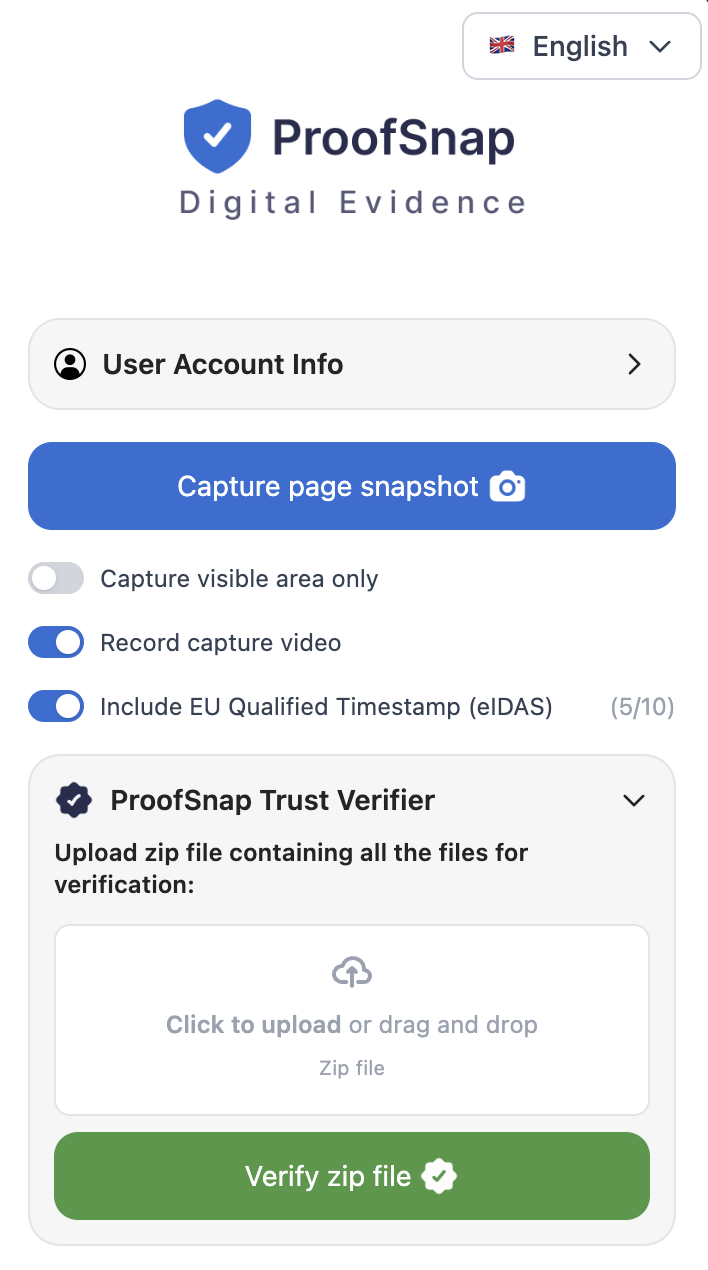
Anyone can verify it, including the other side. Drop the ZIP onto the public Trust Verifier, and the hashes, the signature and the timestamp are all checked in the browser. Nothing is uploaded and nothing depends on ProofSnap still existing.
Three ways to get the evidence
Prices are charged in USD. The approximate euro figures are a rough guide only, and your card issuer sets the actual rate.
One incident
$4.99 once
approx. €4.30
A SnapPack is a single up-front purchase for a set number of captures. No subscription, no auto-renewal, no trial. Best when you have one situation to deal with and you want it documented.
Get a SnapPackOngoing matters
$8.99/month
approx. €7.80
For anyone who captures regularly: solicitors, property managers, HR teams and investigators. The 7-day free trial requires a credit card. Cancel any time during the trial and you are not charged.
Start the 7-day trialWe do it for you
$44.99 per URL
approx. €39
Send us the link and our team captures the page and builds the package for you, with nothing to install. Useful when the capture should not come from someone involved in the matter.
See the capture serviceProofSnap is not a law firm and does not provide legal advice. Ireland applies Regulation (EU) 910/2014 directly as an EU member state, so in an Irish court a qualified timestamp carries the Article 41(2) presumption of the accuracy of the date and time it indicates and of the integrity of the data, with no separate recognition step.
Official sources
Every figure, offence and deadline on this page comes from the following primary sources. Check them yourself rather than taking our word for it.
- Harassment, Harmful Communications and Related Offences Act 2020 the Act itself, including the offences and the penalties.
- Hotline.ie: intimate image abuse the national reporting centre, and its own account of what its intimate image abuse service does.
- StopNCII.org hash-based blocking of matching uploads on participating platforms, with the image never leaving your device.
- Coimisiún na Meán: Online Safety Code Ireland’s Online Safety Code, with Part B applying to designated video-sharing platform services from 21 July 2025.
- Department of Justice: intimate image abuse the official summary of the law and the support available.
- An Garda Síochána: what to do if non-consensual intimate images are shared the official guidance on the criminal reporting route.
- Department of Justice: operational review of the 2020 Act every prosecution, charge, Hotline.ie and awareness figure quoted on this page, published September 2024.
If the same account is also defaming you, the one-year defamation clock in Ireland runs in parallel and both claims can rely on the same capture. Preserve the page before you block the account or delete the conversation, because blocking can cut off your own access to the history.
Questions people ask
Removal is the goal. Losing the record is not.
Preserve the page while it is still there, then report it. The record outlives the removal.