Six months to bring it. Your access disappeared on day one.
A claim to the Workplace Relations Commission must normally be lodged within six months of the dismissal. An adjudication officer can allow up to twelve months, but only where satisfied that reasonable cause prevented you from lodging in time, and that test is applied strictly. In that first week the work email is switched off, the rostering system stops loading and somebody quietly removes you from the team chat.
Works on Chrome and Edge. From $4.99 (approx. €4.30) as a one-off, or a 7-day trial that requires a credit card.
Roster · week of 6 July
Captured 12 July 2026, 21:40 UTC, two days before the dismissal.
Access denied
This account has been disabled. Contact your administrator.
Captured & sealed
SHA-256 · Bitcoin timestamp
Illustrative example. Fictional roster, fictional employer.
An unfair dismissal claim in Ireland must reach the Workplace Relations Commission within six months of the dismissal, extendable to twelve only where reasonable cause is shown. The employer, not you, must prove the dismissal was fair. ProofSnap captures the chats, rosters and emails that prove your side, sealing each one as a hashed, eIDAS-timestamped evidence package, before your work access is switched off.
The evidence that decides these cases is ordinary: the team chat, the roster changes, the performance emails, the message sent late at night, the social post about your replacement. ProofSnap captures each of those as a package containing the full page, the saved source, the URL, the UTC capture time, a SHA-256 hash of every file, an RSA-4096 signature and an eIDAS qualified timestamp. Documents have to be with the adjudication officer, and copied to the other side, at least 15 working days before the hearing, and since Zalewski v Adjudication Officer [2021] IESC 24 those hearings are held in public and the decisions name the parties. It works the same way for employers defending a claim. From $4.99 (approx. €4.30) as a one-off.
By Radim Motycka, Founder and Lead Engineer, ProofSnap · · Independently verifiable via Trust Verifier
What disappears in the first week
Losing the job and losing the evidence happen on the same afternoon
The systems holding your proof belong to the employer, and the clock starts the moment you walk out.
Accounts are usually switched off the same day
Work email, the intranet, the rostering system and the HR portal usually stop working the same day. Anything you meant to save later is behind a door you cannot open, and you cannot compel access before you have even lodged a claim.
Somebody removes you from the group
The team chat where the roster was changed, the shift was refused or the comment was made is often the strongest evidence in the file. Removal from the group can take the history with it, and messages deleted for everyone leave nothing behind.
Six months, and it is applied strictly
An extension to twelve months needs reasonable cause, and an adjudication officer does not grant it as a matter of course. Time spent hunting for evidence you no longer have comes straight out of the time you have left.
The deadlines and how they are applied
These are the fixed points. They decide whether your claim is heard at all, which comes before any argument about whether it succeeds.
Six months from the dismissal
Under section 8(2)(a) of the Unfair Dismissals Act 1977, the claim must be initiated by notice in writing to the Director General within the period of six months beginning on the date of the dismissal. That is the default and it is the date you should work to.
Twelve months, for reasonable cause only
Section 8(2)(b) lets an adjudication officer accept a claim up to twelve months from the date of dismissal, but only where he or she is satisfied that lodging within the six months "was prevented due to reasonable cause". In 2015 the standard was lowered from "exceptional circumstances", but an extension is still not granted as a matter of course.
Out of time means not heard
An adjudication officer has no discretion to hear a claim that is out of time where reasonable cause is not shown. That is why the deadline is worth more attention than the merits in the first fortnight.
Employers are in the same position
If you are defending a claim, preserve the record before the employee accounts are deprovisioned and before anyone clears out a channel. A record made at the time of the decision is worth considerably more than one assembled after the complaint arrives.
Fifteen working days before the hearing
The WRC’s published procedures require documentary evidence to be submitted "no later than 15 working days before the scheduled date of the hearing", with a copy to the other party. The WRC puts the consequence plainly: "It is entirely a matter for the Adjudication Officer whether to allow any evidence to be submitted within 15 working days of the date of the hearing." Treat that date as the real deadline.
The hearing is public and the decision names you
Following the Supreme Court decision in Zalewski v Adjudication Officer [2021] IESC 24 and the Workplace Relations (Miscellaneous Provisions) Act 2021, WRC hearings involving the administration of justice are conducted in public, evidence may be taken on oath or affirmation, and published decisions name the parties. An adjudication officer can order a private hearing or an anonymised decision where "special circumstances" exist, for example a protected disclosure or a sensitive medical matter, but concern about reputation alone is not enough. Expect to be named.
The queue is getting longer, not shorter. The Workplace Relations Commission received 10,559 complaint applications covering 19,068 individual complaints in 2025, a 44 per cent rise in applications on the year before, of which 2,435 were referred under section 8 of the Unfair Dismissals Act 1977 (Workplace Relations Commission, Annual Report 2025). Months pass between lodging a claim and being heard, and in that time nobody is preserving the employer’s systems for you.
Capture this in your first hour, in this order
The order below runs from what vanishes fastest to what usually survives longest, so work your way down it rather than starting with whatever feels most important.
- The team chat and any direct messages with your manager, because removal from a group can take the history with it.
- The rostering or scheduling system, including the weeks before and after the change you are complaining about.
- Anything still open in a browser tab from the work account, before the session expires.
- The performance record and the warning emails, while you can still reach the mailbox.
- The written policy or handbook page as it stands today, since the employer will rely on its own version of it.
- Any public post about the role or about your replacement. These tend to appear within days.
Do not delete or edit anything, and do not access systems you have been told you may no longer use. Capture what you can lawfully see, and let your solicitor or trade union deal with the rest.
Who can claim, and what the WRC can award
Two gates decide whether an unfair dismissal claim gets anywhere: whether you have the service, and whether the employer can justify what it did. Only the second one is about evidence, and it is the one the employer has to win.
Normally one year’s continuous service
Section 2(1)(a) of the Unfair Dismissals Act 1977 puts an ordinary unfair dismissal claim out of reach for an employee who, at the date of dismissal, "had less than one year’s continuous service with the employer". It is one of the most common reasons a claim fails before anyone looks at the facts.
Where no service at all is required
The service requirement falls away where the dismissal is for trade union membership or activity (section 14, Unfair Dismissals (Amendment) Act 1993), for pregnancy, maternity, adoptive, paternity or parent’s leave and related matters (section 6(2A) of the 1977 Act), for parental, carer’s, medical care or domestic violence leave or a flexible working request (sections 6(2B) and 6(2C)), or for making a protected disclosure (section 6(2D)). A discriminatory dismissal under the Employment Equality Acts is a separate route with no service threshold of its own. One catch in the trade union route: section 14 also disapplies section 6(6), so in that case the employee has to prove the reason instead of the employer having to disprove it, which makes the contemporaneous record decisive.
The employer has to justify the dismissal
Two provisions do the work, and they are routinely confused. Section 6(1) of the Unfair Dismissals Act 1977 creates the presumption: a dismissal "shall be deemed, for the purposes of this Act, to be an unfair dismissal unless, having regard to all the circumstances, there were substantial grounds justifying the dismissal". Section 6(6) is the one that places the onus: "it shall be for the employer to show" that the dismissal resulted from one of the permitted grounds or from other substantial grounds. The employer arrives having to prove its case, and it proves it with contemporaneous documents. Your answer to it is built the same way.
Reinstatement, re-engagement or compensation
Section 7 of the Unfair Dismissals Act 1977 gives an adjudication officer three remedies. Compensation is the usual one. It is tied to actual financial loss, and you are expected to mitigate that loss by looking for other work. The figures below are ceilings, not going rates.
| Remedy or ceiling | What it means | Provision |
|---|---|---|
| Reinstatement | Your old job back, treated as though you had never been dismissed, including arrears. | s. 7(1)(a) |
| Re-engagement | Back to work on terms the adjudication officer sets, from a date he or she fixes. | s. 7(1)(b) |
| Compensation, financial loss | Up to 104 weeks of remuneration, which is two years’ pay, where you suffered loss attributable to the dismissal. | s. 7(1)(c)(i) |
| Compensation, no financial loss | Up to 4 weeks of remuneration where the dismissal was unfair but cost you nothing. | s. 7(1)(c)(ii) |
| Protected disclosure dismissal | Up to 260 weeks of remuneration, five years’ pay, where the dismissal was wholly or mainly for making a protected disclosure. | s. 7(1)(c), as amended |
"A claim for redress under this Act shall be initiated by giving a notice in writing ... to the Director General (a) within the period of 6 months beginning on the date of the relevant dismissal, or (b) within such period not exceeding 12 months from the date of the relevant dismissal as the adjudication officer considers appropriate, in circumstances where the adjudication officer is satisfied that the giving of the notice within the period referred to in paragraph (a) was prevented due to reasonable cause."
Which provision actually governs your deadline
Two different sections are commonly quoted, and they are not interchangeable. For most employment complaints the WRC hears, the governing provision is section 41(6) of the Workplace Relations Act 2015, under which an adjudication officer "shall not entertain a complaint ... presented to the Director General after the expiration of the period of 6 months beginning on the date of the contravention to which the complaint relates", with the extension in section 41(8) available "if he or she is satisfied that the failure to present the complaint ... within that period was due to reasonable cause".
A claim under the Unfair Dismissals Acts does not fall under that section at all. Section 41 applies only to the enactments listed in Schedule 5 to the Workplace Relations Act 2015, and the Unfair Dismissals Act 1977 is not one of them. Unfair dismissal is referred under section 8(1) of the 1977 Act, and its time limit is set by section 8(2), quoted above: six months from the date of the dismissal, twelve months at the outer limit. The test in both regimes is reasonable cause, which replaced the older "exceptional circumstances" wording on 1 October 2015. The practical difference is the start date, since the date of dismissal and the date of a contravention are not always the same day, and under the 1977 Act the date of dismissal is the date the notice expires rather than the day it was handed to you.
What actually changed in 2026, and what did not
Coverage of employment law reports announcements as though they were already law, and a Bill or an EU directive is not a right you can enforce at the WRC. Here is where things actually stand.
In force. The Employment (Contractual Retirement Ages) Act 2025 commenced in full on 29 June 2026 (S.I. No. 247 of 2026), alongside the WRC’s revised Code of Practice on Longer Working (S.I. No. 246 of 2026). Where your contractual retirement age is below pensionable age, you may notify your employer in writing that you do not consent to retire at it, no less than three months and no more than a year beforehand. The employer then cannot enforce that age unless retiring you at it is objectively and reasonably justified by a legitimate aim, and it must give a reasoned written reply within one month. Redress is at the WRC, up to the greater of 104 weeks of remuneration or €40,000, and the anti-penalisation protection expressly covers dismissal within the meaning of the Unfair Dismissals Acts. The notification and the reply are the whole file. Capture both.
Enacted but never commenced. The clearest illustration sits in the Workplace Relations Act 2015 itself. Sections 65 to 70, which dissolve the Employment Appeals Tribunal and move its remaining functions to the Labour Court, were passed in 2015 and still await a commencement order eleven years later. Being in an Act is not the same as being in force, and nothing obliges the Minister to ever flip the switch.
Not law, whatever you have read. The EU Pay Transparency Directive, Directive (EU) 2023/970, fell due for transposition on 7 June 2026 and Ireland has transposed nothing. There is no new WRC route: a pay complaint still runs under the Employment Equality Acts 1998 to 2021 or the Gender Pay Gap Information Act 2021. The Platform Work Directive (EU) 2024/2831 is not due until 2 December 2026, whatever the commentary claiming 31 July says. And the Unfair Dismissals (Increased Protections for Workers) (Amendment) Bill 2023, which would scrap the one year service requirement and stretch the limit to nine months, is a Private Member’s Bill that has not moved past Second Stage. Plan around the law as it is.
How do I capture work messages before my access is cut?
No forensic training required. The proof is in the package, not in your testimony about how careful you were.
Capture what is still open
Anything visible in your browser can be captured, including web versions of messaging services and any work systems you are still signed in to. The whole page is saved, not just the visible window.
Each capture carries its own proof
SHA-256 hashes, an RSA-4096 signature over the manifest, an eIDAS qualified timestamp and a Bitcoin blockchain anchor, so the capture time is independent of your computer and cannot be moved.
Lodge within the six months
Lodge the Workplace Relations Complaint Form through the WRC’s online complaint service within the period and keep the ZIP. There is no fee to lodge a complaint. If the matter goes to adjudication, the record is already in a form the other side can verify.
What is in a WRC evidence package?
A ProofSnap evidence package contains between 11 and 15 files depending on the plan, delivered as one ZIP that anyone can check without installing anything.
Full-page screenshot
The whole page, not just the visible window, stitched and hashed.
Saved page source
The document as rendered at capture time, including the head, meta tags and structured data.
Extracted page text
Searchable plain text, so a quote can be found and cited without retyping.
Technical metadata
URL, page title, HTTP response headers, browser, operating system and the capture time in UTC.
Signed manifest
SHA-256 for every file, signed with an RSA-4096 key whose public key ships in the package.
Blockchain timestamp
The manifest hash anchored to Bitcoin via OpenTimestamps, so the capture time cannot be backdated.
Chain of custody and forensic log
A record of what happened during the capture, in the order it happened.
Evidence report as PDF
A readable summary you can attach to an application, a notice or a report.
Verification instructions
Written steps plus scripts, so the other side can re-check the hashes offline.
Where all of that comes from
Every file above is produced by a single click in the side panel, while your login still works. Rosters, payslips, the warning email, the team chat you were removed from: each one takes about as long as reading it does.
Six months sounds generous until you realise your access is gone on day one, so the useful order is capture first and decide later whether any of it matters.
Want to see what comes out before you install anything? Download a sample evidence package and open it yourself.
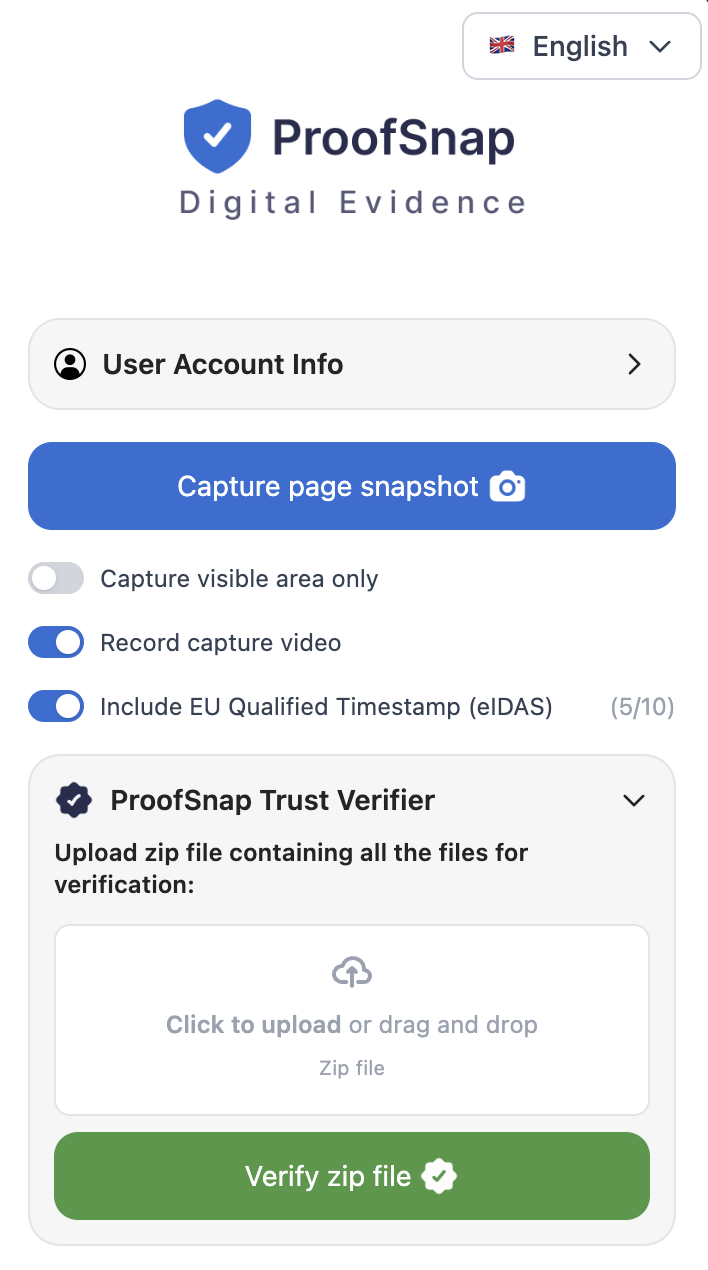
Anyone can verify it, including the other side. Drop the ZIP onto the public Trust Verifier and the hashes, the signature and the timestamp are checked in the browser. Nothing is uploaded and nothing depends on ProofSnap still existing.
Why a qualified timestamp is worth having in an Irish employment file
Irish law does not treat an electronic record as second class. Section 22 of the Electronic Commerce Act 2000 provides that "in any legal proceedings, nothing in the application of the rules of evidence shall apply so as to deny the admissibility in evidence of an electronic communication, an electronic form of a document, an electronic contract, or writing in electronic form ... on the sole ground that it is an electronic communication". That extends to the WRC, because section 2(1) of the same Act defines "legal proceedings" to include "proceedings before a court, tribunal, appellate body of competent jurisdiction or any other body or individual charged with determining legal rights or obligations", which is exactly what an adjudication officer does. The fight is therefore almost never about admissibility.
It is about weight instead, and specifically about two questions. Is the thing you produced actually what it claims to be? And did it exist on the day you say it did? A plain screenshot answers neither, because it carries nothing that anyone else can check.
That is the gap a qualified electronic timestamp closes. Ireland is a member state of the European Union, so Regulation (EU) 910/2014, eIDAS, applies here directly, with no recognition or retained-law step of the kind a non-member state needs. Article 41(2) provides that "a qualified electronic time stamp shall enjoy the presumption of the accuracy of the date and the time it indicates and the integrity of the data to which the date and time are bound". ProofSnap obtains those timestamps from Disig a.s., a Qualified Trust Service Provider on the EU Trusted List.
It is worth being precise about where that presumption operates. The Workplace Relations Commission is not a court. Following Zalewski it administers justice under Article 37 of the Constitution, and it is not bound by the strict rules of evidence in any case, so a qualified timestamp is rarely the difference between a document being admitted and one being excluded. Its real work before an adjudication officer is evidential weight: it puts the burden on the other side to challenge the date, the time and the integrity of the file, which is what actually matters when a respondent suggests something was written after the event.
The route out of the WRC matters here too. An unfair dismissal claim runs from the WRC to the Labour Court on appeal and to the High Court on a point of law only, with enforcement in the District Court under section 43 of the Workplace Relations Act 2015. In those courts the Article 41(2) presumption operates in the ordinary way, as directly applicable EU law.
Three ways to get the evidence
Prices are charged in USD. Approximate euro figures are shown as a rough guide only, and your card issuer sets the actual rate.
One dispute
$4.99 once
approx. €4.30
A SnapPack is a single up-front purchase for a set number of captures, and those captures do not expire. No subscription, no auto-renewal, no trial. Best when you have one problem and you want it documented today.
Get a SnapPackOngoing matters
$8.99/month
approx. €7.80
For anyone who captures regularly: practitioners, property managers, HR, investigators. The 7-day free trial requires a credit card. Cancel at any time during the trial and you are not charged.
Start the 7-day trialWe do it for you
$44.99 per URL
approx. €39
Send us the link and our team will capture the package for you, with nothing to install. Useful when the capture should not come from a party to the dispute.
See the capture serviceProofSnap is not a law firm and does not give legal advice. Qualified timestamps are issued by Disig a.s., a Qualified Trust Service Provider on the EU Trusted List. Ireland applies eIDAS directly as an EU member state, so Article 41 of Regulation (EU) 910/2014 needs no retained-law argument here. Before a WRC adjudication officer that timestamp goes to the weight of your evidence; the Article 41(2) presumption is applied in the ordinary way once a matter reaches a court.
Official sources
Every figure and deadline on this page comes from the following primary sources. Check them yourself rather than taking our word for it.
- Workplace Relations Commission: how to make a complaint and how adjudication works.
- Citizens Information on unfair dismissal: the plain-language summary of your rights and the time limits.
- WRC procedures in the adjudication of complaints: the 15-working-day rule for documentary evidence and the conduct of public hearings.
- Unfair Dismissals Act 1977: the founding statute, as amended through to 2015.
- Unfair Dismissals Act 1977, revised text (Law Reform Commission): the consolidated wording of sections 2(1)(a), 6(1), 6(6), 7 and 8(2) quoted above.
- Workplace Relations Act 2015: sections 41(6) and 41(8), the general six-month limit and the reasonable cause extension for WRC complaints.
- Electronic Commerce Act 2000, section 22: the admissibility of electronic records in Irish legal proceedings.
- Regulation (EU) 910/2014 (eIDAS), consolidated: Article 41 on the legal effect of qualified electronic time stamps, directly applicable in Ireland.
If the conduct also involved intimate images or threats, see the guide to reporting under Coco’s Law, which runs on a criminal track and a takedown track at the same time.
The standard of proof is the balance of probabilities, and section 6(6) of the Unfair Dismissals Act 1977 puts the onus on the employer to show why the dismissal happened. Two things reverse that: a constructive dismissal, where you have to prove you were entitled to resign, and a short-service trade union case, where section 14 of the 1993 Act lifts the employer’s burden. In either case the record decides it, and none of it helps if the messages proving what actually happened have been deleted, which is why the first hour matters more than the sixth month.
Questions people actually ask
Six months, and the first week is the one that matters
Capture what you can still reach today. The rest of the case can wait until tomorrow.