The adjudicator works from what you filed.
Most Irish tenancy disputes are decided by the Residential Tenancies Board rather than by a court. Both sides submit evidence in advance. The adjudicator decides the dispute on that evidence, the RTB issues a legally binding determination order, and most hearings are held remotely by video. Evidence has to reach the RTB at least five working days before the hearing, and if you disagree with the outcome you have ten working days to appeal to the Tenancy Tribunal, which rehears the case in full.
Works on Chrome and Edge. From $4.99 (approx. €4.30) as a one-off, or a 7-day trial that requires a credit card.
Phone screenshot
- Page address
- not recorded
- Time captured
- not recorded
- Deposit claimed
- €1,450
- File hash
- none
- Checked by
- your word
ProofSnap package
- Page address
- rental-listing/4821
- Time captured
- 03:12:47 UTC
- Deposit claimed
- €1,450
- File hash
- a1f3…9c2
- Checked by
- anyone, offline
Anchored to the Bitcoin blockchain, so the capture time cannot be moved.
Illustrative example. Both files can be submitted. Only one of them can be checked.
In Ireland the Residential Tenancies Board, not the courts, decides most tenancy disputes under the Residential Tenancies Act 2004, and it decides them on evidence filed in advance. The RTB requires your evidence at least five working days before the hearing. ProofSnap captures the listing, notice or message thread as a hashed, eIDAS-timestamped package.
By volume the most common applications in 2024 were rent arrears and overholding (27 per cent), deposit retention (19 per cent), breach of landlord obligations (18 per cent) and the validity of a notice of termination (17 per cent), according to the RTB Annual Report and Accounts 2024, published by the RTB in 2025.
A party who disagrees has ten working days from receiving the adjudication report to appeal to the Tenancy Tribunal, which rehears the case in full, and either side may put in extra evidence before that hearing. Because the file is built before anyone speaks, the quality of what you preserved decides most of it. A ProofSnap evidence package is not a folder of screenshots: it is between 11 and 15 files depending on the plan, every one of them carrying its own SHA-256 hash, sealed together by an RSA-4096 signature and an eIDAS qualified timestamp issued by a Qualified Trust Service Provider on the EU Trusted List, and the whole package can be re-checked offline by the other side without installing anything. From $4.99 (approx. €4.30) as a one-off.
By Radim Motycka, Founder and Lead Engineer, ProofSnap · · Independently verifiable via the Trust Verifier
How these disputes actually run
The listing changes, and then the hearing arrives
Applications are heard weeks or months after the thing that caused them. By then the advertisement has been pulled and the thread has been tidied.
The listing no longer says what it said
Rental advertisements are edited constantly: heating, parking, furnishings, what is included in the rent. When the listing that made you sign is gone, you are describing it from memory while the other side describes it differently.
The repair thread gets tidied up
Agents change and portals archive old threads. The repair you chased four times becomes a repair nobody remembers being asked to carry out, and an undocumented request is indistinguishable from one that never happened.
A notice of termination lives or dies on its detail
The validity of a notice of termination was cited in 1,649 RTB applications in 2024, 17 per cent of all applications, according to the RTB Annual Report and Accounts 2024, published by the RTB in 2025. Dates, grounds, service and the wording all matter, and since 28 February 2026, when section 62(1A) of the Residential Tenancies Act 2004 was commenced by S.I. No. 67 of 2026, a landlord's notice is invalid unless a copy is served on the RTB on the same day it is served on the tenant. The notice and the covering message are exactly the documents people fail to preserve.
Adjudication, Tenancy Tribunal and the deadlines between them
Adjudication first, tribunal on appeal, and a determination order that binds. The timelines are short at the points that matter.
This is a busy system, not a rare one. The Residential Tenancies Board received 9,564 applications for dispute resolution in 2024 and held 5,290 mediation and adjudication hearings that year, up 34 per cent on 2023, plus 1,302 Tenancy Tribunal hearings, up 74 per cent, according to the RTB Director's Quarterly Update published by the RTB in 2025.
Evidence filed in advance
Each party submits its evidence before the hearing and the adjudicator reviews it. "Most hearings are held remotely by video call," the RTB says, so unlike in a purely paper process you can speak, but you will be speaking about a file that was already built.
A binding determination order
The RTB issues a determination order embodying the adjudicator's determination, and under section 123(1) of the Residential Tenancies Act 2004 it binds the parties from the moment it is issued to them. Enforcement, if it comes to that, is a separate step through the courts.
Ten working days to appeal
A party has ten working days from receiving the adjudication report to appeal to the Tenancy Tribunal, which rehears the case in full rather than reviewing the first decision. The RTB states in its guide to adjudication that it typically issues the determination order about two weeks after the appeal period ends. That is a short window and it starts running immediately.
Five working days to file your evidence
"You must send all evidence at least 5 working days before the hearing," says the RTB in its own guide to evidence. It can go through the RTB portal, by email or by post, and everything you upload is added to a case file shared with the adjudicator and the other party. Late material is not automatically excluded, but under the RTB's own section 109 procedural rules it is circulated on a best-endeavours basis and it is then at the adjudicator's or the Tenancy Tribunal's discretion whether to admit it. Do not rely on that discretion.
A note for landlords and letting agents
This cuts both ways. A landlord claiming against a deposit has to evidence the condition of the property at the start and at the end of the tenancy, and a notice of termination has to be valid on its face. Capture the listing as published, on the day it goes live, keep the inventory and the photographs, and keep the thread showing what was reported and when. The same package that protects a tenant against an unfair deduction protects a landlord against a claim that the property was never as advertised.
The legal basis in Irish law
Three things decide how far a captured page gets you: a provision that keeps an electronic record admissible, a provision that puts the burden on whoever wants to argue the date is wrong, and the fact that Ireland has no deposit scheme keeping a record for you.
1. Section 22 of the Electronic Commerce Act 2000 keeps it admissible
This provision has not been amended since the Act was enacted in 2000, and it removes the argument that a capture is inadmissible simply because it is digital or is not the original.
"In any legal proceedings, nothing in the application of the rules of evidence shall apply so as to deny the admissibility in evidence of an electronic communication, an electronic form of a document, an electronic contract, or writing in electronic form on the sole ground that it is an electronic communication, an electronic form of a document, an electronic contract, or writing in electronic form, or if it is the best evidence that the person or public body adducing it could reasonably be expected to obtain, on the grounds that it is not in its original form."
Admissible is not the same as persuasive. Section 22 is a non-discrimination rule: it removes grounds for excluding an electronic record, but it does not make that record self-proving or give it any presumption of weight. What it does not do is tell the adjudicator whether the page really said that on the date you claim. That is the gap a hash and a qualified timestamp close.
2. Article 41 of eIDAS applies directly in Ireland, as EU law
Ireland is an EU member state, so Regulation (EU) No 910/2014 applies directly here. There is no retained-law or recognition step of the kind a non-EU jurisdiction needs, and a qualified timestamp issued by any provider on the EU Trusted List has the same standing in Ireland as one issued domestically.
"A qualified electronic time stamp shall enjoy the presumption of the accuracy of the date and the time it indicates and the integrity of the data to which the date and time are bound."
Article 41(1) separately provides that an electronic timestamp is not to be denied legal effect and admissibility as evidence solely because it is electronic. Article 41(3), which used to deal with recognition across member states, was repealed by Regulation (EU) 2024/1183, so cross-border effect now rests on Article 4(2), under which products and trust services that comply with the Regulation circulate freely in the internal market, on Article 22, under which every member state publishes a trusted list of its qualified providers, and on the Regulation being directly applicable in Ireland.
One honest qualification is needed here. An RTB adjudication is not a court, and an adjudicator is not applying a statutory presumption the way a judge would. In practice the qualified timestamp does something simpler and more useful at that stage: it turns "this is when I saw it" into a date a third party issued and anyone can check. Where a matter later reaches a court, on enforcement of a determination order or otherwise, the presumption in Article 41(2) is available in the ordinary way.
3. Ireland has no statutory deposit protection scheme, so your own record is the record
This is the point guides written for another jurisdiction most often get wrong. Ireland does not run the English model in which a deposit sits with an authorised scheme and a scheme adjudicator decides the deduction. The deposit protection scheme provided for in the Residential Tenancies (Amendment) Act 2015 was enacted but never commenced, and as of 2026 no such scheme is in operation. A deposit retention dispute is therefore simply an RTB dispute under the Residential Tenancies Act 2004, decided on the evidence the parties file. Whatever you captured is what exists.
This is not a fringe problem. Deposit retention was the second most common dispute type in Ireland in 2024, cited in 1,811 applications, 19 per cent of all applications, according to theRTB Annual Report and Accounts 2024 published by the RTB in 2025.
Note also that Part 6 of the Residential Tenancies Act 2004 sets no time limit for referring a deposit retention dispute. The 28-day limit in section 76(2) applies only to a dispute about the amount of rent, and the 28-day and 90-day limits in section 80 apply only to a challenge to the validity of a notice of termination. If you come across a claim that deposit disputes must be referred within 28 days of the tenancy ending, it is a misreading of section 76(2).
For the same reason, nothing on this page borrows from England and Wales. There is no assured shorthold tenancy in Ireland, no 30-day protection duty and no Housing Act 2004 penalty of one to three times the deposit. Ignore any of those if you come across them in an Irish context.
How do I capture the listing before an RTB hearing?
No forensic training required. The proof is in the package, not in your testimony about how careful you were.
Capture while it is live
Open the listing, the portal message, the notice or the thread and capture it. The full page is saved, including the parts below the fold that a phone screenshot would cut off.
Everything is hashed and timestamped
SHA-256 for every file, an RSA-4096 signature over the manifest, an eIDAS qualified timestamp and a Bitcoin blockchain anchor, so the date cannot be moved afterwards.
File it with your application
Attach the PDF evidence report to your submission. The adjudicator gets a document that reads cleanly and that the other side can verify independently.
What is in an RTB evidence package?
A ProofSnap evidence package contains between 11 and 15 files depending on your plan, delivered as one ZIP that anyone can check without installing anything.
Full-page screenshot
The whole page, not just the visible window, stitched and hashed.
Saved page source
The document as rendered at capture time, including the head, meta tags and structured data.
Extracted page text
Searchable plain text, so a quote can be found and cited without retyping.
Technical metadata
URL, page title, HTTP response headers, browser, operating system and the capture time in UTC.
Signed manifest
SHA-256 for every file, signed with an RSA-4096 key whose public key ships in the package.
Blockchain timestamp
The manifest hash anchored to Bitcoin via OpenTimestamps, independently of any ProofSnap server.
Chain of custody and forensic log
A record of what happened during the capture, in the order it happened.
Evidence report as PDF
A readable summary you can attach to an application, a notice or a report.
Verification instructions
Written steps plus scripts, so the other side can re-check the hashes offline.
Where all of that comes from
Every file above is produced by a single click in the side panel, while the listing, the messages or the inventory is still on screen. Nothing has to be assembled after the tenancy ends, which is usually when the useful pages start disappearing.
Capture as many pages as the dispute needs. Each one becomes its own sealed package, so an adjudicator can take them one at a time instead of weighing a folder against an explanation.
Want to see what comes out before you install anything? Download a sample evidence package and open it yourself.
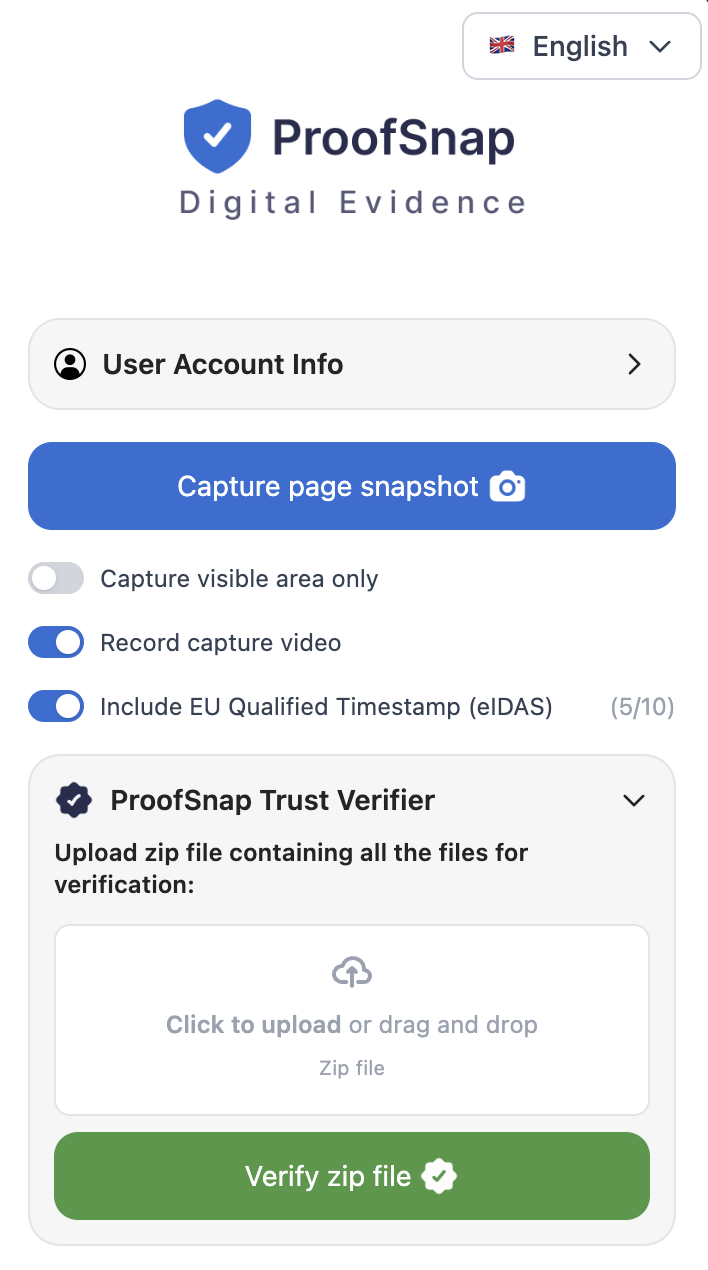
Anyone can verify it, including the other side. Drop the ZIP onto the public Trust Verifier and the hashes, the signature and the timestamp are checked in the browser. Nothing is uploaded and nothing depends on ProofSnap still existing.
Three ways to get the evidence
Prices are charged in USD. Approximate euro figures are shown for guidance only, and your card issuer sets the actual rate.
One dispute
$4.99 once
approx. €4.30
A SnapPack is a single up-front purchase for a set number of captures. No subscription, no auto-renewal, no trial. Best when you have one problem and you want it documented today.
Get a SnapPackOngoing matters
$8.99/month
approx. €7.80
For anyone who captures regularly: letting agents, property managers, solicitors and investigators. The 7-day free trial requires a credit card. Cancel any time during the trial and you are not charged.
Start the 7-day trialWe do it for you
$44.99 per URL
approx. €39
Send us the link and our team captures the package for you. There is nothing to install, which is useful when the capture should not come from a party to the dispute.
See the capture serviceProofSnap is not a law firm and does not provide legal advice. Qualified timestamps are issued by Disig a.s., a Qualified Trust Service Provider on the EU Trusted List. Ireland applies eIDAS directly as an EU member state, so that timestamp carries the Article 41 presumption here without any retained-law argument.
Official sources
Every figure and deadline on this page comes from the following official sources. Check them yourself rather than taking our word for it.
- Residential Tenancies Board: disputes, the application process, adjudication and the Tenancy Tribunal.
- RTB: guide to evidence, what evidence is accepted, the five-working-day deadline and how it is shared.
- RTB: guide to adjudication, what happens at adjudication, the ten-working-day appeal window and how evidence is used.
- RTB: guide to tribunals, how the Tenancy Tribunal rehears an appeal and how evidence is filed for it.
- RTB: section 109 dispute resolution procedural rules, the binding rules on filing documents, late evidence and virtual hearings.
- RTB Annual Report and Accounts 2024, the source of every dispute figure quoted on this page.
- RTB: enforcement of determination orders, what a determination order binds the parties to and how it is enforced through the courts.
- Citizens Information: enforcing an RTB decision, the same process explained in plain English for tenants and landlords.
- Residential Tenancies Act 2004 (No. 27 of 2004), the Act behind the RTB, its dispute machinery and notice of termination validity.
- Residential Tenancies (Miscellaneous Provisions) Act 2026 (No. 3 of 2026), the same-day RTB service rule for notices of termination, in force since 28 February 2026.
- Electronic Commerce Act 2000, section 22, admissibility of electronic records in Irish legal proceedings.
- Regulation (EU) No 910/2014 (eIDAS), consolidated text, Article 41 on qualified electronic time stamps, directly applicable in Ireland.
If the dispute has spilled into online reviews or posts about you, the defamation guide covers the separate one-year clock that attaches to those. If it has spilled into your workplace instead, the WRC unfair dismissal evidence guide covers the Workplace Relations Commission route, and image-based abuse is dealt with in the Coco’s Law guide. Label every document and put the check-in and the check-out material side by side. An adjudicator reading a tidy, dated file decides on the merits. An adjudicator reading a pile of undated screenshots decides on whatever else is in front of them.
Questions people actually ask
Capture it now, file it properly
The listing you are looking at today is the evidence you will need in four months. It will not be there then.