Complain to Netsafe. But capture it first.
New Zealand gave itself a two-step system: Netsafe assesses and tries to resolve the complaint, and the District Court can make binding orders if that fails. Both steps run on evidence of what was actually posted, and by the time either one looks at it, the post has usually been deleted.
Works on Chrome and Edge. From $4.99 (about NZ$9) as a one-off, or a 7-day trial that requires a credit card.
burner_acct_88
Posted 2 hours ago · public
“Everyone is going to see exactly who she really is. I will keep reposting this until she deletes her account.”
Deleted by the poster the next morning. Nothing left to show Netsafe.
Captured & sealed
SHA-256 · Bitcoin timestamp
Illustrative example. Fictional account, not a real post.
Under the Harmful Digital Communications Act 2015, Netsafe is the Approved Agency for complaints about harmful digital communications. Under section 8 it receives and assesses complaints, investigates them, and uses advice, negotiation, mediation and persuasion to resolve them. If that does not resolve matters, the District Court can make binding orders: take the material down or disable it, stop the conduct, stop encouraging others to pile on, publish a correction, give a right of reply, or publish an apology. There is also a criminal route: under section 22 it is an offence to post a digital communication intending to cause harm where harm actually results, and section 22(3) sets the penalty at up to two years imprisonment or a fine of up to NZ$50,000 for an individual, or up to NZ$200,000 for a body corporate. Every one of those paths needs proof of the communication itself. ProofSnap captures the page in about forty seconds and produces a package containing a full-page screenshot, the saved page source, the URL, the capture time in UTC, a SHA-256 hash of every file, an RSA-4096 signature and a Bitcoin blockchain timestamp. From $4.99 (about NZ$9) as a one-off purchase, with no subscription.
By Radim Motycka, Founder and Lead Engineer, ProofSnap · · Independently verifiable via Trust Verifier
What usually goes wrong
The post is deleted long before anyone rules on it
Netsafe complaints and District Court applications both take time. The material they are about takes seconds to delete.
Two steps, and time in between
Netsafe works the complaint first, and a District Court application follows only if that does not resolve it. That is the right order, but it means weeks can pass. Whatever you captured on day one is what the process still has to work with on day fifty.
The poster deletes as soon as it lands
People remove harmful posts the moment they realise a complaint has been made, and a takedown is exactly what you asked for. That is a good outcome and a terrible evidence problem, because the thing everyone is arguing about no longer exists.
A phone screenshot invites the obvious reply
An image file carries nothing about when it was made or whether it was edited. If the matter reaches the District Court, or the Police consider a section 22 charge, that gap is the first thing the other side will point at.
What the Act actually asks you to show
The HDCA is built around ten communication principles and a two-stage process. Each stage asks the same question in a different form: what was communicated, by whom, and what harm followed.
The ten communication principles
A digital communication should not disclose sensitive personal facts, be threatening, intimidating or menacing, be grossly offensive to a reasonable person in the position of the affected individual, be indecent or obscene, be used to harass, make a false allegation, contain a matter published in breach of confidence, incite others to send harmful messages, encourage suicide, or denigrate someone by reason of their colour, race, ethnic or national origins, religion, gender, sexual orientation or disability. Your complaint is measured against these, so capture the wording exactly.
Netsafe as the Approved Agency
Netsafe receives, assesses and investigates complaints and uses advice, negotiation, mediation and persuasion to resolve them. It is the first port of call rather than the last, and a complaint supported by a preserved record moves faster than one supported by a description.
District Court orders
If the complaint is not resolved, section 19(1) lets the court order the material taken down or disabled, order the defendant to stop the conduct, order them not to encourage others to do the same, and order a correction, a right of reply or an apology. Section 19(2) and 19(3) go further and reach the online content host and the internet provider, including an order to release the identity of an anonymous or pseudonymous author. Those orders are binding and enforceable. If the same post also lowers your reputation, it may support a defamation claim under the Defamation Act 1992, which runs on the same preserved record.
The criminal route under section 22
Posting a digital communication with intent to cause harm, where it would harm an ordinary reasonable person in the position of the victim and harm actually results, is an offence. Section 22(3) sets the penalty at up to two years imprisonment or a fine of up to NZ$50,000 for an individual, and up to NZ$200,000 for a body corporate. Police work from evidence, and the evidence is the post.
One practical warning about your own safety
If the material is an intimate image of a person under 18, do not download, copy or forward it, including to preserve it. Report it to Netsafe and to Police and let them handle the material itself. ProofSnap is for the public page, the profile, the threatening message or the demand for payment, which is usually what proves the conduct anyway. If you are in immediate danger, call 111. Netsafe can be reached on 0508 638 723.
Three steps, about forty seconds
No forensic training required. The proof is in the package, not in your testimony about how careful you were.
Open the page and capture
Open the profile, post, comment thread or message window in Chrome or Edge and start the capture from the side panel. The whole page is captured, not just the part on screen.
The package seals itself
Every file is hashed with SHA-256, the manifest is signed, and the manifest hash is anchored to the Bitcoin blockchain. The capture time is recorded in UTC, independent of your device clock.
Complain, then keep the ZIP
Lodge the complaint with Netsafe. Keep the ZIP. If the matter goes on to the District Court or to Police, the record is already in a form that anyone can verify.
What lands in the evidence package
Between 11 and 15 files depending on your plan, delivered as one ZIP that anyone can check without installing anything.
Full-page screenshot
The whole page, not just the visible window, stitched and hashed.
Saved page source
The document as rendered at capture time, including the head, meta tags and structured data.
Extracted page text
Searchable plain text, so a quote can be found and cited without retyping.
Technical metadata
URL, page title, HTTP response headers, browser, operating system and the capture time in UTC.
Signed manifest
SHA-256 for every file, signed with an RSA-4096 key whose public key ships in the package.
Blockchain timestamp
The manifest hash anchored to Bitcoin via OpenTimestamps, so the capture time cannot be backdated.
Chain of custody and forensic log
A record of what happened during the capture, in the order it happened.
Evidence report as PDF
A readable summary you can attach to an application, a notice or a report.
Verification instructions
Written steps plus scripts, so the other side can re-check the hashes offline.
Where all of that comes from
Every file above is produced by one press in the side panel, while the communication is still on screen. You do not assemble anything, name anything or remember to record the time, which matters because the moment you find harmful material is rarely the moment you are thinking clearly about evidence.
The panel stays open beside the page, so you can capture a profile, a comment thread and a message window one after another and end up with a separate sealed package for each.
Want to see what comes out before you install anything? Download a sample evidence package and open it yourself.
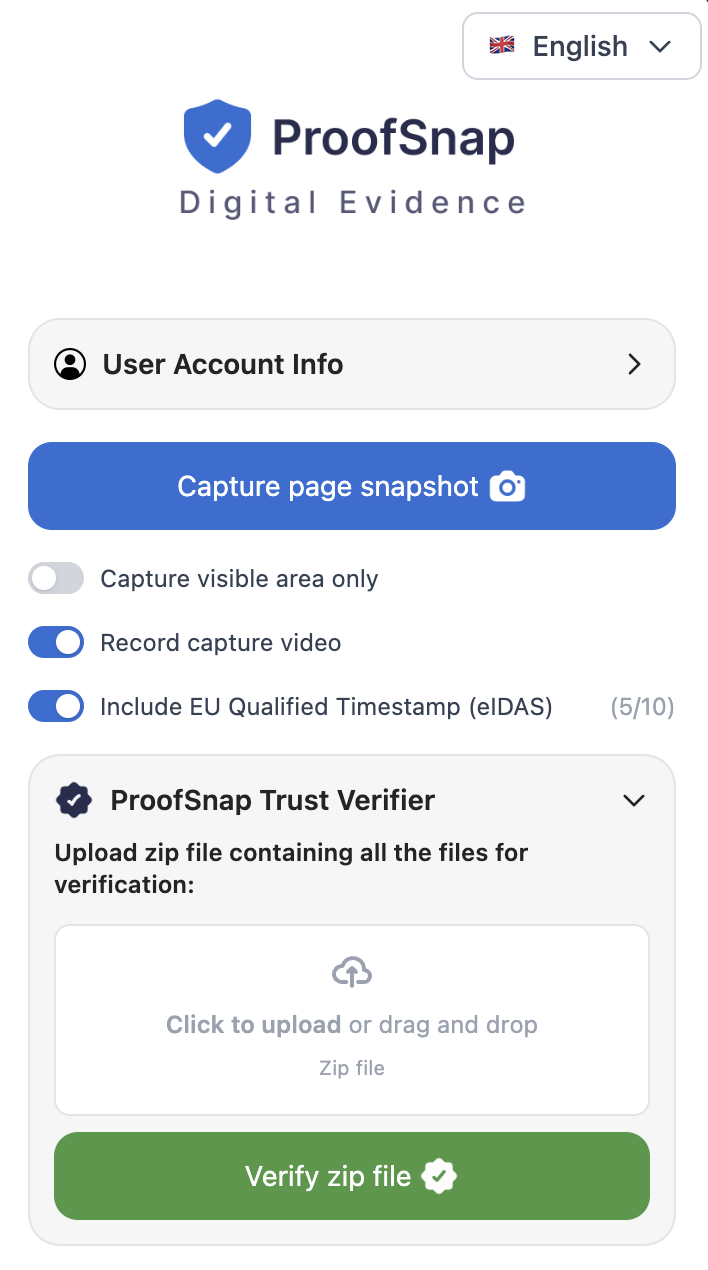
Anyone can verify it, including the other side. Drop the ZIP onto the public Trust Verifier and the hashes, the signature and the timestamp are checked in the browser. Nothing is uploaded and nothing depends on ProofSnap still existing.
Three ways to get the evidence
Prices are charged in USD. Approximate New Zealand figures are shown for orientation only, and your card issuer sets the actual rate.
One dispute
$4.99 once
about NZ$9
A SnapPack is a single up-front purchase for a set number of captures. No subscription, no auto-renewal, no trial. Best when you have one problem and you want it documented today.
Get a SnapPackOngoing matters
$8.99/month
about NZ$16
For anyone who captures regularly: practitioners, property managers, HR, investigators. The 7-day free trial requires a credit card. Cancel any time during the trial and you are not charged.
Start the 7-day trialWe do it for you
$44.99 per URL
about NZ$78
Send us the link and our team captures the package for you, with nothing to install. Useful when the capture should not come from a party to the dispute.
See the capture serviceProofSnap is not a law firm and does not give legal advice. Qualified timestamps are issued by Disig a.s., a Qualified Trust Service Provider on the EU Trusted List. New Zealand has no equivalent regime, so that timestamp is independent corroboration here rather than a legal presumption.
Official sources
Every figure and deadline on this page comes from the following primary sources. Check them yourself rather than taking our word for it.
- Netsafe: the Harmful Digital Communications Act what Netsafe does as the Approved Agency and how to make a complaint.
- Harmful Digital Communications Act 2015 the Act itself, including the ten communication principles and section 22.
- Ministry of Justice: harmful digital communications the District Court process and the orders available.
- New Zealand Police: harmful digital communications when the conduct becomes a Police matter.
Capture before you block or delete the account. Blocking can cut off your own access to the history, so the order matters. And do not make copies of illegal material under any circumstances, which is why the safety note above matters more than any feature on this page.
Questions people actually ask
A takedown is the goal. Losing the proof is not.
Capture the page while it is still there, then complain. The record outlives the takedown.