Apply for the takedown. But capture it first.
British Columbia lets you apply online to the Civil Resolution Tribunal for an order that an intimate image be deleted, destroyed, de-indexed and removed from a website or platform, and since 18 March 2026 the Tribunal can award up to C$75,000 in damages rather than the previous C$5,000. Every one of those outcomes ends with the material gone, which is exactly when your proof of what was shared disappears too.
Works on Chrome and Edge. From $4.99 (about C$7) as a one-off, or a 7-day trial that requires a credit card.
unknown_acct_41
Posted 2 hours ago · public
Image posted without consent. Shown here only as a placeholder.
Removed 4 days later, and the account went with it.
Captured & sealed
SHA-256 · Bitcoin timestamp
Illustrative example. No real image, no real account.
Canada handles non-consensual intimate images through two routes, and both need evidence of what was shared and where. British Columbia has the most direct civil route: under the Intimate Images Protection Act, in force since 29 January 2024, you apply online to the Civil Resolution Tribunal for a protection order requiring the image be deleted, destroyed, de-indexed or removed, and the maximum damages the Tribunal can award rose to C$75,000 on 18 March 2026, up from C$5,000. As at that date the Tribunal had resolved 389 of 486 submissions. The Act reaches back to images distributed on or after 6 March 2023, and the Provincial Court and the Supreme Court can hear these claims too. Separately, section 162.1 of the Criminal Code makes it an offence to knowingly publish, distribute, transmit, sell, make available or advertise an intimate image knowing the person depicted did not consent, or being reckless as to consent. The Protecting Victims Act raised the indictable maximum to ten years with effect from 18 July 2026, added a threat offence, and widened the definition of an intimate image to cover realistic synthetic depictions, so AI-generated material is now squarely in scope. Other provinces have their own intimate image statutes. ProofSnap captures the page in about forty seconds and produces a package containing a full-page screenshot, the saved page source, the URL, the capture time in UTC, a SHA-256 hash of every file, an RSA-4096 signature and a Bitcoin blockchain timestamp. From $4.99 (about C$7) as a one-off purchase, with no subscription.
By Radim Motycka, Founder and Lead Engineer, ProofSnap · · Independently verifiable via Trust Verifier
What usually goes wrong
The record disappears at the moment things start working
Every route out of this ends with the material being removed. That is the point, and it is also the problem, because a deleted page proves nothing on its own.
Removal erases the record
A protection order can require an image to be deleted and de-indexed. If your only copy of the URL, the account and the surrounding page was the live page, the order succeeds and your evidence goes with it. Capturing first costs under a minute.
The person who posted it deletes first
People remove this material the moment they realize an application has been made, and accounts get deactivated. A capture made while it is live is not something they can undo.
Where it was posted matters as much as what
An order to de-index or remove needs the location: the URL, the platform, the account. Those details live on the page and in its source, not in a cropped phone screenshot.
The two routes, and what each asks for
One is civil and fast, the other is criminal and slower. They are not alternatives, and people commonly use both.
British Columbia: the Civil Resolution Tribunal
In force since 29 January 2024 and reaching back to images distributed on or after 6 March 2023, the Intimate Images Protection Act lets you apply online for a protection order requiring an intimate image be deleted, destroyed, de-indexed or removed from a site or platform, and to claim compensation from the person, the platform or the website. The maximum damages the Tribunal can award rose to C$75,000 on 18 March 2026, up from C$5,000. That is compensation to you, not a fine, and the separate administrative penalties for ignoring an order are unchanged. The Provincial Court and the Supreme Court also hear these claims.
Criminal Code section 162.1
An offence to knowingly publish, distribute, transmit, sell, make available or advertise an intimate image knowing the person depicted did not consent, or being reckless as to consent. The Protecting Victims Act raised the indictable maximum from five years to ten with effect from 18 July 2026, and added a separate offence of threatening to distribute such an image. On summary conviction the section sets no term, so the general penalty in section 787 applies, which has been two years less a day since 2019. Police work from evidence, and the evidence is the posting.
Other provinces
Several provinces have their own intimate image legislation with civil remedies, and the details differ. Check the statute where you live rather than assuming the British Columbia process applies to you.
If it reaches a courtroom
Section 31.1 of the Canada Evidence Act puts the burden of authenticity on whoever tenders the electronic document, and section 31.2 satisfies the best evidence rule on proof of the integrity of the electronic documents system. A capture that documents its own integrity answers both. If the same posting also carries false statements about you, the anti-SLAPP burden on a defamation claim is worth understanding before you file.
One practical warning about your own safety
If the image is of a person under 18, do not download, copy or forward it, including to preserve it. Report it to police and, where the platform allows, use its own reporting route. Making or keeping a copy of that material is itself an offence and there is no exception for evidence gathering. ProofSnap is for the public page, the profile, the threatening message or the demand for payment, which is usually what proves the conduct anyway. If you are in immediate danger, call 911. In British Columbia, help with the application process is available through the province intimate images support service.
Three steps, about forty seconds
No forensic training required. The proof is in the package, not in your testimony about how careful you were.
Capture the page and the account
Open the page, the profile and any messages in Chrome or Edge and start the capture from the side panel. The whole page is captured, with the URL and the account recorded in the metadata.
The package seals itself
Every file is hashed with SHA-256, the manifest is signed, and the manifest hash is anchored to the Bitcoin blockchain. The capture time is recorded in UTC, independent of your device clock.
Apply, then keep the ZIP
Make the application to the Civil Resolution Tribunal or the equivalent where you live, and keep the ZIP. If police become involved or the matter escalates, the record is already in a verifiable form.
What lands in the evidence package
Between 11 and 15 files depending on your plan, delivered as one ZIP that anyone can check without installing anything.
Full-page screenshot
The whole page, not just the visible window, stitched and hashed.
Saved page source
The document as rendered at capture time, including the head, meta tags and structured data.
Extracted page text
Searchable plain text, so a quote can be found and cited without retyping.
Technical metadata
URL, page title, HTTP response headers, browser, operating system and the capture time in UTC.
Signed manifest
SHA-256 for every file, signed with an RSA-4096 key whose public key ships in the package.
Blockchain timestamp
The manifest hash anchored to Bitcoin via OpenTimestamps, so the capture time cannot be backdated.
Chain of custody and forensic log
A record of what happened during the capture, in the order it happened.
Evidence report as PDF
A readable summary you can attach to an application, a notice or a report.
Verification instructions
Written steps plus scripts, so the other side can re-check the hashes offline.
Where all of that comes from
Every file above is produced by one press in the side panel. You never have to keep the material yourself in a loose folder, and you do not have to look at it again to prove where it was and when.
Capture the post, the account and any reposts before you apply for the takedown, because a successful application ends with all of it gone.
Want to see what comes out before you install anything? Download a sample evidence package and open it yourself.
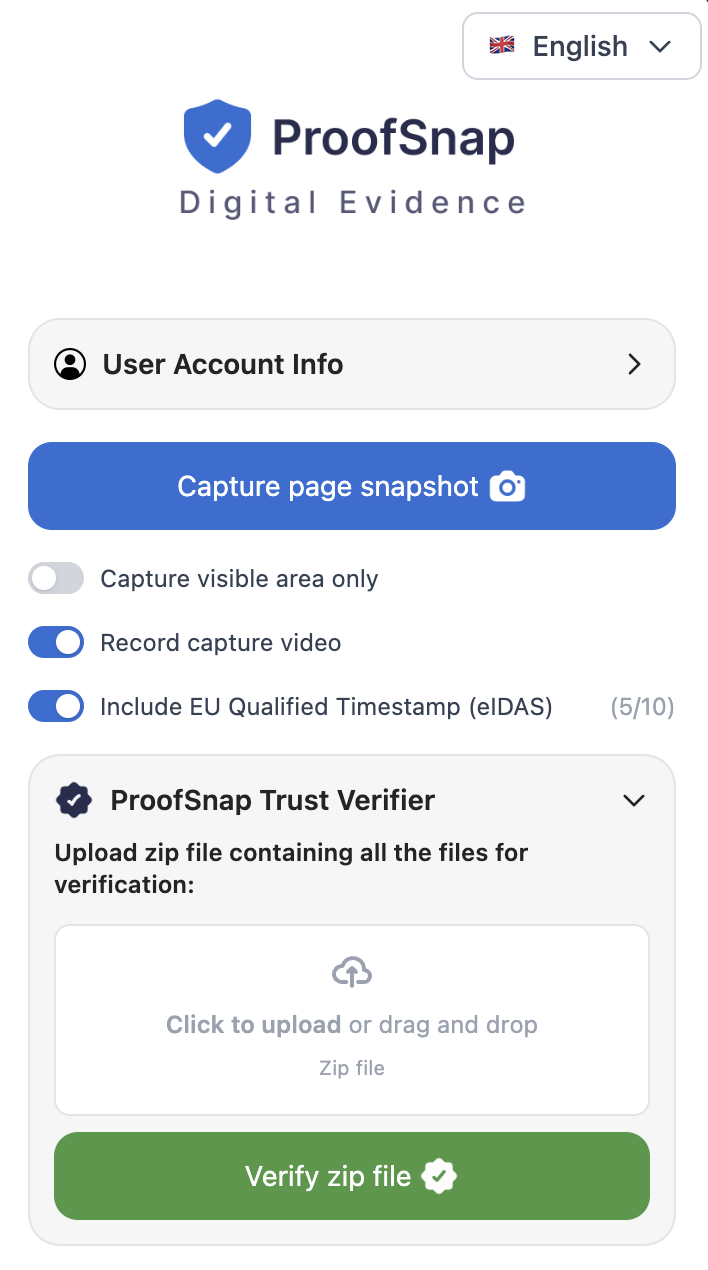
Anyone can verify it, including the other side. Drop the ZIP onto the public Trust Verifier and the hashes, the signature and the timestamp are checked in the browser. Nothing is uploaded and nothing depends on ProofSnap still existing.
Three ways to get the evidence
Prices are charged in USD. Approximate Canadian figures are shown for orientation only, and your card issuer sets the actual rate.
One dispute
$4.99 once
about C$7
A SnapPack is a single up-front purchase for a set number of captures. No subscription, no auto-renewal, no trial. Best when you have one problem and you want it documented today.
Get a SnapPackOngoing matters
$8.99/month
about C$13
For anyone who captures regularly: practitioners, property managers, HR, investigators. The 7-day free trial requires a credit card. Cancel any time during the trial and you are not charged.
Start the 7-day trialWe do it for you
$44.99 per URL
about C$63
Send us the link and our team captures the package for you, with nothing to install. Useful when the capture should not come from a party to the dispute.
See the capture serviceProofSnap is not a law firm and does not give legal advice. Qualified timestamps are issued by Disig a.s., a Qualified Trust Service Provider on the EU Trusted List. Canada has no equivalent regime, so that timestamp is independent corroboration here rather than a legal presumption.
Official sources
Every figure and deadline on this page comes from the following primary sources. Check them yourself rather than taking our word for it.
- Intimate Images Protection Act (British Columbia) the statute behind the protection order and the compensation claim.
- Civil Resolution Tribunal: intimate images how to apply online and what orders the Tribunal can make.
- Province of British Columbia: damages raised to C$75,000 the 18 March 2026 regulation change and the reasoning behind it.
- Criminal Code, section 162.1 the offence of publishing an intimate image without consent and its penalties.
- Justice Canada: the Protecting Victims Act the 2026 amendments, including the higher maximum and the widened definition, in force 18 July 2026.
- Criminal Code, section 787 the general summary conviction penalty of two years less a day, in force since 2019.
Capture before you block or delete the account. Blocking can cut off your own access to the history, so the order matters. And do not make copies of material involving anyone under 18 under any circumstances, which is why the safety note above matters more than any feature on this page.
Questions people actually ask
Removal is the goal. Losing the proof is not.
Capture the page while it is still there, then apply. The record outlives the takedown.