Small claims court fees UK 2026: every fee since 2014 and what a claim really costs
In 2026 a small claim in England and Wales costs £35 to £455 to issue and £27 to £346 more if it goes to a hearing: £62 to £801 in court fees. Neither fee changed on 13 July 2026, and Money Claim Online costs the same as paper. Enter your amount in the ProofSnap calculator below.
Small claims court fee calculator
Enter the amount you claim, including interest.
Claim of £1,500, with a hearing
£203 in court fees
- Issue fee£80
- Hearing fee£123
- Fees the defendant can be ordered to pay you if you winup to £203
Low income or little savings? Help with Fees can reduce or cover both fees.
Older fees (claims issued before 30 September 2021)
Interest you claim counts toward the issue fee band, and above £10,000 a claim normally leaves the small claims track, so only the issue fee is shown.
| Amount claimed | Issue fee | Hearing fee | Total |
|---|---|---|---|
| Up to £300 | £35 | £27 | £62 |
| £300.01 to £500 | £50 | £59 | £109 |
| £500.01 to £1,000 | £70 | £85 | £155 |
| £1,000.01 to £1,500 | £80 | £123 | £203 |
| £1,500.01 to £3,000 | £115 | £181 | £296 |
| £3,000.01 to £5,000 | £205 | £346 | £551 |
| £5,000.01 to £10,000 | £455 | £346 | £801 |
Typical totals with a hearing
- £1,500 claim£203£80 + £123
- £5,000 claim£551£205 + £346
- £10,000 claim£801£455 + £346
By Radim Motycka, Founder and Lead Engineer at ProofSnap, who builds its web capture and timestamping system · · 8 min read
1. Small claims court fees in 2026
A small claim in England and Wales is a money claim in the County Court that is allocated to the small claims track. You pay two court fees, both set by Schedule 1 to the Civil Proceedings Fees Order 2008 and both based on the amount you claim:
- the issue fee when you start the claim (fee 1.1), calculated on the claim plus any interest, and
- the hearing fee if the claim is defended and the court fixes a hearing (fee 2.1(c)).
The table at the top gives both fees for every band. The small claims track is the normal track for claims of up to £10,000 under rule 26.9 of the Civil Procedure Rules. Lower limits apply to personal injury claims and to housing disrepair claims by tenants. Above £10,000, the issue fee is 5% of the claim for claims of up to £200,000, and the claim normally goes to another track, with a higher hearing fee.
2. The issue fee and interest
The issue fee is paid when the claim is started. It is set by bands of the amount claimed, and when you claim interest on a specified sum the band is based on the claim and the interest together. A claim of £2,950 plus £80 interest is therefore a claim of £3,030, which costs £205 to issue, not £115.
Tip
Add the interest before you look up the band: a claim just under a band limit can move into the next band, and the fee follows the total. Online and paper claims have paid the same fee since 18 May 2021.
3. What happens after you file, and how long it takes
Once the claim is served, the defendant has 14 days from service of the particulars of claim to file a defence, or 28 days if they first file an acknowledgment of service, under the Civil Procedure Rules on defences. If they do neither in time, you can ask for default judgment, which is judgment without a trial.
If the defendant disputes a claim of £10,000 or less, both sides must attend the free Small Claims Mediation Service: a mediator phones each side separately, in an appointment of up to one hour. Without an agreement, the claim goes to a hearing. In April to June 2026 the median time from issuing a small claim to its trial was 41.0 weeks, according to the Ministry of Justice civil justice statistics.
Before the hearing
At least 14 days before the hearing, each side sends copies of the documents it relies on (section 9). With a median wait of 41 weeks, a listing, review or chat can be edited or gone by then. Preserve it now, while it is still online.
For a business. When another business pays late, the Late Payment of Commercial Debts (Interest) Act 1998 lets you add statutory interest of 8% plus the Bank of England base rate and a fixed sum of £40, £70 or £100, depending on the size of the debt. The interest counts toward the amount that sets your issue fee band.
4. The small claims hearing fee and Help with Fees
The hearing fee is due once the court fixes a hearing date for a claim on the small claims track. The claimant pays it, unless the case goes ahead on the defendant's counterclaim alone, in which case the defendant pays. Where notice of the hearing is given 36 days or more ahead, the fee is payable at least 28 days before the hearing; with shorter notice it is payable within 7 days of the notice.
If the fee is not paid by the date in the court's order, and no Help with Fees application has been made, EX50 states that the claim is struck out and the hearing is cancelled. It adds that if the parties settle before the hearing fee is due, it does not have to be paid.
Help with Fees for a small claim
Depending on your savings and income, Help with Fees can reduce or cover court fees, including the issue fee and the hearing fee. Every small claims fee is below £1,420, so if you are under 66 you can have up to £4,250 in savings; if you or your partner are 66 or older, the limit is £16,000 whatever the fee. You apply when you make the claim, and if you have already paid a fee you can still apply within 3 months, provided you were eligible when you paid.
5. Can you claim court fees back? Who pays if you win or lose
The claimant pays the issue fee and, if there is one, the hearing fee. On the small claims track the costs the court can order are limited to a list, and rule 27.14(2)(c) of the Civil Procedure Rules includes, in these words: any court fees paid by that other party
. The same list includes the fixed costs of issuing the claim, reasonable travel expenses for the hearing, and capped amounts for loss of earnings and an expert's fees. Further costs can be ordered against a party who has behaved unreasonably.
If you lose. The same list works the other way: you can be ordered to pay the other side's court fees and the other listed items, but not their full legal costs, unless you behaved unreasonably.
In practice, ask the judge at the end of the hearing to include the court fees you paid in the order. If you win a £5,000 claim after paying £551 in fees, the order can cover the £5,000, interest and the £551. Whether the defendant actually pays is a separate question: enforcing a judgment has its own fees, such as £96 for a warrant of control since 13 July 2026.
6. What changed on 13 July 2026
The Court and Tribunal Fees (Miscellaneous Amendments) Order 2026 raised many court fees from 13 July 2026, but its Schedule 2 leaves out fee 1.1 and fee 2.1(c), so money claim issue fees and small claims hearing fees stayed the same. Fees you may face later in a small claim did go up:
| Fee | Before 13 July 2026 | From 13 July 2026 | Change |
|---|---|---|---|
| Appeal in a small claim (appellant's or respondent's notice, County Court)Fee 2.3(a) | £147 | £151 | +£4 |
| Application on notice where no other fee is specifiedFee 2.4(a) | £313 | £321 | +£8 |
| Application by consent or without notice where no other fee is specifiedFee 2.5(a) | £123 | £126 | +£3 |
| Application to vary a judgment or suspend enforcementFee 2.7 | £15 | £16 | +£1 |
| Warrant of control against goods (County Court)Fee 8.1 | £94 | £96 | +£2 |
| Order for the debtor to attend court to provide informationFee 8.3 | £67 | £69 | +£2 |
| Third party debt orderFee 8.4(a) | £135 | £139 | +£4 |
| Charging orderFee 8.4(b) | £135 | £139 | +£4 |
| Attachment of earnings orderFee 8.7 | £135 | £139 | +£4 |
7. Every fee since 2014
We read Schedule 1 to the Fees Order on legislation.gov.uk as it stood on each date a small claims fee changed. Since the schedule was replaced on 22 April 2014, the small claims bands have been amended on three dates, and two of them changed what a small claim costs:
- 9 March 2015: the issue fee for claims above £10,000 became 5% of the amount claimed (4.5% online). The bands up to £10,000 kept their amounts.
- 18 May 2021: the lower online issue fee was removed, so online claimants pay the paper fee. The rise was £10 in the lowest band and £45 in the top small claims band.
- 30 September 2021: every small claims hearing fee went up by between 3.3% (£335 to £346) and 8.0% (£25 to £27).
For a claim issued online that goes to a hearing, total fees for a £10,000 claim went from £745 to £801 (+£56), and for a £1,000 claim from £140 to £155 (+£15):
Every issue and hearing fee since 2014 (two tables)
| Period and route | Up to £300 | To £500 | To £1,000 | To £1,500 | To £3,000 | To £5,000 | To £10,000 |
|---|---|---|---|---|---|---|---|
| Since 18 May 2021Paper and online, fee 1.1 | £35 | £50 | £70 | £80 | £115 | £205 | £455 |
| 9 March 2015 to 17 May 2021Online (Money Claim Online), fee 1.2 | £25 | £35 | £60 | £70 | £105 | £185 | £410 |
| 9 March 2015 to 17 May 2021Paper, fee 1.1 | £35 | £50 | £70 | £80 | £115 | £205 | £455 |
| 22 April 2014 to 8 March 2015Online (Money Claim Online), fee 1.3; top band to £15,000 | £25 | £35 | £60 | £70 | £105 | £185 | £410 |
| 22 April 2014 to 8 March 2015Paper, fee 1.1; top band to £15,000 | £35 | £50 | £70 | £80 | £115 | £205 | £455 |
| Period | Up to £300 | To £500 | To £1,000 | To £1,500 | To £3,000 | Over £3,000 |
|---|---|---|---|---|---|---|
| Since 30 September 2021Fee 2.1(c), unchanged on 13 July 2026 | £27 | £59 | £85 | £123 | £181 | £346 |
| 22 April 2014 to 29 September 2021Fee 2.1(c) | £25 | £55 | £80 | £115 | £170 | £335 |
The paper issue fees for claims up to £10,000 are the only figures that did not move at all: £35 to £455, the same on 22 April 2014 as on 10 November 2026. Every figure, with the instrument, fee number, dates and source address, is in the CSV data file.
8. Small claims in Scotland (simple procedure) and Northern Ireland
The fees above apply in England and Wales only. In Scotland small claims go to the sheriff court under simple procedure, and the fees are set by the Sheriff Court Fees Order 2026. The fee for the claim form also covers issuing the decision:
| Fee | 1 November 2024 to 31 March 2026 | From 1 April 2026 | From 1 April 2027 |
|---|---|---|---|
| Simple procedure claim form, payment of £300 or less | £22 | £23 | £23 |
| Simple procedure claim form, other actions | £123 | £127 | £131 |
| Marking an appeal or sending an appeal form | £72 | £74 | £77 |
Northern Ireland has its own small claims procedure in the County Court and its own fees order, which this study does not cover.
9. Evidence for a small claim, and preserving it
Under the small claims rules, hearings are informal and the strict rules of evidence do not apply, but the judge still decides the case on what you can show. The court's standard directions ask each side to send the court and the other party copies of every document they rely on, at least 14 days before the hearing. For a typical dispute over a purchase, a tenancy deposit or an online order, that means:
- The agreement. The contract, quote, order confirmation or terms and conditions as they stood when you agreed them.
- The messages. Emails, WhatsApp or marketplace chats in which the other side promised, admitted or refused something, with dates and the names of the accounts.
- The listing. The seller's advert or product page, with its description, photos, price and condition, because it shows how the item was described when it was sold.
- Reviews and public posts, where they show what the business said or how it dealt with the same problem.
- Proof of payment. Bank or card statements, PayPal records and receipts.
- The loss. Photos of the defect, a repair quote or invoice, delivery tracking, and your letter before claim, with the reply.
Paper documents stay as they are. Online material does not: a seller can edit or delete a listing, close the account or remove a chat. If the claim depends on a page, preserve it before you send the letter before claim.
How to preserve online evidence
- Capture it now. Save the listing, the chat or the review while it is still online, before you tell the other side you are claiming.
- Capture the whole page, with its address and the time. A cropped screenshot shows neither, and the defendant may say it was edited.
- Capture the full conversation. Scroll back to the first message, so the judge sees the context and not only the line you rely on.
ProofSnap seals each capture into a verifiable package. For a business claim, capture the emails, orders and invoices you rely on next to the listings and chats.
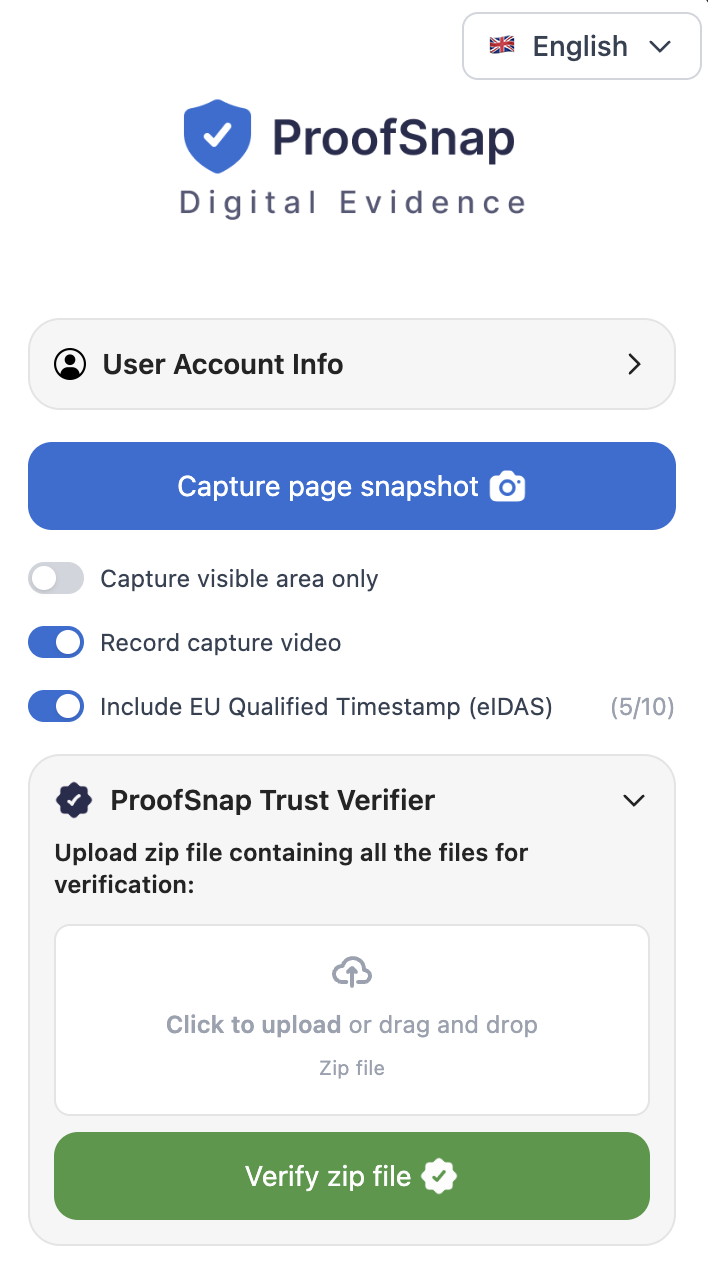
Option 1
Chrome extension
Captures the page in front of you in your own browser, including a page behind a login or a WhatsApp Web chat.
A 7-day trial (a credit card is required) or a SnapPack of 10 captures for $4.99 (about £3.70), with no subscription.
Capture the listing in Chrome On a phone? Have it captured for you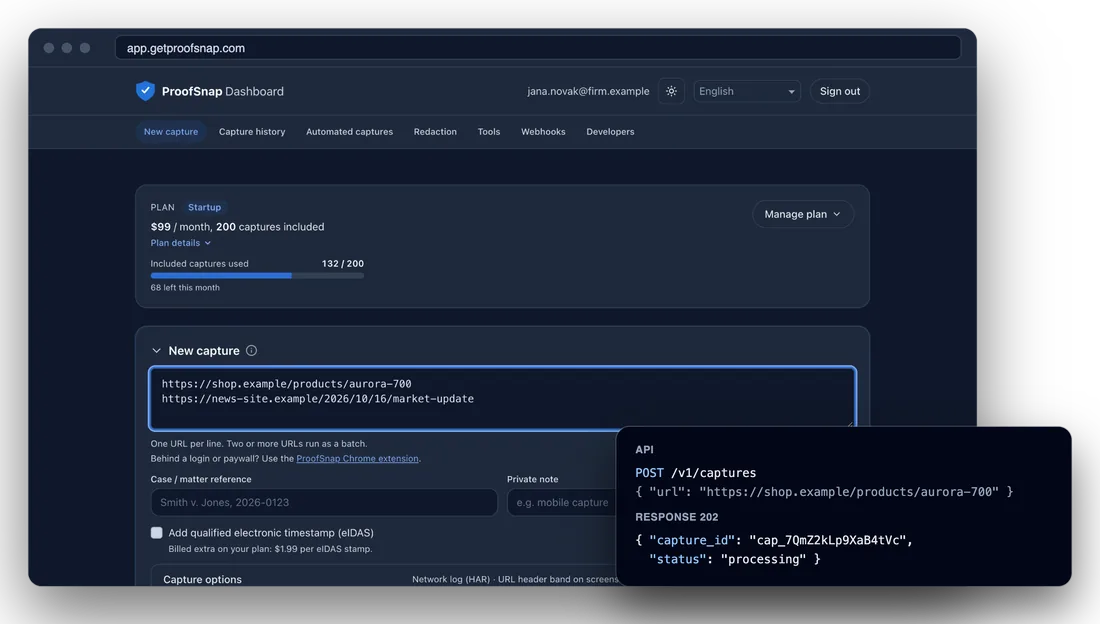
Option 2
API and dashboard
Captures public pages once or at set intervals, from the dashboard or through the API, for example a seller's listing you want to keep watching.
50 free test captures in the sandbox, no card needed. Live plans from $1.49 (about £1.10) per capture.
Watch a listing with the APIOn a phone, or short of time? Our capture service captures the page for you, from $44.99 (about £33), within 48 hours. Each package holds a full-page screenshot, the HTML and text, SHA-256 hashes in an RSA-signed manifest and a chain of custody record, plus, depending on the plan, an OpenTimestamps anchor and an eIDAS qualified timestamp from Disig a.s., a Qualified Trust Service Provider on the EU Trusted List. Anyone can check a package in the free Trust Verifier.
10. Frequently asked questions
How much does it cost to take someone to the small claims court?
In England and Wales in 2026 you pay an issue fee of £35 to £455, set by the amount you claim including interest, and a hearing fee of £27 to £346 if the claim goes to a hearing. A £1,000 claim costs £70 plus £85, so £155. A £10,000 claim costs £455 plus £346, so £801. Money Claim Online and paper claims pay the same issue fee.
How much is the small claims hearing fee?
£27 up to £300, £59 up to £500, £85 up to £1,000, £123 up to £1,500, £181 up to £3,000 and £346 above £3,000, unchanged since 30 September 2021. You pay it only once the court fixes a hearing.
What happens if the other side ignores the claim or the judgment?
If the defendant files neither an acknowledgment of service nor a defence in time, you can ask for default judgment, which is judgment without a trial. If they then do not pay, you can ask the court to enforce the judgment. The fees from 13 July 2026 are £96 for a warrant of control, £139 for an attachment of earnings order or a charging order, and £69 for an order for the debtor to attend court to provide information.
How long does a small claim take?
The defendant has 14 days from service of the particulars of claim to file a defence, or 28 days if they first file an acknowledgment of service. A defended claim goes to the free Small Claims Mediation Service and, without an agreement, to a hearing. In April to June 2026 the median time from issuing a small claim to its trial was 41.0 weeks.
Can I get the court fees back if I win?
Usually, yes. On the small claims track the costs the court can order are limited, but the small claims costs rule lets it order the losing side to pay the court fees you paid, together with fixed issue costs, reasonable travel expenses and limited loss of earnings. Ask the judge at the end of the hearing to include the court fees you paid in the order. If you lose, the same limits apply to what you can be ordered to pay.
What is the small claims limit in England and Wales?
£10,000 for most money claims. Lower limits apply to personal injury claims and to housing disrepair claims by tenants. A claim above the limit is normally allocated to another track, where the hearing fee is higher and different costs rules apply.
How much does a small claim cost in Scotland?
Scotland uses simple procedure in the sheriff court, with its own fees. From 1 April 2026 the claim form costs £23 for a claim of £300 or less and £127 for other claims, rising to £131 on 1 April 2027. The fee covers issuing the decision.
11. Method and data
Sources. ProofSnap checked every version of the Fees Order since 2014. Every amount comes from the text of the instrument itself on legislation.gov.uk: Schedule 1 to the Civil Proceedings Fees Order 2008 as it stood on 22 April 2014, 9 March 2015, 17 May 2021, 18 May 2021, 30 September 2021 and 10 November 2026, and the amending orders as made: SI 2014/874, SI 2015/576, SI 2021/588, SI 2021/985, SI 2026/642 and SI 2026/665. The 2026 fees were checked against EX50, and the Scottish fees against the Sheriff Court Fees Orders 2024 and 2026 as made. The waiting time is the median published by the Ministry of Justice for April to June 2026.
Scope. Money claims in the County Court in England and Wales, for the bands that fall within the small claims limit of £10,000, plus the 2026 changes to related County Court fees and the Scottish simple procedure fees. Totals add the issue fee and the hearing fee and leave out enforcement, appeal and application fees. Pound amounts next to ProofSnap prices in US dollars are approximate and use the European Central Bank reference rates of 10 November 2026.
Data. The CSV file holds one row per fee, band, route and period, with the fee number, effective dates, instrument and source address. It is published under CC BY 4.0. Please cite ‘ProofSnap, Small claims court fees 2014 to 2026’ with a link to this page.
Related reading
Sources
- The Civil Proceedings Fees Order 2008 (SI 2008/1053), Schedule 1, latest available version, legislation.gov.uk
- Schedule 1 as it stood on 30 September 2021, legislation.gov.uk
- Schedule 1 as it stood on 18 May 2021, legislation.gov.uk
- Schedule 1 as it stood on 17 May 2021, legislation.gov.uk
- Schedule 1 as it stood on 9 March 2015, legislation.gov.uk
- Schedule 1 as it stood on 22 April 2014, legislation.gov.uk
- The Court and Tribunal Fees (Miscellaneous Amendments) Order 2026 (SI 2026/642), as made
- The Court and Tribunal Fees (Miscellaneous Amendments) (Change of coming into force) Order 2026 (SI 2026/665), as made
- The Court Fees (Miscellaneous Amendments) Order 2021 (SI 2021/985), as made
- The Civil Proceedings Fees (Amendment) Order 2021 (SI 2021/588), as made
- The Civil Proceedings and Family Proceedings Fees (Amendment) Order 2015 (SI 2015/576), as made
- The Civil Proceedings Fees (Amendment) Order 2014 (SI 2014/874), as made
- HM Courts & Tribunals Service: Civil court fees (EX50), updated 26 October 2026, GOV.UK
- Civil Procedure Rules, Part 26, justice.gov.uk
- Civil Procedure Rules, Part 27, the small claims track, justice.gov.uk
- The Sheriff Court Fees Order 2026 (SSI 2026/74), as made, legislation.gov.uk
- The Sheriff Court Fees Order 2024 (SSI 2024/235), as made, legislation.gov.uk
- Get help paying court and tribunal fees, GOV.UK
- Get help paying court and tribunal fees: eligibility, GOV.UK
- Civil Procedure Rules, Part 15, defence and reply, justice.gov.uk
- Civil Procedure Rules, Part 12, default judgment, justice.gov.uk
- Small Claims Mediation Service, GOV.UK
- Ministry of Justice: Civil justice statistics quarterly, April to June 2026, GOV.UK
- Late Payment of Commercial Debts (Interest) Act 1998, legislation.gov.uk
- Late commercial payments: charging interest and debt recovery, GOV.UK