Image theft evidence for photographers, illustrators, e-shops and creators
Someone is using your photo? Prove it is yours.
You cannot stop the copy. You can prove your original came first and capture the theft before it vanishes.
Watermarks get cropped, AI upscalers rebuild the resolution, and social platforms strip your metadata on upload. In 2026, ProofSnap gives photographers in the US, UK, Canada, Australia and Ireland what watermarks and metadata cannot: a certified, timestamped record of your original and of the page that stole it, in an evidence package anyone can verify for free.
Also available for Microsoft Edge
From $4.99 one-time · or 7 days free (card required)
Framed coastal print, ready to hang
Illustrative example. ProofSnap timestamps your original as proof of priority, and captures the infringing page as proof of the theft, before it is taken down.
Every package can be verified by anyone, for free, in the open Trust Verifier.
Quick answer
How do I prove I own a photo, and that someone stole it?
You prove two things: that your original existed first, and that someone else is using it. In 2026, ProofSnap captures the infringing page with a SHA-256 hash and a certified timestamp before it is deleted, then timestamps your original file as proof of priority. It works for photographers in the US, UK, Canada, Australia and Ireland. Both go into an evidence ZIP anyone can verify for free. A one-time SnapPack is $4.99.
Why the usual "protection" does not prove a thing
You cannot stop a screenshot or a right-click. What matters is being able to prove your original came first when the copy shows up. Here is where the common defenses fail.
Watermarks get cropped
A visible watermark can be cut off, cloned out or covered. It slows a casual thief, but it does not survive a determined one, and it does not establish when you created the work.
Metadata is stripped on upload
Instagram and Facebook usually strip EXIF from the published copy, including your name, camera and capture date. The copy that circulates online arrives with its history already gone, and metadata can be edited anyway.
AI closes the resolution gap
"They only have a low-res copy" is no longer a defense. AI upscalers rebuild a small stolen thumbnail into a print-ready file, so poor resolution no longer marks the copy as inferior to your original.
The infringer controls the page
The listing, profile or article lives on a site the other side controls. The moment you complain, they can edit the caption, swap the file or delete the page.
A screenshot alone is easy to challenge
This is the gap that decides cases. A screenshot you took yourself has no provable date and is simple to dismiss as edited, and the other side can demand that you authenticate it. You need to capture the page now, with a date that cannot be backdated: the full page, a SHA-256 hash and a certified timestamp, before the page is taken down.
Watch your ownership evidence vanish on upload
The same file, before and after you post it. The one line that survives is the one a platform cannot strip.
Your original file
Author Jane Doe
Camera Sony A7 IV
Date 2023-03-14
GPS 37.81, -122.47
After upload to a social platform
Author Jane Doe stripped
Camera Sony A7 IV stripped
Date 2023-03-14 stripped
GPS 37.81, -122.47 stripped
The whole case is one question: who was first?
A certified timestamp answers it in a way a watermark, a metadata field or a screenshot cannot.
Your original
certified Jan 14, 2026
Their listing appears
captured Jul 4, 2026
Your certified original predates the copy by almost six months. That is proof of priority, and it cannot be backdated.
Two jobs, one extension
Winning an image-theft case comes down to two pieces of evidence. ProofSnap creates both, each sealed with a certified timestamp.
ProofSnap web capture
Capture the theft before it disappears
This is the one that cannot wait. Found the copy on a marketplace, a website or a social feed? Capture the full page with its URL, content and date now, because the page is on a site the infringer controls and can pull the minute you reach out. A reverse image search (try Google Images or TinEye) often shows the same file on several sites at once, so grab each one.
Full-page screenshot, HTML source, metadata and a certified timestamp, preserved even after the page is taken down.
ProofSnap File Certification
Then prove your original came first
Once the theft is locked down, use ProofSnap File Certification, built into the same extension and included in every plan, to timestamp your original files. Point it at your photo, illustration or design (.jpg, RAW, .psd, .ai) and the date by which it existed is certified, so you never have to prove priority from scratch again. The file never leaves your device; only its hash is timestamped. For an online portfolio page, capture the URL the same way as in job 1.
How ProofSnap File Certification works
Only the 64-character hash is sent for timestamping, so the file itself never leaves your device. Included in every ProofSnap plan; the $4.99 SnapPack comes with 3 file certifications. See exactly how ProofSnap File Certification works →
Best done on the day you publish. A timestamped original is the strongest answer to "I had it first."
7 days free (card required), then from $4.99 one-time or $8.99/mo
Chrome extension
What ProofSnap looks like
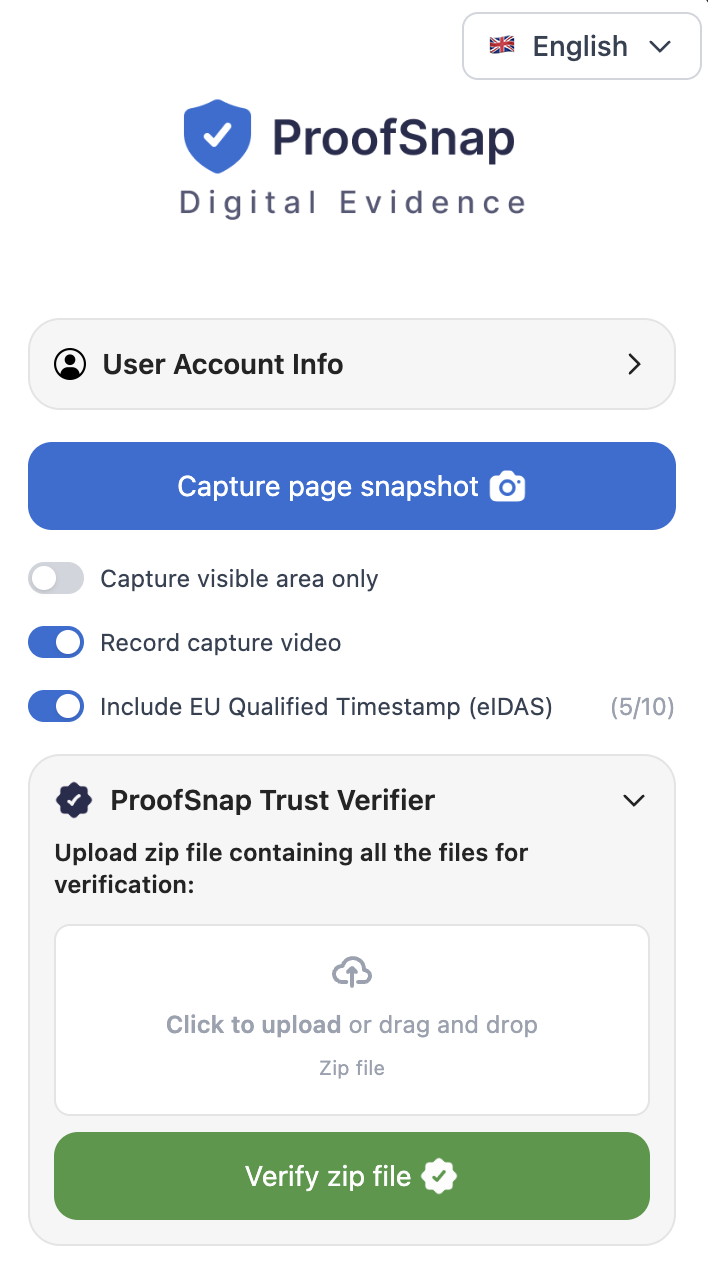
It all happens in the browser side panel. Open the infringing page, click once, and you have a complete evidence package.
- Full-page capture with the URL, content, HTML source and metadata
- Certified timestamp and SHA-256 hash on every capture
- A short video recording and a provenance certificate
- Free verification of any package in the open Trust Verifier
7 days free (card required), then from $4.99 one-time. Also available for Microsoft Edge.
One click. One evidence ZIP.
Every capture produces a complete evidence package you can hand to a platform, a lawyer or a court. Depending on your plan it holds 11 to 15 files, each hashed and sealed.
Everything is verifiable by anyone, for free, in the open Trust Verifier.
Inside the signed evidence ZIP
Tamper-evident
Every file is hashed with SHA-256 and the manifest is signed. Change one pixel and verification fails, which is exactly what makes it credible.
Independently dated
A Bitcoin OpenTimestamps anchor (with SnapPacks and every plan above Essential), plus an eIDAS qualified timestamp from Disig a.s. on higher tiers, proves the capture existed by a specific point in time.
Provenance certificate
A PDF summarizing the capture's source, hashes and timestamp.
Open the ZIP, read the PDF, verify the hash. Judge it for yourself before you install.
Real cases. Real money.
Each of these turned on what the creator could prove. Certified evidence is what makes it provable.
Architectural photographer Scott Hargis found 43 of his images used in a senior-living chain's marketing without a license. In December 2023 a jury found the infringement willful and awarded the $150,000 maximum on 42 registered images: $6.3 million.
Photographer Andrew Paul Leonard licensed rare stem-cell images that were reused far beyond the scope of the license. In 2016 the Third Circuit upheld a $1.6 million actual-damages award, showing what a single set of images can be worth when the record is clear.
Source: CDAS LLP
Photographer Daniel Morel posted Haiti earthquake photos to Twitter. An agency grabbed them, credited someone else and resold them to major outlets. In 2013 a jury awarded the maximum statutory damages, $1.2 million: posting publicly on Twitter gave nobody a license.
Source: PBS NewsHour
Real-estate photographer Jennifer Bouma shot a $1.9M home, then found a viral account had republished her photos to millions of followers without permission or payment. She did not discover it for over two years. Timestamped originals would have strengthened her position.
Source: PetaPixel, Aug 2024
Nearly two in three professional photographers had work stolen more than 200 times in a single year, per a 2016 survey by image-monitoring service Pixsy. Theft is not an edge case; it is the baseline.
Source: Pixsy
More than half of professional photographers have already lost work to generative AI, an Association of Photographers survey found in January 2026, with an average reported loss of £34,900 (about $48,000). Scraped and AI-rebuilt images make a certified original more valuable, not less.
Source: PetaPixel, Jan 2026
The other side of the coin. In a 2024 New York federal case the court found the infringement was not willful and the photographer's evidence of licensing value was thin, so it awarded just $940. What you can prove is the difference between $940 and $150,000.
Source: Plagiarism Today, Nov 2024
In every case, a certified, timestamped original and a preserved capture of the infringing use would have strengthened the creator's hand. ProofSnap creates both, with timestamps that cannot be faked or backdated.
Watermark, metadata, screenshot, or certified evidence
The first three deter or annotate. Only the last one proves that your original existed first and that the theft happened.
| What it does | ProofSnap | Watermark | EXIF metadata | Screenshot |
|---|---|---|---|---|
| Proves your original existed by a date | No | Editable | No | |
| Survives cropping and re-upload | Croppable | Stripped | ||
| Preserves the infringing page | No | No | Fakeable | |
| Tamper-evident (SHA-256 + signature) | No | No | No | |
| Independent certified timestamp | Included | No | No | No |
| Typical cost | From $4.99 | Free | Free | Free |
What about C2PA Content Credentials, now shipping in some phone cameras? They record origin at the moment of capture, which is useful, but like EXIF they are stripped by most platforms on re-upload, and they say nothing about the page that stole your work. ProofSnap is complementary: it captures the infringement independently and timestamps it, so you have proof even when the credentials are gone.
Photo copyright infringement by country
An original photo is protected the moment you create it, with no registration or formality, in the 180+ countries that WIPO lists as parties to the Berne Convention. What changes from country to country is the remedy and how damages are calculated. Your evidence does not change: a timestamped original (priority) and a certified capture of the infringing page (the theft).
“Copyright protection exists from the moment an original work is ‘fixed’ in a tangible medium. For photographers, for example, fixation occurs when you take a picture.”
U.S. Copyright Office, What Photographers Should Know about Copyright. For US disputes worth up to $30,000, the Office also runs the Copyright Claims Board, a voluntary forum that requires you to have filed a registration application.
United States
Primary marketSend a DMCA takedown notice, or sue. Statutory damages run $750 to $30,000 per work, up to $150,000 for willful infringement, and to claim them, the copyright generally has to be registered in time: before the infringement, or within three months of first publication.
United Kingdom
BerneUnder the CDPA 1988, protection is automatic and needs no registration. You can claim damages, with additional damages where the infringement was flagrant (s. 97(2)).
Canada
BerneThe Copyright Act protects your work on creation (registration optional). It provides statutory damages of CAD 500 to CAD 20,000 per work for commercial infringement. No eIDAS presumption; the timestamp is strong technical proof.
Australia and New Zealand
BerneThe Copyright Act 1968 (AU) and the Copyright Act 1994 (NZ) protect photos automatically, with no registration.
Ireland
EU, eIDASPhotos are protected as artistic works under the Copyright and Related Rights Act 2000, automatically and without registration. As Ireland is an EU member, an eIDAS qualified timestamp carries the presumption of the accuracy of its date and time and of the integrity of the data under Article 41(2) of the eIDAS Regulation.
Outside the EU, the certified timestamp is technical proof of date and integrity that the court weighs under local law.
Your photo was just stolen? Capture first, then choose your route.
Capture everything before you make contact. Once the infringer knows you have found them, the page can change or vanish. Grab the infringing page, the seller or profile, your original, and any licensing message, each with a certified timestamp.
DMCA and platform takedown
Instagram, Etsy, Amazon, eBay, Pinterest, TikTok and Google all have IP reporting forms that ask for the infringing URL and identification of your work. A certified capture of the page plus your timestamped original is exactly what they need. For the full route, see our DMCA takedown and copyright evidence guide.
Back-license invoice
Rather than just remove the copy, bill for the use. This is the Copytrack and Pixsy model. The certified capture proves the unlicensed use existed no later than a specific date, so the invoice is hard to wave away.
Statutory-damages claim
In the US, a copyright registered in time opens the door to statutory damages and attorney's fees. Your evidence package is the documentation.
Defend against a false claim
If a reseller files a false claim against your own listing, your timestamped original predating theirs answers it. For an ongoing program, see brand protection.
Pricing
One recovered license or claim pays for years of ProofSnap. Same integrity in every plan: SHA-256 hash, signed manifest and a provenance certificate, packaged into an 11- to 15-file evidence ZIP you can verify for free.
Standard SnapPack
10 captures · no expiration · one-time purchase
Pay-as-you-go, no subscription and no auto-renewal. All features: full-page capture, metadata, a short video recording, provenance certificate and blockchain timestamp. Ideal for documenting one theft.
eIDAS SnapPack
EU qualified timestamps (Disig a.s.)
$5.00 / stamp · also 1× $6.99 or 10× $49.99
Adds a qualified eIDAS timestamp per capture, which in the EU carries a presumption of the accuracy of the date and time and of the integrity of the data. White-label branding on the evidence PDF.
Subscription
Essential · Professional · Enterprise
Annual plans save 20%
For regular use: monthly capture allowances and File Certification, plus eIDAS stamps on higher tiers. Includes a 7-day free trial (a credit card is required to start).
Prefer no subscription and no auto-renewal? The Standard SnapPack at $4.99 is a one-time purchase. SnapPacks are bought inside the extension after you install it. See the full ProofSnap pricing and features on getproofsnap.com.
Free to install · from $4.99 one-time · or 7 days free (card required)