Statutory declaration (stat dec) in Australia: forms and who can witness, state by state
ProofSnap read all nine Australian statutory declaration laws in November 2026. Use the official form of the law that applies: the Commonwealth form for federal and ACT matters, otherwise your state's or the NT's own form, and sign it in front of an authorised witness.
- Pharmacist or Australia Post?Yes for a Commonwealth declaration and in the ACT, Victoria, WA, SA, Tasmania and the NT. No in NSW and Queensland, unless the person is also a JP (or, in Queensland, a commissioner for declarations). At Australia Post: the agent in charge of a post office, or a permanent employee with 5 years' service.
- myGov?Only for Commonwealth and ACT matters, such as a declaration for a federal agency, a visa or a passport. It needs a Digital ID and no witness. A state or NT matter needs that jurisdiction's own form.
- By video?In 7 of the 9 jurisdictions: the Commonwealth, the ACT, NSW, Victoria, Queensland (before a special witness only), SA and the NT. Not in WA or Tasmania.
General information, not legal advice.

· 8 min read
Practice
How to write a statutory declaration, with an example
Use the official form for the law that applies and fill in the parts it leaves blank. If the agency that asked for the declaration gives instructions, follow them.
- Your details exactly as the form asks: full name, address and occupation.
- Numbered paragraphs, one fact each, in the first person and in plain words. Say so when a fact comes from someone else.
- Dates, places and amounts as precisely as you can, so the reader can match them to other records.
- Annexures referred to in the text, each marked with a letter, as set out below.
- Sign only in front of the witness, in person or by video where the law allows it. For a digital Commonwealth declaration, sign in myGov instead.
How annexures are marked
- Commonwealth: you and the witness sign every page, including extra pages and attachments (Attorney-General's Department).
- New South Wales: mark each annexure A, B, C (or 1, 2, 3) at the top, number the pages consecutively; the JP then adds a signed statement such as "This is the annexure marked A referred to in the statutory declaration of ..." (NSW JP Handbook).
- Victoria: you and the witness sign an exhibit certificate attached to each document the declaration refers to (Justice Victoria, with a template).
- Queensland: it is recommended that you and the witness initial each supporting document (Queensland Government).
Example wording
2. On [date] I reported a leak in the bathroom to [agent] by email. A copy of that email is annexed and marked "A".
3. On [date] the listing for the property at [web address] showed the bathroom as "newly renovated". A sealed capture of that page, made on [date], is annexed and marked "B".
4. I make this declaration in support of my claim for [purpose].
Before you see a JP
- Fill in the form, but do not sign it: you sign in front of the witness (Justice Victoria, Service NSW).
- Bring an identity document. A NSW JP must see one unless they have known you for at least 12 months.
- Bring every annexure the declaration refers to. A NSW JP must not witness the declaration if one is missing.
- JP services are free. JPs are volunteers: they cannot charge a fee, help write the declaration or give legal advice (WA Government, Justice Victoria).
Statutory declaration or affidavit? Both are written statements of fact that you confirm as true. An affidavit is sworn or affirmed and is mainly used in court proceedings; a statutory declaration is mainly used for agencies, insurers, employers and banks. If a court asks for an affidavit, a statutory declaration does not replace it.
Finding 1
Statutory declaration forms by state: NSW, Vic, Qld, WA, SA, Tas, NT, ACT
A statutory declaration, or stat dec, is made under one of eight Acts. The Commonwealth Act covers Commonwealth matters and the ACT; every state and the Northern Territory has its own Act and its own form, and the Attorney-General's Department notes that there is currently no mechanism for mutual recognition between them. A declaration on the wrong form may be rejected.
As at 13 November 2026, from the official sources. Each cell links to its source; the CSV file holds the exact provision and the date read.
| Jurisdiction | Law and official form | Who can witness | Pharmacist, police, Australia Post | Electronic signing and video witnessing | myGov digital declaration | Penalty for a false declaration |
|---|---|---|---|---|---|---|
| Commonwealth statutory declaration | Statutory Declarations Act 1959 Form: Commonwealth statutory declaration form |
57 (17 licensed occupations plus 40 other roles) Anyone on the Commonwealth list: 17 licensed occupations (such as medical practitioner, nurse, pharmacist, legal practitioner) and 40 other roles (such as JP, police officer, bank officer with 5 years of service, teacher), plus anyone who may witness a statutory declaration under the law of the state or territory where you sign. |
Pharmacist: yes, if currently licensed or registered Police: yes Australia Post: yes (the agent in charge of a post office, or a permanent employee with 5 or more years of continuous service) |
Yes, since 1 January 2024: video witnessing and electronic signing | Yes: the myGov digital declaration needs no witness | Up to 4 years' imprisonment (s 11) |
| ACT statutory declaration (Australian Capital Territory) | Statutory Declarations Act 1959 (Cth); the ACT has no Act of its own Form: Commonwealth statutory declaration form |
57 (the Commonwealth list) The Commonwealth list applies: 17 licensed occupations and 40 other roles. |
Pharmacist: yes, if currently licensed or registered Police: yes Australia Post: yes (the agent in charge of a post office, or a permanent employee with 5 or more years of continuous service) |
Yes, since 1 January 2024, under the Commonwealth Act | Yes: the Commonwealth Act also covers ACT matters | Up to 4 years' imprisonment, as under the Commonwealth Act |
| NSW statutory declaration (New South Wales) | Oaths Act 1900 Form: NSW statutory declaration, Eighth Schedule (Ninth for some matters) |
8 (named in one sentence of the Act) The Registrar-General, a Deputy Registrar-General, a JP, a notary public, a commissioner for affidavits, an Australian legal practitioner, a federal judicial officer, or another person authorised by law to administer an oath. |
Pharmacist: no Police: no (unless also a JP) Australia Post: no |
Yes: video witnessing, made permanent in 2021 (Electronic Transactions Act 2000, Part 2B); the witness signs a counterpart or a scanned copy | No: where NSW law asks for a statutory declaration, use the NSW form | Up to 5 years' imprisonment (s 25); up to 7 years if the declarant gains or tries to gain a material benefit (s 25A) |
| Victorian statutory declaration (Vic) | Oaths and Affirmations Act 2018 Form: Vic stat dec template: the official Victorian form |
39 (22 named affidavit takers, 5 prescribed classes of affidavit takers and 12 prescribed classes of witnesses; the Commonwealth list also applies) An authorised affidavit taker (such as an honorary justice, a lawyer or a police sergeant), a prescribed class of witness, or anyone who may witness a Commonwealth declaration. |
Pharmacist: yes, through the Commonwealth list Police: yes, through the Commonwealth list Australia Post: yes (the agent in charge of a post office, or a permanent employee with 5 or more years of continuous service) |
Yes, permanent since 26 April 2021: video witnessing and electronic signing | No: where Victorian law asks for a statutory declaration, use the Victorian form | Up to 5 years' imprisonment, a fine of 600 penalty units, or both (s 36) |
| Queensland (Qld) statutory declaration | Oaths Act 1867 Form: Qld stat dec template: official Form 1 version 3 |
7 (roles in the Act and the Oaths Regulation) A JP, a commissioner for declarations, a notary public, a lawyer, a conveyancer, or another person authorised to administer an oath. Senior police officers can witness only declarations made by police officers. |
Pharmacist: no (unless also a JP or commissioner for declarations) Police: only senior officers, and only for declarations by police officers Australia Post: no |
Yes, permanent since 30 April 2022, but only before a "special witness" such as a lawyer or a JP approved for the purpose | No: where Queensland law asks for a statutory declaration, use the Queensland form | Up to 3 years' imprisonment (Criminal Code, s 194); up to 7 years where a law requires the statement to be verified by declaration (s 193) |
| WA statutory declaration (Western Australia) | Oaths, Affidavits and Statutory Declarations Act 2005 Form: WA statutory declaration |
48 (items in Schedule 2; the Commonwealth list also applies) Anyone in Schedule 2 of the Act (48 items, from academic to veterinarian) or anyone who may witness a Commonwealth declaration. |
Pharmacist: yes Police: yes Australia Post: yes (the person in charge of a post office, or through the Commonwealth list a permanent employee with 5 or more years of continuous service) |
No: you must sign in the physical presence of the witness. The COVID-19 remote witnessing rules expired on 31 December 2022. | No: where WA law asks for a statutory declaration, use the WA form | Up to 5 years' imprisonment; on summary conviction 2 years and a fine of A$24,000 (Criminal Code, s 169) |
| SA statutory declaration (South Australia) | Oaths Act 1936 and Oaths Regulations 2021 Form: South Australian statutory declaration form |
35 (5 in the Act plus 30 in the Regulations) A JP, a lawyer, a notary, a police officer, a registered health practitioner, a full-time teacher, and 29 more categories in the Act and the Regulations. |
Pharmacist: yes, as a registered health practitioner Police: yes, except a probationary constable Australia Post: yes (the agent in charge of a post office, or a permanent employee with 5 or more years of continuous service) |
Yes, since 1 January 2025: video witnessing and electronic signing | No: where South Australian law asks for a statutory declaration, use the South Australian form | Up to 4 years' imprisonment (s 27) |
| Tasmanian statutory declaration (Tas) | Oaths Act 2001 Form: Tasmanian statutory declaration form for physical documents |
62 (on the Department of Justice list: 17 professionals plus 45 appointment holders, built on the Commonwealth list) A JP, a commissioner for declarations, or a person in one of the 62 professions and roles on the Department of Justice list, which, under the Oaths Act, is built on the Commonwealth list. |
Pharmacist: yes Police: yes Australia Post: yes (the agent in charge of a post office, or a permanent employee with 5 or more years of continuous service) |
No provision in the Oaths Act; Department of Justice guidance says the declarant must appear before the witness | No: where Tasmanian law asks for a statutory declaration, use the Tasmanian form | A crime with no specific maximum, so the general maximum of 21 years' imprisonment or a fine applies (Criminal Code, ss 113 and 389) |
| NT statutory declaration (Northern Territory) | Oaths, Affidavits and Declarations Act 2010 Form: NT statutory declaration form |
Any adult (no list of occupations) Any adult (18 or over). A JP or commissioner for oaths is not needed. |
Pharmacist: yes (any adult can witness) Police: yes (any adult can witness) Australia Post: yes (any adult can witness) |
Yes, permanent since 2 March 2022: video witnessing and electronic signing | No: the Commonwealth Act does not cover NT matters | Up to 3 years' imprisonment (Criminal Code, s 119); up to 7 years where a law requires the statement to be verified by solemn declaration (s 118) |
Scroll the table sideways to see all seven columns.
Finding 2
Who can witness a statutory declaration: any adult in the NT, eight roles in NSW
Who can sign as the witness depends on the law the declaration is made under. The Northern Territory has no list at all: its Act asks for "an adult witness". New South Wales and Queensland sit at the other end, with eight and seven categories, and a JP or a lawyer can witness everywhere. The Commonwealth list is the long one, with 17 licensed occupations and 40 other roles; Victoria and Western Australia accept everyone on it in addition to their own lists, and the Tasmanian list is built on it.
Police officers can witness almost everywhere. The exceptions: in New South Wales only a police officer who is also a JP, in South Australia not a probationary constable, and in Queensland only senior officers, for declarations made by police officers.
Video witnessing and myGov
Six jurisdictions permanently allow video witnessing, and the Commonwealth rule also covers the ACT, making seven. Western Australia let its COVID-19 remote witnessing rules lapse at the end of 2022, and Tasmania's Oaths Act has no provision for it. Queensland allows it only before a "special witness", and in New South Wales the witness signs a counterpart or a scanned copy. The myGov digital declaration needs no witness, but it is a Commonwealth declaration: where a state or Northern Territory law asks for its own form, it does not replace that form.
Penalty for a false declaration
Knowingly making a false statement in a statutory declaration is a crime in all nine jurisdictions. Under section 11 of the Statutory Declarations Act 1959 the maximum is 4 years' imprisonment; the states and territories that set a specific term set 3 to 5 years, rising to 7 years in New South Wales, Queensland and the Northern Territory in aggravated cases. The table gives each maximum.
Online evidence
When you annex a web page or a chat to your declaration
Many statutory declarations rest on something that was online: the listing behind an insurance claim, the profile and messages in a scam report, a rental advert in a tenancy dispute, the messages behind a stat dec for a partner visa, the post you report to eSafety, or the post behind a defamation concerns notice. A pasted screenshot does not show the page address, when it was taken, or whether it was edited.
A ProofSnap capture is a sealed package: a full-page screenshot, the page HTML and text, metadata, SHA-256 hashes in an RSA-signed manifest and a chain-of-custody record, plus, depending on the plan, an OpenTimestamps anchor and an eIDAS qualified timestamp from Disig a.s., a Qualified Trust Service Provider on the EU Trusted List. Each package contains a printable evidence.pdf.
Annex the printed evidence.pdf to a declaration signed before a witness: mark it (for example "B"), refer to it in a numbered paragraph with the file name and capture date, and keep the ZIP file, so anyone the declaration goes to can check it in the free Trust Verifier. There are two ways to make the capture, depending on whether it is a public page or something you see in your own browser.
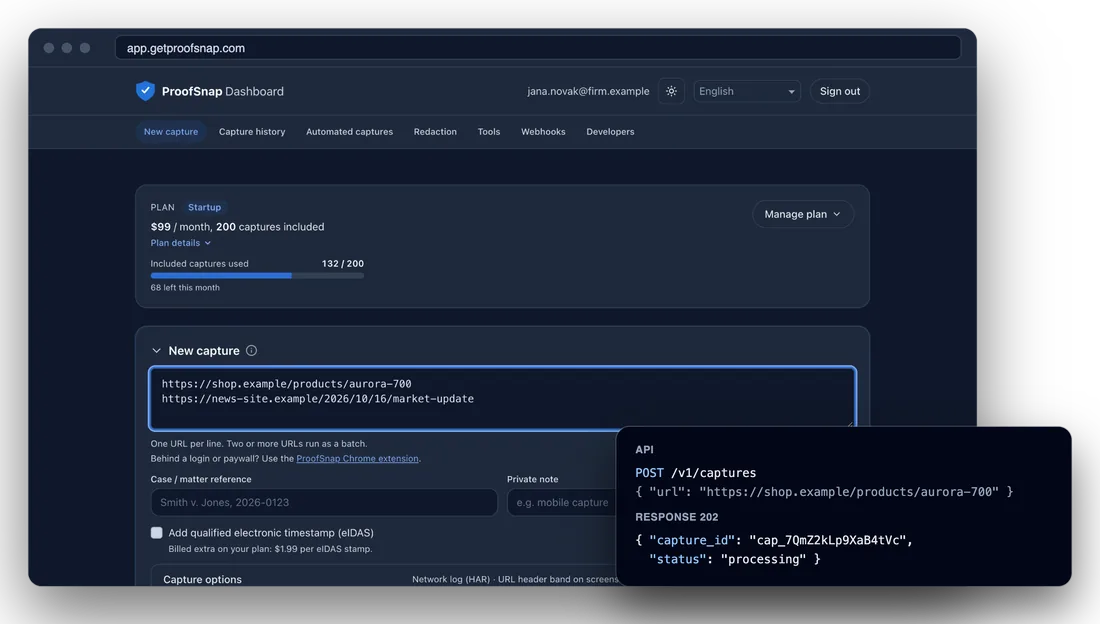
Path 1
API and dashboard
For a public page or listing. Paste the URL into the web dashboard or call the API, then annex the sealed PDF.
- 1 to 50 URLs per request, each sealed as its own full-page package, in desktop or mobile view.
- Scheduled captures, for example to keep watching a listing until the claim is settled.
- A printable evidence.pdf in every package, ready to mark as an annexure.
50 free test captures in the sandbox. Live plans from US$1.49 (approx. A$2.20) per capture.
See the API and dashboardPath 2
Chrome extension
For what you see in your own browser, including a page behind a login, such as a profile or a WhatsApp Web chat.
- One click captures the full page, its HTML, text and metadata, and seals the package.
- Video recording of the capture or, in Manual mode, of your own browsing up to the moment you save.
- File certification seals files you already have, such as a PDF or an old screenshot, to annex alongside.
A 7-day trial (a credit card is required), or a SnapPack for US$4.99 (approx. A$7.20): 10 captures that do not expire plus 3 file certifications, with no subscription.
Add ProofSnap to Chrome On a phone? Have it captured for youShort of time? Our capture service captures the page for you within 48 hours, from US$44.99 (approx. A$65).
FAQ
Statutory declarations in Australia: frequently asked questions
What is a statutory declaration, and how legally binding is it?
A statutory declaration, or stat dec, is a written statement of facts that you declare to be true, usually in front of an authorised witness, under a statutory declarations law. Knowingly making a false one is a criminal offence in every Australian jurisdiction, with a maximum of 4 years' imprisonment under the Commonwealth Act and 3 to 5 years in the states and territories that set a term.
Who can witness a statutory declaration in Australia? Do I need a JP or a solicitor?
It depends on the law the declaration is made under. A JP or a lawyer can witness in every jurisdiction, but you do not always need one: a Commonwealth declaration can be witnessed by anyone on the Commonwealth list of 17 licensed occupations and 40 other roles, and in the Northern Territory any adult can witness. New South Wales and Queensland have the shortest lists, with 8 and 7 categories.
Can a pharmacist or chemist witness a stat dec?
Yes, for a Commonwealth declaration and for declarations in the ACT, Victoria, Western Australia, South Australia, Tasmania and the Northern Territory. No, for a New South Wales or Queensland declaration, unless the pharmacist is also a JP or, in Queensland, a commissioner for declarations.
Can Australia Post witness a statutory declaration?
For a Commonwealth declaration, yes: the agent in charge of a post office, or a permanent employee with 5 or more years of continuous service. Victoria, Western Australia, South Australia and Tasmania accept the same people, and in the Northern Territory any adult can witness. New South Wales and Queensland accept neither.
Can I do a stat dec online or in myGov?
For a Commonwealth matter, yes: a digital Commonwealth statutory declaration in myGov needs a Digital ID of at least Standard identity strength and no witness. For a state or territory matter you use that jurisdiction's form. Seven of the nine jurisdictions let a witness watch you sign by video; in Queensland, only a special witness can, such as a lawyer or a JP approved for the purpose.
Who is an authorised witness for a NSW statutory declaration?
The NSW Oaths Act names 8 categories: the Registrar-General, a Deputy Registrar-General, a JP, a notary public, a commissioner for affidavits, an Australian legal practitioner, a federal judicial officer, or another person authorised by law to administer an oath. A pharmacist or an Australia Post employee qualifies only if also a JP.
Where can I get a stat dec form (PDF)?
Download it from the government that issues it: the Attorney-General's Department for Commonwealth and ACT matters, Service NSW, the Victorian Department of Justice and Community Safety, and the Queensland, WA, SA, Tasmanian and NT government sites. The form finder and the table on this page link to each official form. The official form is also the template, so you do not need a separate one.
Can I use a stat dec for sick leave?
It can be. The Fair Work Ombudsman says medical certificates or statutory declarations are examples of acceptable evidence for sick or carer's leave, and the evidence has to convince a reasonable person that you were genuinely entitled to the leave. An award or registered agreement can set when you have to give evidence and what type.
How do you write a simple statutory declaration?
Fill in the official form: your full name, address and occupation, then numbered paragraphs with one fact each, in the first person, with dates, places and amounts. Refer to each annexure by its letter, then sign in front of the witness, or in myGov for a digital Commonwealth declaration. The example wording on this page shows the format.
How do you mark an annexure to a statutory declaration?
Refer to it in the text and mark it with a letter or number, such as annexure A. For a Commonwealth declaration you and the witness sign every page, including attachments. In New South Wales the JP adds a signed statement identifying the annexure, and in Victoria you and the witness sign an exhibit certificate attached to it.
Is an affidavit the same as a statutory declaration?
No. Both are written statements of fact you confirm as true, but an affidavit is sworn or affirmed and is mainly used in court proceedings, while a statutory declaration (stat dec) is declared under a statutory declarations law and is mainly used for agencies, insurers, employers and banks. If a court asks for an affidavit, a stat dec does not replace it.
Method and data
- Laws. The current version of each Act, regulation and Criminal Code on the official register of its jurisdiction, read on 13 November 2026. Where a register or a government page blocked automated access (New South Wales legislation, and the Tasmanian and Northern Territory government pages), we read its most recent Internet Archive copy and say so in the file.
- Forms and JP finders. The pages of the government departments that issue each form and keep each register of JPs.
- Witness counts. Categories as the source lists them: paragraphs of the Act, items of a schedule or regulation, or entries on the official list. One category can cover many people.
- myGov. The Attorney-General's Department counted 297,643 digital Commonwealth declarations completed in myGov between 9 February 2024 and 31 December 2025 (discussion paper). Amounts in Australian dollars next to ProofSnap prices are approximate.
Download the data
75 rows, CSV, CC BY 4.0. Columns: jurisdiction, field, value, official source, source type and date read.
Please cite "ProofSnap, Statutory declarations in Australia 2026" with a link to this page. Questions about the data: support@getproofsnap.com.
Before you sign
Attach a sealed capture, not a loose screenshot
ProofSnap records the page, its HTML and text, and the time of capture in one package with SHA-256 hashes and a signed manifest. Anyone who receives your declaration can check it in the free Trust Verifier.
Related reading
Sources: 37 official laws, forms and guidance pages
- Statutory Declarations Act 1959 (Cth), compilation No. 8, Federal Register of Legislation
- Statutory Declarations Regulations 2023 (Cth), Schedule 1, Federal Register of Legislation
- Attorney-General's Department: Statutory declarations
- Attorney-General's Department: Commonwealth statutory declaration form
- Attorney-General's Department: About Commonwealth statutory declarations
- Attorney-General's Department: Making a Commonwealth statutory declaration with a witness
- myGov: Create a digital Commonwealth statutory declaration
- Attorney-General's Department: Statutory review of the Statutory Declarations Act 1959, discussion paper
- ACT Legislation Register: Statutory Declarations Act 1959 (Cth)
- Oaths Act 1900 (NSW), NSW Legislation
- Electronic Transactions Act 2000 (NSW), Part 2B, NSW Legislation
- Service NSW: Prepare a NSW statutory declaration
- Service NSW: Find a Justice of the Peace
- NSW Department of Communities and Justice: JP Handbook, section 2
- Oaths and Affirmations Act 2018 (Vic), Victorian Legislation
- Department of Justice and Community Safety Victoria: Statutory declarations
- Department of Justice and Community Safety Victoria: Find a Justice of the Peace
- Oaths Act 1867 (Qld), Queensland Legislation
- Oaths Regulation 2022 (Qld), Queensland Legislation
- Criminal Code Act 1899 (Qld), Queensland Legislation
- Queensland Government: Making a statutory declaration
- Oaths, Affidavits and Statutory Declarations Act 2005 (WA), WA Legislation
- Criminal Code Act Compilation Act 1913 (WA), WA Legislation
- WA Government: Authorised witnesses for statutory declarations
- WA Government: Find a Justice of the Peace in your area
- Landgate: Statutory declarations and supporting evidence
- Oaths Act 1936 (SA), South Australian Legislation
- Oaths Regulations 2021 (SA), South Australian Legislation
- SA.GOV.AU: Making a statutory declaration
- Attorney-General's Department SA: Witnessing statutory declarations online
- Oaths Act 2001 (Tas), Tasmanian Legislation
- Criminal Code Act 1924 (Tas), Tasmanian Legislation
- Department of Justice Tasmania: Statutory declarations
- Department of Justice Tasmania: Professions and employment groups for commissioners for declarations
- Oaths, Affidavits and Declarations Act 2010 (NT), NT Legislation
- Criminal Code Act 1983 (NT), NT Legislation
- NT Government: Statutory declarations
- Fair Work Ombudsman: Notice and medical certificates
- ProofSnap dataset: Statutory declarations in Australia 2026 (CSV)