The scam site will be gone before anyone investigates.
The National Anti-Scam Centre's Targeting Scams report, published in March 2026, recorded A$2.18 billion in Australian scam losses for 2025 across 481,523 reports, with investment scams taking A$837.7 million of that total. What almost nobody has by the time a bank or an investigator asks is the thing itself: the site, the dashboard, the listing, the promise.
Works on Chrome and Edge. From $4.99 (about A$7) as a one-off, or a 7-day trial that requires a credit card.
secure-invest-au.co/portfolio
Your portfolio value
A$48,320.75
Available to withdraw after the final verification fee.
Licensed Australian broker · Funds held in trust
Domain offline three days later. Nothing to show the bank.
Captured & sealed
SHA-256 · Bitcoin timestamp
Illustrative example. Fictional site, fictional balance, invented domain.
Every scam recovery path in Australia runs on evidence of what the scammer actually showed you, so capture the site, dashboard or chat before it disappears. ProofSnap seals the page in about forty seconds: full-page screenshot, saved source, SHA-256 hash, RSA-4096 signature and a Bitcoin timestamp, ready for your bank, ReportCyber and Scamwatch in 2026.
Your bank wants to see the payment instruction and what induced it. ReportCyber issues a reference number you can give to your financial institution, and asks you to keep your evidence somewhere secure rather than attaching it to the report, which is precisely why a sealed package with its own hash and timestamp is worth having. Scamwatch feeds the National Anti-Scam Centre. Australia's Scams Prevention Framework, which began taking effect on 1 July 2026 with sector codes phasing in through 2027, makes banks, telcos and digital platforms accountable for scam prevention, and where a regulated entity has failed its obligations and that contributed to your loss, you may be able to recover from it. All of that turns on proving what was on the screen. ProofSnap captures the page in about forty seconds and produces a package with the full-page screenshot, the saved source, the URL, the UTC capture time, a SHA-256 hash of every file, an RSA-4096 signature and a Bitcoin blockchain timestamp. From $4.99 (about A$7) as a one-off purchase, with no subscription.
By Radim Motycka, Founder and Lead Engineer, ProofSnap · · Independently verifiable via Trust Verifier
Why victims lose twice
By the time you report it, there is nothing left to show
Scam infrastructure is disposable by design. Domains are burned, dashboards go dark and accounts are deleted the moment the money moves.
The fake dashboard disappears
Investment scams work because the portal shows your balance growing. That portal is the single most persuasive piece of evidence in the whole matter, and it is also the first thing switched off. Capture it while you can still log in.
The chat and the promises go with it
WhatsApp, Telegram and Instagram threads are deleted for both sides. The guarantee, the payment instruction and the pressure to send more all live in those messages, and none of it survives a deleted account.
Banks ask what induced the payment
A transaction record shows money leaving. It does not show the invoice with swapped bank details, or the listing that promised delivery. Payment redirection scams alone cost A$166.8 million in 2025 according to the National Anti-Scam Centre's Targeting Scams report, and they are argued entirely on what the document looked like.
Where the evidence has to go
Reporting a scam in Australia usually means three or four destinations, and each wants the same underlying proof in a slightly different form.
Your bank, first and fastest
Contact them immediately, because speed determines whether funds can be recalled. Under the Scams Prevention Framework, which began taking effect on 1 July 2026, the banks in scope include both the sending and the receiving institution. Give them the captured page alongside the transaction details.
ReportCyber
The Australian Government cybercrime reporting tool. You complete the report with losses, dates and amounts. ReportCyber asks you not to attach your evidence, but to keep it somewhere secure in case investigators ask for it. You receive a unique reference number, which financial institutions and other organisations may ask for.
Scamwatch and the National Anti-Scam Centre
Reports feed national disruption work, including taking down scam websites. In the first quarter of 2026, according to the National Anti-Scam Centre's published Scamwatch statistics, Scamwatch alone received 45,816 reports with A$76.7 million in losses, and combined with ReportCyber the same quarter of 2026 ran to 60,657 reports and A$248.3 million.
A civil claim or a chargeback
If you pursue the money privately or through a card scheme, you are back to proving what was represented to you. That is a documentary exercise, and it fails on memory and succeeds on records.
Capture in this order, it takes five minutes
Start with the thing most likely to vanish: the scam site or the trading dashboard while you are still logged in. Then the payment page or the invoice with the bank details. Then the chat thread, including the profile of whoever contacted you. Then the listing or the advertisement that started it. Capture each as its own record so every page carries its own URL and its own timestamp, then report. Do not delete the messages or block the account until you have captured, because blocking sometimes removes your access to the history.
"Scams are often described as a 'wicked problem' because they are complex, fast-evolving, and resistant to simple solutions."
Three steps, about forty seconds
No forensic training required. The proof is in the package, not in your testimony about how careful you were.
Capture before you report or block
Open each page and capture it. The full page is saved along with the source, so the fake bank details or the balance on the dashboard are preserved as text, not just as pixels.
The package proves its own age
Every file is hashed, the manifest is signed, and its hash is anchored to the Bitcoin blockchain. Nobody can later claim you made the capture after the fact.
Report everywhere with the same file
Attach the PDF evidence report to your bank dispute and your ReportCyber lodgement, and keep the ZIP. One capture serves every destination.
What lands in the evidence package
Between 11 and 15 files depending on your plan, delivered as one ZIP that anyone can check without installing anything.
Full-page screenshot
The whole page, not just the visible window, stitched and hashed.
Saved page source
The document as rendered at capture time, including the head, meta tags and structured data.
Extracted page text
Searchable plain text, so a quote can be found and cited without retyping.
Technical metadata
URL, page title, HTTP response headers, browser, operating system and the capture time in UTC.
Signed manifest
SHA-256 for every file, signed with an RSA-4096 key whose public key ships in the package.
Blockchain timestamp
The manifest hash anchored to Bitcoin via OpenTimestamps, so the capture time cannot be backdated.
Chain of custody and forensic log
A record of what happened during the capture, in the order it happened.
Evidence report as PDF
A readable summary you can attach to an application, a notice or a report.
Verification instructions
Written steps plus scripts, so the other side can re-check the hashes offline.
Where all of that comes from
Every file above is produced by one press in the side panel, while the site is still reachable. That window closes fast: the dashboard, the chat with the account manager and the payment page often disappear within days of the last transfer.
Capture each page separately, including the login screen and the withdrawal request. One sealed package per page is what lets a bank follow the sequence rather than reconstruct it from your notes.
Want to see what comes out before you install anything? Download a sample evidence package and open it yourself.
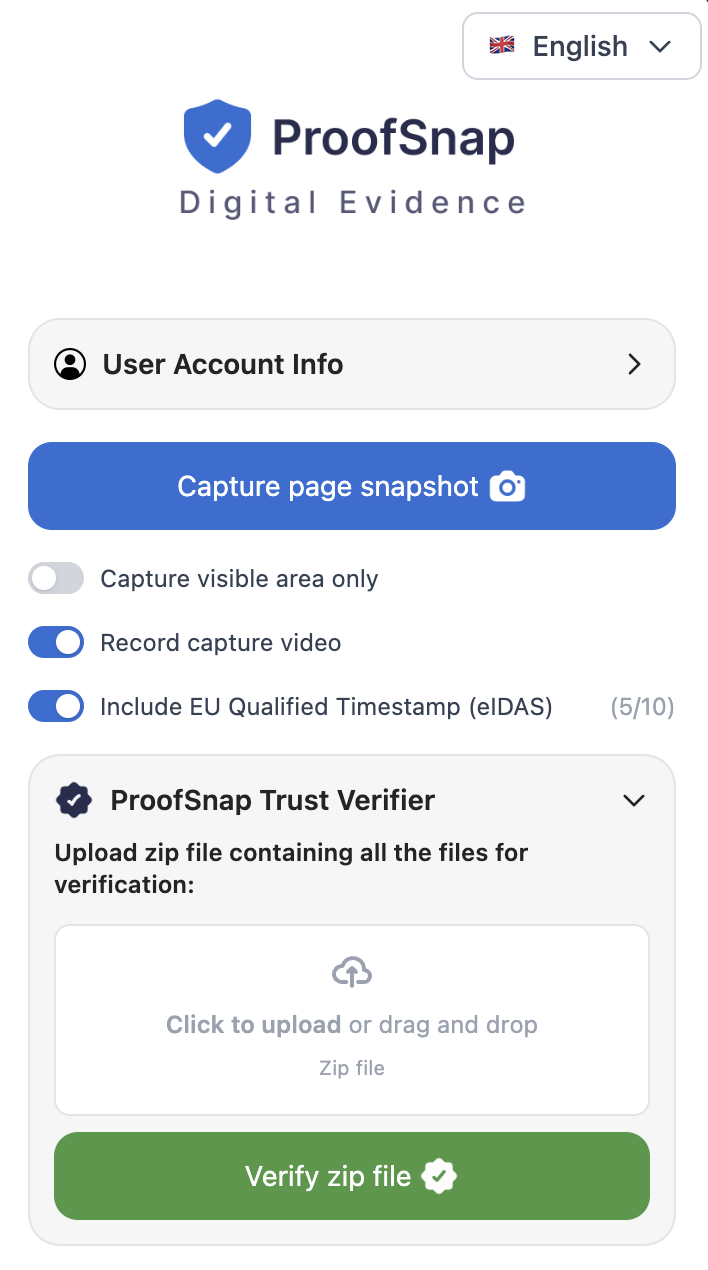
Anyone can verify it, including the other side. Drop the ZIP onto the public Trust Verifier and the hashes, the signature and the timestamp are checked in the browser. Nothing is uploaded and nothing depends on ProofSnap still existing.
Three ways to get the evidence
Prices are charged in USD. Approximate Australian figures are shown for orientation only, and your card issuer sets the actual rate.
One dispute
$4.99 once
about A$7
A SnapPack is a single up-front purchase for a set number of captures. No subscription, no auto-renewal, no trial. Best when you have one problem and you want it documented today.
Get a SnapPackOngoing matters
$8.99/month
about A$13
For anyone who captures regularly: practitioners, property managers, HR, investigators. The 7-day free trial requires a credit card. Cancel any time during the trial and you are not charged.
Start the 7-day trialWe do it for you
$44.99 per URL
about A$64
Send us the link and our team captures the package for you, with nothing to install. Useful when the capture should not come from a party to the dispute.
See the capture serviceProofSnap is not a law firm and does not give legal advice. Qualified timestamps are issued by Disig a.s., a Qualified Trust Service Provider on the EU Trusted List. Australia has no equivalent regime, so that timestamp is independent corroboration here rather than a legal presumption.
Official sources
Every figure and deadline on this page comes from the following primary sources. Check them yourself rather than taking our word for it.
- Scamwatch: report a scam the National Anti-Scam Centre reporting form.
- ReportCyber the government cybercrime reporting tool that issues your reference number.
- National Anti-Scam Centre: Targeting scams the annual report the loss figures on this page come from.
- Cyber.gov.au: recover from scams the recovery steps, in the order they actually help.
One detail worth getting right: most Australian banks want a suspicious email forwarded to them rather than screenshotted, because the forwarded message carries its headers. Forward the email as they ask, and use a capture for the website, the dashboard and the chat, where forwarding is not possible.
Questions people actually ask
The site is still up right now. That will not last.
Five minutes of capturing today is the difference between a report and a case.