State insurance advertising rules
Insurance advertising file: website archiving for insurers and agencies
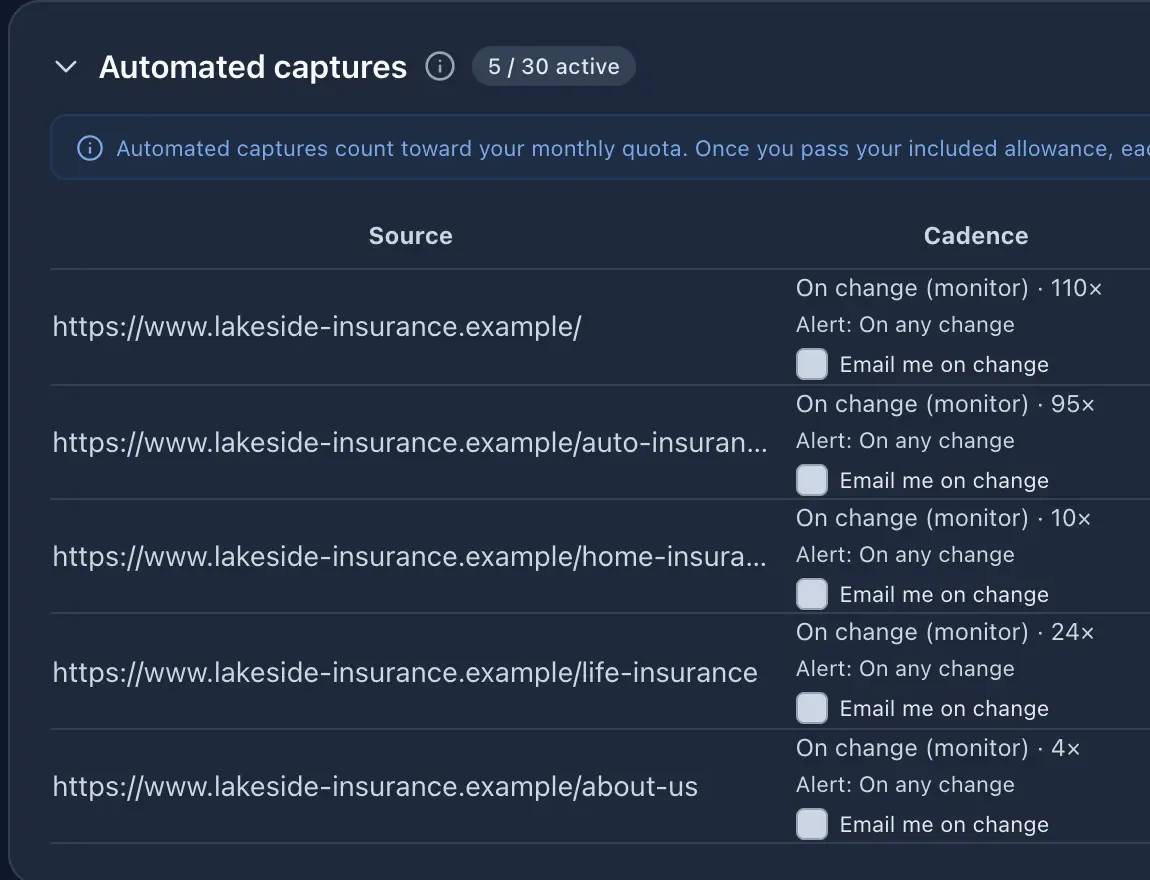
As of 2026, Utah's insurance advertising rule and Virginia's accident and sickness rule are two US state rules that require an insurance advertising file, and both name websites as advertising. ProofSnap Website Archive checks up to 30 public pages daily and keeps a sealed, dated copy of each detected version.
Sandbox: 50 watermarked test captures, no card required.
See what you get in this watermarked test capture: sample evidence PDF or full sample package (ZIP, 1 MB).
By Radim Motycka, Founder and Lead Engineer at ProofSnap, who built this dashboard ·
What state insurance advertising rules require
An insurance advertising file is the set of advertisements a state rule requires an insurer or agent to keep. There is no single US rule. Each state sets its own insurance advertising regulations, and they differ in who is bound, how long the file is kept, and which lines of insurance are covered. The three rules below are examples, as they stood when we reviewed them in November 2026.
| State and rule | Who keeps the file | How long | Websites named |
|---|---|---|---|
| UtahR590-130-13 | Who keeps the fileEach advertiser or insurer | How long3 years from the date last used | Websites namedYes |
| Virginia14VAC5-90-170, accident and sickness | Who keeps the fileEach insurer | How long4 years or until the next regular examination report, whichever is longer | Websites namedYes |
| MichiganR 500.668, accident and sickness | Who keeps the fileEach insurer, and each agent for the agency's own general advertising | How longInsurers: from one regular examination report to the next. Agents: at least 3 years after last use. | Websites namedNot by name |
Insurance advertising file duties and what Website Archive keeps
| Duties the Utah, Virginia, and Michigan rules share | Website Archive gives you |
|---|---|
| Keep advertisements in the file, as each rule defines them | A sealed package of each version the daily check detects, plus any capture you start yourself after you publish a change. |
| Keep it for the period your state sets | On an active plan, 10 years from the last check that found that copy's text still on the page, or from the capture date for a capture you start yourself. |
| Keep the insurer's file open to inspection | For a market conduct exam, filter by page and date range. Provide each sealed ZIP and print its screenshot and page text. |
Website Archive covers public web pages only. Print and broadcast advertising, email and text messages, any required notation of how each advertisement was distributed, the form number of any policy advertised, and the required location of your file are outside the scope of Website Archive. The required records remain your responsibility.
Do websites count as insurance advertising, and when does the retention period start?
Yes in Utah and Virginia, whose definitions of "advertisement" name websites; Michigan's rule does not name them. Utah's three years run from the date a version was last used.
"[...] radio scripts, television scripts, web sites and other Internet displays or communications, other forms of electronic communications, billboards, and similar displays [...]"
Definition of "advertisement" in 14VAC5-90-30 (Virginia).
"Each advertiser or insurer shall maintain a file containing advertisements for three years from the date last used [...]"
R590-130-13 (Utah). The same rule lists "a website, an email" in its definition of "advertisement."
Under Utah's rule, for a product page last used on March 2, 2026:
Last used
March 2, 2026
Utah minimum runs through
March 2, 2029
On an active plan, kept until
March 2, 2036
Capture history dates each copy. When a copy's text differs from the text of the copy before it, its date shows when the page changed, normally to within a day.
On an active plan, Website Archive keeps each copy for 10 years, more than three times Utah's three-year minimum (rule text reviewed in November 2026).
How Website Archive works
- 1List your pages. Up to 30 public URLs, such as your homepage, product and quote pages, and About page. Nothing to install on your site. ProofSnap reads public pages from its own servers, so no website login or policyholder data is involved.
- 2Daily check. ProofSnap compares each page's text with its text from the previous check. Checks are not billed.
- 3New version, new copy. The first check that finds readable text seals a copy, and so does each check that detects a change. You can get an email when a change is detected.
Quotes and state availability notices. If they load from a widget or with JavaScript, or appear only in an image or a linked file, or if you are not sure, use a daily Fixed interval schedule for any page that shows them. You get a sealed copy every day, about 30 captures a month.
A 70-second demo with a sample account.
What a sealed copy of an insurance web page contains
Each sealed copy is a package that holds a screenshot, the page HTML and text, and an evidence PDF. "Sealed" means each file is hashed into a signed manifest, and the manifest hash is sent to OpenTimestamps, which uses the public Bitcoin ledger (shown by the BTC label in Capture history). Once the timestamp is confirmed, the manifest can be shown to have existed no later than the time of the Bitcoin block that records it. You do not buy or hold any cryptocurrency. Open a sample evidence PDF or download a full sample package (ZIP, 1 MB). See every screen in the step-by-step Website Archive guide. Other regulated firms: see MAP Rule website archiving for mortgage firms and SEC Rule 204-2 website archiving for advisers.
Website Archive pricing
$49 a month
or $490 a year, two months free
- Up to 30 pages checked daily
- 100 captures a month included, then $0.60 per capture
- Copies kept for 10 years on an active plan and stored in two locations
Test first: 50 watermarked sandbox captures, no card required. Automated checks start when you subscribe to the plan.
Typical use. Thirty pages use 30 captures for their first copies, then about 10 a month with a Full capture every 90 days. Each detected change adds one. A page on a daily Fixed interval schedule adds about 30 a month. You can set a monthly limit; once you reach it, further captures wait until you are back under the limit.
If you cancel. The 10-year retention period runs while a plan is active. When a plan ends, copies are kept for 30 days and then deleted, including any under legal hold. Export them with Download all captures before then, or move to the Archive only plan at $9 a month, which keeps every package readable and verifiable.
Who is behind ProofSnap
ProofSnap is operated by Software Innovations Group LLC, a United Arab Emirates company founded in 2026 by Radim Motycka, who is based in Dubai. Registration details are in the Legal Notice, and the Terms of Service are governed by UAE law.
Packages are encrypted and stored in Frankfurt, with a second copy in Ireland; see Security and data handling. Each package carries its own verification scripts, so copies you download can be checked without ProofSnap. Send vendor due diligence questionnaires to support@getproofsnap.com.
Common questions from compliance teams
Start with your main product page
Run a test capture of it first: 50 watermarked sandbox captures, no card required.
Run a test capture in the sandbox