Key findings (ProofSnap test, November 8, 2026)
- Just 3 of 1,331 images (0.2%) on 55 major websites carried a C2PA Content Credentials manifest.
- Only 1 of the 3 still matched its file. Two AP photos signed by a Sony camera reached politico.com with their manifests, but the hash recorded in each manifest no longer matched the published image.
- The intact one was an ad. A banner ad on corriere.it, made with Canva AI, carried both a matching hash binding and the IPTC label for AI-composited images.
- Not even the websites of the standard's backers served labeled images. None of the 123 images we downloaded from ten of the standard's backers (among them c2pa.org, contentauthenticity.org, Truepic, Digimarc, Microsoft, Google's blog, Samsung and Nikon, plus one image each from Canon and Leica) carried a manifest.
- The pipeline decides. One image proxy removed the manifest in all six tests. WordPress's Photon kept the manifest, but re-signed the image only when it converted it to WebP.
1. What is C2PA? Content Credentials explained
Content Credentials are a signed record of where an image came from and what was done to it, embedded in the image file itself. The format is the C2PA standard, published by the Coalition for Content Provenance and Authenticity. A camera, an editing app or an AI generator writes a manifest that lists the actions taken (captured, cropped, generated), signs it with a certificate, and records a SHA-256 hash of the image so that a verifier can tell whether the file changed afterward.
A second, simpler label lives in the image metadata. The IPTC digital source type vocabulary has a term that, in IPTC's own words, describes "Digital media created algorithmically using an Artificial Intelligence model trained on captured content." Generators and editors can write that term into an image, inside a C2PA manifest or on its own.
Both labels share one weakness: they travel inside the file. Anything that rewrites the file, such as a content management system, an image CDN or a social platform, can drop them or leave them out of date.
2. What the EU AI Act requires
Since August 2, 2026, providers of generative AI systems in the EU have a labeling duty. Article 50(2) of the AI Act reads:
"Providers of AI systems, including general-purpose AI systems, generating synthetic audio, image, video or text content, shall ensure that the outputs of the AI system are marked in a machine-readable format and detectable as artificially generated or manipulated."
The Act does not name C2PA, but a signed, machine-readable manifest is the most widely implemented way to meet that requirement. Systems already on the market before August 2, 2026, were given until December 2, 2026, by a 2026 amendment. The duty falls on the provider of the AI system, so the Act says nothing about whether a website that later publishes an image keeps the label intact. That gap is what we measured.
3. How we tested 1,331 images
On November 8, 2026, we visited 105 large websites in six groups: news (30), stock photo sites (15), AI image generators (15), social and user-generated content platforms (15), ecommerce (15) and companies that build or promote content provenance (15). From each site we took the homepage and up to three inner pages, and, for the 30 news sites, their public RSS feeds as well. We collected the images those pages publish, choosing the largest variant offered, and downloaded each file exactly as a visitor's browser would receive it.
For every file, we inspected its bytes directly to see whether it carried a C2PA manifest, the IPTC label for AI-generated media, and EXIF or XMP metadata. Where a manifest was present, we recomputed the image's SHA-256 and compared it with the hash recorded in the manifest. Of the 105 sites, 55 returned images we could analyze; the others refused automated requests or loaded their images only through JavaScript. The full method and its limits are in the methodology section.
4. How many images carry Content Credentials
Almost none. In ProofSnap's November 2026 test, 3 of the 1,331 images carried a C2PA manifest and 1 carried the IPTC AI label, in the same image as one of those manifests. Ordinary metadata survived far more often: 233 images (17.5%) still had EXIF data, and so did 126 of 914 news images (13.8%), compared with the 20% that Imatag reported for editorial sites in 2018. That gap suggests most of these images never carried a manifest, though our data cannot show what the original files contained.
| Group | Sites analyzed | Images | With C2PA | With EXIF |
|---|---|---|---|---|
| News | 24 of 30 | 914 | 3 | 126 |
| Content provenance companies | 10 of 15 | 123 | 0 | 33 |
| Ecommerce | 7 of 15 | 117 | 0 | 29 |
| AI image generators | 7 of 15 | 98 | 0 | 36 |
| Stock photo sites | 4 of 15 | 63 | 0 | 9 |
| Social and user-generated content | 3 of 15 | 16 | 0 | 0 |
| All groups | 55 of 105 | 1,331 | 3 | 233 |
Read the AI generator row with care. The images we reached on Ideogram, Playground, Krea, Runway, Stability AI, DeepAI and Lexica are what those sites publish on their own pages, which mixes generated showcase images with ordinary marketing graphics. None of the 98 we checked in November 2026 carried a manifest. That does not show what a user receives when downloading from the generator itself; it shows that the images these sites put on the open web arrive without one.
5. The three labeled images we found
Each of the three tells a different part of the story:
- Two AP photos on politico.com. Both carry a full chain: signed inside a Sony camera, then edited in Capture One, with the actions recorded and the IPTC source type set to digital capture. The provenance traveled all the way from the camera to Politico's image server. But when we recomputed the hash, neither file matched the hash in its manifest, so something changed the file after it was signed. A C2PA verifier checks that hash, so these manifests would not verify as served.
- One ad on corriere.it. A 300 x 250 banner served from an advertising partner's server carried a manifest signed by Canva, with the action "created" by "Canva AI" and the IPTC source type for images composited with AI. Its hash still matched. This was the only intact, AI-labeled image in the whole sample, and it was an ad.
A fourth image, on Google's blog, carried no manifest but referenced one stored elsewhere. Checking such a remote manifest requires a verifier that follows the link.
6. Where the label gets lost
Most images in our sample were not the files their creators uploaded: in November 2026, 784 of 1,331 images (58.9%) arrived as WebP or AVIF, formats that image CDNs usually produce by re-encoding the original. To see what such services do with Content Credentials, we passed two signed images through three public image services: one of the AP photos above, and the official C2PA test file from the standard's own code repository.
| Service | Unchanged size | Resized to 800 px | Converted to WebP |
|---|---|---|---|
| wsrv.nl image proxy | Removed | Removed | Removed |
| Photon (Automattic, WordPress.com and Jetpack) | Kept, hash no longer matches | Kept, hash no longer matches | Re-signed, hash matches |
| Cloudinary (public demo account) | Not testable: the demo account refused remote images | ||
The WebP result is the encouraging one. Photon added its own signed manifest, identifying itself as "Automattic C2PA Signer - Photon", recorded that the image was resized and transcoded, and kept the original manifest as an ingredient, so the provenance chain continued. When Photon returned a JPEG instead, it copied the old manifest unchanged, and the hash no longer matched the new file. The same service, two outcomes, depending only on the output format the browser asked for.
The practical conclusion is short: a label survives only when every system between the creator and the reader is built to carry it. On today's web, few are.
7. How to tell if an image or photo is AI
No single test answers the question, so work from the strongest signal to the weakest:
- Check for Content Credentials. Upload the image, or paste its address, into a C2PA verifier such as Content Credentials Verify. A valid manifest that names an AI tool is strong evidence. A manifest whose check fails tells you the file changed after signing.
- Check for a Google AI watermark. Upload the image to Gemini and ask whether it was created or edited by Google AI. Gemini looks for SynthID, an invisible watermark that, unlike a C2PA manifest, sits in the image content rather than in the file's metadata. It only recognizes images made with Google's AI tools.
- Read the metadata. An EXIF or XMP viewer shows the camera model, the editing software and, if present, the IPTC digital source type. Remember that metadata can be edited by anyone.
- Find earlier copies. A reverse image search often surfaces the original source, an earlier date or the photographer's credit.
- Read nothing into a missing label. In our 2026 sample, 99.8% of images carried no manifest at all, including real news photos. The absence of a label does not make an image real, and an AI image stripped of its label looks exactly like any other.
- Use AI detectors with care. Detection tools give a probability, not a proof, and their results can change when an image is resized or compressed.
8. If the image is evidence
When an image on a web page matters to a dispute, the question is not only whether it is AI, but what exactly was published, where and when. Any label can disappear on the next upload, so record the page while it is online, with the image as served.
ProofSnap is a forensic web capture platform that makes such a record for you and gives you the sealed package to keep. There are two ways in, depending on whether you are watching public pages or capturing what you see in your own browser.
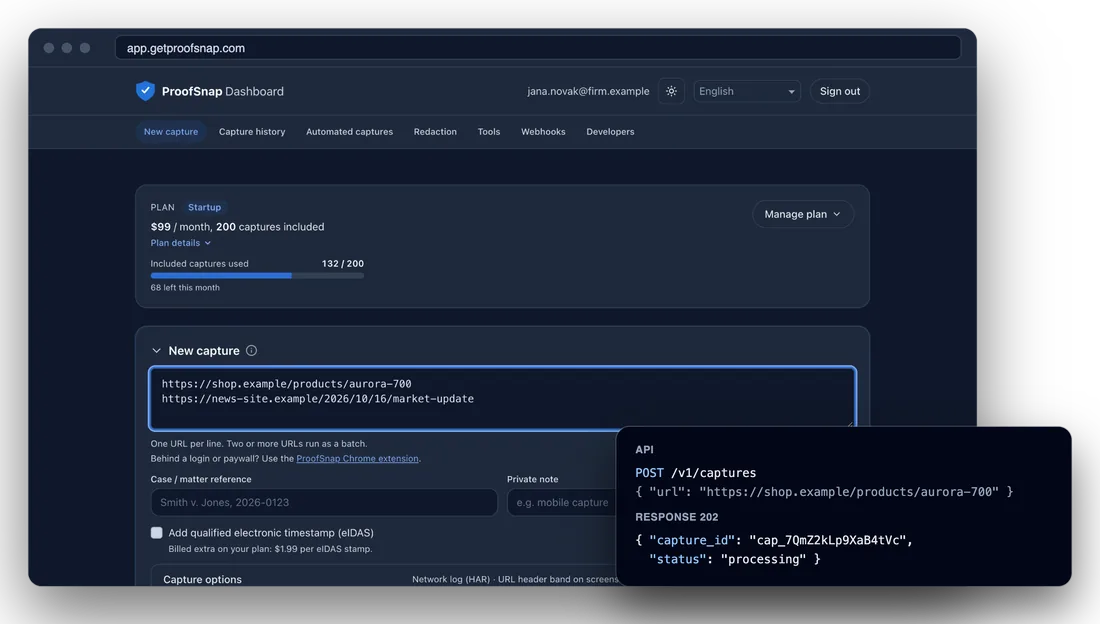
Path 1
API and dashboard
For public pages you want to keep a record of, once or on a schedule. Paste URLs into the web dashboard or call the API.
- An inventory of the displayed images with the SHA-256 of the bytes received, plus copies of those images.
- A screenshot signed with C2PA Content Credentials when signing succeeds.
- Scheduled and change-triggered captures, so a replaced or relabeled image is caught while the page is still online.
- 1 to 50 URLs per request, each sealed as its own full-page package, in desktop or mobile view.
- Comparison, redaction, webhooks and matters for teams and legal work.
50 free test captures in the sandbox, no card. Live plans from $1.49 per capture.
See the API and dashboardPath 2
Chrome extension
For the page in front of you. ProofSnap captures it in your own browser, so a page behind a login, or a feed that loads images as you scroll, is captured as you see it.
- An image check at every capture: the images on the page are checked for C2PA Content Credentials and EXIF data, and the findings go into the evidence PDF and metadata.json.
- Its own screenshot signed with C2PA Content Credentials.
- One click captures the full page, its HTML, text and metadata, and seals the package.
- Video recording of the capture or, in Manual mode, of your own browsing up to the moment you save.
7-day trial (card required), or a one-time SnapPack of 10 captures for $4.99.
Add ProofSnap to ChromeWhat every package holds, whichever path you take
The page
A full-page screenshot, the HTML, the visible text and metadata, with the HTTP headers and the DNS and WHOIS records where available.
Integrity
A SHA-256 hash of every file in a manifest signed with RSA-4096, a forensic log of every step and a chain-of-custody record modeled on ISO/IEC 27037.
Time
An OpenTimestamps anchor in Bitcoin (every API capture, and the Professional and higher extension plans) and, where your plan or credits include it, an eIDAS qualified timestamp from Disig a.s., a Qualified Trust Service Provider on the EU Trusted List.
The package includes verification scripts, and anyone can check it in the free Trust Verifier.
9. Frequently asked questions
How can I tell if an image is AI?
Check it for Content Credentials with a C2PA verifier, read its metadata and search for earlier copies. A valid manifest that names an AI tool is strong evidence. A missing label proves nothing: in our 2026 test, only 0.2% of images on major websites carried any manifest, so most real and most AI images look the same in this respect.
What are C2PA Content Credentials?
A signed record, embedded in a media file, of where the file came from and what was done to it, such as whether it was captured by a camera, edited or generated by AI. It includes a hash of the image, so a verifier can tell whether the file changed after signing.
How do I check an image for C2PA metadata?
Upload the file or paste its address into a C2PA verifier such as Content Credentials Verify. It shows who signed the manifest, the recorded actions and whether the image still matches it. Check the file you actually have, because a copy saved from a social network or a resized version may no longer carry the manifest.
What is the difference between C2PA and SynthID?
C2PA Content Credentials are signed metadata stored in the file. They come from an industry standard that many companies support and record the origin and edit history of both AI and non-AI content. SynthID is Google's invisible watermark, embedded in the content itself by Google's AI models, and according to Google it usually survives resizing or compression. Gemini can currently recognize SynthID only in content made with Google AI, so a negative result does not show that an image is real.
How do I see an image's metadata?
On Windows, right-click the file, choose Properties and open the Details tab. On a Mac, open the image in Preview, choose Tools, then Show Inspector. Both show EXIF data such as the camera model and the date, if the file still has it. For C2PA Content Credentials, use a C2PA verifier instead, because ordinary metadata viewers do not check the signed manifest.
Can EXIF data show that an image is AI?
Not on its own. Camera EXIF, such as a camera maker and model, points toward a photo, but anyone can add, edit or remove EXIF data, and most published images lose it: in our November 2026 test, only 41 of 1,331 images (3.1%) still named a camera maker. Missing EXIF proves nothing either way.
Are AI image detectors accurate?
They give a probability, not a proof. A detector compares an image with patterns it has learned, so results can differ between tools and can change when an image is resized or compressed. Use a detector as one signal next to Content Credentials, metadata and the image's earliest known source.
Can C2PA Content Credentials be removed?
Yes. They live inside the file, so any system that rewrites the file can drop them. In our 2026 test, one public image proxy removed the manifest every time. Another kept the manifest, but it no longer matched the delivered image, except when that service converted the image to WebP and signed a new manifest.
Does C2PA use blockchain?
No. A C2PA manifest is protected by a digital signature from a certificate and by a hash of the content, both stored in the file. No blockchain is involved. A separate time proof, such as a Bitcoin timestamp, can be added on top by other tools.
Does the EU require AI images to be labeled?
Since August 2, 2026, the EU AI Act requires providers of generative AI systems to mark their outputs in a machine-readable format so they are detectable as artificially generated or manipulated. Systems on the market before that date have until December 2, 2026. The duty is on the AI provider, not on websites that later publish the image.
Do phones add Content Credentials to photos?
Some do. Google said in September 2025 that the Pixel 10 camera app attaches Content Credentials to JPEG photos, and some professional cameras sign images too, such as the Sony camera behind the two AP photos in our sample. Whether the label reaches the reader depends on every service the photo passes through afterward.
Why don't news sites show Content Credentials?
Most news images arrived as WebP or AVIF files re-encoded by image CDNs, a process that usually drops embedded data. In our November 2026 test, only 3 of 914 news images carried a manifest, and the two genuine photos among them no longer matched their manifests.
Can I use this data?
Yes. The image-by-image CSV is free to reuse under CC BY 4.0. Please cite "ProofSnap, Content Credentials study, November 2026" with a link to this page.
10. Methodology, limits and the data
Sample. We chose 105 large websites by hand, in six groups. The sample leans toward the best-known sites in each group and is not random. Of these, 55 returned images we could analyze. Most stock photo sites, social platforms and the large AI generators refused automated requests or loaded their images only through JavaScript, so those groups are thin and their rows should be read as an illustration, not a measurement.
Images. From the homepage and up to three inner pages of each site, plus the public RSS feeds of the 30 news sites, we collected images from Open Graph tags, img and picture elements, and srcset lists, choosing the largest variant offered. We filtered out most logos and icons, though some small graphics remain in the data. Each file was downloaded with a desktop browser's request headers, so the server returned the format it serves to ordinary visitors. That gave 1,331 distinct images.
Detection. We read each file's structure directly: the APP11 JUMBF segments of a JPEG, the caBX chunk of a PNG, the C2PA chunk of a WebP and the boxes of AVIF and HEIF files, plus EXIF, XMP and the IPTC digital source type. We tested the detector against the official C2PA test files before the run. For each image with a manifest, we recomputed the SHA-256 over the file with the manifest excluded and compared it with the hash recorded in the manifest. We did not verify the signing certificates, so "matches" means the hash binding holds, not that the signature was validated.
Image services. We passed two signed images (one AP photo from our sample and the C2PA reference file CA.jpg) through wsrv.nl, Photon at i0.wp.com and Cloudinary's public demo account in three variants: unchanged, resized to 800 pixels wide, and converted to WebP. We then ran the same checks on the results.
Data. One row per image: group, site, image address, host it was served from, format, size, and whether it carried a C2PA manifest, a matching hash, the IPTC AI label, EXIF, camera EXIF and XMP. Download the CSV.
The label exists. It rarely reaches the reader.
- Just 3 of 1,331 images on 55 major websites carried Content Credentials.
- Only 1 still matched its file, and it was an ad made with Canva AI.
- Even the websites of the standard's backers served images without a manifest.
- A missing label says nothing about whether an image is AI.
- If an image matters, record the page and the file as served.
Sources
- Regulation (EU) 2024/1689 (AI Act), Official Journal
- Regulation (EU) 2026/1744 amending the AI Act, Official Journal
- IPTC Digital Source Type: Created using Generative AI
- Google Security Blog: Pixel and Android trusted images with C2PA Content Credentials (September 2025)
- Imatag: State of image metadata in 2018
- Content Authenticity Initiative: c2pa-rs reference implementation and test files
- Content Credentials Verify
Related articles
Wayback Machine Alternatives: 190 Sites Tested
Which websites block the archive, and what still preserves a page.
DeepfakesEvidence That Survives Deepfake Objections
How a capture record answers the claim that an image is fake.
Web pagesHow to Authenticate Web Evidence (2026 Guide)
What a court checks before it accepts a web page.
Disclaimer: This article is general information, not legal advice. ProofSnap is not affiliated with the Coalition for Content Provenance and Authenticity (C2PA).