Key findings (ProofSnap test, November 7 and 8, 2026)
- 29 of 162 readable robots.txt files block an Internet Archive crawler. Of the 24 US local news sites whose robots.txt we could read, 14 do; no ecommerce, SaaS or social platform in our sample does.
- Homepages are unaffected. 27 of the 29 blocking sites had a homepage snapshot from the last 30 days, a higher share than sites with no block (99 of 114).
- Articles are where it shows. 47 of 75 sampled pages on blocking sites have a readable copy (63%), compared with 253 of 261 on sites with no block (97%).
- A robots.txt rule alone does not decide the outcome. The Washington Post, USA Today, Der Spiegel and El País block the archive's crawler in robots.txt, yet every article we sampled from them is archived. At eight Advance Local newspapers, 23 of 24 articles exist only as a 403 Forbidden page.
- Old snapshots survived. We found no exclusion notice on any blocking news site. Exclusion notices did appear on three non-news sites: Yelp, Booking.com and Quora.
1. Why websites are blocking the Internet Archive
Since late 2025, news publishers have been shutting the Internet Archive's crawlers out of their sites. Their stated worry is AI training: if the Wayback Machine holds a full copy of every article, an AI company could take the articles from the archive instead of from the publisher. In May 2026, Nieman Lab counted 382 news sites limiting the archive's access through robots.txt, 342 of them local outlets, up from 241 sites in January.
The evidence for that worry is thin. Nieman Lab reported in May 2026 that no publisher it contacted had confirmed that an AI company had already scraped its content from the Wayback Machine. Mark Graham, who directs the Wayback Machine, calls the archive "collateral damage caught up in the conflict between AI companies and publishers."
Coverage so far has counted robots.txt files. Nobody had checked what the blocks actually do to the archive, which is what matters to anyone who expects to find an old article there. So we measured it.
2. How we tested 190 websites
We picked 190 large websites in eight groups: US national news (30); US local news (30); international news (30); social and user-generated content platforms (20); ecommerce (20); reviews, travel and jobs (20); government (20); and SaaS platforms (20). For each one we checked three things on November 7 and 8, 2026:
- The robots.txt file. Does it disallow the whole site for a crawler name that Nieman Lab tracks as the Internet Archive's: archive.org_bot, heritrix (including its named variants), archive-it or special_archiver? We counted rules naming only ia_archiver separately, because Mark Graham told Nieman Lab in May 2026 that the Wayback Machine does not use that name.
- The homepage. Is there a snapshot from the last 30 days, and does it replay?
- Pages inside the site. We took up to three article or product links from each site's homepage as the Wayback Machine saved it in early September 2026, so every page had at least two months to be archived. For each one we read every record in the Wayback Machine's index and replayed the copy a visitor would get.
That gave 436 pages on 148 sites. A page counts as having a readable copy when the archive replays the page itself, not an error or a paywall notice. The full method and its limits are in the methodology section, and the site-by-site results are in the downloadable CSV.
3. Which websites block the Wayback Machine
On November 7, 2026, we could read the robots.txt of 162 of the 190 sites. Of those, 29 disallow an Internet Archive crawler, and 28 of them are news sites. The other is the World Health Organization. Ten more sites disallow all crawlers by default with a wildcard rule, which covers the archive along with everyone else: Reddit, X, Facebook, LinkedIn, Pinterest, Yelp, Trustpilot, Reuters, The Wall Street Journal and Netflix.
| Group | robots.txt read | Blocks an Internet Archive crawler | Names only ia_archiver | Blocks all crawlers |
|---|---|---|---|---|
| US local news | 24 | 14 | 0 | 0 |
| US national news | 29 | 8 | 1 | 2 |
| International news | 29 | 6 | 5 | 0 |
| Government | 13 | 1 | 0 | 0 |
| Social and user-generated content | 17 | 0 | 1 | 5 |
| Reviews, travel and jobs | 17 | 0 | 2 | 2 |
| SaaS platforms | 18 | 0 | 0 | 1 |
| Ecommerce | 15 | 0 | 0 | 0 |
| All groups | 162 | 29 | 9 | 10 |
The 29 sites that block an Internet Archive crawler: al.com, The Atlantic, azcentral.com, The Baltimore Sun, Chicago Tribune, cleveland.com, CNN, Daily Mail, The Denver Post, Detroit Free Press, El Mundo, El País, IndyStar, Le Monde, MassLive, MLive, NBC News, The New York Times, The New Yorker, NJ.com, OregonLive, PennLive, la Repubblica, Der Spiegel, syracuse.com, USA Today, The Washington Post, Wired and the World Health Organization. The crawler named most often is archive.org_bot (27 sites), followed by heritrix (15).
We could not read the robots.txt file of 28 sites, most of which refused our requests. They include the Miami Herald, The Sacramento Bee, The Kansas City Star and The Charlotte Observer. On the eight news sites in this group, only 7 of 19 sampled articles had a readable copy, so the true number of blocking news sites in our sample may be higher.
4. Homepages stay archived, articles do not
If you check a blocking site in the Wayback Machine, it looks fine: 27 of the 29 blocking sites have a homepage snapshot from the last 30 days, and the median blocking site gained 1,551 new homepage snapshots between August 1 and November 7, 2026. The gap only appears one click deeper.
| Group | Blocks an Internet Archive crawler | No block |
|---|---|---|
| All sites | 47 of 75 (63%) | 253 of 261 (97%) |
| News sites only | 45 of 73 (62%) | 109 of 117 (93%) |
| US local news | 15 of 41 (37%) | 29 of 29 (100%) |
| US national news | 18 of 20 (90%) | 48 of 51 (94%) |
| International news | 12 of 12 (100%) | 32 of 37 (86%) |
| Non-news sites | 2 of 2 (WHO) | 144 of 144 (100%) |
The archive also visits blocked articles far less often. In our sample, a typical page on a site with no block had 57 successful captures by November 2026, and a typical page on a blocking site had 2.
In our November 2026 sample, of the 28 pages on blocking sites with no readable copy, 23 had been visited by the archive and stored as an error response. The other five had no record at all. Sites with no block lost eight pages, all to error or paywall responses: Bloomberg and the South China Morning Post answered with 403 Forbidden, and The Telegraph with 402 Payment Required.
5. Same robots.txt rule, very different results
The averages hide the real pattern. Sites with nearly identical robots.txt rules end up in completely different places:
- Eight Advance Local newspapers (al.com, cleveland.com, MassLive, MLive, NJ.com, OregonLive, PennLive and syracuse.com, all Advance Local brands): 1 readable article out of 24. The archive visited the other 23, and for every one of them it stored a 403 Forbidden response. The most recent homepage snapshot of seven of the eight is dated October 17, 2026, three weeks before our test.
- The six other US local news sites that block (The Baltimore Sun, Chicago Tribune, The Denver Post, Detroit Free Press, azcentral.com and IndyStar): 14 readable articles out of 17.
- US national news that blocks, including The Washington Post, USA Today, The New Yorker and The New York Times: 18 out of 20.
- International news that blocks (Der Spiegel, El País, El Mundo and la Repubblica): 12 out of 12.
Why the robots.txt rule does not decide the outcome
So the robots.txt line correlates with a lower archiving rate, but it does not decide the outcome on its own. Where articles disappear, the record shows why: the site answered the archive with HTTP 403. That is a server refusing the request, which is a separate step from a robots.txt rule. The New York Times told Nieman Lab in January that it was "blocking the Internet Archive's bot," and the one Times interactive in our sample with no readable copy shows the same pattern: 10 visits by the archive, none of which produced a readable copy.
We cannot see when each block was added, and a robots.txt file read in November says nothing about September. What the data does show is that a blocking site can still leave a public, archived trail of its articles, and that the publishers who actually make articles disappear do it at the server.
6. What you see when a page is missing
The Wayback Machine has several ways of saying no, and they mean different things:
- An archived 403, 401 or 402 page. The archive tried, and the site refused or demanded payment. This is what most missing articles in our sample look like. The calendar can still mark these dates as captures, so open the snapshot before you rely on it.
- "The Wayback Machine has not archived that URL." No visit is on record. Five pages on blocking sites and 12 on news sites whose robots.txt we could not read ended here.
- "This URL has been excluded from the Wayback Machine." The page or site has been removed from public view. The Internet Archive explains that this happens because of a robots.txt file or at a site owner's direct request. We saw it on the homepages of Yelp, Booking.com and Quora, not on any news site.
- A search that returns nothing, while the page still opens. The archive's lookup service refused to answer for The Guardian and NBC News, yet both homepages replay, and two Guardian articles from September 2026 that we tested opened normally from their exact addresses. The Guardian told Nieman Lab it had excluded itself from the archive's APIs and filtered its article pages out of the URL listing. If you know the exact URL, try it directly.
Old snapshots of blocking sites survived
One reassurance: the blocks we saw did not erase old snapshots. Of the 29 blocking sites, 28 still have homepage snapshots from 2024, and every one we were able to replay showed the page.
7. Wayback Machine alternatives, by task
If you are looking for sites like the Wayback Machine, our data points to one limit they share: every crawler-based archive depends on the site letting its crawler in. There is no single replacement, because people use the Wayback Machine for different tasks. Pick the tool that fits yours:
| What you need | Tool | What to know |
|---|---|---|
| See how a public page looked in the past | Wayback Machine, then Arquivo.pt | Open the snapshot; do not trust the calendar dot. Arquivo.pt is a public web archive that follows robots.txt and publishes its collections after a one-year embargo. |
| Save one page right now | Save Page Now (Wayback Machine) | Saves a single page once. The Internet Archive's help pages note a 3- to 10-hour lag before it appears. Open the result to check that you saved the page and not an error. |
| Cite a source permanently in a paper or legal brief | Perma.cc | Built by the Harvard Law School Library for citation links, after a 2014 study found that half of the links in US Supreme Court opinions no longer pointed to the original material. |
| Do research at scale | Common Crawl | Bulk crawl data for analysis, not a page lookup tool. It follows robots.txt and does not run JavaScript. |
| Get a one-off public archive link | archive.today, Ghostarchive | Both store a page on request. Wikipedia deprecated archive.today in February 2026 after finding evidence that the site had tampered with some archived pages. |
| Keep a record of your own website | Scheduled captures | Capture your own pages on a schedule rather than depending on a third party's crawler. See website archiving for regulated firms. |
| Prove what a page showed in a dispute | Forensic capture, such as ProofSnap | A signed, timestamped package you hold yourself, made in your own browser. See the next section. |
Two practical habits work with any of them. Save the page as soon as you know it matters: on the Advance Local sites the archive tried within a day or two of publication, was refused, and never got a readable copy later. And for anything important, check what was saved by opening it, since an archive can hold a 403 page under the right address.
8. If you need the page as evidence
A public archive answers the question "What did the crawler get?" In a dispute, the question is "What did the page show, when, and can anyone prove the copy was not changed?" Our data shows why a third-party crawler is a weak foundation for that question: the archive may never have been allowed in, and you cannot fix it later.
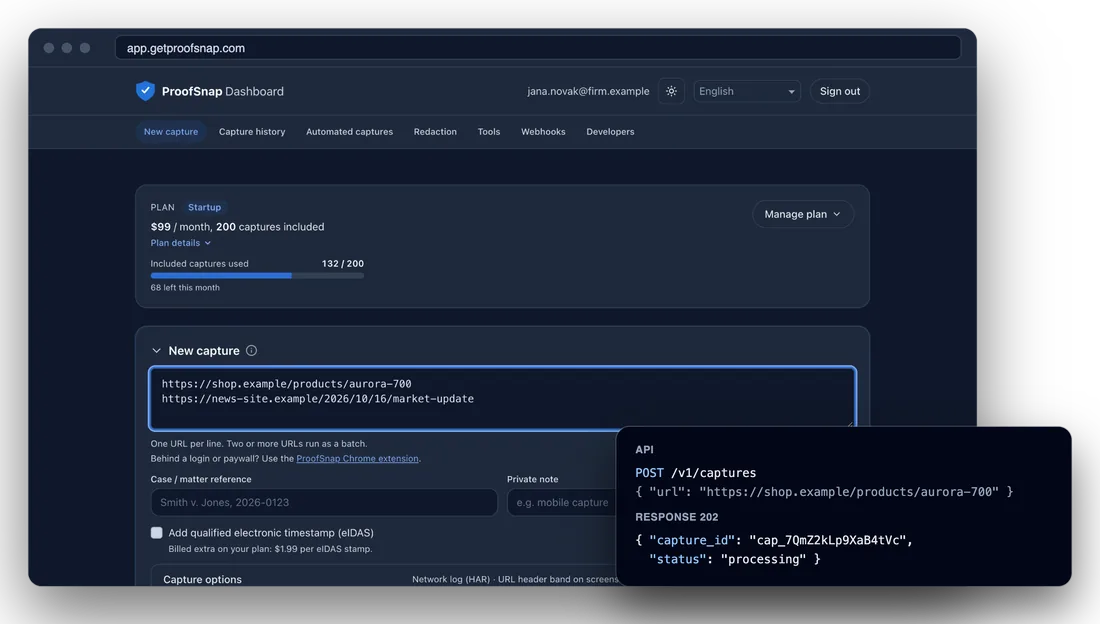
ProofSnap is a forensic web capture platform that makes such a record for you, at the moment you choose, and gives you the sealed package to keep. There are two ways in, depending on whether you are watching public pages or capturing what you see in your own browser.
Path 1
API and dashboard
For public pages you want to keep a record of, once or on a schedule. Paste URLs into the web dashboard or call the API.
- Scheduled and change-triggered captures, so you do not depend on a crawler visiting the page.
- 1 to 50 URLs per request, each sealed as its own full-page package, in desktop or mobile view.
- An optional WARC file (ISO 28500) that web archiving tools can open, plus a HAR network log.
- An optional Wayback Machine copy: ProofSnap can also ask the Internet Archive to save the URL as an independent public snapshot. Off by default.
- Comparison, redaction, webhooks and matters for teams and legal work.
50 free test captures in the sandbox, no card. Live plans from $1.49 per capture.
See the API and dashboardPath 2
Chrome extension
For the page in front of you. ProofSnap captures it in your own browser, so a page behind a login or a paywall, or on a site that refuses crawlers, is captured as you see it.
- One click captures the full page, its HTML, text and metadata, and seals the package.
- Video recording of the capture or, in Manual mode, of your own browsing up to the moment you save.
- Session mode records a browsing session across several tabs, with a snapshot of each tab you view.
- File certification seals files you already have, such as a PDF or an old screenshot, with a hash and a timestamp.
7-day trial (card required), or a one-time SnapPack of 10 captures for $4.99.
Add ProofSnap to ChromeWhat every package holds, whichever path you take
The page
A full-page screenshot, the HTML, the visible text and metadata, with the HTTP headers and the DNS and WHOIS records where available.
Integrity
A SHA-256 hash of every file in a manifest signed with RSA-4096, a forensic log of every step and a chain-of-custody record modeled on ISO/IEC 27037.
Time
An OpenTimestamps anchor in Bitcoin (every API capture, and the Professional and higher extension plans) and, where your plan or credits include it, an eIDAS qualified timestamp from Disig a.s., a Qualified Trust Service Provider on the EU Trusted List.
The package includes verification scripts, and anyone can check it in the free Trust Verifier. If you already have an old Wayback snapshot and need to compare it with today's page, see how to prove what changed on a web page.
9. Frequently asked questions
Is the Wayback Machine blocked?
Not for visitors: anyone can still open it. What is blocked is the archive's crawler on some sites. In our November 2026 test, 29 of 162 large websites used their robots.txt to block an Internet Archive crawler, almost all of them news sites, and 10 more disallowed all crawlers by default.
Why are news sites blocking the Internet Archive?
Publishers say they fear AI companies could collect their articles from the Wayback Machine instead of directly from them. Nieman Lab reported in May 2026 that no publisher it contacted had confirmed that this had already happened, and the Internet Archive calls itself collateral damage in the conflict between AI companies and publishers.
Does blocking the Wayback Machine delete old snapshots?
Not in our sample: 28 of the 29 blocking sites still had homepage snapshots from 2024, and every one we could replay showed the page. A site can still ask to be excluded, and then visitors see "This URL has been excluded from the Wayback Machine," as we found on Yelp, Booking.com and Quora.
What does "This URL has been excluded from the Wayback Machine" mean?
It means the page or the whole site has been removed from public view in the Wayback Machine. The Internet Archive says this happens because of a robots.txt file or at a site owner's direct request. It is different from a page that was never archived, which shows "The Wayback Machine has not archived that URL." In our 2026 test, Yelp, Booking.com and Quora showed the exclusion notice; no news site did.
Why is the Wayback Machine not working for a page?
Usually the archive works and the page is the problem. The archive may hold only an error page because the site refused its crawler, it may never have visited the address, the page may be excluded, or the archive's search may hide a page that still opens from the exact URL. Try the full address directly, open the snapshot itself and read what it shows.
How do I check if a site blocks the Wayback Machine?
Open the site's robots.txt (for example, example.com/robots.txt) and look for a User-agent line naming archive.org_bot, heritrix, archive-it or special_archiver followed by "Disallow: /". Then open a recent article from the site in the Wayback Machine and check whether the copy shows the article, because in our 2026 test the robots.txt rule alone did not decide the outcome.
Can I still see a page that is excluded from the Wayback Machine?
Not in the Wayback Machine itself. Another public archive, such as Arquivo.pt, may hold an older copy. If the page is still online, capture it yourself now, with a hash and a timestamp, so you are not depending on any archive.
Why does the Wayback Machine show a 403 Forbidden page for an article?
Because that is what the site sent the archive's crawler. The archive stores the response it receives, so a site that refuses the crawler leaves a 403 page under the article's address. At eight Advance Local newspapers, 23 of 24 articles we sampled existed in the archive only in this form.
Can I still find Guardian articles in the Wayback Machine?
Often, yes, if you have the exact URL. The archive's search and listing services returned nothing for The Guardian in our test, but the homepage and the September 2026 articles we tried opened normally when we entered their full addresses.
What are the best Wayback Machine alternatives?
Sites like the Wayback Machine each fit a different job. Use Arquivo.pt as a second public archive, Perma.cc for permanent citation links, Common Crawl for research at scale, scheduled captures for your own website, and a forensic capture tool such as ProofSnap when you need a page as evidence. Wikipedia deprecated archive.today in February 2026 after finding evidence of tampering.
Is a Wayback Machine snapshot good enough as evidence?
It is a record made and held by a third party, and whether a court accepts it is for the court to decide. Our data adds a practical problem: for a growing number of news articles there is no readable snapshot to offer. If a page matters in a dispute, capture it yourself while it is online, with a hash and a timestamp.
Can I use this data?
Yes. The site-by-site CSV is free to reuse under CC BY 4.0. Please cite "ProofSnap, Wayback Machine block study, November 2026" with a link to this page.
10. Methodology, limits and the data
Sample. 190 large websites chosen by hand in eight groups of 20 or 30. The sample is not random and leans toward the best-known sites in each group, so it says more about large publishers than about the web as a whole.
robots.txt. Fetched from each site's www host on November 7, 2026. A site counts as blocking when a user-agent group disallows the root path for one of the crawler names Nieman Lab tracks as the Internet Archive's: archive.org_bot, heritrix (and its variants my-heritrix-crawler and heritrix/3.3.0), archive-it or special_archiver. Groups naming only ia_archiver, ia_archiverbot or ia_archiver-web.archive.org are reported separately, because Mark Graham told Nieman Lab in May 2026 that the Wayback Machine does not use those names. A wildcard group (User-agent: *) that disallows the root counts as "blocks all crawlers." The files for 28 sites could not be read, mostly because the site refused our request; they are reported as unreadable, not as blocking.
Homepages. We read the Wayback Machine's index (CDX) for each domain from January 2024 and replayed the latest snapshot and one from 2024.
Pages. From each homepage as archived in early September 2026 (August or October where September was missing), we chose at random, with a fixed seed, up to three links that look like articles or product pages, excluding login, search, tag and similar paths. For each page we read every index record without a status filter, which separates successful captures, deduplicated captures and stored error responses, and replayed the latest capture that was not an error. A page has a readable copy when the replay is the page itself. Ten pages that we could not resolve because of rate limits are left out of the percentages.
Limits. We see robots.txt as it was on the test date, not when each rule was added. Pages linked from a homepage are among the most prominent a site publishes, so other pages are likely to be archived less often. Three pages per site is a small sample, and results for a single site should be read as an illustration, not a measurement. The archive's lookup service refused to answer for five domains (The Guardian, NBC News, Yelp, Booking.com and Quora), and we tested those by direct replay instead.
Data. One row per site: group, robots.txt status, the Internet Archive crawler names it blocks, homepage captures between August 1 and November 7, 2026, the latest homepage snapshot, and the number of sampled pages with a readable copy, an error page only or no record. Download the CSV.
The Wayback Machine still has the homepage. It may not have the article you need.
- 29 of 162 large sites block an Internet Archive crawler, 28 of them news sites.
- Blocking sites: 63% of sampled pages have a readable copy. Sites with no block: 97%.
- Where articles vanish, the site refused the crawler with a 403, not just a robots.txt line.
- Old snapshots of blocking sites were still there.
- If a page matters to you, save it yourself and open what you saved.
Sources
- Nieman Lab: More than 340 local news outlets are limiting the Internet Archive's access to their journalism (May 2026)
- Nieman Lab: News publishers limit Internet Archive access due to AI scraping concerns (January 2026)
- Internet Archive: FAQ, publishers blocking the Wayback Machine
- Internet Archive: Using the Wayback Machine
- Advance Local: brands
- Wikipedia: Archive.today guidance
- Arquivo.pt: Collection and archiving of content
- Common Crawl: FAQ
- Zittrain, Albert and Lessig, "Perma: Scoping and Addressing the Problem of Link and Reference Rot in Legal Citations," Harvard Law Review Forum (2014)
Related articles
Notary, Wayback Machine or ProofSnap?
Three ways to save a web page as evidence, compared.
ChangesHow to Prove What Changed on a Web Page
Compare an old version of a page with today's.
Web pagesHow to Authenticate Web Evidence (2026 Guide)
What a court checks before it accepts a web page.
Disclaimer: This article is general information, not legal advice. Evidence rules differ between courts and jurisdictions, so ask a qualified lawyer about your case. Wayback Machine is a trademark of the Internet Archive, which is not affiliated with ProofSnap.