Visual Evidence
screenshot.jpeg
Full-page scrolling capture of the entire web page
evidence.pdf
Human-readable forensic summary with all metadata
The only web evidence tool whose proofs survive even if our company disappears. Self-verifiable cryptography, no vendor lock-in, no “trust us” required.
ProofSnap is a Chrome and Edge extension that captures a web page as evidence for courts in The Bahamas. Every capture carries a SHA-256 hash and an RSA-4096 signature, with a Bitcoin timestamp from Professional up. The Bahamas never adopted the presumption that computers work, so the package proves it instead.
From $8.99/month · Up to 15 files per package · 23 countries
Also available for Microsoft Edge · Browser extension with SHA-256 hashing, an RSA-4096 signed manifest and an independently verifiable EU qualified timestamp (eIDAS)
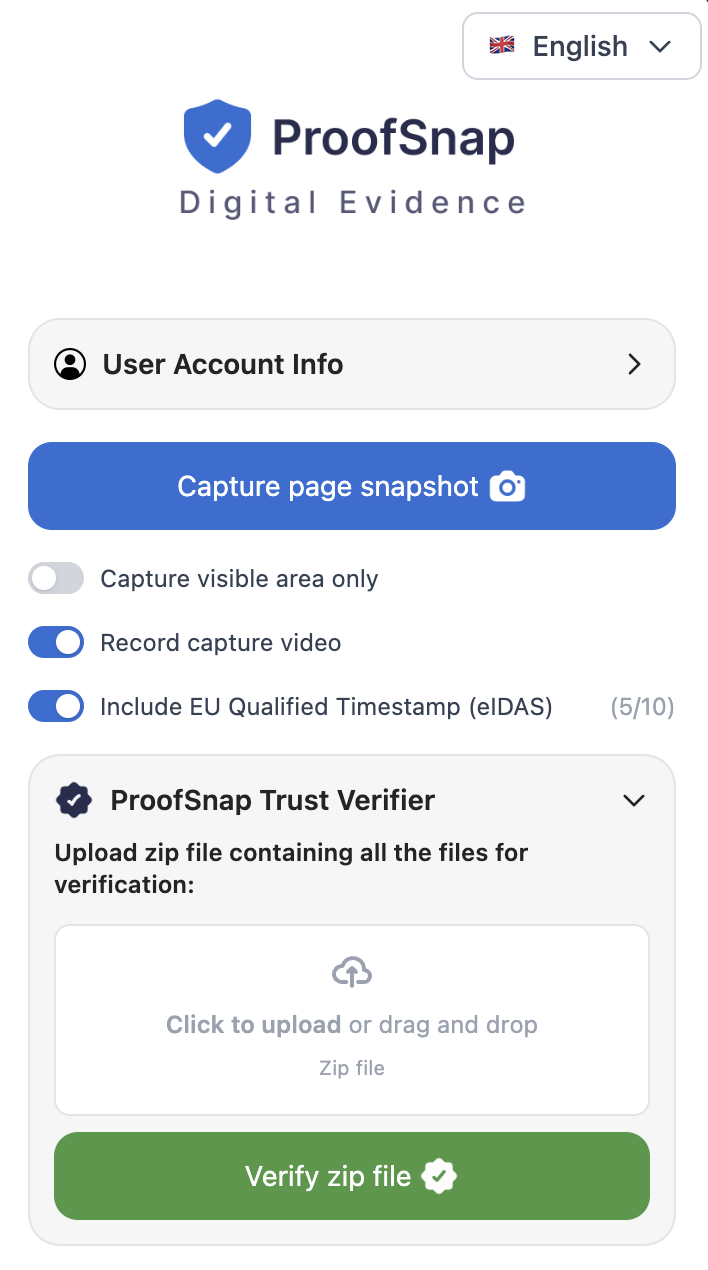
No account, nothing to set up.
Download a real evidence package. Open the PDF, read the chain of custody, then drop the whole ZIP into the Trust Verifier and watch it check the hashes, the signature and the timestamps in front of you.
Download the sample package9.4 MB ZIP. No account, no email address, nothing to install.
You send a link or the files. Within 24 hours we send back a signed, timestamped package that a Bahamian court can check.
A chat export is the file the app gives you when you tap ‘Export chat’. We render it as a readable transcript, hash every file and timestamp the result, so the other side cannot argue the messages were edited.
In The Bahamas, ProofSnap captures any web page as court-ready digital evidence in one click. Section 12(2) of the Electronic Communications and Transactions Act tells a Bahamian court to weigh how reliably the communication was generated and how reliably its integrity was maintained. A hashed, signed package answers both, well before the notice to prove falls due.
The Bahamas kept a statutory route for computer evidence that England repealed in 1997. Section 61 of the Evidence Act, Chapter 65 (The Bahamas) is a close descendant of section 5 of the English Civil Evidence Act 1968 and is still live. England took its version out on 31 January 1997, when the Civil Evidence Act 1995 repealed Part I of the 1968 Act, and removed the criminal equivalent in 1999. The Bahamas kept both, section 61 for civil proceedings and section 67 for criminal. Section 61(2)(c) is the condition that bites: throughout the material part of the period, the computer has to have been operating properly. A bare screenshot proves nothing about that.
Alongside it sits the Electronic Communications and Transactions Act, Chapter 337A. Section 12(1) stops the rules of evidence denying admissibility to an electronic communication just because it is in electronic form. Section 12(2) is the part that decides value, and it is a four-limb checklist: the reliability of the manner in which the communication was generated, stored or transmitted, the reliability of the manner in which its integrity was maintained, the manner in which the originator was identified, and any other relevant factor. Section 12(3) then expressly preserves sections 61 and 67 of the Evidence Act, so admissibility does not excuse you from the conditions.
The Bahamas has a brand new procedural code with nothing in it about electronic evidence. The Supreme Court Civil Procedure Rules 2022 came into force on 1 March 2023, and Part 28 requires standard disclosure of documents that are “directly relevant”. There is no e-disclosure protocol, no ESI questionnaire, no metadata rule and no native-format requirement, and the CPR also dropped the old RSC provision for giving notice of computer-derived hearsay. Practitioners are three years into a new code working it out matter by matter.
ProofSnap is a Chrome and Edge extension that captures web pages as court-ready evidence in one click. Three capture options: single page, multi-tab browsing session (with per-tab forensic packages), or signed video proof (Auto, Manual, or Session-wide screen recording). Every capture includes a SHA-256 cryptographic hash, RSA-4096 digital signature, Bitcoin blockchain timestamp via OpenTimestamps, and a Provenance Certificate with 6 integrity checks for deepfake detection. An eIDAS qualified timestamp from Disig a.s., a Qualified Trust Service Provider on the EU Trusted List, is available on Enterprise and Company plans. The Bahamas is not in the EU, so it carries no presumption here. What it does carry is an independent attestation of time and integrity that anyone can verify offline, which is exactly what section 12(2) tells a Bahamian court to weigh.
A digital asset offering turns on what the marketing page and the offering memorandum said before the Commission ordered them changed. A liquidator's clawback turns on a collapsed platform's claims. An unfair dismissal turns on what the employer believed at the time. And the status of a firm on the Securities Commission register on the day it took the money exists only as a PDF snapshot that has since been replaced. The same signed package supports a post or an account, a chat thread you need to exhibit or a law firm's evidence file. Pricing starts at $8.99/month with a 7-day free trial that requires a credit card. Used by lawyers, STR hosts, copyright enforcement firms and compliance teams in 23 countries.
By Radim Motycka, Founder & Lead Engineer, ProofSnap · · Independently verifiable via Trust Verifier
Trusted by professionals at
Powered by Disig a.s., a Qualified Trust Service Provider on the EU Trusted List under Regulation (EU) No 910/2014. Verify on EU Trusted List.
This is not theoretical. In Maurice Johnson v Bahamas Waste Limited the Supreme Court stopped a GPS call log going in through an HR manager, because she held no responsible position relative to the computer system. The log was admitted only after a fresh application backed by a section 61(4) certificate from an IT technician. The trial was adjourned and the costs of that application were awarded against the party that produced the evidence. United States courts refused screenshot evidence on the same authentication gap in United States v Vayner, Griffin v State and Serrano v Cruz-Angeles.
File timestamps can be changed in seconds. Without a blockchain or eIDAS-qualified timestamp, you can't prove when you captured it.
Any screenshot can be edited in seconds with a generative model, and section 61(2)(c) asks whether the computer was operating properly and whether anything affected the accuracy of the contents. Without a SHA-256 hash, there is no way to prove yours is real.
Who captured it? When? On what device? How was it stored? Screenshots don't answer any of these questions. In The Bahamas the statute asks four questions about how a record was generated and kept, and a plain image answers none of them.
Your screenshot
ProofSnap evidence package
Built for how disputes start in The Bahamas
The Bahamas handles large financial services disputes alongside a steady flow of employment and consumer work, and most of them turn on documents. Digital asset offerings, liquidations, regulatory investigations and Industrial Tribunal claims are all decided on what the parties can produce. The pages that decide them are live pages: a regulator register with no history, a published index estimate that gets restated, a portal that shows different terms next quarter. ProofSnap seals what one of them said in seconds, with a signed PDF, a SHA-256 hash and a chain of custody built for the four factors section 12(2) names.
England repealed its statutory computer-evidence regime in two steps, civil in 1997 and criminal in 1999. The Bahamas kept both. Section 61 of the Evidence Act, Chapter 65 sets the four pre-1995 conditions for a computer-produced statement in civil proceedings, including section 61(2)(c), that throughout the material part of the period the computer was operating properly. Section 67 does the same on the criminal side and is stricter. Section 12(3) of the Electronic Communications and Transactions Act expressly preserves both. A screenshot is not self-proving here, and section 61(6) defines a computer as “any device for storing and processing information”, which a laptop running a browser plainly is.
In Maurice Johnson v Bahamas Waste Limited (Supreme Court, Commercial Law and Labour Division, Claim No. 2022/COM/lab/00054, Klein J, 24 February 2025) an HR manager tried to put a GPS call log into evidence at trial. The objection succeeded because she did not hold a responsible position relative to the computer and GPS system. The court later admitted the log, but only on a fresh application backed by a section 61(4) certificate from an IT technician familiar with the system. The trial was adjourned and the costs of that application were awarded against the party that produced the evidence. The certificate is not a formality.
The Supreme Court Civil Procedure Rules 2022 came into force on 1 March 2023, so The Bahamas is only three years into a modern CPR. Part 28 requires standard disclosure of documents that are “directly relevant”, narrower than the old train-of-enquiry test, and the Practice Guide's examples expressly include computer files and databases. What does not exist is any e-disclosure protocol, ESI questionnaire, metadata rule or native-format requirement. Counsel in Johnson drew the court's attention to a related gap: the CPR contains no provision for giving notice of an intention to rely on computer-derived hearsay, unlike the old RSC.
Rule 28.18 of the CPR 2022 is blunt: a party is deemed to admit the authenticity of a document disclosed to it, unless it serves notice that the document must be proved at trial, and that notice must be served well before trial. Because the CPR has no hearsay-notice regime for computer evidence, this is effectively the only hard authenticity deadline on the calendar. The commercial proposition is not that your evidence will be admitted, it is that your opponent will decide it is not worth the trial day to fight it.
The Securities Commission of The Bahamas publishes its registrant lists as downloadable PDF snapshots rather than a searchable live database, and the register page itself carries a notice that the search feature is under development. There is no public archive of previous snapshots. So if the question is whether a firm was registered on the day it took your client's money, and you did not capture the list yourself, the public record will not give it back to you. In a jurisdiction where that question is live, this is a real evidentiary gap.
Under the Digital Assets and Registered Exchanges Act 2024, an advertisement of a token offering must be accurate, clearly identifiable and consistent with the offering memorandum (section 45), and the Commission may require “the amendment or removal of any advertisement, material or publication on the issuer's website” (section 46(c)). Stablecoin issuers owe quarterly proof of reserve reports, and purchasers have rescission, damages and withdrawal rights under sections 54 and 55. Those are the causes of action in which a captured marketing page becomes the pleading, and the page is removable by order.
CPR 2022, Commercial Division, section 61
The Bahamas is an unusual combination. Procedure is modern: the Supreme Court Civil Procedure Rules 2022 came into force on 1 March 2023, drafted from the English CPR with input from New Zealand, the Cayman Islands and Barbados, and they use the modern vocabulary of disclosure and standard disclosure. Evidence is not modern: the Evidence Act, Chapter 65 still carries the pre-1995 computer-evidence regime at section 61 for civil proceedings and section 67 for criminal ones, and section 12(3) of the Electronic Communications and Transactions Act expressly preserves both.
Standard disclosure is narrower
Rule 28.4 requires disclosure of documents that are “directly relevant”, not the old train-of-enquiry test. “Document” carries the widest possible meaning and the Practice Guide's examples include computer files and databases.
No e-disclosure guidance at all
Three years into the new code there is no e-disclosure protocol, no ESI questionnaire, no metadata rule and no native-format requirement. Counsel in Johnson also pointed out that the CPR dropped the old RSC provision for giving notice of computer-derived hearsay.
Commercial Division, and a labour sub-code
The Supreme Court has six divisions, including the Commercial Division. There is no Financial Services Division. Labour work runs through the Commercial Division under a sub-code, which is why claim numbers read like 2022/COM/lab/00054.
One consequence is worth planning around. Because the CPR has no hearsay-notice regime for computer evidence, the notice to prove under rule 28.18 is effectively the only hard authenticity deadline in the case. Miss it as an opponent and authenticity is conceded. Rely on a bare screenshot as the producing party and you are exposed at trial, which is precisely what happened in Johnson.
Section 61(4) of the Evidence Act, Chapter 65 requires a certificate signed by a person occupying a responsible position in relation to the operation of the relevant device. Maurice Johnson v Bahamas Waste Limited is what happens when the wrong person signs it. Who holds that position when the document is a web page rather than a company system? Whoever ran the capture, because the package records the device, the process and the time in a form they can attest to from their own knowledge.
If you are dealing with a single scam or one bad actor, a one-off SnapPack is a single up-front purchase, with no subscription, no auto-renewal, and no trial. Or send us the link and our team captures the court-ready package for you, no installation required.
Guides for Bahamian matters
Each guide covers what the decision-maker is actually weighing, and what to capture first.
What to capture before a defamation claim, and in what order. The Bahamas gives you six years under the Limitation Act and has no Defamation Act at all.
WhatsApp, Telegram, Signal and Messenger threads, rendered as a transcript you can exhibit. Section 61 of the Evidence Act covers exactly this material.
Headers and attachments certified, which is what a business email compromise claim turns on.
The listing, the spoofed page and the payment screen, sealed before the link goes dead.
What an eIDAS qualified timestamp is, what it proves anywhere in the world, and why it carries evidential weight rather than a presumption in The Bahamas.
How the package is disclosed under Part 28, what goes into a section 61(4) certificate, whitelabel PDFs, and per-seat licensing for a Nassau litigation team.
Adverse media and sanctions screening captured at a point in time, so the client file shows what was seen and when, not just that somebody looked. Built for compliance teams regulated by the Securities Commission and the Central Bank.
“In any legal proceedings, nothing in the rules of evidence shall apply so as to deny the admissibility of an electronic communication in evidence solely on the ground that it is in electronic form.”
“Information in the form of an electronic communication will be given due evidential weight and in assessing the evidential weight of an electronic communication, regard shall be had to (a) the reliability of the manner in which the electronic communication was generated, stored or transmitted; (b) the reliability of the manner in which the integrity of the information was maintained; (c) the manner in which the originator was identified; and (d) any other relevant factor.”
“This section shall not affect the application of sections 61 and 67 of the Evidence Act (which relates to the admissibility of documents produced by computers).”
The order matters, because section 61 asks about the state of things at the time of capture, and because section 62(3)(c) weighs contemporaneity and incentive.
This page covers The Bahamas. For other common-law jurisdictions that kept the pre-1995 computer-evidence regime, see Singapore, the Cayman Islands or Bermuda.
The legal framing on this page rests on the following primary sources. Check them rather than take our word for it.
The Bahamas legislation portal serves consolidated texts as PDFs. If a link above does not open on the first attempt, open laws.bahamas.gov.bs directly and search the Act by name and chapter.
Don't trust us. Trust the maths.
Most web-evidence tools force you to depend on them. ProofSnap evidence is self-verifiable: anyone with the ZIP can confirm authenticity using open standards (SHA-256, OpenTimestamps, eIDAS), with or without ProofSnap continuing to exist.
| ProofSnap | Page Vault / Pagefreezer | Notary / Wayback Machine | |
|---|---|---|---|
| Verifiable without the vendor? | Yes, SHA-256 + OpenTimestamps work forever | No, verification requires their portal | No, depends on archive availability |
| What if the vendor disappears? | Evidence still valid | Evidence becomes hard to defend | Wayback can be wiped on request |
| Independent court-expert verification | Any IT expert, in 60 seconds | Requires vendor cooperation | Requires manual screenshot |
| Cryptographic proof in the file itself | Yes, open standards (SHA-256, OTS, eIDAS) | Proprietary format | None |
“Its merit is based on it being self-verifiable, and not necessarily dependent on the credit or level of trust afforded to the company or institution behind it.”
No account required · Open the Trust Verifier and drop in any ProofSnap ZIP
Watch how ProofSnap captures legally admissible web evidence with blockchain timestamping in one click.
Learn how ProofSnap creates court-admissible digital evidence in one click
Click to watch on YouTube
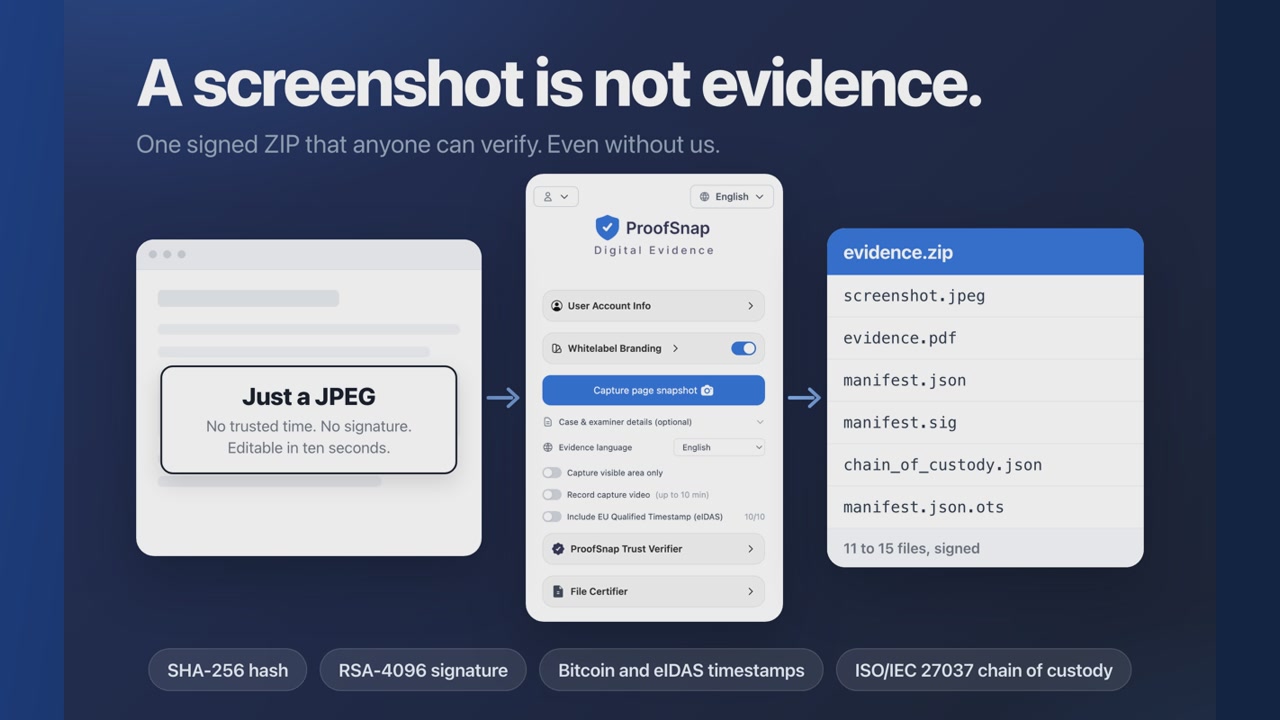
One click in the extension. The ZIP contains 11-15 files, independently verifiable by any party or court.
screenshot.jpeg
Full-page scrolling capture of the entire web page
evidence.pdf
Human-readable forensic summary with all metadata
page.html
Complete HTML source code of the page
domtextcontent.txt
Extracted visible text content
metadata.json
URL, timestamp, browser info, TLS certificate
forensic_log.json
ISO/IEC 27037 forensic log with tamper-evident hash chain
chain_of_custody.json
Chain of custody with device integrity and NTP time verification
manifest.json
SHA-256 hashes of every file in the package
manifest.sig
RSA-4096 digital signature of the manifest
publickey.pem
Public key for independent signature verification
manifest.json.ots
OpenTimestamps proof anchored to the Bitcoin blockchain
Immutable proof of when the evidence was captured. Cannot be forged or backdated. Independently verifiable by anyone.
provenance_certificate.pdf
Anti-deepfake certificate with 6 integrity checks proving the evidence is an unaltered original
c2pa.json
C2PA Content Credentials manifest (open content-provenance standard): signed origin metadata, interoperable with C2PA / Content Authenticity Initiative tools and aligned with EU AI Act Art. 50
As AI-generated content floods the web, courts increasingly question whether digital evidence is real. The Provenance Certificate and C2PA manifest prove your capture is authentic, not AI-generated or manipulated.
capture_video.webm
Screen recording included in the evidence package, three modes:
All three modes hash the recorded video into the signed manifest, so any single-frame change breaks the signature. Available on all plans.
manifest.json.tsr
EU qualified timestamp (RFC 3161), carrying the eIDAS presumption of accurate date and time.
Record across tabs. Every visited http(s) tab gets its own forensic folder (screenshot, HTML, DOM, DNS, WHOIS, TLS, signed evidence.pdf) inside a single signed, blockchain-timestamped ZIP with a session-wide video.
Use cases: multi-platform fraud, IP theft across domains, employment claims, regulator portal audits.
See exactly what a court receives
Download Sample Evidence PackageOpen the ZIP, check the PDF, verify the hash. Or send a URL to support@getproofsnap.com and we'll capture it for you free of charge (the URL must be publicly accessible, with no login, paywall or geo-block).
Independent legal opinion · 21 April 2026
The opinion was prepared by SEDLAKOVA LEGAL s.r.o. (Brno, Czech Bar Association, Company ID 05669871) under EU law (Regulation (EU) No 910/2014, eIDAS) with reference to Czech civil procedure. Cross-references to the US Federal Rules of Evidence and the English Civil Procedure Rules were added by the ProofSnap team to orient common-law readers.
Federal Rules of Evidence · Civil Procedure Rules · eIDAS
ProofSnap outputs are usable as means of evidence in civil, criminal and administrative proceedings. Authentication is addressed under the Federal Rules of Evidence in the US and the Civil Procedure Rules in England and Wales, and a civil-law court assesses the evidence at large, reinforced by US case law (Vayner, Lorraine v Markel, Mendones).
Notarial deed · Sworn affidavit
The opinion describes ProofSnap as “a suitable and economical alternative” to notarial certification of the state of a website. Notarial certification and sworn affidavits (US $200-500, UK £200-800) require waiting time during which content can disappear; ProofSnap captures immediately with cryptographic integrity.
eIDAS Art. 41(2) · Regulation (EU) No 910/2014
The qualified eIDAS timestamp issued by Disig a.s., a Qualified Trust Service Provider on the EU Trusted List, carries a rebuttable presumption of the accuracy of the date and time and of the integrity of the data bound to them.
“The outputs of the ProofSnap service are, from the perspective of Czech procedural law and the EU legal framework, generally usable as means of evidence in any type of proceedings.”
Conclusion of the legal opinion, SEDLAKOVA LEGAL s.r.o., 21 April 2026
The opinion is publicly accessible and requires no registration. The conclusions express the legal view of the author and do not constitute binding legal advice.
Straight answer first, because this is where vendors overclaim. ProofSnap's eIDAS qualified timestamp is issued by a Qualified Trust Service Provider on the EU Trusted List, and the statutory presumption it carries is an EU presumption. The Bahamas is an independent Commonwealth country that was never connected to the EU, so we claim no Bahamian presumption. What the timestamp gives you here is an independent, offline-verifiable record of the time and integrity of your file, which goes straight to the first two factors section 12(2) lists.
Article 41(1): “An electronic time stamp shall not be denied legal effect and admissibility as evidence in legal proceedings solely on the grounds that it is in an electronic form or that it does not meet the requirements of the qualified electronic time stamp.”
Article 41(2): “A qualified electronic time stamp shall enjoy the presumption of the accuracy of the date and the time it indicates and the integrity of the data to which the date and time are bound.”
eIDAS qualified timestamps issued by Disig a.s., a Qualified Trust Service Provider on the EU Trusted List, under Regulation (EU) No 910/2014. Verify on EU Trusted List.
per month
Monthly Snapshots: 100
Regular use, archiving
per month
Monthly Snapshots: 200
Blockchain timestamping, audit-grade documentation
Premium
per month
Monthly Snapshots: Unlimited
1 stamp during trial
High-volume teams, compliance-driven workflows
Flexible team licensing for organisations. Unlimited snapshots for all team members.
Minimum 2 licences
1 stamp during trial
Perfect for legal teams, compliance departments, and enterprises
Minimum 2 licences
1 stamp during trial
Flexible monthly billing for teams
One-off purchase, no auto-renewal. Credits are valid for 12 months (Standard SnapPack never expires).
10 captures · no expiry
All features: export, metadata, 5-min video proof, Provenance Certificate, blockchain timestamp.
EU qualified timestamps (Disig a.s.)
$5.00 / stamp · save 28% · also 1× $6.99 or 10× $49.99
Court-grade EU timestamp per capture (eIDAS Art. 41). Includes whitelabel branding on evidence PDF.
75-min recording with audio + bundled credits
$19.99 / video · save 20% · also 1× $24.99 or 10× $169.99
Includes 3 regular captures + 3 eIDAS stamps bundled. Whitelabel branding included.
Purchase in the extension after sign-up. Install ProofSnap →
Evidence disappears. Messages get deleted. Pages go offline. Every day you wait is a day your evidence is at risk.
Be clear about which rule is doing the work. The Bahamas is an independent Commonwealth country, was never connected to the EU, and has not adopted eIDAS, so no European regulation gives your capture a presumption before a Bahamian court. What The Bahamas has instead is section 12 of the ECTA and section 61 of the Evidence Act, neither of which it repealed. Both ask about how the record was produced and kept, and both are technical questions you can either answer or not.
Admissibility is largely settled, and then section 12(3) bites
Section 12(1) of the Electronic Communications and Transactions Act stops the rules of evidence denying admissibility to an electronic communication just because it is in electronic form. So a capture gets in. But section 12(3) is the trap: that subsection does not affect the application of sections 61 and 67 of the Evidence Act. Admissibility under the ECTA does not relieve you of the section 61 conditions, one of which is that the computer was operating properly throughout the material part of the period. Section 12(2) then sets four factors for weight.
The challenge that does come is forgery
With electronic material on the same footing as a written document, the way to attack it is to say it was altered. That is an allegation about bytes, not about credibility, and it is met with bytes: per-file SHA-256 hashes, an RSA-4096 signed manifest, the public key in the package and a script that recomputes all of it. Change one pixel and the hash stops matching.
Where the eIDAS timestamp still earns its place
Bahamian financial services business is cross-border by default. The qualified timestamp from Disig a.s., a Qualified Trust Service Provider on the EU Trusted List, is an independently verifiable record of time and integrity anywhere in the world, and it carries the eIDAS presumption if the matter reaches an EU forum. It confers no presumption in The Bahamas and we do not present it as one. What section 12(2) asks about is reliability and integrity, not nationality, and an independently verifiable timestamp speaks to both.
Deadlines are short, and access is shorter
Six years to sue for defamation under section 5(1)(a) of the Limitation Act, and there is no Defamation Act at all. A deadline before trial for an opponent to challenge authenticity. Twelve months to report a trade dispute to the Minister. And the Securities Commission register is a PDF that gets replaced. Capture is the one step that cannot be done later.
What the package does and does not do: it fixes what a page said and when, and shows the file has not changed since. It says nothing about whether the content was true, and it is not legal advice about your matter. A Bahamian court still weighs the evidence under section 12(2), and counsel still runs the case. What the package removes is the argument about when the capture was made and whether it was edited afterwards, which in practice is the argument you would otherwise be having.
Prices are charged in USD. The Bahamian dollar is pegged one to one with the US dollar, so the figures on this page are the figures you pay. The 7-day trial requires a credit card. Prefer not to subscribe? A one-off SnapPack is a single up-front purchase, with no subscription, no auto-renewal and no trial.
Evidence capture service
For one-off legal disputes and single fraud reports, or for anyone who needs evidence captured without installing anything. Send us a publicly accessible URL (no login, paywall, or geo-block). We deliver the same court-ready package of up to 15 files to your inbox: full-page screenshot with Content Credentials (C2PA-aligned), video and audio recording of the capture, multi-tab session capture, eIDAS qualified timestamp, and Bitcoin blockchain anchor. Not sure what to capture? Tell us what you have and we will recommend which capture format and package fit. We do not give legal advice.
Web capture · you send a URL
1 URL · delivered in 24 hours
Up to 5 URLs · delivered in 24 hours
File certification · you send the files
Already have the evidence as files? We authenticate chat exports, recordings, and documents as-is. One certification covers one piece of evidence, which can be several related files.
1 evidence item · certified in 24 hours
Same forensic engine as the Chrome extension. Disig a.s., a Qualified Trust Service Provider on the EU Trusted List under Regulation (EU) No 910/2014.
Need more info, or have a detailed URL list to send us? Email support@getproofsnap.com before checkout and we’ll handle it from there.
Certifying a WhatsApp conversation? See how the certified transcript works in your jurisdiction on WhatsApp evidence by country, or follow the free guide to print a WhatsApp chat for court yourself. We certify Telegram chat exports and Signal chat exports the same way.

Document evidence for legal proceedings and regulatory compliance
“Screenshots aren't enough in court. ProofSnap gives us the structure, timestamp, and traceability we need.”

Preserve online evidence for investigative reporting and OSINT research

“ProofSnap lets us document the truth before it's edited, censored, or erased.”

Verify candidates, archive onboarding flows, and document employment records

“It gives us a timestamped snapshot of the entire onboarding flow, perfect for audits, visa processing, or internal reviews.”

Save pricing pages, receipts, agreements, or any web content you may need later

“I don't just save what I see, I save what it means.”
Practical guides on digital evidence, compliance, and online verification.
Provenance Certificate with 8 integrity checks. Case law: Mendones v Cushman (2025). FRE 707, Louisiana Act 250, EU AI Act Art. 50.
Screenshots fail under FRE 901. SHA-256 hashes, blockchain timestamps, ISO 27037 chain of custody, and open-source verification survive. Case law, Page Vault comparison.
46% of teenagers are cyberbullied. Messages get deleted, accounts vanish. 5-step guide to capturing evidence police and courts accept. WhatsApp, Instagram, Discord, TikTok. Commonwealth, UK, EU and US law.
$467B counterfeit trade. Document Buy Box hijacking, fake reviews & counterfeits. US Lanham Act, EU DSA, eIDAS 2, US and EU platform rules. Case law and evidence playbook.
X, LinkedIn, Telegram & 6 more platforms. Authentication, blockchain timestamps, data protection, deepfake challenges, 15 FAQs. OSINT guide.
ProofSnap is a Chrome and Edge extension that captures web pages as legal evidence with blockchain timestamping, so the authenticity and integrity of the files can be checked independently.
ProofSnap uses OpenTimestamps to anchor a SHA-256 hash of your evidence to the Bitcoin blockchain, creating a cryptographic proof of when the capture was made. This timestamp is independently verifiable and cannot be backdated or tampered with, providing independently checkable proof that your evidence existed at a specific point in time.
ProofSnap includes a 7-day free trial with all plans. The trial requires a credit card, and you are not charged if you cancel before it ends. Choose from flexible monthly or annual subscriptions: Essential, $8.99 per month or $80 per year; Professional, $16.99 per month or $160 per year; Enterprise, $28.99 per month or $280 per year. Annual plans save 20%.
Regular screenshots can be challenged in court because they carry no proof of when they were taken or whether they have been altered. In The Bahamas the first half of that problem is largely solved for you: section 12(1) of the ECTA stops the rules of evidence denying admissibility just because a communication is electronic. What remains is the half that decides cases, and section 12(3) makes sure you cannot skip it: the section 61 conditions still apply. Section 12(2) asks how reliably the communication was generated and stored, how reliably its integrity was maintained, and how the originator was identified. Each is a technical fact you can demonstrate or fail to demonstrate.
ProofSnap addresses this by creating a forensic evidence package containing a SHA-256 hash proving the content has not been modified, an RSA-4096 digital signature for authenticity, an eIDAS qualified timestamp issued by Disig a.s., a Qualified Trust Service Provider on the EU Trusted List, a Bitcoin blockchain anchor, and full metadata including the URL and the capture time in UTC. The presumption goes to the time and the integrity of the data rather than to admissibility generally or to the truth of what the page said, so a court or an adjudicator still weighs the evidence. What it removes is the argument about when the capture was made and whether it changed afterwards.
No. The Bahamas is an independent Commonwealth country, was never connected to the EU, and the presumption in Article 41(2) of Regulation (EU) No 910/2014 does not run here.
Section 12(2) of the Electronic Communications and Transactions Act is what a Bahamian court actually applies, and an independently verifiable qualified timestamp goes directly to the first two factors it lists: the reliability of the manner in which the communication was generated and the reliability of the manner in which its integrity was maintained. That is evidential weight, not a presumption, and it is a stronger pitch than claiming a privilege the statute does not give.
ProofSnap uses three layers of cryptographic protection:
Together, these mechanisms create a chain of integrity that proves that the evidence is authentic and unaltered, and that it was captured at a specific point in time.
Regulation (EU) 2024/1183, known as eIDAS 2, is rolling out through 2026, establishing stricter standards for electronic identification, digital signatures, and qualified electronic timestamps across all EU member states.
Under Article 41(2), a qualified electronic time stamp shall enjoy the presumption of the accuracy of the date and the time it indicates and the integrity of the data to which the date and time are bound. That presumption operates in the European Union. It does not reach The Bahamas, which is an independent Commonwealth country that was never connected to the EU, so before a Bahamian court the qualified timestamp is corroboration of time and integrity rather than a statutory presumption. Section 12(2) of the ECTA is what a Bahamian court actually applies, and it asks about exactly the reliability and integrity the timestamp evidences.
ProofSnap's cryptographic proofs align with eIDAS 2 requirements: SHA-256 hashing for data integrity, RSA-4096 digital signatures for authenticity, and blockchain timestamps via OpenTimestamps for independent time verification. Each of those is verifiable offline by anyone, which is what makes the package useful in a Bahamian proceeding and, where a matter also touches Europe, in an EU one.
Usually yes, and then the work starts. Section 12(1) of the Electronic Communications and Transactions Act says nothing in the rules of evidence denies admissibility to an electronic communication solely because it is in electronic form.
But section 12(3) is the trap: that subsection “shall not affect the application of sections 61 and 67 of the Evidence Act”. So admissibility under the ECTA does not relieve you of the section 61 conditions, one of which is that the computer was operating properly throughout the material part of the period. Section 12(2) then sets four factors for weight: the reliability of the manner in which the communication was generated, stored or transmitted, the reliability of the manner in which its integrity was maintained, the manner in which the originator was identified, and any other relevant factor.
The Bahamas kept the pre-1995 English computer-evidence regime on both sides. Section 61 governs civil proceedings and sets four conditions, including section 61(2)(c), that throughout the material part of the period the computer was operating properly or that any malfunction did not affect the production of the document or the accuracy of its contents. Section 61(6) defines a computer as “any device for storing and processing information”.
Section 67 covers criminal proceedings and is stricter: a computer-produced statement is not admissible unless there are no reasonable grounds to believe it inaccurate through improper use and the computer was operating properly. Section 67(5) makes a knowingly false certificate an offence. If your matter has a criminal dimension, plan for the stricter test.
It has to be signed by a person occupying a responsible position in relation to the operation of the relevant device, and it identifies the document, describes the manner in which it was produced, gives particulars of the device and deals with the section 61 conditions.
The person matters as much as the content. In Maurice Johnson v Bahamas Waste Limited the objection succeeded because the HR manager tendering a GPS call log did not hold a responsible position relative to the computer and GPS system. The document only got in once an IT technician swore the certificate. The court accepted that certificate as sufficient to prove the authenticity and reliability of the document. A ProofSnap package supplies the underlying facts at capture time: the chain of custody is the manner of production, the forensic log and extension integrity record are the particulars of the device, and the Provenance Certificate speaks to proper operation.
Part 28 governs disclosure and rule 28.4 sets standard disclosure as documents that are “directly relevant”, a narrower test than the old train-of-enquiry approach. “Document” is given the widest possible meaning and the Practice Guide expressly includes computer files and databases in its examples.
What is missing is any guidance on electronic disclosure: no protocol, no ESI questionnaire, no metadata rule, no native-format requirement. Three years into a brand new code, practitioners are working it out matter by matter. That makes a described, repeatable capture method genuinely useful, because you can annex it rather than argue about it. Watch rule 28.18 as well: authenticity is deemed admitted unless a notice to prove is served before trial.
That is the objection every screenshot invites, and with a plain image there is no answer to it beyond your own word. In The Bahamas the allegation is that the file was altered after capture, and that is answered with bytes, not with credibility.
A ProofSnap package answers the objection from the file. Every file carries a SHA-256 hash, the manifest listing those hashes is signed with an RSA-4096 key, the public key travels with the package, and the verification scripts recompute all of it in front of whoever is asking. Change one pixel and the hash no longer matches. That is also what lets you speak to section 61(2)(c), whether the computer was operating properly, and to a section 61(4) certificate.
Because section 62(3)(c) of the Evidence Act makes the weight of a computer statement turn on whether the information was recorded contemporaneously with the facts it deals with, and on whether anyone concerned had an incentive to conceal or misrepresent them. Evidence created before the dispute crystallises carries more weight than evidence assembled after it.
There is a second reason specific to The Bahamas. Section 20(1) of the Electronic Communications and Transactions Act obliges an intermediary with actual knowledge that information gives rise to liability to remove it as soon as practicable, and to notify the police. There is no counter-notice procedure and no duty to preserve a copy. Removal here is a legal duty, not an accident, so the page you need may be deleted precisely because someone did the right thing.
That is the point of the package. Every ProofSnap ZIP ships with verification scripts, the public key and a manifest listing the SHA-256 hash of every file. The other side runs the script on their own hardware, recomputes the hashes and checks the RSA-4096 signature. Nothing depends on our being reachable, solvent or trusted.
That matters more in a small jurisdiction than in a large one. There is no Bahamian web-capture vendor to send a witness, and flying one in from abroad for an authenticity point is disproportionate in most matters. A record that verifies itself removes the question rather than answering it. It also helps the opponent decide, before the notice to prove deadline under rule 28.18, that challenging authenticity is not worth a trial day.
Capture it before anything else happens. Open the page, run the capture, and keep the package unopened. The result is a ZIP of 11 to 15 files depending on your plan: the screenshot, the page source, the DOM text, a SHA-256 hash of every file, an RSA-4096 signed manifest, the public key, a chain of custody, a forensic log and verification scripts.
Then work out who signs. Section 61(4) of the Evidence Act, Chapter 65 wants a person in a responsible position relative to the device, describing the manner of production and the particulars of the device and dealing with the section 61 conditions. The package gives that person the facts to attest to. If the matter has a criminal dimension, plan for section 67 instead, which is stricter and carries an offence for a knowingly false certificate.
Forensic mode is an optional, deeper form of capture included in the Professional, Enterprise and Company plans (not in Essential or the SnapPacks).
It adds a complete archive of the page's network layer: every HTTP request and response (network.har), a WARC copy of the page, all loaded resources, and the full TLS certificate chain. To capture that it attaches the debugger (the browser shows a “being debugged” banner).
Every one of those files is hashed into the RSA-4096 signed manifest, so the OpenTimestamps blockchain anchor and the eIDAS qualified timestamp cover the network archive exactly as they cover the screenshot.
Have questions about ProofSnap or need a business solution? Get in touch with our team.
Or contact us directly at support@getproofsnap.com
